
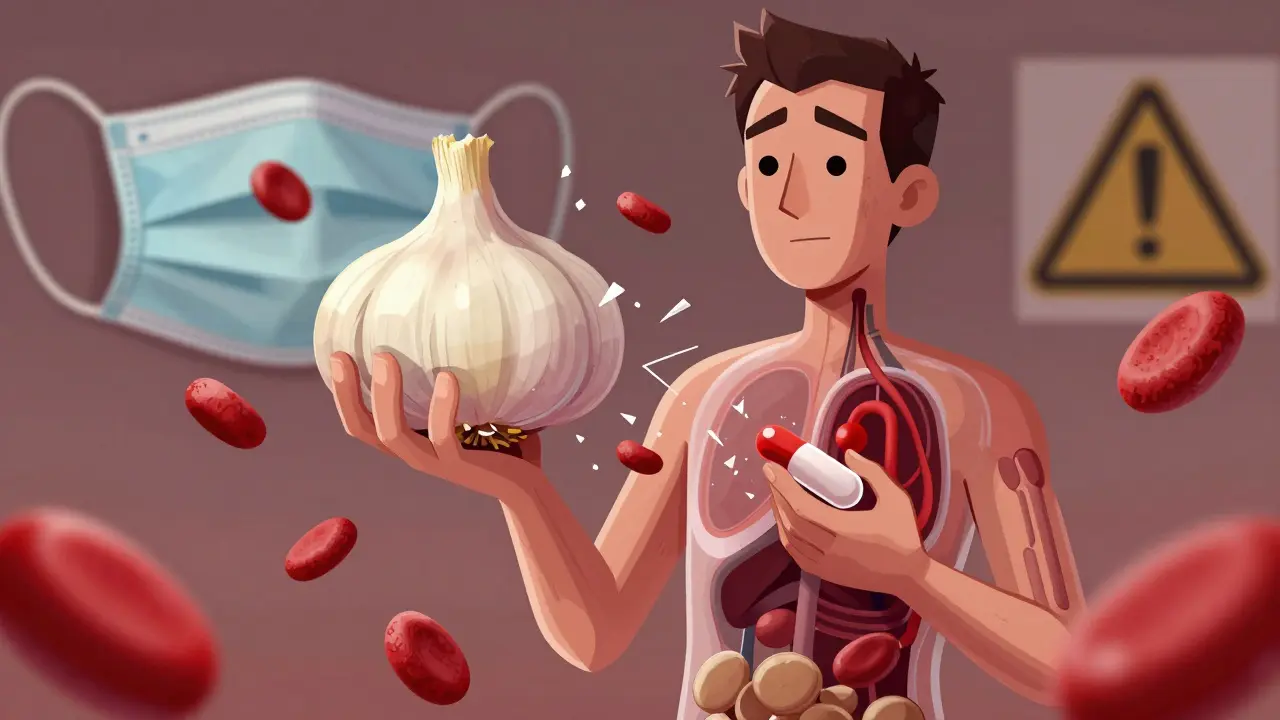
If you're taking a blood thinner like warfarin, apixaban, or aspirin, and you're also popping garlic pills for your heart or immune system, you could be putting yourself at serious risk. It’s not just a theory - real patients have bled uncontrollably during surgery because of it. Garlic supplements aren’t harmless herbal extras. They’re powerful enough to interfere with your medication in ways that can land you back in the hospital - or worse.
Garlic Isn’t Just a Spice When It’s in a Pill
When you crush a clove of garlic into your stir-fry, you’re getting a tiny amount of active compounds. That’s fine. But when you take a supplement - even one labeled "natural" or "standardized" - you’re consuming a concentrated dose. Some pills pack 600 to 1,200 mg of garlic extract per serving. That’s the equivalent of eating 10 or more cloves a day. And that’s where the danger starts.
The key player here is ajoene, a sulfur compound in garlic that blocks platelets from sticking together. Platelets are your body’s first responders to cuts and injuries. They form clots to stop bleeding. When ajoene shuts them down, your blood can’t clot properly. This effect isn’t temporary. It’s irreversible for the lifespan of those platelets - about 7 to 10 days. That’s why doctors tell you to stop garlic supplements at least a week before any surgery.
What Happens When Garlic Meets Blood Thinners
Anticoagulants like warfarin, rivaroxaban, and dabigatran work by slowing down different parts of your clotting system. Garlic doesn’t just add to that effect - it attacks from a different angle. While warfarin targets clotting factors in the liver, garlic disables platelets directly. Together, they create a double hit: your blood takes longer to form clots, and the clots that do form are weaker.
Studies show this isn’t theoretical. In one trial with 120 people, those taking 240 mg of aged garlic extract twice daily had bleeding times that were nearly 50% longer than those not taking it. Their aPTT - a lab test that measures how long it takes blood to clot - rose significantly. Another study found that 5.3% of people on blood thinners who took garlic supplements had bleeding serious enough to need a transfusion. Only 1.2% of those not taking garlic did.
And it’s not just surgery. People have had nosebleeds so bad they couldn’t stop them. Others developed bruising all over their bodies from minor bumps. One case report described a man on warfarin who developed a brain bleed after starting garlic pills - he didn’t even realize the two were connected.
Not All Garlic Supplements Are the Same
Here’s the messy part: garlic supplements vary wildly. A 2024 analysis of 45 different brands found that 68% didn’t even list how much ajoene they contained. Some had none. Others had over 3 mg per pill. You can’t know what you’re getting unless you buy from a lab-tested brand - and even then, the label might be wrong.
Oil macerates - garlic soaked in oil - have the highest ajoene levels and the strongest blood-thinning effect. Aged garlic extract, like Kyolic, is often marketed as "gentler," but it still prolongs bleeding time. Powdered garlic and dried extracts fall somewhere in between. If you’re on a blood thinner, it doesn’t matter which form you take. All of them carry risk.
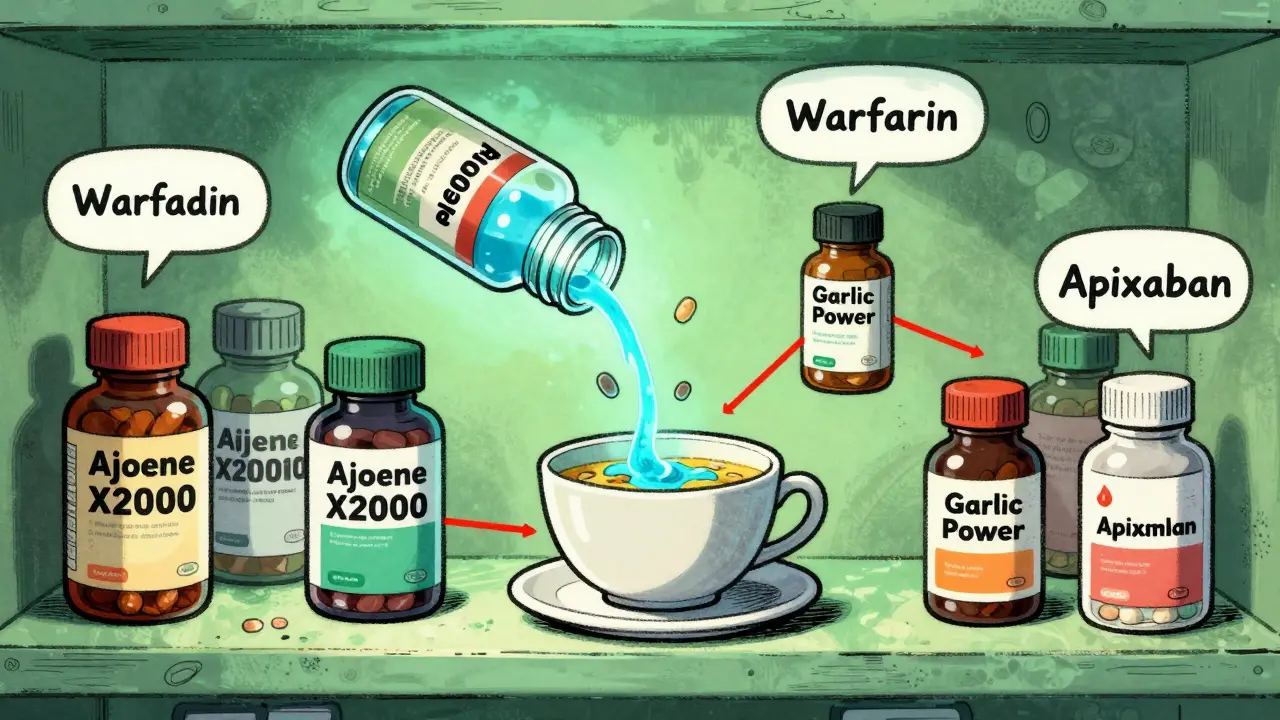
What About Eating Garlic in Food?
Don’t panic - you can still enjoy garlic in your cooking. Eating 1 to 2 cloves a day (about 3 to 6 grams) doesn’t raise your bleeding risk. The amount of ajoene in food is too low to interfere with medications. That’s why the FDA says garlic as a spice is unlikely to cause problems.
But here’s the catch: if you suddenly start eating a whole head of garlic every day - roasting it, crushing it into sauces, eating it raw - you’re approaching supplement levels. And if you’re already on blood thinners, that’s a red flag. Consistency matters. If you’ve been eating one clove a day for years, keep doing it. But don’t start ramping up your intake.
When You Must Stop Garlic Before Surgery
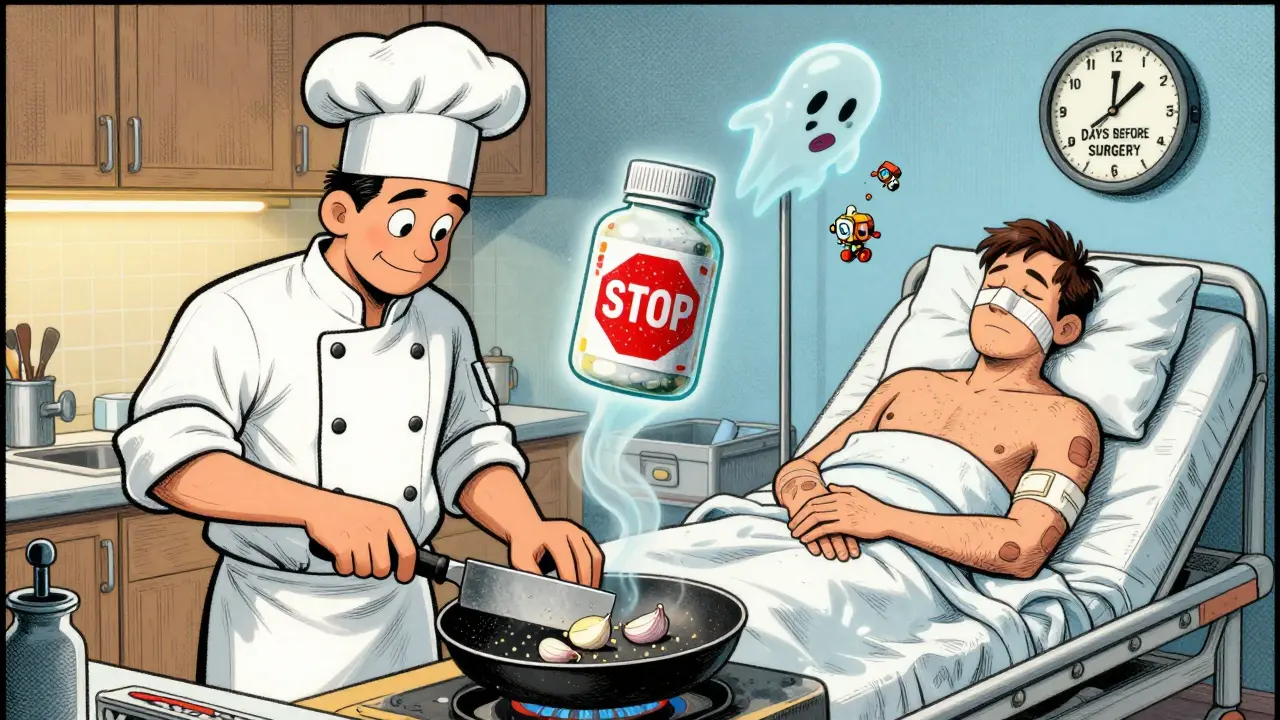
Major medical groups agree: stop garlic supplements at least seven days before any surgery. That includes dental work like extractions, colonoscopies with biopsies, and even minor skin procedures. The American Society of Anesthesiologists, the European Medicines Agency, and the American Heart Association all list garlic as a high-risk supplement.
Why seven days? Because platelets take that long to regenerate. If you stop earlier, your body might still be carrying damaged platelets. If you stop later, you’re gambling. One study showed patients who stopped garlic within three days of surgery had nearly triple the blood loss and more than three times the chance of needing a transfusion.
Some hospitals now use a test called PFA-100 to check platelet function before surgery. If closure time is over 193 seconds, they won’t proceed without giving platelet transfusions. That’s how seriously they take this.
What to Do If You’re Already on Both
If you’re currently taking garlic supplements and a blood thinner, don’t quit cold turkey without talking to your doctor. But do prepare for a conversation. Bring your supplement bottle. Write down how much you take and how often. Ask:
- Is my INR (if on warfarin) being monitored regularly since I started garlic?
- Have my bleeding times or platelet counts been checked recently?
- Could I switch to eating garlic instead of taking pills?
Some patients have been able to safely stop supplements and rely on dietary garlic. Others need to switch to a different blood thinner with less interaction risk. Your doctor might recommend checking your INR within 48 to 72 hours after stopping garlic to see how your clotting responds.
Other Supplements That Play Nice With Garlic - And Why You Should Avoid Them
Garlic doesn’t just mix dangerously with anticoagulants. It also interacts with:
- Statins - Can cause muscle pain or a rare but deadly condition called rhabdomyolysis.
- Red yeast rice - Often contains the same compound as prescription statins. Combine it with garlic and you’re doubling the risk.
- Fish oil, ginkgo, ginger, turmeric - These all thin blood too. Stack them with garlic and you’re stacking the odds against you.
Dr. Pieter Cohen from Harvard puts it plainly: "I don’t know of any evidence that taking garlic supplements is better for your heart than eating garlic in food." If you’re taking them for heart health, you’re not getting extra benefit - just extra risk.
What’s Next? Research Is Still Evolving
Scientists are still working to understand exactly how garlic interacts with newer blood thinners like apixaban. Two clinical trials registered with ClinicalTrials.gov are currently studying this exact question. Results aren’t expected until late 2024 or early 2025.
Until then, the safest approach is simple: if you’re on a blood thinner, skip the garlic pills. Eat the garlic. Enjoy the flavor. Get the antioxidant benefits without the danger. And if you’ve already taken garlic supplements and notice unusual bruising, nosebleeds, or prolonged bleeding from cuts - see your doctor immediately.
There’s no magic in a pill. Your body doesn’t need extra garlic. What it needs is predictable, safe care. And that means knowing what’s in your medicine cabinet - and what’s not.
Comments (15)
Emma Duquemin
December 29, 2025 AT 21:10I’ve been on warfarin for atrial fibrillation for 8 years, and I swear by my daily garlic clove in pasta sauce - but I’ve never touched a supplement. I read this and thought, ‘Thank God I didn’t go down that rabbit hole.’ My cardiologist never even mentioned garlic pills, but now I’m printing this out to show her next visit. You don’t need a pill to get the flavor or the antioxidants - just don’t turn your kitchen into a garlic farm.
Kevin Lopez
December 31, 2025 AT 09:16Platelet inhibition via ajoene. Mechanism is well-documented. AUC of allicin derivatives correlates with bleeding risk in PK/PD models. Supplement variability = uncontrolled confounder. Stop. Now.
David Chase
January 1, 2026 AT 23:40OMG YES!!! 😱 I KNEW IT!!! My uncle had a brain bleed after taking ‘natural heart support’ pills - guess what was #1 on the label? GARLIC!!! 🤬 America needs to regulate these supplements like REAL drugs!!! Why is this even legal?!?!!! 🇺🇸 #StopTheScam #NaturalIsNotSafe
Duncan Careless
January 3, 2026 AT 03:10Interesting read. I’ve been on apixaban since my DVT last year. I’ve taken garlic supplements for years thinking they were ‘gentle’. Didn’t realize they were this potent. I’ll stop tomorrow. Thanks for the clarity. I’ve been meaning to ask my GP about this but never got around to it. Now I know what to say.
Teresa Rodriguez leon
January 4, 2026 AT 16:12My mother died after her knee replacement because the surgeons didn’t ask about supplements. She took garlic pills ‘for her immune system’. They didn’t even check her INR. This is negligence. This should be mandatory info on every supplement bottle.
Aliza Efraimov
January 5, 2026 AT 00:43As a pharmacist, I’ve seen this too many times. Patients think ‘natural’ means ‘safe’ - and then they show up in the ER with uncontrolled bleeding. I hand out printed handouts on herb-drug interactions now. Garlic, ginkgo, ginger, fish oil - all of them. It’s not conspiracy. It’s pharmacology. And yes, the 7-day rule is non-negotiable. Even dental extractions. Even.
Russell Thomas
January 5, 2026 AT 04:04Wow. So what, I’m supposed to give up my garlic bread because some dude in a lab said so? I eat garlic every day. I’m fine. Maybe your blood is just weak. Maybe you’re the problem.
Joe Kwon
January 7, 2026 AT 02:55Thanks for this - super helpful. I’ve been on rivaroxaban and took garlic supplements for ‘cholesterol’ for 2 years. Just stopped them yesterday. Will get my platelet function checked next week. Also, I had no idea about the PFA-100 test. That’s gold. I’m sharing this with my mom - she’s on warfarin and takes turmeric too. 😅
Henriette Barrows
January 7, 2026 AT 22:06I’m 72 and on Xarelto. I’ve been eating 3 cloves of roasted garlic every night with my potatoes. Should I be worried? I don’t take pills, just food. I’m scared now. 😢
Fabian Riewe
January 8, 2026 AT 11:36Hey Henriette - you’re good to go. Eating 3 cloves as food? Totally fine. The issue is concentrated extracts. Your body handles the food dose just fine. You’re not gonna bleed out from garlic bread. But if you start crushing 10 cloves into a smoothie every morning… yeah, that’s a different story. Keep enjoying it - just don’t turn it into a supplement.
Alex Ronald
January 9, 2026 AT 18:24Just want to add: if you’re on anticoagulants and taking any herbal product - even ‘organic’ or ‘organic-certified’ - check the label for garlic, ginkgo, or ginger. If it’s not listed as a ‘medicinal ingredient’ with a standardized dose, it’s a gamble. I’ve worked in ER for 15 years. This is a silent killer. Don’t wait for a bleed to find out.
Nicole K.
January 11, 2026 AT 07:29People who take garlic pills are just selfish. They think their ‘wellness’ is more important than their life or their family’s peace of mind. If you’re on blood thinners and still taking garlic pills, you’re not healthy - you’re dangerous.
Tamar Dunlop
January 12, 2026 AT 23:40As a Canadian nurse working in perioperative care, I’ve seen this exact scenario unfold - multiple times. A patient arrives for elective surgery, declares they’ve been ‘taking garlic for heart health’ - no mention of it on their med list. We cancel the procedure. They’re furious. We explain. They leave. They return two weeks later, having stopped the supplement. We proceed. No bleeding. No complications. This isn’t fearmongering - it’s protocol. And yes, we check PFA-100 now. Every time. The science is clear. The risk is real. The solution? Simple. Eat garlic. Don’t pill it.
Jim Rice
January 14, 2026 AT 06:41So what? I’m not scared of science. I’ve been taking garlic pills for 10 years. I’m 50. I run marathons. I don’t bleed. You’re all overreacting. Maybe your meds are the problem, not the garlic.
Samar Khan
January 14, 2026 AT 11:13Bro I take fish oil, turmeric, AND garlic pills. I’m fine. 😎 My blood is like… ultra-slick. Like a lubricated engine. 🤷♀️🔥