

For many seniors living on a fixed income, the cost of medications can feel impossible to manage. A single prescription for a chronic condition like diabetes or high blood pressure can cost hundreds of dollars a month. But there’s a federal program designed specifically to help - the Extra Help Program, also known as the Medicare Part D Low-Income Subsidy (LIS). Since January 2024, this program has become simpler and more powerful than ever. If you’re a Medicare beneficiary with limited income and resources, you could be saving thousands each year on your prescriptions - and you might not even know it.
What Exactly Does Extra Help Cover?
Extra Help pays for nearly all of your Medicare Part D prescription drug costs. That means no monthly premiums, no deductible, and very low copays. Before 2024, some people got only partial help. Now, if you qualify, you get full benefits - no exceptions.
Here’s what you pay with Extra Help in 2025:
- $0 monthly premiums for any Part D plan that offers a $0 premium (most do)
- $0 deductible - you start getting discounts right away
- Generic drugs: $1.60 per prescription if your income is at or below 100% of the Federal Poverty Level (FPL), or $4.90 if you’re between 100% and 150% of FPL
- Brand-name drugs: $4.80 or $12.15, depending on your income level
And if you need insulin? Thanks to the Inflation Reduction Act, you pay no more than $35 per month. Same goes for certain vaccines - you pay nothing. You also won’t face a late enrollment penalty, even if you didn’t sign up for Part D when you first became eligible.
Who Qualifies for Extra Help?
You don’t need to be broke to qualify. The income and resource limits are set to help people who are struggling, not those living in poverty. For 2025, the limits are:
- Individuals: Annual income under $23,475
- Married couples living together: Annual income under $31,725
Your resources - like bank accounts, stocks, bonds, and non-primary real estate - must be under $17,600 for individuals or $35,130 for couples. But here’s what doesn’t count:
- Your primary home
- One car
- Furniture, clothes, and personal items
- Up to $1,500 set aside for burial costs
Some income is also ignored when calculating eligibility. The first $20 of monthly income doesn’t count. The first $65 of earned income (like from a part-time job) plus half of what’s left over is also excluded. Income from a child serving in the military? Not counted. These exclusions mean more people qualify than they think.
How Do You Get Extra Help?
You don’t always have to apply. In fact, about 12.5 million people are enrolled automatically - meaning no paperwork needed. You’re automatically enrolled if you:
- Have both Medicare and Medicaid
- Get Supplemental Security Income (SSI)
- Are enrolled in a Medicare Savings Program (MSP)
- Get help from your state paying your Medicare Part B premium
If you’re not automatically enrolled, you can apply in three easy ways:
- Online: Go to ssa.gov/extrahelp and fill out the application. It takes about 15 minutes.
- By phone: Call Social Security at 1-800-772-1213 (TTY: 1-800-325-0778), Monday through Friday, 8 a.m. to 5:30 p.m.
- In person: Visit your local Social Security office with your documents.
You’ll need to provide proof of income - like your most recent tax return or pay stubs - and proof of resources, such as bank statements. If you don’t have tax documents, you can use other records like Social Security statements or pension letters.
What Happens After You Apply?
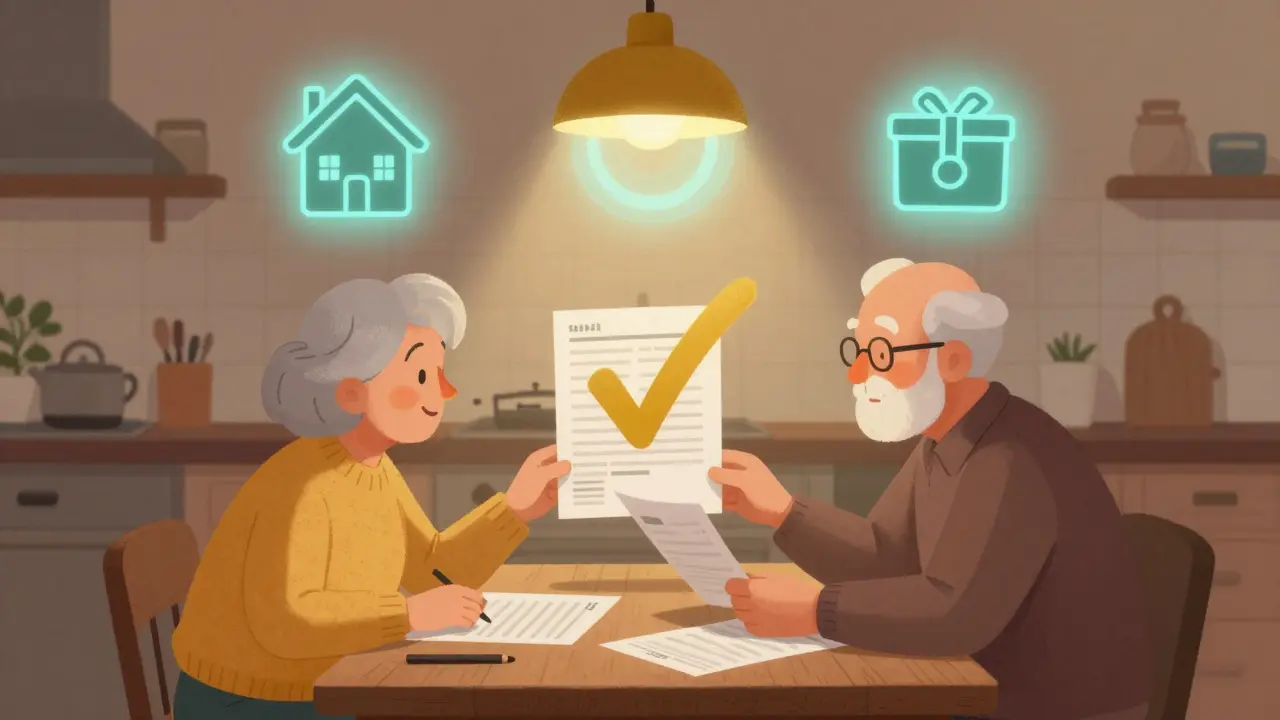
Most applications are processed in 3 to 6 weeks. Social Security says 87% of applications are completed within 21 days. If approved, you’ll get a letter confirming your Extra Help status. Then, if you’re not already enrolled in a Part D plan, Social Security will automatically sign you up for one with a $0 premium.
You’ll start seeing savings at the pharmacy right away. Your drug plan will adjust your copays, and you won’t be charged the deductible. If you’re already in a plan, your costs will be reduced automatically.
Common mistakes that delay approval? Miscounting income by including excluded amounts, overvaluing assets like a second car or vacation property, or forgetting to sign the application. About 55% of denied applications are fixed with a simple correction and resubmission.
Why So Many Seniors Miss Out
Despite the benefits, the Government Accountability Office found that 4.3 million eligible seniors aren’t enrolled - that’s nearly $27 billion in unused assistance every year. Why? Many think they make too much money. Others believe the process is too complicated. Some don’t know the program even exists.
But here’s the truth: You don’t need to be living paycheck to paycheck to qualify. Many seniors with modest savings and part-time income still meet the limits. The program is designed for people who can’t afford their meds - not just those on public assistance.
And if you’re unsure? Apply anyway. The worst that happens is you get denied - but you won’t know until you try. And if you’re denied, you can appeal or reapply if your situation changes.
What If You’re Just Above the Limit?
Even if your income or resources are slightly over the threshold, you might still qualify. The SSA allows for deductions that aren’t always obvious. For example, if you pay out-of-pocket medical expenses that aren’t covered by insurance, those can sometimes be subtracted from your income. If you’re caring for a disabled family member and pay for their medical care, that might count too.
Call Social Security and ask for a free eligibility screening. In February 2025, they launched an automated tool on their website that checks your records against public data to see if you might qualify - even if you never applied. It’s fast, private, and completely free.
What Happens If Your Situation Changes?
Extra Help is reviewed every year. If your income drops - maybe because you retired earlier than planned or had unexpected medical bills - you can reapply at any time. If your income goes up, you won’t lose your benefits immediately. You’ll get a notice, and your coverage continues until the next review.
And if you lose Extra Help, you can still get help. Many states offer their own pharmaceutical assistance programs. Some drug manufacturers have patient assistance programs that give free or discounted medicines to low-income people. Your pharmacist can help you find them.
Real Impact: What Extra Help Actually Does
Kaiser Family Foundation found that Extra Help cuts out-of-pocket drug spending by 83% on average. For someone taking five or more prescriptions a month, that’s often $500 to $800 saved every month. That’s not just money - it’s peace of mind. It means you can afford your blood pressure pills, your insulin, your arthritis meds - without skipping doses or splitting pills.
And it’s not just about saving cash. When seniors can afford their meds, they go to the hospital less. They stay healthier longer. They live better.
Next Steps: What to Do Today
If you’re a senior on Medicare and you’re struggling to pay for prescriptions, here’s what to do right now:
- Go to ssa.gov/extrahelp and use the online screening tool.
- Call 1-800-772-1213 and ask if you qualify.
- Gather your most recent tax return, bank statements, and a list of your medications.
- Apply - even if you think you don’t qualify. You have nothing to lose and thousands to gain.
You don’t need a lawyer. You don’t need to wait for an appointment. You don’t need to be perfect. You just need to take one step. And that step could change how you live the rest of your year - and the rest of your life.
Comments (13)
Natasha Sandra
December 26, 2025 AT 16:39OMG I just applied!! 🥳 I was scared I made too much money but guess what? I qualified!! Saved $600 last month on my insulin alone. My pharmacist said I’m basically getting free meds now. Thank you for posting this!! 🙏💖
Sophia Daniels
December 27, 2025 AT 19:01Typical American entitlement. You think the government owes you free drugs? My dad worked 40 years, paid taxes, and still had to choose between food and meds. Now we’re handing out freebies like candy? Pathetic. This country’s going down the drain.
Steven Destiny
December 29, 2025 AT 07:24STOP WAITING. Seriously. If you’re over 65 and on Medicare, you’re literally leaving thousands on the table every year. I told my mom to apply last year - she thought she was too rich. She’s now paying $5 for her blood pressure pills. I’m yelling at you from across the internet - APPLY. TODAY. Your life depends on it.
Fabio Raphael
December 29, 2025 AT 09:47This is such an important post. I’ve been helping elderly neighbors navigate this for years. Most don’t even know the program exists - or they think it’s too complicated. The fact that you can apply online in 15 minutes and get automatic enrollment if you have Medicaid? That’s a game-changer. I’ve seen people cry when they find out they qualify. It’s not just money - it’s dignity.
Amy Lesleighter (Wales)
December 31, 2025 AT 00:19just apply dont overthink it. i helped my aunt and she thought she had too much in savings but turns out her couch and her 2015 honda dont count. they gave her extra help and now she takes all her meds. no more splitting pills. life changed. you dont need a degree to do this. just go to ssa.gov/extrahelp and click apply. done.
Becky Baker
January 1, 2026 AT 07:19Why should I pay for someone else’s prescriptions? My taxes are already too high. If you can’t afford your meds, get a job. This is socialism with a smiley face. I’m tired of it.
Rajni Jain
January 3, 2026 AT 03:24i’m from india but my sister lives in florida and she just got extra help last month. she said she cried when she saw her new copay. i told her it’s not charity - it’s justice. people who worked their whole lives shouldn’t have to choose between medicine and rent. thank you for sharing this. i’m sharing it with everyone i know.
Erwin Asilom
January 4, 2026 AT 02:33One thing missing from the post: if you’re denied, you can appeal. Many people give up after the first rejection. But if you’ve been denied and your income dropped recently - even by $50/month - you can resubmit with updated documentation. The SSA is required to reconsider. Don’t take ‘no’ as final.
Sumler Luu
January 4, 2026 AT 02:35My uncle was denied twice because he listed his car as worth $15,000. Turns out, the SSA only counts the value if it’s not his primary vehicle. He had a 2018 Toyota Camry - they reassessed it at $8,000 and approved him. Don’t guess - call them. They’ll walk you through it.
sakshi nagpal
January 5, 2026 AT 15:40Thank you for this detailed and compassionate breakdown. In my country, such programs are either nonexistent or inaccessible. I hope more people in the U.S. take advantage of this. It’s not just policy - it’s humanity. I will share this with my friends who are caregivers for elderly relatives.
Sandeep Jain
January 6, 2026 AT 18:08i had no idea about the insulin cap. i thought it was just for new plans but nope - it applies to everyone with extra help. my mom’s insulin went from $120 to $35. i almost cried in the pharmacy. thank you for this. i’m printing it out for my aunts.
roger dalomba
January 7, 2026 AT 06:21Wow. A post that doesn’t end with ‘like and subscribe.’ Radical.
Brittany Fuhs
January 7, 2026 AT 14:09Of course the government makes it sound easy. But have you tried actually filling out the form? The website crashes. The phone lines are a joke. And don’t get me started on the ‘free’ Part D plan they assign you - half the drugs your doctor prescribes aren’t covered. You’re not getting help. You’re getting a consolation prize.