

Statin CK Risk Assessment Tool
Is Baseline CK Testing Recommended for You?
This tool helps determine if baseline CK testing is appropriate when starting statin therapy based on your individual health factors.
Your Risk Assessment
How we calculated this: Each risk factor adds points to your total risk score. A score of 0-1 indicates low risk, 2-3 indicates moderate risk, and 4+ indicates high risk.
When you start taking a statin, your doctor might order a blood test for creatine kinase (CK) before you even take your first pill. You might wonder: Why? Isn’t this just another lab test adding cost and hassle? The truth is, baseline CK testing isn’t needed for everyone-but when it’s done right, it can prevent unnecessary statin stops, avoid misdiagnoses, and even save lives.
What Is Creatine Kinase, and Why Does It Matter with Statins?
Creatine kinase, or CK, is an enzyme found in your muscles. When muscle cells get damaged-whether from intense exercise, injury, or a reaction to medication-CK leaks into your bloodstream. That’s why doctors measure it: high CK levels can signal muscle damage. Statin drugs, which lower cholesterol and reduce heart attack risk, can rarely cause muscle problems. Most people feel nothing. But about 5-10% report muscle aches or weakness. In 1 in 1,000, the damage can become serious-rhabdomyolysis, a condition where muscle breaks down so badly it can wreck your kidneys. The problem? Muscle pain is common. And not all of it comes from statins. You might have just run a 5K, done heavy yard work, or taken a new supplement. Without knowing your normal CK level, your doctor can’t tell if the pain is from the drug-or from life.When Is Baseline CK Testing Actually Useful?
You don’t need a baseline CK test just because you’re on a statin. But there are clear situations where it makes sense. First: if you have risk factors. People with kidney problems (eGFR under 60), hypothyroidism, or those taking other drugs like amiodarone or fibrates have a much higher chance of muscle issues. For example, combining a statin with a fibrate raises the risk of rhabdomyolysis by 6 to 15 times. In these cases, knowing your starting CK level isn’t optional-it’s essential. Second: if you’ve had muscle problems with statins before. If you stopped a statin in the past because of muscle pain, and it wasn’t clearly explained, a baseline test helps determine whether the next statin is safe. About 7% of statin users fall into this category. Third: if you’re on a high-intensity statin. Atorvastatin 40-80 mg or rosuvastatin 20-40 mg carry a slightly higher risk-rising from 0.05% to 0.3% per year for severe muscle injury. That’s still rare, but for someone with other risks, that small increase matters. Fourth: if you’re older, especially over 75. Older adults often have reduced kidney function, take multiple medications, and may have undiagnosed muscle loss. A baseline CK gives doctors a reference point if symptoms pop up later.What the Guidelines Actually Say
There’s no global rule. Different countries and organizations disagree. The American College of Cardiology (ACC) and American Heart Association (AHA) say baseline CK is optional. But their 2022 Statin Intolerance Tool recommends it for high-risk patients. The American Association of Clinical Endocrinologists (AACE) says test everyone-strongest evidence level. In Europe, the guidelines are looser. The European Society of Cardiology calls it optional. But in Japan, where muscle side effects are reported more often, baseline testing is standard for all patients. Canada’s RxFiles guidelines are practical: test before starting if you’re at risk. Don’t test routinely. Don’t check CK every few months just because you’re on a statin. That’s a waste of time and money. The bottom line? Baseline CK is a tool for risk assessment, not routine screening.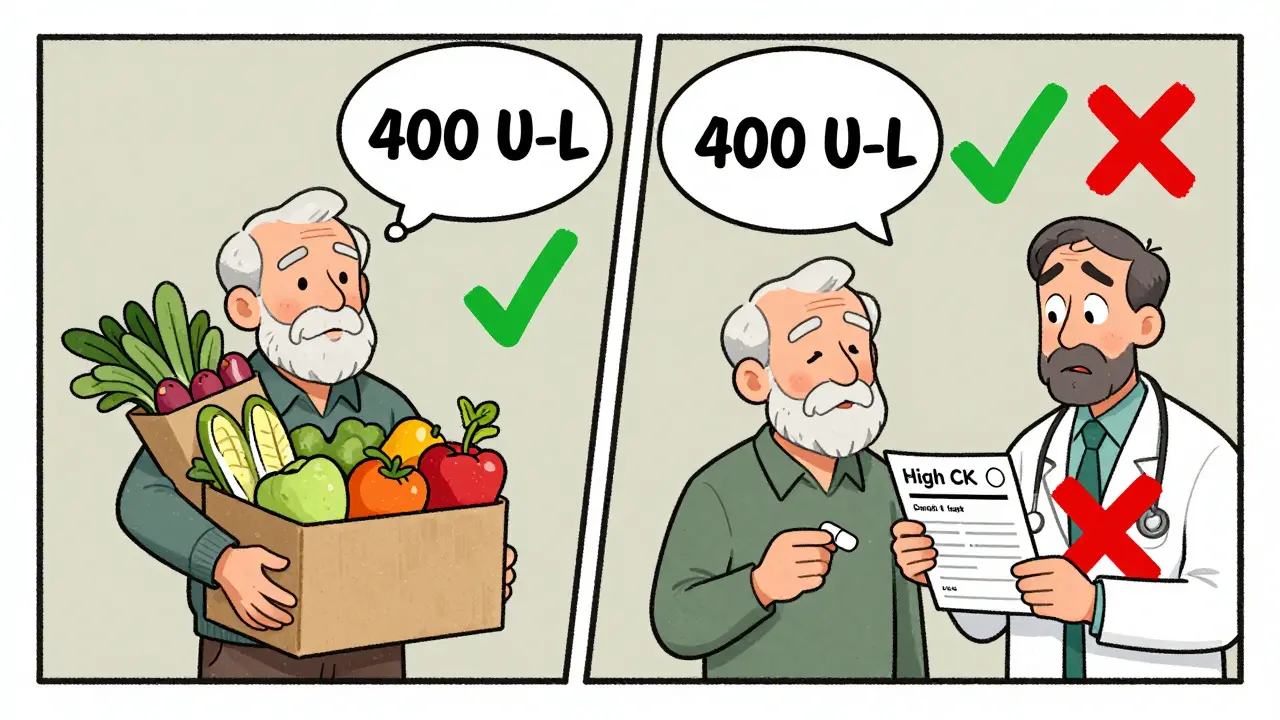
What’s a Normal CK Level? It’s Not What You Think
Lab reports say “normal” is up to 195 U/L for men and 110 U/L for women. But that’s misleading. A 2019 study found that 25-30% of healthy people have CK levels above the lab’s “normal” range-just because they’re active, had an injection, or have a genetic variation. African Americans often have CK levels 50-100% higher than others. Athletes? Their CK can be triple the “normal” limit and still be perfectly healthy. That’s why a baseline matters. If your CK was 400 U/L before you started a statin, and it goes to 450 U/L two months later, that’s not a problem. But if your baseline was 120 U/L and now it’s 600 U/L? That’s a red flag.What Happens If Your CK Is High After Starting Statins?
If you start feeling muscle pain and your CK is checked:- If CK is less than 3 times the upper limit of normal (ULN) and you feel fine? Keep taking the statin. Most of the time, the pain isn’t from the drug.
- If CK is 3-10 times ULN and you have symptoms? Pause the statin, see a specialist, and check thyroid and kidney function. Re-test in a week.
- If CK is over 10 times ULN? Stop the statin immediately. This is a medical emergency.
Why Some Experts Say Skip It
Not everyone agrees. Dr. John Kastelein, a top European cardiologist, argues that baseline CK testing creates false alarms. He points to a Cochrane Review of nearly 50,000 patients that found no difference in muscle injury rates between those who had baseline tests and those who didn’t. Canada’s Choosing Wisely campaign says baseline CK testing costs $14.7 million a year there-and only 1.2% of abnormal results change treatment. In other words, for most people, it adds cost without benefit. But here’s the counter: when patients report muscle pain, having a baseline CK helps doctors avoid stopping a life-saving drug unnecessarily. A 2023 registry of over 84,000 patients found clinics that checked baseline CK had 22% fewer unnecessary statin discontinuations. That’s not just about saving money-it’s about keeping people protected from heart attacks.
What to Do Before the Test
If your doctor orders a baseline CK, don’t just show up. Do this:- Avoid intense exercise for 48 hours before the test. A hard workout can spike CK for days.
- Don’t get a deep muscle injection (like a flu shot in the arm) within a week. That can also raise CK.
- Tell your doctor about all supplements, herbs, or over-the-counter meds you take.
- Ask for your exact CK number-not just “normal” or “abnormal.” Write it down.
What’s Coming Next?
The future might make baseline CK less necessary. Genetic testing for the SLCO1B1 gene variant can tell you if you’re at higher risk for statin myopathy. About 12% of Europeans have this variant, which increases risk by 4.5 times. If you know you have it, your doctor might pick a safer statin or lower dose from the start. Point-of-care CK devices are also in development. These are like glucose meters for muscle enzymes-results in minutes, right in the clinic. If they work, more people will get tested because it’s fast and cheap. But for now, the best practice is simple: test before you start if you’re at risk. Don’t test everyone. Don’t retest every few months. And never stop a statin based on muscle pain alone without checking CK-and comparing it to your baseline.Final Thought: It’s Not About the Number. It’s About the Story.
A single CK value doesn’t tell you if a statin is safe. But a baseline number, combined with your symptoms, your health history, and your lifestyle, tells a full story. That story helps you and your doctor decide: keep going, switch drugs, or pause and re-evaluate. Statin therapy saves millions of lives. Muscle side effects are rare. But when they happen, they’re scary. Baseline CK testing isn’t magic. It’s just smart medicine-for the right people, at the right time.Do I need a baseline CK test if I’m starting a statin for the first time?
Not always. If you’re healthy, under 65, with no kidney problems, no thyroid issues, and not taking other high-risk medications, baseline CK isn’t needed. But if you have any of those risk factors-or you’ve had muscle pain with statins before-then yes, get it tested before you start.
Can a high CK level mean I have a muscle disease?
Yes. A very high CK level-even before starting a statin-could point to an undiagnosed muscle disorder like muscular dystrophy or polymyositis. That’s why doctors look at the number in context. If your CK is unusually high and you feel fine, further testing might be needed to rule out other conditions.
If my CK is normal before starting a statin, does that mean I won’t get muscle pain?
No. A normal baseline doesn’t prevent muscle pain. Statins can still cause side effects even if your starting CK was low. The baseline just helps your doctor tell if a later rise is due to the drug or something else, like overexertion or an infection.
How often should CK be checked after starting a statin?
Not at all-if you feel fine. Routine CK monitoring isn’t recommended by any major guideline. Only check it if you develop muscle pain, weakness, or dark urine. Then, compare the new result to your baseline.
Are there alternatives to CK testing for monitoring statin safety?
Yes. Genetic testing for the SLCO1B1 gene variant can identify people at higher risk before they even start a statin. Also, paying attention to symptoms-like unexplained muscle soreness, weakness, or dark urine-is more important than any blood test. The FDA now emphasizes patient-reported symptoms over lab numbers.
Comments (8)
Natasha Sandra
December 26, 2025 AT 02:19OMG YES THIS!!! 🙌 I started statins last year and my CK was 412 before I even took one pill-my doc was like 'yep, you're an athlete, keep going' and I cried because no one ever believed me before. 😭 Don't make people feel crazy for having normal-high numbers. Baseline = life saver.
Nikki Brown
December 27, 2025 AT 23:31People who skip baseline CK testing are gambling with their health-and frankly, it’s irresponsible. If you're too lazy to get a $15 blood test, don’t be surprised when you end up in the ER with rhabdo. This isn’t 'medical overkill'-it’s basic due diligence. 🙄
Fabio Raphael
December 28, 2025 AT 18:10I’ve been on statins for 8 years and had two episodes of muscle pain. The first time, they stopped my meds because my CK was 'high'-but I hadn’t told them I’d just done 100 burpees. Second time, I asked for my baseline. It was 380. New CK was 410. They said 'keep taking it.' I’m alive because someone finally listened to the story, not just the number. Thank you for writing this.
Amy Lesleighter (Wales)
December 30, 2025 AT 08:47baseline ck is just a starting point dont overthink it. if you feel weird stop and check. if you feel fine and ck is up a little? probably just ran after the kids or lifted heavy groceries. doctors love labs but your body talks too. listen to it. 🤷♀️
Rajni Jain
January 1, 2026 AT 06:31As someone from India where statins are often prescribed without any testing, this was eye-opening. My dad had muscle pain and they just switched him to another statin-no baseline, no follow-up. He suffered for months. This post should be shared everywhere. Thank you for the clarity.
roger dalomba
January 2, 2026 AT 20:06So… we’re spending $14 million a year in Canada to prevent… what? A few hundred unnecessary discontinuations? Meanwhile, people are dying from untreated high cholesterol because they got scared off by a $15 test and a 20 U/L rise. I’ll take the heart attack over the muscle ache, thanks.
Becky Baker
January 3, 2026 AT 02:26Japan tests everyone? Of course they do. They’re obsessed with numbers. Here in America we’ve got common sense. If you’re healthy, don’t get tested. If you’re old and on 12 meds? Maybe. But don’t turn every statin patient into a lab rat.
Peter sullen
January 4, 2026 AT 04:10While the clinical utility of baseline creatine kinase (CK) assessment remains contextually contingent upon individual risk stratification, the evidentiary foundation supporting its selective implementation-particularly in populations exhibiting comorbid renal insufficiency, hypothyroidism, or polypharmacy-is both statistically significant and clinically actionable. Furthermore, the longitudinal trajectory of CK elevation, when normalized against an individualized baseline, permits differentiation between physiologic adaptation and pharmacologically induced myopathy, thereby mitigating the risk of premature therapeutic discontinuation. Therefore, the integration of baseline CK measurement into high-risk statin initiation protocols represents a paradigm of precision medicine, not routine screening.