
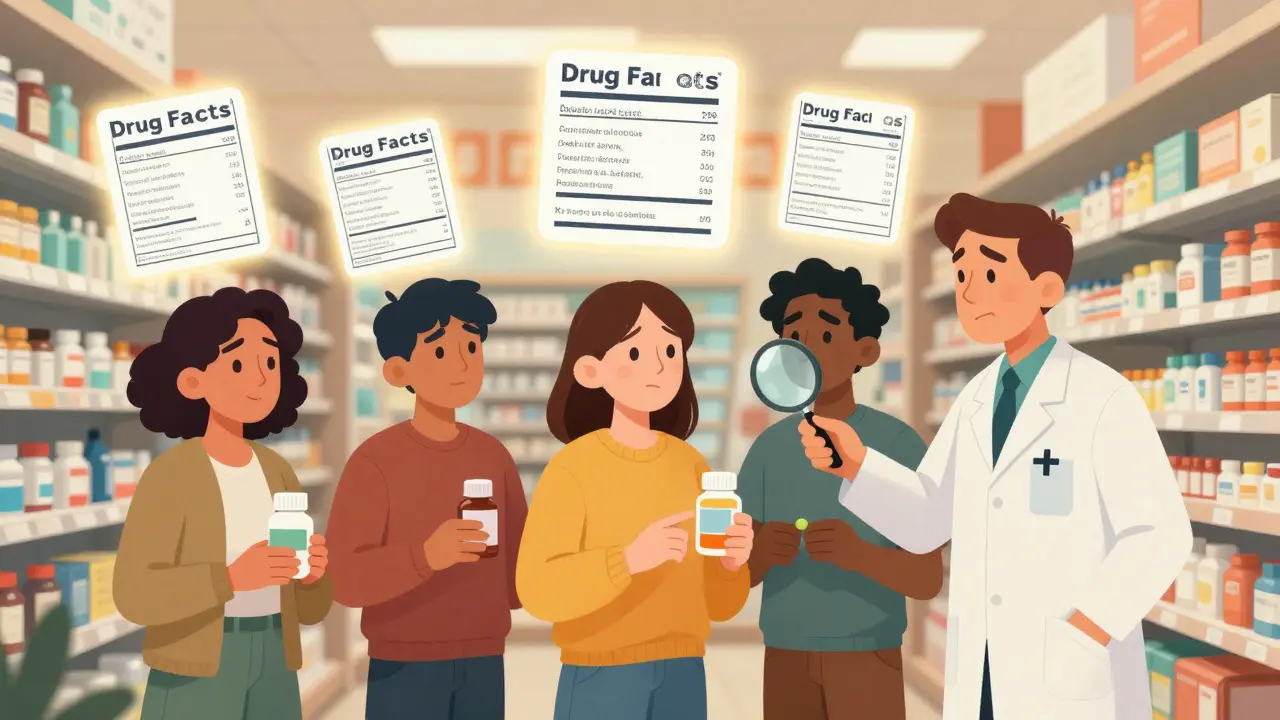
Every year, millions of people in the UK and across the world pick up OTC medications without a prescription-headache pills, cold syrups, antacids, or allergy tablets. It’s easy to assume they’re harmless because you can buy them off the shelf. But here’s the truth: OTC medications are still drugs. And like any drug, they can hurt you if you don’t use them right.
Read the Drug Facts Label-Every Time
You’ve probably glanced at the back of a medicine bottle a hundred times. But how often do you actually read it? The FDA made the Drug Facts label mandatory in 1999 so you wouldn’t have to guess what’s in your medicine. It’s not decoration. It’s your safety guide.Look for these six sections:
- Active ingredients: These are the actual drugs in the product. Don’t just look for the brand name. If you’re taking two different cold medicines, you might accidentally double up on acetaminophen or diphenhydramine.
- Purpose: What is this medicine supposed to do? For example, is it a pain reliever, a decongestant, or an antihistamine?
- Uses: What symptoms is it meant to treat? If you have a sore throat and a runny nose, but the bottle only says “for fever and pain,” it won’t help your congestion.
- Warnings: This is where you find red flags. Does it say “do not use if you have high blood pressure”? “Avoid alcohol”? “Consult your doctor if you’re pregnant”? Skip this section at your risk.
- Directions: How much? How often? For how long? Never assume “more is better.” Exceeding the dose doesn’t make it work faster-it just makes it more dangerous.
- Inactive ingredients: These don’t treat your symptoms, but they can cause reactions. If you’re allergic to dyes, gluten, or certain preservatives, this is where you’ll find out.
Here’s a real example: You grab a “Nighttime Cold & Flu” tablet. It says it contains acetaminophen, dextromethorphan, and doxylamine. You already took Tylenol for your headache earlier today. Now you’ve doubled your acetaminophen dose. That’s how liver damage starts.
Know Your Active Ingredients
Brand names change. Packaging changes. But active ingredients? They stay the same. That’s why you need to memorize the most common ones.- Acetaminophen (Tylenol, Panadol): Great for pain and fever. But it’s in over 600 OTC products-from cold medicines to sleep aids. Taking more than 4,000 mg in 24 hours can cause serious liver damage. The FDA says it causes about 56,000 ER visits every year in the US alone. Don’t take it with alcohol. Ever.
- Ibuprofen (Advil, Nurofen): Good for inflammation, muscle aches, or menstrual pain. But it can irritate your stomach, raise blood pressure, or harm your kidneys if you take it too long or too often.
- Diphenhydramine (Benadryl): An antihistamine that causes drowsiness. Used for allergies or sleep. But it can cause confusion, dry mouth, or urinary retention-especially in older adults.
- Pseudoephedrine (Sudafed): A decongestant that shrinks swollen nasal passages. But it can spike blood pressure and make heart conditions worse. In the UK, it’s kept behind the counter for a reason.
- Dextromethorphan (Robitussin): A cough suppressant. But when taken in high doses, it can cause hallucinations or even overdose. Some teens abuse it. Don’t take it with antidepressants-it can trigger serotonin syndrome.
Never assume a “multi-symptom” product is better. If you only have a headache, buy acetaminophen alone. If you have a cough and nothing else, get a simple cough syrup. More ingredients = more chances for mistakes.
Don’t Guess the Dose
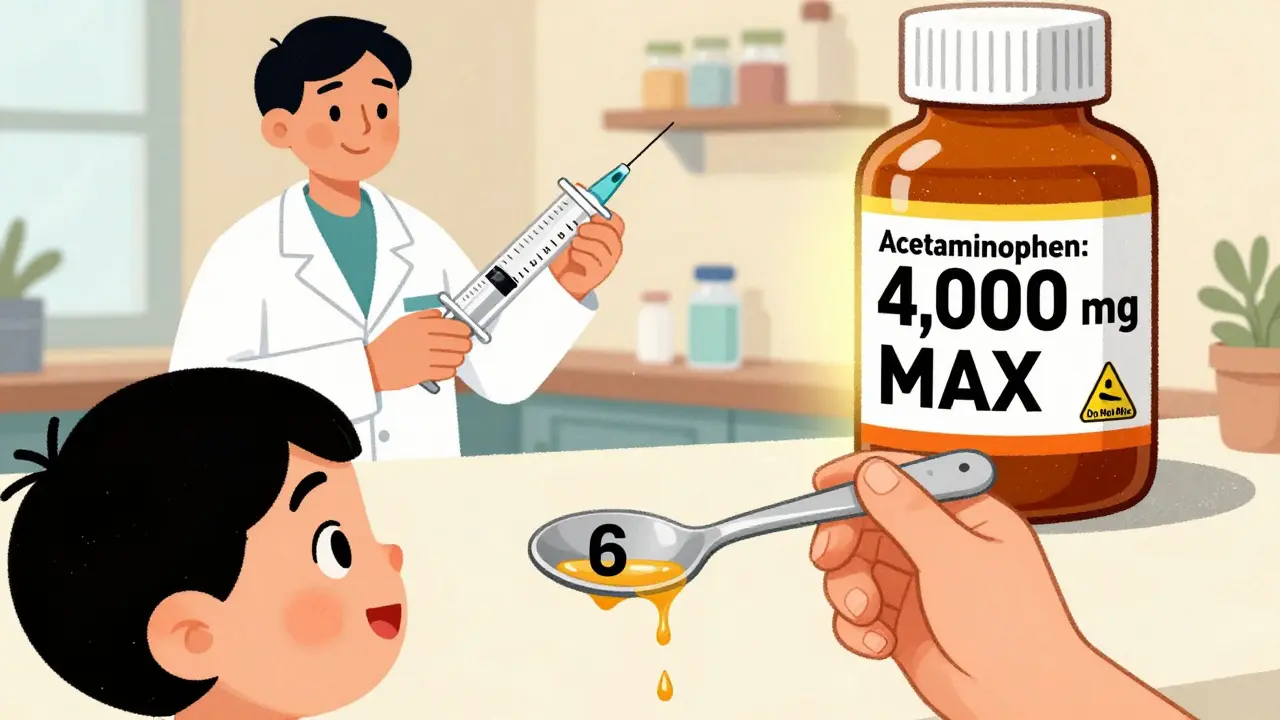
Children aren’t just small adults. And adults aren’t just big kids. Dosing isn’t about weight alone. It’s about age, liver function, kidney health, and other medications you’re taking.Here’s a common mistake: Using a kitchen spoon to measure liquid medicine. A tablespoon isn’t a tablespoon. A teaspoon isn’t a teaspoon. The FDA tested household spoons and found their volumes varied by up to 200%. That means you could be giving your child half the dose-or twice the overdose.
Always use the measuring cup, syringe, or dosing spoon that comes with the medicine. If it’s missing, ask the pharmacist for one. They’ll give it to you for free.
And don’t assume “one pill a day” means “one pill every 24 hours.” Some medicines say “every 4 to 6 hours.” That means you can take it up to 4 times a day-not just once. Read the directions again. Then read them once more.
Talk to the Pharmacist
You don’t need a prescription to buy OTC meds. But you absolutely need to talk to the pharmacist.They’re not just the person who rings you up. They’re trained professionals who know what’s in every bottle, what interacts with what, and who’s at risk. They’ve seen people take five different cold remedies at once. They’ve seen seniors on eight prescriptions accidentally add a sleep aid that made them fall. They’ve seen pregnant women take ibuprofen because they thought it was “just a painkiller.”
Ask them:
- “Is this safe with my other medications?”
- “Does this have acetaminophen in it?”
- “Is this okay for someone with high blood pressure/diabetes/liver problems?”
- “Is there a simpler option?”
Pharmacist consultations are free. No appointment needed. And they can cut your risk of an adverse reaction by two-thirds, according to a 2022 study in Research in Social and Administrative Pharmacy.
Watch Out for Hidden Risks
Some conditions make OTC meds dangerous-even if they seem harmless.- Diabetes: Decongestants can raise blood sugar. Some cough syrups are loaded with sugar. Look for sugar-free versions.
- High blood pressure: Avoid decongestants like pseudoephedrine and phenylephrine. They tighten blood vessels-which is the opposite of what you need.
- Enlarged prostate: Antihistamines and decongestants can make it harder to urinate. This can lead to urinary retention, which is a medical emergency.
- Heart disease: NSAIDs like ibuprofen can increase the risk of heart attack or stroke, especially with long-term use.
- Pregnancy or breastfeeding: Some OTC drugs cross the placenta or enter breast milk. Acetaminophen is usually okay in moderation. Ibuprofen and aspirin are not. Always check.
- Older adults: One in two adverse drug reactions in the UK happens to people over 65. Why? They often take multiple medications, and their bodies process drugs slower. A dose that’s fine for a 30-year-old could be toxic for a 70-year-old.
Keep a Medication List
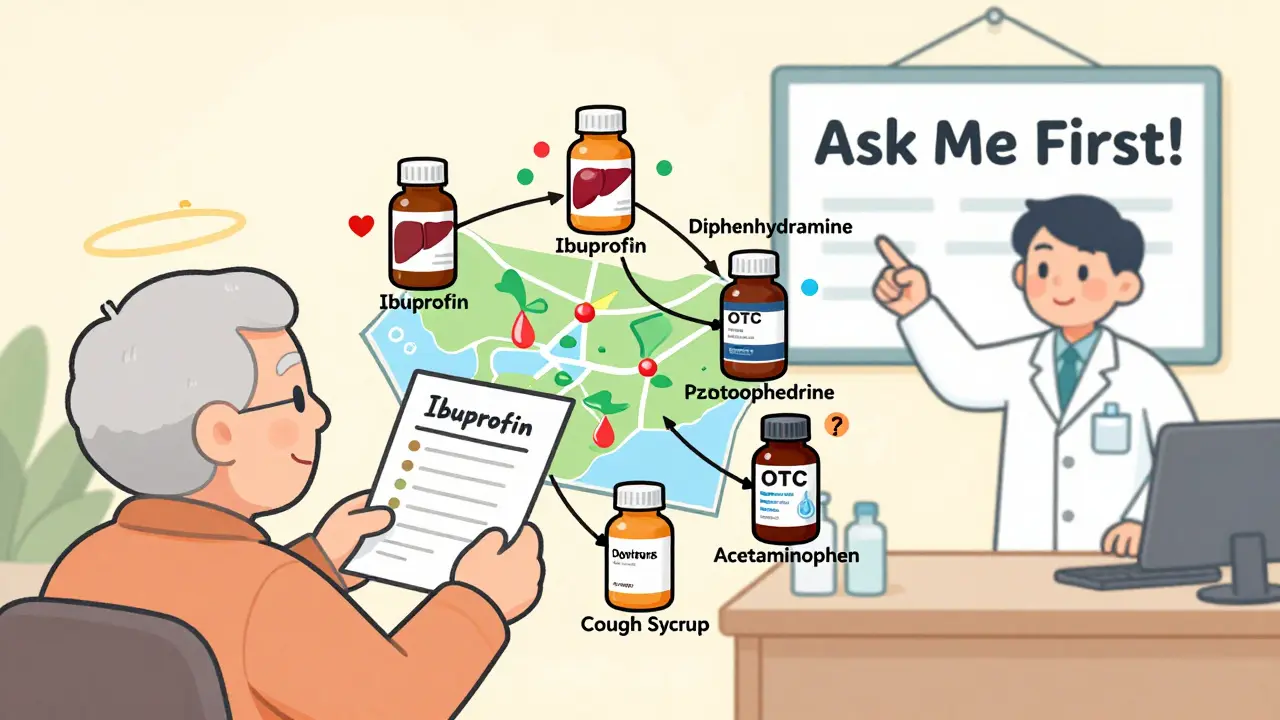
Write down everything you take-prescription, OTC, vitamins, supplements. Include the name, dose, and how often you take it. Update it every time you start or stop something.Bring this list to every doctor’s visit. Show it to the pharmacist when you buy OTC meds. If you’re rushed or confused, your list will keep you safe.
Use your phone. Use a notebook. Use a free app. Just don’t rely on memory.
Don’t Use Old Medicine
That bottle of ibuprofen from last winter? The cough syrup from when you had the flu in January? Toss it.Medicines lose potency over time. Some can even break down into harmful substances. The expiration date isn’t a suggestion. It’s a safety cutoff.
And never take medicine prescribed for someone else-even if they had the same symptoms. Their body, their history, their risks-none of that applies to you.
What If You Make a Mistake?
If you took too much, took the wrong one, or feel strange after taking an OTC drug:- Call NHS 111 immediately.
- Don’t wait for symptoms to get worse.
- Have the medicine bottle with you when you call.
The UK’s National Poisons Information Service handles over 198,000 OTC medication exposures every year. Most are preventable. But they’re not always obvious. A headache after taking too much acetaminophen might not show up for 12 hours. By then, the damage is done.
When in doubt-call someone who knows.
Comments (15)
Tim Goodfellow
December 18, 2025 AT 23:18OMG this is the most important post I've read all year. I used to grab whatever cold medicine looked cute on the shelf until I almost killed myself with acetaminophen. Now I read every label like it's a contract with my liver. And yeah, the pharmacist? My new best friend. They saved my life last winter when I tried to mix NyQuil with my blood pressure med. Don't be a hero. Ask questions.
Elaine Douglass
December 20, 2025 AT 21:18i used to think otc meant safe but now i always check the active ingredients. also never use a kitchen spoon. my cousin gave her kid half a teaspoon of cough syrup with a spoon and he ended up in the er. so dumb. just use the thing that comes with it. free. easy. lifesaving.
Kathryn Featherstone
December 22, 2025 AT 14:02This is such a needed reminder. I’m 42 and started taking ibuprofen daily for back pain without realizing how much it was stressing my kidneys. I didn’t even know it was in two different pain relievers I was using. Thank you for laying this out so clearly. I’m printing this out and taping it to my medicine cabinet.
Jedidiah Massey
December 23, 2025 AT 20:03Let’s be real - most people treat OTC meds like candy. The FDA label? A suggestion. Active ingredients? Who reads those? 😒 I’ve seen folks stack 3 different cold formulas because ‘they need to feel better ASAP.’ Spoiler: they don’t. They end up in the ER with transaminitis. This is public health 101 and we’re failing. #PharmacistNotATeller
Gloria Parraz
December 23, 2025 AT 22:32Thank you for writing this. I’m a nurse and I see this every single shift. People think because it’s over the counter, it’s not a drug. But your body doesn’t care if it’s prescription or not - it just reacts. Please, if you’re unsure, ask the pharmacist. No judgment. No shame. We’ve seen it all. And we’re here to help.
Nicole Rutherford
December 24, 2025 AT 01:24Of course you’re telling people to talk to pharmacists. They’re paid by Big Pharma to sell you more pills. The real solution? Stop taking all this crap. Eat turmeric. Drink lemon water. Let your body heal naturally. You think your liver needs a break? Try not poisoning it with chemicals in the first place.
Emily P
December 25, 2025 AT 13:11Do you know how many OTC meds have diphenhydramine in them? I didn’t until I started having trouble urinating at 3 a.m. Turns out I was taking allergy meds, sleep aids, and cold pills - all with the same ingredient. I felt like a moron. But now I keep a list. And I check every bottle. It’s weirdly empowering.
mark shortus
December 26, 2025 AT 03:00MY GOD. I JUST REALIZED I’VE BEEN TAKING TYLENOL AND A COLD MEDICINE TOGETHER FOR 3 YEARS. I’M A LIVING TIME BOMB. I JUST THREW OUT EVERYTHING IN MY CABINET. I’M GOING TO THE PHARMACY RIGHT NOW TO ASK WHAT’S SAFE. I HOPE I’M NOT TOO LATE. MY LIVER IS CRYING.
Kelly Mulder
December 26, 2025 AT 10:36While the intent of this piece is commendable, its structural and lexical deficiencies undermine its credibility. The use of passive voice, inconsistent capitalization, and the absence of semicolons in compound-complex sentences renders it pedagogically inadequate. Furthermore, the conflation of FDA guidelines with UK pharmacological norms is a glaring methodological flaw. One must exercise rigorous epistemological discipline when disseminating medical advice - especially when the audience is susceptible to heuristic-based decision-making. This post, while well-meaning, lacks the necessary scholarly rigor to serve as a reliable heuristic.
Sahil jassy
December 26, 2025 AT 17:02bro this is gold 🙏 i live in india and we just grab whatever looks cheap. i had no idea pseudoephedrine was behind the counter in the us. here its just on the shelf with candy. i showed this to my mom and she finally stopped giving my dad sudafed for his 'cold'. he has bp. thanks for the wake up call.
Chris Clark
December 26, 2025 AT 18:09As a former pharmacy tech, I can tell you - 80% of the people who buy OTC meds don’t know what’s in them. I had a guy buy three different ‘nighttime’ formulas because ‘they all looked different’. He didn’t know they all had doxylamine. He slept for 18 hours straight. Woke up confused. Thought he was in a cult. We had to call his daughter. Just… read the label. Please.
Dorine Anthony
December 28, 2025 AT 08:32I used to think expired medicine was fine if it didn’t look weird. Then I found a 7-year-old bottle of ibuprofen in my purse. I tossed it. Now I check dates every time I buy something. It’s weird how much you forget until you’re staring at a label you’ve ignored for years.
Mark Able
December 28, 2025 AT 19:43Hey I just read this and I’m like… wait, you’re saying I shouldn’t take my wife’s leftover antibiotics with my cold? But she had the same symptoms! Also, why do you keep saying ‘pharmacist’ like they’re wizards? Can’t I just Google it? I did and someone said aspirin is a weed. Is that true?
Takeysha Turnquest
December 29, 2025 AT 08:04We live in a world where a pill can fix a feeling. But what are we really healing? The body is not a machine to be calibrated with chemicals. The label is a distraction. The real question isn’t ‘what’s in this’ - it’s ‘why do I need this?’ Maybe your headache isn’t from stress… maybe it’s from ignoring your soul. The medicine won’t fix that. Only stillness will.
jessica .
December 30, 2025 AT 09:51THIS IS A GOVERNMENT PROPAGANDA TOOL. OTC MEDS ARE SAFE. THEY JUST WANT YOU TO BE DEPENDENT ON PHARMACISTS SO THEY CAN CONTROL YOU. THE FDA IS A LIE. THEY’RE HIDING THE TRUTH ABOUT ACETAMINOPHEN. I SAW A VIDEO ON TRUTHSAYER THAT SAID IT’S A SYNTHETIC POISON DESIGNED TO MAKE YOU BUY MORE DRUGS. I’M NOT TAKING ANYTHING FROM A STORE. I’M DRINKING GINGER TEA AND PRAYING.