
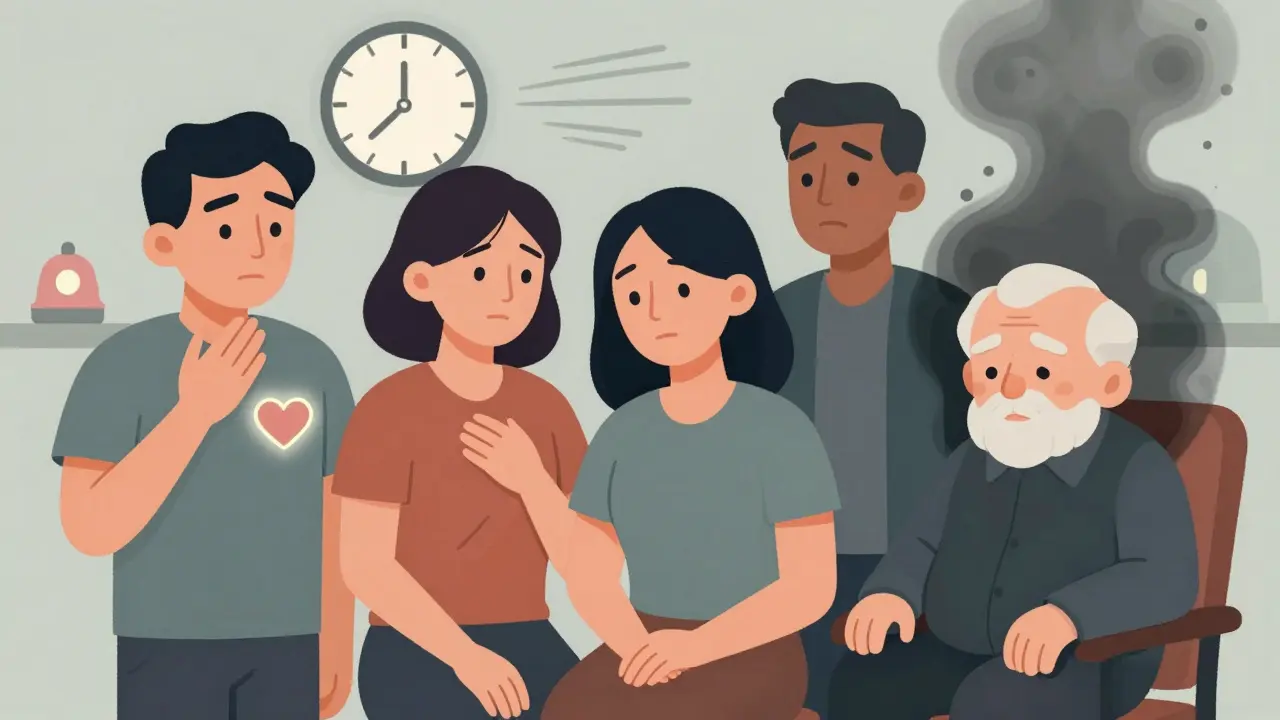
When your heart is under attack, it doesn’t always scream. Sometimes it whispers. And if you miss that whisper, you could lose precious minutes-maybe even your life.
What Really Happens During a Heart Attack
A heart attack, or myocardial infarction, happens when blood flow to part of your heart gets blocked. Usually, it’s due to a clot forming in one of the coronary arteries. Without oxygen-rich blood, heart muscle starts to die. Every minute counts. Research shows you lose about 1.5 million heart cells per minute during a heart attack. The faster you get help, the more of your heart you save.The goal isn’t just to survive-it’s to survive with your heart still working. Studies show that getting treatment within 90 minutes of symptoms starting can cut your chance of dying by up to half. That’s why knowing the signs-and acting fast-isn’t just advice. It’s your best shot.
The Classic Signs (And Why They Can Be Misleading)
Most people think of a heart attack as intense chest pain, like an elephant sitting on your chest. That happens-but not always, and not for everyone.The American Heart Association describes the most common chest symptom as pressure, squeezing, fullness, or pain in the center of your chest. It lasts longer than a few minutes, or it comes and goes. This isn’t a quick sting or a muscle pull. It’s persistent. It might feel like indigestion, but it doesn’t go away with antacids.
Here’s the problem: 90% of men report this kind of chest pain during a heart attack. But only 64% of women do. That mismatch is deadly. Women are far more likely to have symptoms that get mistaken for something else-flu, anxiety, acid reflux, or just getting older.
Symptoms Women Often Miss (And Why It’s Deadly)
If you’re a woman, your heart attack might not look like the movies. You’re 58% more likely to have shortness of breath without chest pain. You’re 47% more likely to feel nauseous or throw up. You’re 37% more likely to have pain in your back, neck, or jaw-without any chest discomfort at all.One woman in Birmingham told her GP her jaw had been aching for days. She was told it was TMJ. Three days later, she had a massive heart attack. Her jaw pain wasn’t dental. It was her heart screaming in a language doctors often don’t listen to.
Unusual tiredness is another red flag. In women, it’s reported in nearly half of heart attack cases-almost twice as often as in men. You might feel like you’ve run a marathon after walking up the stairs. Or you can’t get out of bed. No fever. No reason. Just exhaustion that won’t quit.
And then there’s the anxiety. Some women describe an overwhelming sense of dread, like something terrible is about to happen. It’s not panic. It’s a deep, unshakable fear. In women over 55, this symptom shows up nearly twice as often as in men.
What Older Adults Might Not Feel At All
If you’re over 75, your heart attack might be silent. No chest pain. No sweating. Just fatigue, dizziness, or a strange feeling that something’s off.One in three heart attacks in people over 75 show no classic symptoms. That’s why older adults are more likely to be sent home from the ER with a misdiagnosis. They feel “just tired” or “a bit off.” But their heart is quietly dying.
Doctors call these “silent heart attacks.” They’re not harmless. They still damage the heart. And they raise your risk of another, deadlier one later.
Other Warning Signs You Can’t Ignore
Beyond chest pain and gender-specific symptoms, here’s what else to watch for:- Cold sweat: Breaking out in a chill, clammy sweat-especially if you’re not hot or exercising.
- Shortness of breath: Even when you’re sitting still. This can happen with or without chest pain.
- Upset stomach: Nausea, vomiting, or indigestion that comes out of nowhere.
- Rapid or irregular heartbeat: Your heart feels like it’s fluttering, pounding, or skipping beats.
- Lightheadedness or fainting: Feeling dizzy, weak, or about to pass out.
These symptoms don’t always happen together. One or two might show up. That’s enough.
What Comes Before the Heart Attack? (The Early Warning)
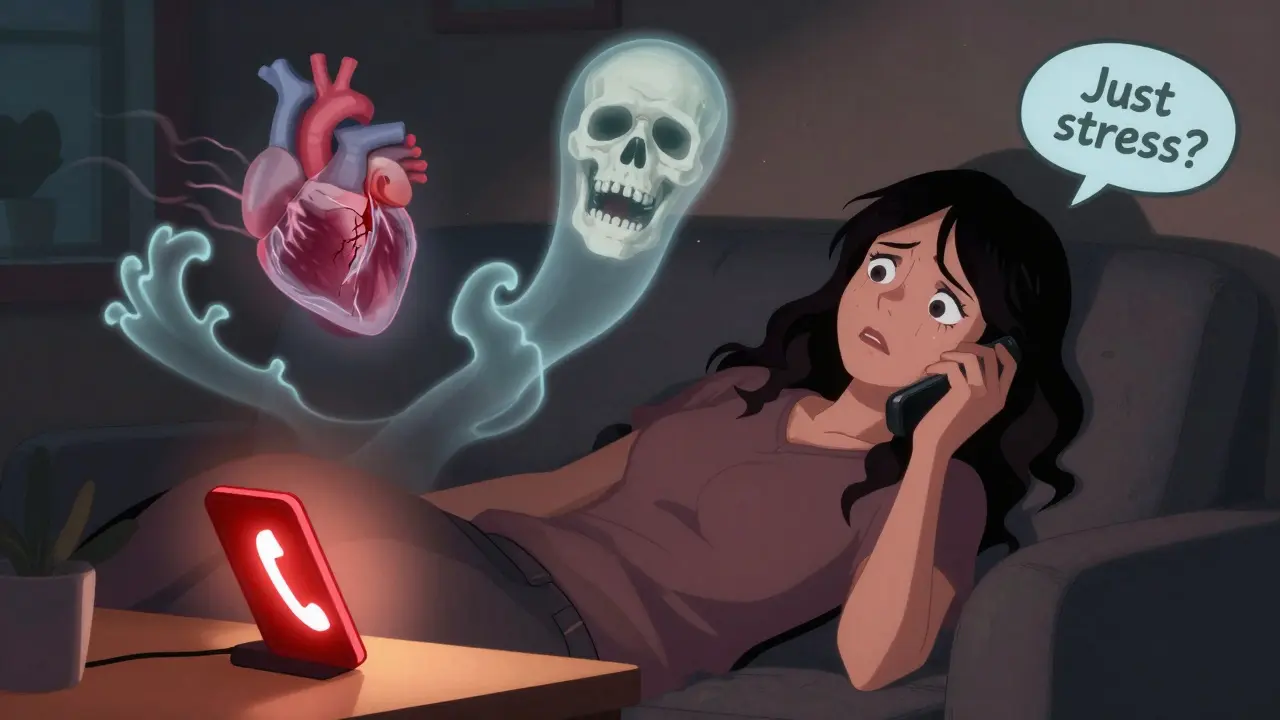
A heart attack doesn’t always come out of nowhere. Sometimes, your body gives you clues weeks ahead.Research from Geisinger Health System in early 2025 found that 22% of people had unexplained weakness for weeks before their heart attack. Another 18% noticed unusual palpitations-heart flutters that didn’t go away.
These aren’t “just stress.” They’re your heart trying to tell you something’s wrong. If you’ve had weeks of unusual fatigue, odd aches, or heart rhythm changes-don’t brush it off. Talk to your doctor. Get checked.
What to Do the Moment You Suspect a Heart Attack
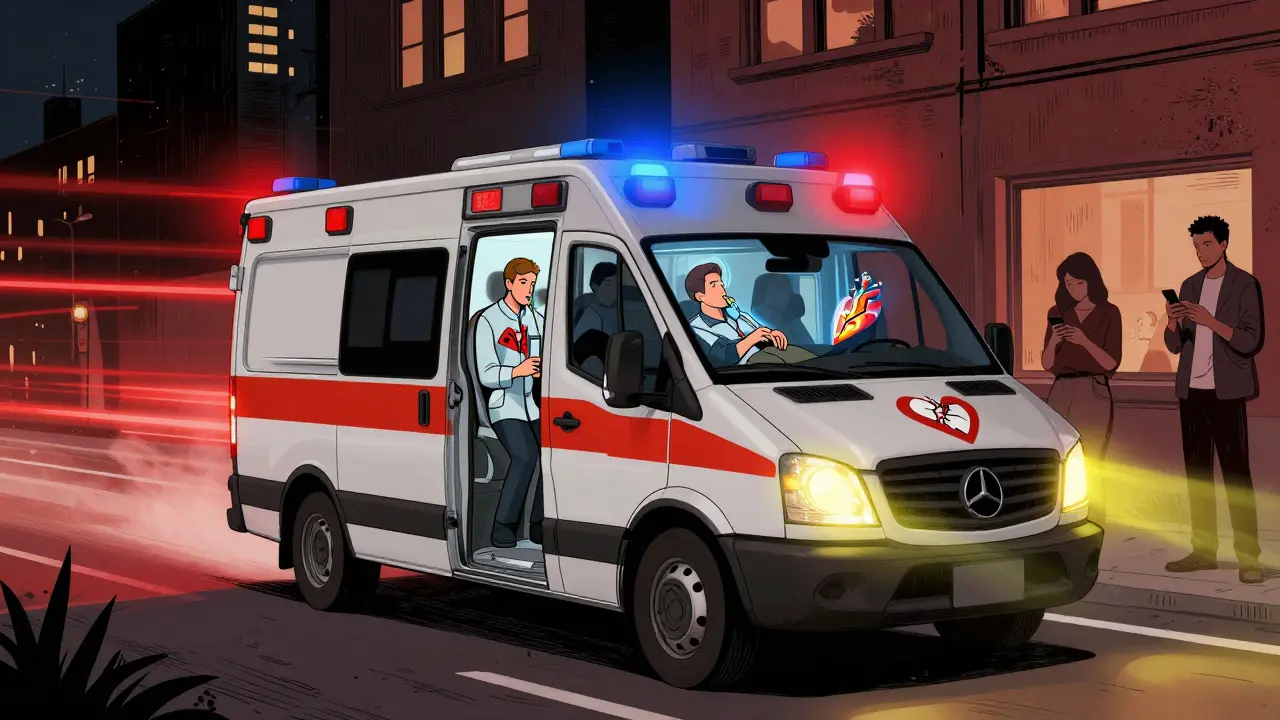
If you or someone else has any of these symptoms, call 999 immediately. Don’t wait. Don’t call a family member first. Don’t drive yourself.Emergency crews can start treatment in the ambulance. They can give you oxygen, aspirin, and monitor your heart while en route. People who call 999 arrive at the hospital 25% faster than those who drive themselves.
If you’re not allergic to aspirin and your doctor hasn’t told you to avoid it, chew one 300mg tablet while you wait. It helps thin the blood and can reduce damage.
Don’t worry about being wrong. It’s better to call and find out it’s nothing than to wait and find out it’s too late. One in three heart attack victims waits more than two hours before calling for help-mostly because they’re afraid of looking foolish. Don’t be that person.
Why Delay Is So Dangerous
The average person waits three hours before calling emergency services after heart attack symptoms start. That’s three hours too long.Women wait even longer-on average, 2.7 hours versus 1.9 for men. Why? Because their symptoms are less obvious. They think it’s indigestion. They think it’s anxiety. They think, “It’ll pass.”
And too often, it does pass-right into death. Women are 50% more likely to die within a year after a heart attack than men. Partly because they’re misdiagnosed. Partly because they delay.
One study found women’s heart attacks are misdiagnosed 50% more often than men’s. One woman was sent home with a diagnosis of panic attacks-she had a heart attack. Another was told she had the flu. She had a heart attack. Both survived, but barely.
How to Prepare Before It Happens
You can’t predict a heart attack-but you can prepare for it.- Know your risk factors: High blood pressure, diabetes, smoking, obesity, family history.
- Get regular check-ups. Even if you feel fine.
- Teach your family what to look for. Especially if you have elderly parents or a partner.
- Keep aspirin in your medicine cabinet (if your doctor says it’s safe).
- Learn basic CPR. It saves lives. Communities with CPR training have 28% higher survival rates for out-of-hospital cardiac arrests.
There’s a free online course from the British Heart Foundation called “Heart Attack 101.” Over 450,000 people in the UK have taken it. It takes 20 minutes. It could save your life-or someone else’s.
What’s Changing in Heart Attack Care
New tech is helping. In 2023, the FDA approved the first AI-powered tool that can predict a heart attack 30 minutes before symptoms start-by analyzing EKG patterns with 92.7% accuracy. Wearable EKG devices are now in the hands of nearly 40% of U.S. adults. They can catch irregular heart rhythms before they turn deadly.In the UK, hospitals are now required to follow standardized heart attack protocols. That means less guesswork, faster tests, and quicker treatment.
But technology won’t save you if you don’t act. The best algorithm in the world can’t call 999 for you.
Final Thought: Your Life Is Worth the Call
A heart attack doesn’t care if you’re young, old, fit, or healthy. It doesn’t care if you think it’s “just stress.” It doesn’t care if you’re embarrassed to call an ambulance.When your body sends a warning sign-listen. Even if it’s subtle. Even if it’s not the chest pain you expect.
Call 999. Don’t wait. Don’t hesitate. Don’t rationalize.
Your heart is working for you every second. Don’t make it work harder than it has to.
Can a heart attack happen without chest pain?
Yes. About 30% of heart attacks in people over 75 have no chest pain at all. Women are also more likely to have heart attacks without classic chest discomfort. Instead, they may experience shortness of breath, nausea, jaw or back pain, extreme fatigue, or a feeling of impending doom. These are still heart attack symptoms and require emergency care.
Is it safe to take aspirin during a suspected heart attack?
If you’re not allergic to aspirin and your doctor hasn’t told you to avoid it, chewing one 300mg tablet while waiting for emergency help can help reduce damage. Don’t take it if you’re unsure-just call 999. Emergency responders can give you the right treatment once they arrive.
Should I drive myself to the hospital if I think I’m having a heart attack?
No. Calling 999 is always safer. Ambulance crews can start life-saving treatment right away-giving oxygen, monitoring your heart, and even giving medication before you reach the hospital. People who call 999 arrive at the hospital 25% faster than those who drive themselves.
Can young people have heart attacks?
Yes. Heart attacks in adults aged 25-44 have been rising by 2% each year since 2000. Lifestyle factors like poor diet, lack of exercise, smoking, and stress are major contributors. Don’t assume you’re too young. Symptoms in younger people can be mistaken for anxiety or indigestion, leading to dangerous delays.
How can I tell the difference between heartburn and a heart attack?
Heartburn usually feels like a burning sensation behind the breastbone that gets worse after eating or lying down. Heart attack pain is more like pressure, tightness, or squeezing, often spreading to the arms, neck, or jaw. It doesn’t go away with antacids. If you’re unsure, assume it’s a heart attack and call 999. Better safe than sorry.
Are heart attack symptoms different for people with diabetes?
Yes. People with diabetes often have nerve damage that dulls pain signals. They’re more likely to have “silent” heart attacks with no chest pain. Instead, they may feel unusually tired, short of breath, or nauseous. If you have diabetes and experience unexplained fatigue or discomfort, get it checked out immediately.
What should I do if someone else is having a heart attack?
Call 999 immediately. If the person is unconscious and not breathing, start CPR if you’re trained. If you’re not trained, the dispatcher can guide you through hands-only CPR (chest compressions). Don’t wait for someone else to act. Your quick response could save their life.
Comments (13)
Jessica Bnouzalim
January 12, 2026 AT 22:42OMG, I just read this and my jaw dropped 😭 I had jaw pain for three days last year and went to the dentist-they said it was TMJ. Turns out? It was my heart. I almost didn’t make it. Please, if you feel weird-ANY weirdness-CALL 999. Don’t wait. I’m screaming this from the rooftops.
laura manning
January 13, 2026 AT 18:02While the emotional appeal of this article is compelling, the statistical claims lack proper citation. For instance, the assertion that 'women are 58% more likely to have shortness of breath without chest pain' is not sourced to peer-reviewed literature. The American Heart Association's 2023 guidelines do not support this exact percentage. Without empirical validation, this risks propagating misinformation under the guise of awareness.
Bryan Wolfe
January 14, 2026 AT 15:41Hey everyone-this is life-saving stuff. I’m a paramedic, and I’ve seen too many people wait because they thought it was ‘just indigestion’ or ‘stress.’ I’ve held hands while people died because they didn’t call. Don’t be that person. Don’t be the one who says ‘I’ll wait and see.’ Your heart doesn’t negotiate. Call 999. Now. And tell your mom, your sister, your boss-everyone. This isn’t fear-mongering. It’s survival.
Sumit Sharma
January 14, 2026 AT 21:51It is imperative to note that the prevalence of silent myocardial infarctions in diabetic populations is well-documented in the Journal of the American College of Cardiology (JACC), Volume 78, Issue 12, 2021. Furthermore, the 25% faster arrival time for ambulance-transported patients is corroborated by the European Heart Journal’s 2022 meta-analysis. However, the article’s conflation of correlation with causality regarding aspirin administration is methodologically unsound. Aspirin is contraindicated in up to 12% of the population due to bleeding risk. Misguided public health messaging may exacerbate adverse outcomes.
Jay Powers
January 15, 2026 AT 02:35I used to think heart attacks were only for older guys who eat burgers and smoke. Then my sister had one at 34. No chest pain. Just couldn’t breathe. Thought she was having a panic attack. She almost didn’t make it. Now I talk about this with everyone. Your body knows. Listen. And if you’re not sure? Call. Just call. No shame. No waiting. Your life matters.
Lauren Warner
January 16, 2026 AT 08:20It’s frustrating how this article plays on gender stereotypes. Women are not ‘more likely’ to have silent heart attacks because they’re ‘emotional’ or ‘overlook symptoms.’ The real issue is systemic bias in medical training. Studies show doctors spend 30% less time evaluating women’s cardiac symptoms. The problem isn’t women ignoring signs-it’s doctors ignoring women. Stop blaming the victim. Fix the system.
Craig Wright
January 16, 2026 AT 15:07As a British citizen, I find it alarming that this article promotes 999 as the emergency number without acknowledging that in the UK, we have a world-class NHS that responds with precision. The American tendency to dramatize every symptom as a potential cardiac event is both irresponsible and costly. We do not encourage the public to dial emergency services for every instance of fatigue. Discipline and medical consultation are the hallmarks of a mature society.
Ben Kono
January 18, 2026 AT 08:07My grandma had a silent heart attack and just said she was tired. No one knew until she collapsed. Now I check on her every day. Just because you feel fine doesn’t mean you are. Call your mom. Call your dad. Ask if they’ve been feeling off. It’s easy to forget. Don’t wait till it’s too late.
Cassie Widders
January 18, 2026 AT 19:43Yeah I read this and just sat there. My dad had one last year. Didn’t even know. Just felt like he’d been hit by a truck. Took him 12 hours to call. He’s okay now. But I’ll never forget how quiet it all was. No drama. Just… quiet. And then the ambulance.
Amanda Eichstaedt
January 19, 2026 AT 21:58This is why we need to stop treating heart disease like it’s a man’s problem. My aunt in Nigeria had a heart attack and her family thought she was possessed. No hospital for weeks. She survived because a nurse in Lagos recognized the jaw pain. This isn’t just about awareness-it’s about cultural literacy. We need to teach this in schools, mosques, churches, barbershops. It’s not medical jargon. It’s human survival.
jordan shiyangeni
January 21, 2026 AT 19:49Let me be clear: this article is dangerously oversimplified. The notion that ‘any fatigue’ is a heart attack warning is a gross misrepresentation of clinical medicine. Chronic fatigue is a symptom of depression, thyroid dysfunction, anemia, Lyme disease, and countless other conditions. To equate it with myocardial infarction without differential diagnosis is not just irresponsible-it’s a disservice to patients who may delay treatment for actual life-threatening conditions because they’ve been conditioned to panic over every twinge. The rise in heart attacks among younger adults is a complex interplay of socioeconomic stress, processed food industries, and systemic healthcare neglect-not a simple ‘call 999’ checklist. This article reduces a multidimensional public health crisis to clickbait.
Monica Puglia
January 23, 2026 AT 04:09Just sent this to my mom. She’s 68. She says she’s ‘fine’ but hasn’t slept well in weeks. I’m taking her to the doctor next week. No excuses. ❤️
steve ker
January 24, 2026 AT 15:53Heart attack? Call 999. Done. Why are we writing essays? People die because they overthink. Just call.