
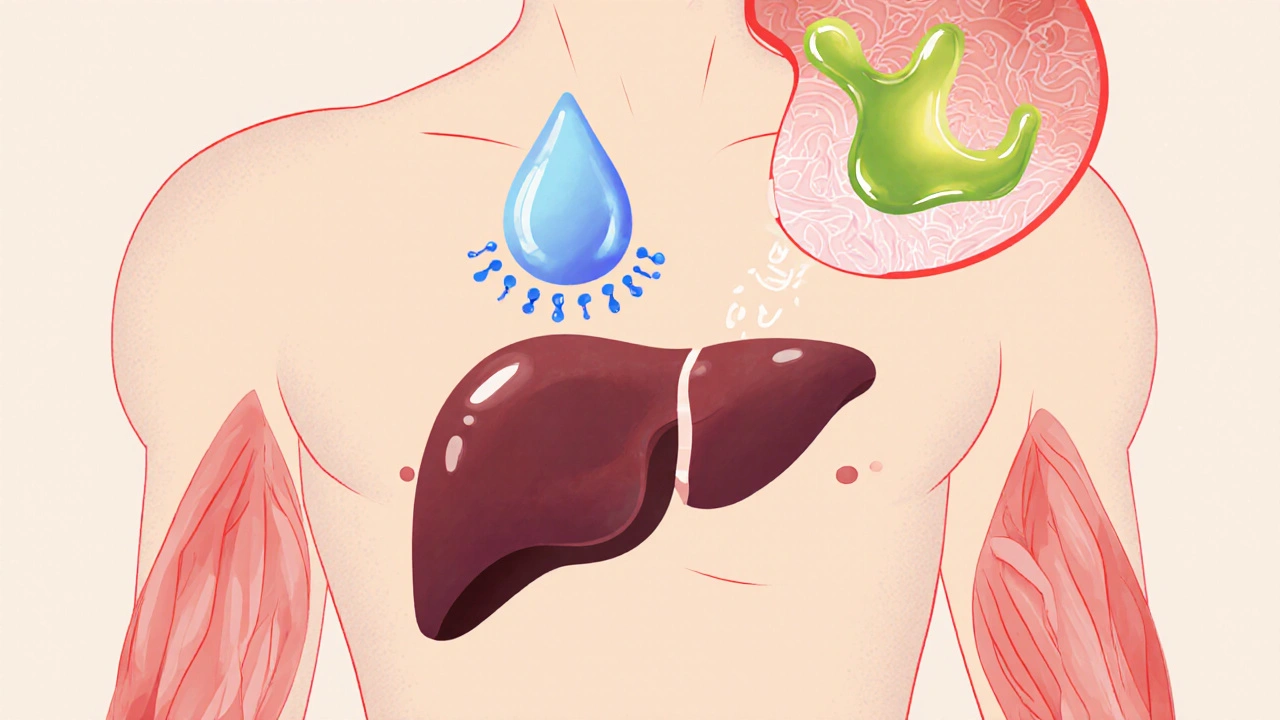
When you’re prescribed a statin, your doctor doesn’t just pick a name out of a hat. The type of statin you get-whether it’s hydrophilic or lipophilic-can affect how your body handles it, and that might mean the difference between feeling fine or dealing with muscle pain, fatigue, or other side effects. But here’s the twist: what you’ve heard about these two types might not be true anymore.
What’s the Difference Between Hydrophilic and Lipophilic Statins?
It all comes down to solubility. Lipophilic statins dissolve in fat. That means they can slip easily through cell membranes, not just in your liver where they’re supposed to work, but also into your muscles, nerves, and even your brain. Examples include simvastatin, atorvastatin, lovastatin, fluvastatin, and pitavastatin.
Hydrophilic statins dissolve in water. They can’t just drift into cells on their own. Instead, they need special transporters-called OATPs-to get into liver cells. That makes them more focused on the liver and less likely to wander into other tissues. The two main ones are pravastatin and rosuvastatin.
This difference isn’t just chemistry class trivia. It affects how much of the drug ends up where. Studies show lipophilic statins can reach muscle tissue at levels 3 to 5 times higher than hydrophilic ones. That’s why, for years, doctors assumed lipophilic statins caused more muscle problems.
Do Lipophilic Statins Really Cause More Muscle Pain?
The old story goes like this: lipophilic statins = more muscle pain. Hydrophilic statins = safer for muscles. It made sense. More access to muscle tissue = more chance of damage. But real-world data doesn’t always follow logic.
A 2021 study of 15 million patients in the UK found something surprising. When comparing pravastatin (hydrophilic) to simvastatin (lipophilic), pravastatin had a lower risk of muscle issues-good for the old theory. But when they compared rosuvastatin (hydrophilic) to atorvastatin (lipophilic), rosuvastatin had a higher risk. Same with simvastatin versus atorvastatin: the lipophilic one had a higher risk, but not because of its fat-soluble nature. The dose and the individual mattered more.
Another study from the Journal of the American Heart Association found hydrophilic statins actually led to fewer heart attacks and lower death rates. But a different study in the British Journal of Clinical Pharmacology said lipophilic statins worked better at lowering cholesterol. And then there’s the data from patient forums: 78% of people on Reddit reported muscle pain with lipophilic statins, but 42% also had issues with hydrophilic ones. One person on a health forum got severe muscle pain from rosuvastatin-yes, the hydrophilic one-and only felt better after switching to pravastatin, another hydrophilic statin.
Bottom line: the simple rule that hydrophilic = fewer muscle problems doesn’t hold up. Rosuvastatin, despite being water-soluble, is one of the most potent statins and has been linked to muscle complaints in some people. Simvastatin, even at low doses, is notorious. But some people take high-dose atorvastatin for years with no issues.
Why Do Side Effects Vary So Much Between People?
If the type of statin doesn’t fully explain side effects, what does?
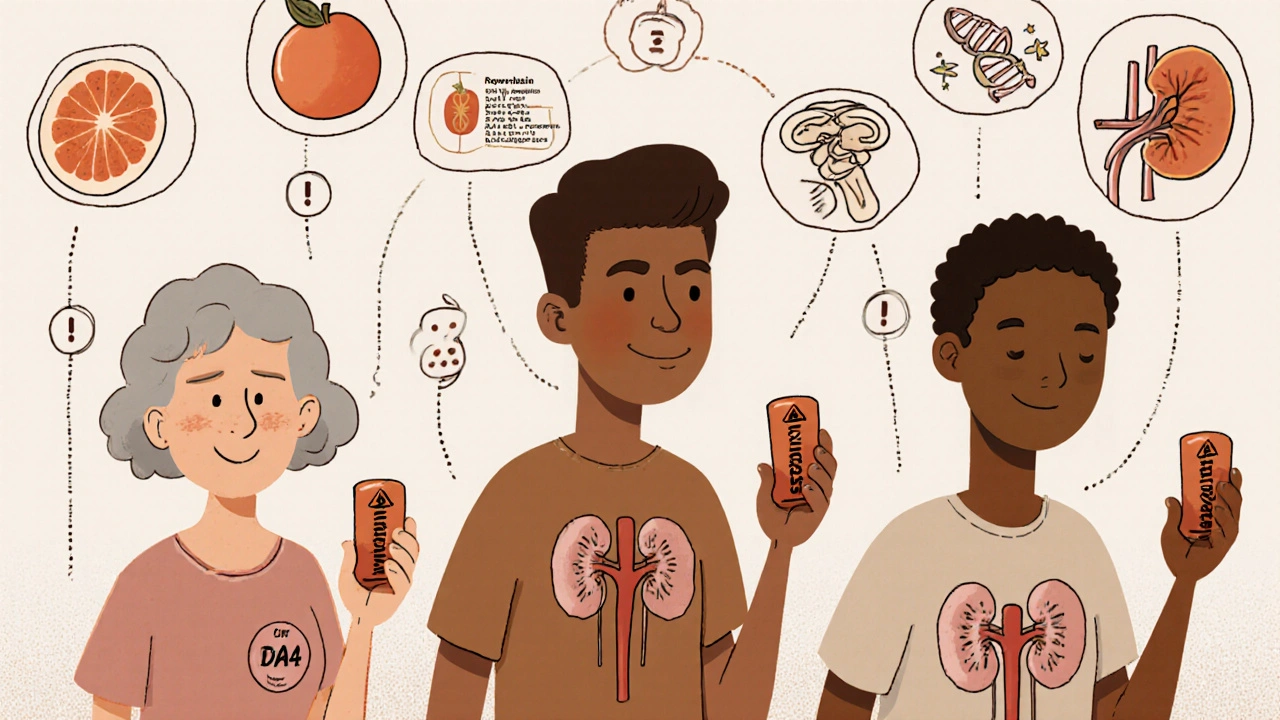
Age. Women. Low body weight. Kidney problems. Other meds. These matter more than whether a statin is fat-soluble or water-soluble.
People over 65 are nearly twice as likely to get muscle pain from statins. Women have a 57% higher risk than men. If you’re underweight (BMI under 25), your risk goes up. And if you’re taking amiodarone for heart rhythm issues? Your chance of muscle damage jumps more than threefold.
Also, some people just metabolize statins differently. If your liver uses the CYP3A4 enzyme to break down a statin-like simvastatin or atorvastatin-then anything that blocks that enzyme (grapefruit juice, certain antibiotics, antifungals) can cause the drug to build up in your blood. Pravastatin and rosuvastatin barely use that pathway, so they’re less likely to interact with other drugs.
And here’s something no one talks about much: genetics. Some people have a gene variant that makes their muscle cells more sensitive to statins. Researchers are working on genetic tests to predict who’s at risk, but they’re not in clinics yet.
What About Cognitive Side Effects or Liver Damage?
People worry about statins making them forgetful. The theory is that lipophilic statins, because they cross the blood-brain barrier, might cause brain fog. But large studies haven’t found a clear link. The FDA removed warnings about cognitive side effects in 2012 after reviewing the data. Most people who report memory issues don’t have them confirmed by testing.
Liver damage? Rare. Routine liver tests aren’t needed anymore unless you have symptoms. Even then, mild enzyme elevations without symptoms usually don’t mean anything.
One surprising finding: hydrophilic statins might protect against hearing loss in men-but increase the risk in women. That’s from a 2023 study. We don’t know why. But it shows how complex this is. A benefit in one group can be a risk in another.
Which Statin Should You Take?
Don’t pick based on lipophilicity alone. Pick based on your body, your health, and your goals.
If you’re older, female, underweight, or taking other meds that interact with CYP3A4, start with a hydrophilic statin like pravastatin. It’s less likely to cause drug interactions. If you have kidney disease, hydrophilic statins are preferred-they’ve been shown to reduce heart events more in this group.
If you need a big drop in LDL cholesterol, rosuvastatin or atorvastatin are your best bets. Rosuvastatin at 20 mg can lower LDL by 52%. Pravastatin at the same dose? Only 34%. If you need strong results, potency matters more than solubility.
And if you’ve had muscle pain before? Don’t assume switching from simvastatin to rosuvastatin will fix it. Try pravastatin instead. Or go lower dose. Or take it every other day. Many people find relief with intermittent dosing.

What If You Have Muscle Pain?
First, don’t stop your statin without talking to your doctor. The heart protection is real.
Check your creatine kinase (CK) levels. But remember: if your CK is high but you feel fine, you probably don’t need to do anything. The American Heart Association says that’s common and not dangerous.
Try coenzyme Q10. Some people swear by it-200 mg a day. It doesn’t work for everyone, but it’s safe and worth a try.
Switch statins. About 68% of people who switch after muscle pain get relief, according to one study. Pravastatin is often the best second choice. Pitavastatin, though lipophilic, has a lower risk profile than simvastatin and may be a good alternative.
And if nothing works? Bempedoic acid (Nexletol) is a newer option. It lowers cholesterol without entering muscle cells. No muscle pain. No liver strain. It’s not a statin, but it works alongside one.
The Big Picture: Lipophilicity Isn’t the Answer-Personalization Is
The idea that hydrophilic statins are always safer is outdated. The data doesn’t support it. Rosuvastatin is hydrophilic, yet it’s one of the most potent-and most commonly linked to muscle complaints. Simvastatin is lipophilic and risky, but atorvastatin is lipophilic too, and many people tolerate it just fine.
What really matters is your individual risk profile. Your age. Your sex. Your kidney function. Your other meds. Your genes. Your cholesterol goals.
Statins are the most studied drugs in history. They save lives. But they’re not one-size-fits-all. The future of statin therapy isn’t about whether a drug is fat-soluble or water-soluble. It’s about matching the right drug to the right person.
Right now, the best advice is simple: if you’re having side effects, talk to your doctor. Don’t blame the statin type. Don’t assume hydrophilic is safer. Try a different one. Adjust the dose. Give it time. And remember: your heart needs protection. You just need to find the right way to get it.
Do hydrophilic statins cause fewer muscle side effects than lipophilic ones?
Not always. While hydrophilic statins like pravastatin and rosuvastatin are designed to target the liver and avoid muscle tissue, real-world data shows mixed results. One large study found rosuvastatin had a higher risk of muscle problems than atorvastatin, even though both are widely used. Muscle side effects depend more on your age, sex, kidney function, other medications, and genetics than on whether a statin is water- or fat-soluble.
Which statin is safest for someone with kidney problems?
Hydrophilic statins like pravastatin and rosuvastatin are preferred for people with kidney disease. Studies show they reduce heart events by 31% more than lipophilic statins in this group. They’re also cleared through the kidneys less, so they’re less likely to build up to dangerous levels.
Can grapefruit juice interact with statins?
Yes-but only with certain ones. Grapefruit juice blocks the CYP3A4 enzyme, which breaks down lipophilic statins like simvastatin, lovastatin, and atorvastatin. This can cause the drug to build up in your blood and increase side effect risks. Pravastatin and rosuvastatin aren’t affected, so they’re safer if you drink grapefruit juice regularly.
Is it true that statins cause memory loss or dementia?
No strong evidence supports this. Early reports of brain fog led to warnings, but large studies and FDA reviews found no consistent link. Some people report feeling mentally foggy, but controlled tests don’t show real memory decline. If you notice changes, talk to your doctor-but don’t assume it’s the statin.
What should I do if I have muscle pain from a statin?
Don’t stop taking it without talking to your doctor. First, try lowering the dose or switching to every-other-day dosing. If that doesn’t help, switch to a different statin-pravastatin is often the best alternative. Coenzyme Q10 (200 mg daily) may help some people. If pain continues, ask about non-statin options like bempedoic acid (Nexletol), which doesn’t enter muscle cells.
Are hydrophilic statins better for long-term heart health?
Some studies suggest hydrophilic statins may lower death rates and heart events slightly more than lipophilic ones, especially in people with kidney disease. But other research shows no difference when doses are matched for LDL-lowering power. The biggest factor for long-term heart health is sticking with the medication that works for you and keeps your cholesterol low.
Why is rosuvastatin considered hydrophilic but still causes muscle pain?
Rosuvastatin is hydrophilic, but it’s also extremely potent. Even though it doesn’t easily enter muscle cells, its high concentration in the liver can still lead to systemic effects. Also, some people have genetic differences that make their muscles more sensitive. Dose matters too-20 mg of rosuvastatin is a high dose. Lower doses (5-10 mg) are often better tolerated.
Will switching from a lipophilic to a hydrophilic statin help my side effects?
It might-but not always. About 68% of people who switch after experiencing muscle pain find relief. But if you had pain with simvastatin and switch to rosuvastatin, you might still have issues. Pravastatin tends to be the most tolerated alternative. The key is trying different options, not just assuming hydrophilic = better.
Comments (10)
Clay Johnson
November 29, 2025 AT 08:53Statins aren't about solubility. They're about individual biochemistry. The body doesn't care if a molecule is hydrophilic or lipophilic-it cares about transporters, enzymes, and genetic noise. Reductionist labels like 'safer' or 'riskier' are intellectual laziness.
Jermaine Jordan
December 1, 2025 AT 00:19Let me be clear: this isn't chemistry-it's survival. Statins save lives. Period. But we ignore the human variable at our peril. Age, sex, kidney function, meds-these aren't footnotes. They're the entire script. If your doctor still pushes 'hydrophilic = better,' they're reading 2015 textbooks.
Chetan Chauhan
December 1, 2025 AT 07:42lol hydrophilic statins r safer?? what abt dat guy who got rhabdo on pravastatin? i think the whole thing is a pharma scam. also i heard statins make you gay. just saying.
Phil Thornton
December 2, 2025 AT 04:00Switched from simvastatin to pravastatin. Muscle pain vanished. No magic. Just the right drug for my body. Stop overthinking. Try it.
Pranab Daulagupu
December 3, 2025 AT 14:15CoQ10 supplementation is underutilized. 200mg daily. Minimal risk. Potential benefit. Worth a shot before switching meds. Also-genetic testing for SLCO1B1 variants is available. Ask your doc.
Barbara McClelland
December 4, 2025 AT 07:36Hey everyone-don't panic if you're on rosuvastatin. I'm 62, female, on 10mg, and feel great. It's not one-size-fits-all, but it's not a death sentence either. Talk to your doctor. Adjust. Don't quit.
Alexander Levin
December 4, 2025 AT 09:49They're lying. Statins cause Alzheimer's. The FDA knows. They just don't want you to know. Also, grapefruit juice is a government mind-control agent. 🤫
Ady Young
December 5, 2025 AT 05:14My dad was on simvastatin for 10 years. No issues. Then switched to rosuvastatin and got muscle cramps. Went back to simvastatin-fine. So yeah, it's personal. Not chemical. Not even close.
Travis Freeman
December 5, 2025 AT 16:58Just wanted to say thanks for this breakdown. I'm from India and we don't get this kind of nuanced info here. My uncle switched from atorvastatin to pravastatin after muscle pain-and it worked. Simple. Real. No hype.
Sean Slevin
December 5, 2025 AT 21:34Here's the thing: we're treating a statistical outcome (LDL reduction) as if it's a biological imperative. But biology doesn't care about statistics-it cares about survival. The liver doesn't have a spreadsheet. The muscle cells don't know what 'hydrophilic' means. We're mapping corporate guidelines onto organic systems. That's why some people break. Not because of the drug. Because of the dogma.
Pravastatin isn't 'safer.' It's just less likely to interfere with your CYP3A4. Rosuvastatin isn't 'dangerous.' It's just potent. And potency isn't evil-it's precision. But precision without personalization? That's just arrogance dressed as science.
And yes-genetics matter. But we don't test for them. Why? Because it's cheaper to prescribe one-size-fits-all and hope for the best. That's not medicine. That's logistics.
So when you feel weird on a statin? It's not you being weak. It's the system being lazy. Try pravastatin. Try lower dose. Try every other day. But don't let anyone tell you it's 'just in your head.' It's in your genes. In your kidneys. In your mitochondria.
And if you're still on simvastatin? Please, for the love of all that's holy-check your dose. 80mg is a relic. 20mg is the new 80mg. And grapefruit? Keep it. Just not with simva.