
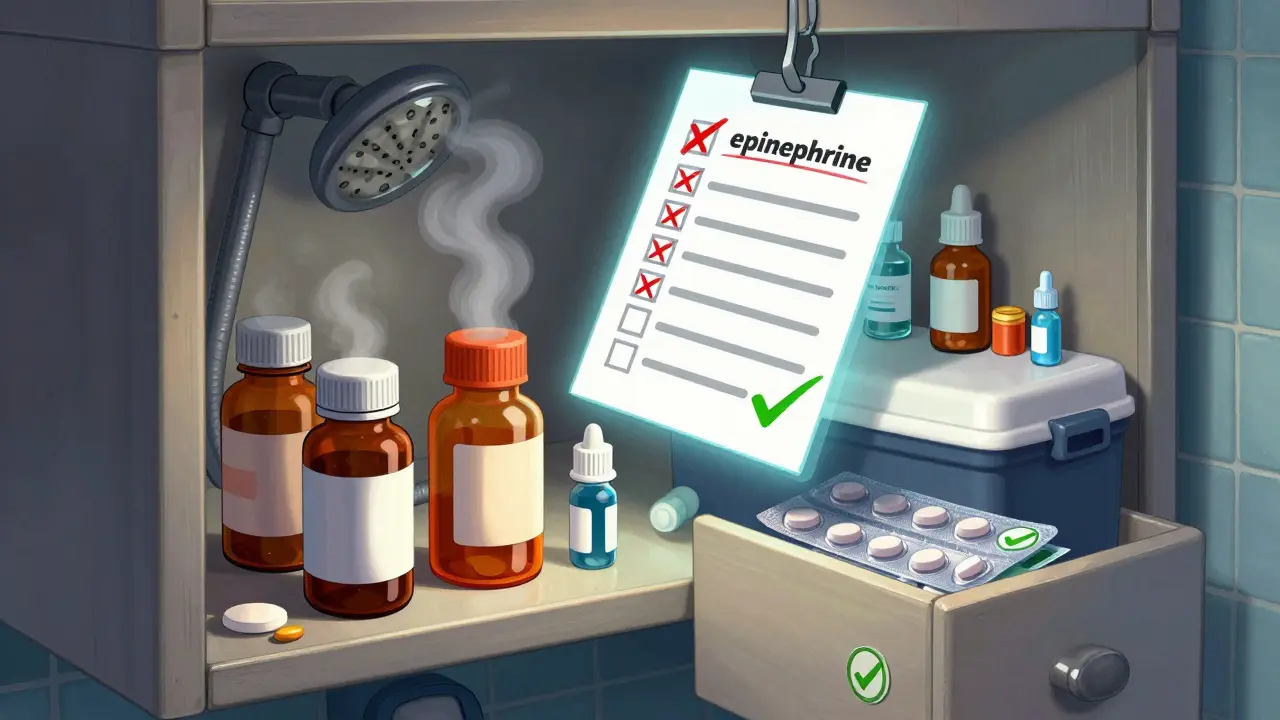
Most households keep a first-aid kit for emergencies, but how many of them actually check what’s inside? By the time you need it-during a burn, a cut, or an allergic reaction-you don’t want to find a bottle of medicine that’s been sitting there for three years. The truth is, expired OTC first-aid medications aren’t always dangerous, but they can be useless. And in some cases, using them might make things worse.
Not All Expired Medicines Are the Same
Think of your first-aid kit like a toolbox. Some tools rust over time, others just get dull. The same goes for medications. Solid pills like ibuprofen, acetaminophen, and aspirin are pretty stable. A 2019 U.S. Department of Defense study found that 80% of these drugs still worked at 90% strength even 15 years after their expiration date-if they were stored in cool, dry places, sealed in their original bottles.
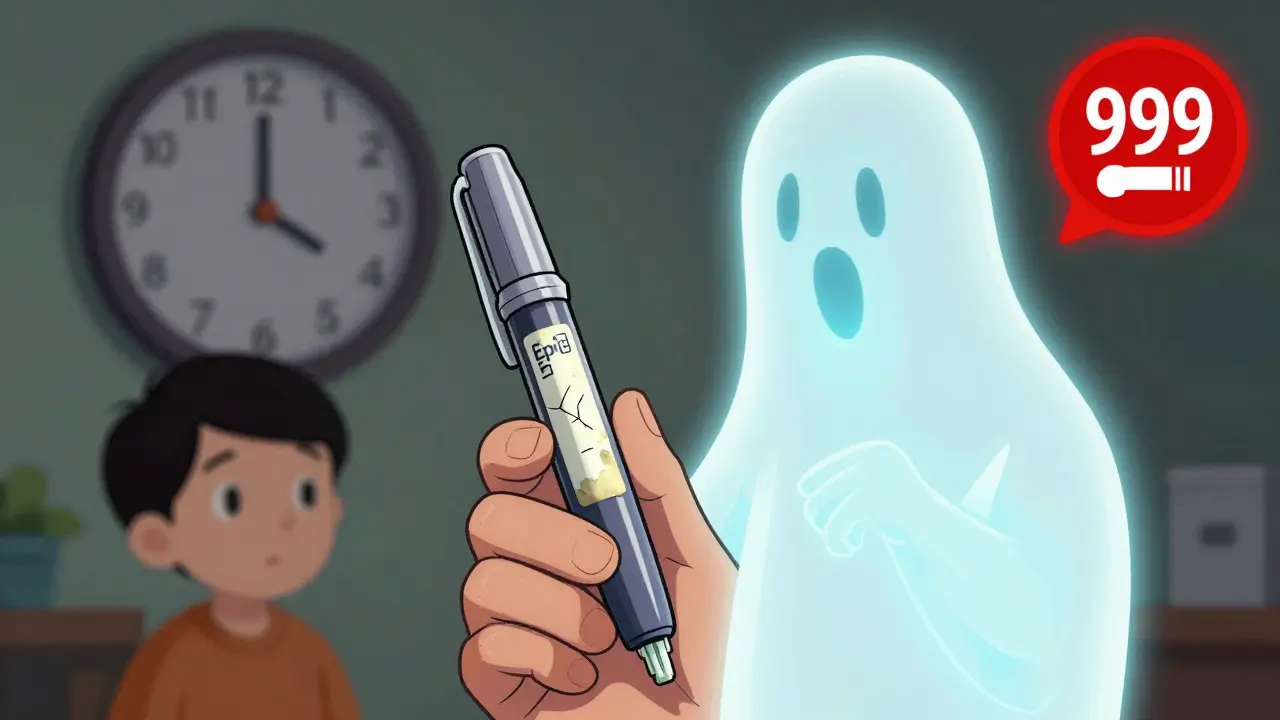
But that’s not true for everything. Liquid medicines? Not so much. Eye drops, antibiotic suspensions, and epinephrine auto-injectors (EpiPens) break down fast. Epinephrine, for example, loses 20-30% of its potency within six months of expiration. That means if you’re having a severe allergic reaction and your EpiPen is past its date, it might not work well enough to save your life. In fact, a 2022 study in the Journal of Allergy and Clinical Immunology showed that expired EpiPens often require multiple doses to get the same effect as a fresh one.
What Should You Replace Immediately?
The FDA and American Red Cross agree: some items should never be used past their expiration date. These include:
- Epinephrine auto-injectors (EpiPen, Auvi-Q)-critical for anaphylaxis
- Nitroglycerine tablets-used for chest pain
- Liquid antibiotics (like amoxicillin suspension)
- Eye and ear drops-they can grow bacteria
- Insulin-even if it’s not technically OTC, many keep it in home kits
These aren’t just suggestions-they’re life-or-death rules. A 2023 FDA lab analysis found that hydrocortisone cream, when expired, had bacterial contamination in nearly half of the samples tested. That’s not a coincidence. Liquid and topical meds are more exposed to air, moisture, and temperature swings. Once they’re past expiration, they’re not just weak-they’re risky.
What Can You Possibly Still Use?
If you’re in a pinch and only have an expired pain reliever, you’re probably okay. Solid tablets like ibuprofen or naproxen can last 1-2 years past their date without losing much strength. A 2022 study from UC San Francisco showed they retain 90-95% potency if kept in a cool, dry drawer-not a steamy bathroom.
Antihistamines like diphenhydramine (Benadryl) also hold up well. University of Florida research found they stay at 85% effectiveness for about 18 months after expiration. Even bandages and gauze have rules: adhesive strips lose 40% of their stickiness after 18 months, and sterile gauze can become contaminated after two years-even if unopened.
But here’s the catch: once you open a bottle, clock starts ticking. Hydrogen peroxide, for instance, is only good for 30 days after opening, no matter what the label says. Isopropyl alcohol (70%) lasts longer-up to two years if sealed-but if you’ve been leaving it on the counter near the sink, it’s probably already degraded.
Storage Matters More Than You Think
Where you store your first-aid kit can make or break your meds. A 2022 Johns Hopkins study found that medicines kept in bathroom cabinets (hot, humid, steamy) lost potency 40% faster than those stored in a bedroom drawer. Humidity and heat are the worst enemies of pills and liquids.
Transferring pills into a pill organizer? That cuts their shelf life by 35-50%. Original containers have moisture-absorbing packets and sealed lids. Once you move them, you’re exposing them to air. Same goes for transferring eye drops or creams into smaller containers. The manufacturer’s date? That’s your baseline. But if you’ve been storing it poorly, it might be expired already.
How to Keep Your Kit Reliable
Here’s a simple, no-nonsense system to follow:
- Check every 3 months-look for discoloration, odd smells, or clumping. If a pill looks cracked or powdery, toss it.
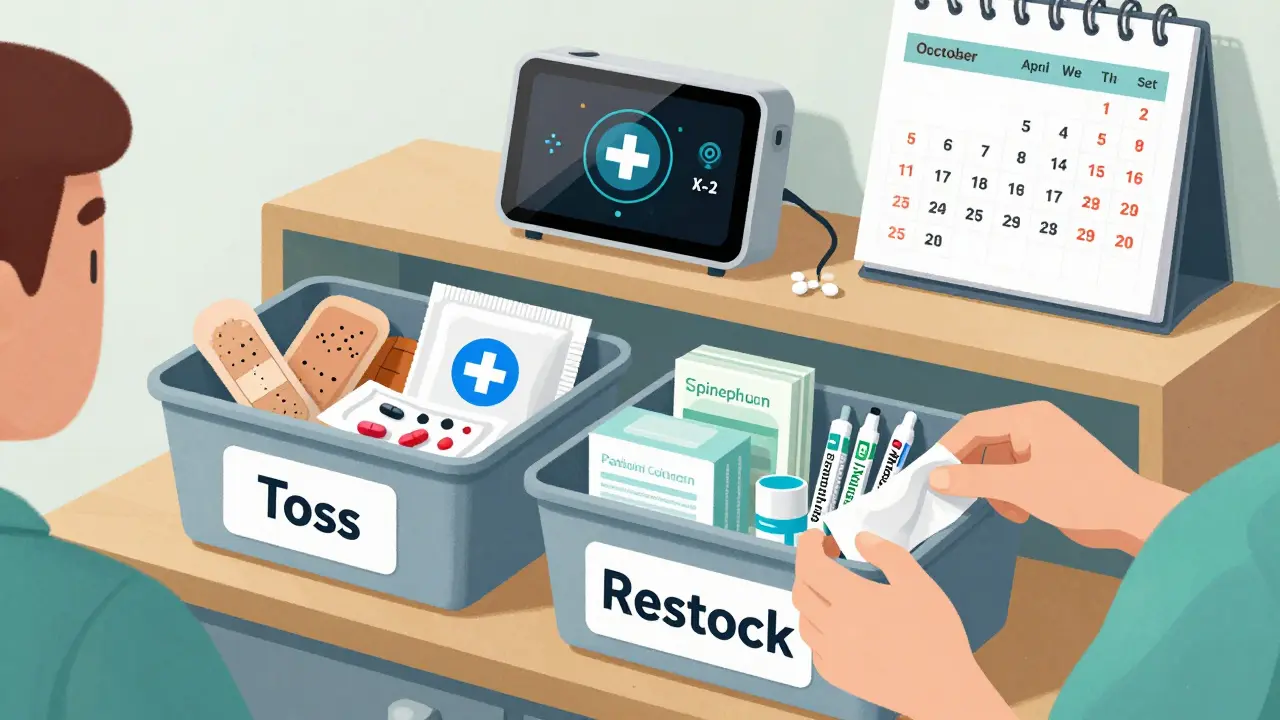
- Review expiration dates twice a year-set a reminder on your phone for April and October.
- Replace emergency meds 30 days before they expire-don’t wait until the last day. Epinephrine and nitroglycerine need fresh stock.
- Do a full kit overhaul once a year-throw out everything that’s expired, broken, or open. Buy new gauze, tape, and antiseptic wipes.
Pharmacists at the University of Michigan say pills taken out of original packaging last only 6-12 months, even if the label says three years. So if you’ve been using a pill organizer for months, you’re already on borrowed time.
What to Do If You Have to Use an Expired Medicine
Let’s say you’re camping, your EpiPen expired six months ago, and someone has a severe reaction. What now?
The Cleveland Clinic says: use it anyway. Better to give a weak dose than nothing. Administer the full dose, then call 999 or get to a hospital immediately. Same goes for an expired inhaler-use it, then get help.
But don’t use expired antibiotics. If they’re weak, they won’t kill all the bacteria. That can lead to stronger, resistant infections. And never use expired eye drops-they’re a direct path to eye infections.
The Bigger Picture: Why This Matters
A 2023 Consumer Reports survey found 71% of people think OTC meds stay effective for two or more years past expiration. That’s not true. And 44% admitted to using expired meds during emergencies. That’s risky.
Meanwhile, the FDA’s 2024 ‘Check. Toss. Restock.’ campaign is pushing for better public awareness. Smart first-aid kits now have Bluetooth reminders that ping you 60 days before expiration. Companies like First Aid Only are making kits with built-in tracking. And pharmacies are starting to offer barcode scanners that tell you how long your meds will last based on how you stored them.
It’s not about being paranoid. It’s about being ready. Your first-aid kit should be a lifeline-not a gamble.
Dispose of Expired Meds the Right Way
Don’t flush them. Don’t throw them in the trash. The DEA’s National Prescription Drug Take Back Day collected over a million pounds of expired meds in October 2023. In 22 states, pharmacies now offer free take-back bins. Check your local pharmacy or health department. If none are available, mix pills with coffee grounds or cat litter, seal them in a container, and throw them away. That makes them unappealing to kids or pets.
Can I still use expired ibuprofen or acetaminophen?
Yes, if they’re solid tablets, stored properly, and only slightly past their date. Studies show they often retain 90%+ potency for 1-2 years beyond expiration. But if they’re discolored, cracked, or smell odd, throw them out.
Why do epinephrine pens expire so soon?
Epinephrine is a liquid that breaks down quickly when exposed to light, heat, and air. Even in its sealed pen, it loses potency over time. By 6 months past expiration, it can be 20-30% weaker. In an emergency, that difference could mean the difference between stopping an allergic reaction and needing emergency care.
Is it safe to use expired antiseptic wipes?
If the wipes are dry or smell off, they’ve lost their disinfecting power. Alcohol-based wipes (70% isopropyl) last about two years unopened. Once opened, they start drying out. If they don’t feel wet, they won’t kill germs. Replace them.
What should I do if I accidentally used an expired EpiPen?
If you used an expired EpiPen during a severe allergic reaction, call 999 immediately-even if you feel better. The medication may have worked partially, but you still need medical evaluation. Always replace your EpiPen before it expires.
Can I store my first-aid kit in the car?
No. Cars get extremely hot in summer and freezing in winter. Heat and cold ruin medications. Keep your first-aid kit in a cool, dry place like a bedroom drawer or kitchen cabinet away from the sink.
How often should I replace bandages and gauze?
Adhesive bandages lose stickiness after 18 months. Sterile gauze pads can become contaminated after 24 months-even if unopened. Replace them annually as part of your full kit overhaul.
If you want your first-aid kit to actually work when you need it, treat it like a fire extinguisher: check it regularly, replace what’s old, and never assume it’s still good. Your life-or someone else’s-might depend on it.
Comments (12)
Brandon Osborne
February 10, 2026 AT 23:57Let me tell you something-people who let expired EpiPens sit in their glovebox are one bad allergy attack away from a funeral. I saw a guy die because his ‘just-in-case’ pen was ‘still good’ according to his mom. No. Just no. If it’s expired, it’s trash. Period. And don’t even get me started on people who store meds in the bathroom. That’s not a cabinet-it’s a science experiment in humidity and regret.
Marie Fontaine
February 11, 2026 AT 17:39OMG yes!! I just checked my kit last week and found a 4-year-old bottle of Benadryl 🤯 I tossed it immediately and bought new ones!! Also switched my kit to a drawer instead of the bathroom-no more steamy mornings ruining my meds! 🙌 So glad someone finally broke this down simply. You’re a lifesaver!! 💕
Ken Cooper
February 13, 2026 AT 14:26so i read this whole thing and honestly? i had no idea most of this. i thought pills just… lasted forever. like, if it didn’t look moldy, it was fine. but wow. i had a bottle of ibuprofen from 2019 in my drawer. i just threw it out. also-i’ve been using that little pill organizer for months. turns out that’s like putting your meds in a microwave? no wonder they stop working. also, hydrogen peroxide? 30 days after opening? mind blown. i’ve been using the same bottle since college. yikes.
MANI V
February 14, 2026 AT 06:31How can Americans be so careless? In my country, we are taught from childhood that expired medicine is not just ineffective-it is dangerous. You people treat your health like a garage sale. I have seen people use expired insulin, and I have seen children die because their parents thought ‘it’s just a little expired.’ This is not negligence-it is moral failure. Your first-aid kit should be treated like a weapon. And you are not worthy of carrying one.
Random Guy
February 15, 2026 AT 01:18So let me get this straight-you’re telling me my 2021 EpiPen that I’ve been carrying since my cousin’s wedding is now a fancy paperweight? And I’ve been storing it in my car? Wow. I just saved a life… by not using it. I’m basically a hero for not being an idiot. Congrats, science. You’ve made me feel guilty for the first time since 2017.
Ryan Vargas
February 16, 2026 AT 22:31Consider the epistemological implications of expiration dates: they are not merely temporal markers, but social constructs designed by pharmaceutical conglomerates to perpetuate cycles of consumer dependency. The FDA’s ‘Check. Toss. Restock.’ campaign is not a public health initiative-it is a manufactured scarcity algorithm. The 2019 DoD study proves that 80% of solid medications retain efficacy for over a decade. Why, then, do we obey arbitrary expiration dates? Because we have been conditioned to distrust our own judgment. We have surrendered autonomy to corporate packaging. The real crisis isn’t expired medicine-it’s the loss of personal sovereignty over bodily care. If you store your meds properly, you don’t need a calendar. You need courage.
Tasha Lake
February 17, 2026 AT 13:15From a pharmacokinetics standpoint, the degradation kinetics of liquid formulations like epinephrine are heavily influenced by Arrhenius reaction rates-temperature and humidity exponentially accelerate decomposition. That’s why the 2022 JACI study showed 20-30% potency loss within 6 months post-expiry. Solid dosage forms, by contrast, are crystalline matrices with low molecular mobility, hence their stability. But once you compromise the primary packaging-transfer to organizers, expose to ambient moisture-you’re introducing nucleation sites for hydrolysis and oxidation. Bottom line: original packaging + cool/dry = shelf life extension. Everything else is entropy in action.
Sam Dickison
February 18, 2026 AT 16:48Appreciate the breakdown. I’ve been keeping my kit in the kitchen cabinet for years-away from the sink, no direct sun. Never thought about the pill organizer thing though. That’s wild. I’m gonna switch back to the original bottles. Also, I just replaced my gauze and tape this month-had no idea adhesive strips lose 40% stick after 18 months. Good to know. Thanks for the practical stuff.
Brett Pouser
February 18, 2026 AT 23:01As someone who grew up in rural India, we never had expiration dates on meds. We’d use what we had. But here in the US? It’s like we’ve been brainwashed into thinking every pill has a sell-by date. I’ve used expired ibuprofen for years. Never had an issue. Maybe it’s different here. Still, I respect the science. Just wish we didn’t treat health like a corporate subscription service.
John McDonald
February 19, 2026 AT 20:15Just did my biannual kit check-tossed 3 expired things, replaced 2 bandages, and bought new antiseptic wipes. Also moved my kit from the bathroom to the bedroom drawer. Best decision ever. Feels good to be prepared. Honestly, this post saved me from a potential disaster. Thanks for the clarity!
Andrew Jackson
February 20, 2026 AT 13:57It is an affront to American ingenuity that we have become so dependent on corporate-dictated expiration dates. The Founding Fathers did not rely on pharmaceutical compliance officers to determine when a pill was still potent. The fact that the FDA even has a ‘Check. Toss. Restock.’ campaign proves how far we’ve strayed from self-reliance. We have become a nation of children, afraid to trust our own senses. If the pill looks intact, smells clean, and dissolves properly-it is still good. The real enemy is not expired medicine. It is the erosion of personal responsibility.
John Sonnenberg
February 21, 2026 AT 06:53So… if I used an expired EpiPen… and then called 999… and then survived… does that mean I’m a hero… or just lucky? Also… why is this article so long? Like… I get it. Replace your stuff. I’m not an idiot. But do I need 12 paragraphs on humidity? I’m not a lab technician. I just want to know if my bandages still stick. And the answer is… no. They don’t. I’m replacing them tomorrow. Done. Moving on.