
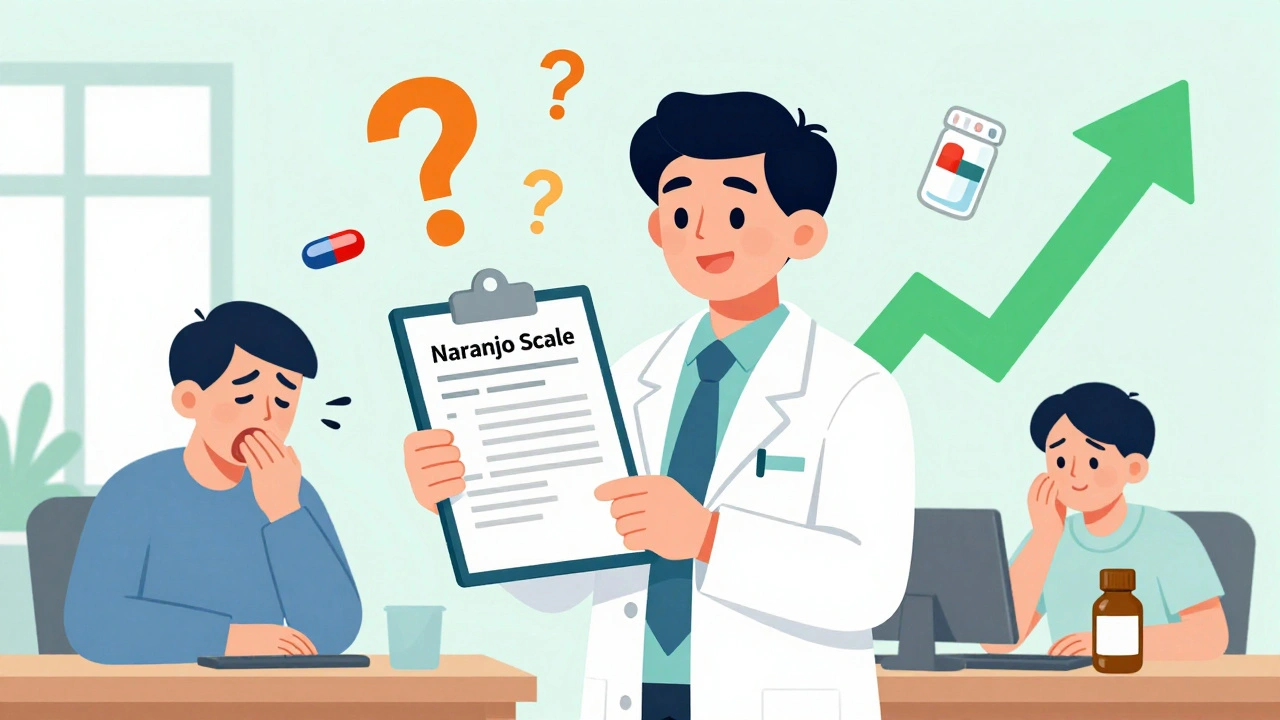
When a patient gets sick after taking a new medication, how do you know if the drug actually caused it? It’s not always obvious. Maybe the patient had a virus. Maybe their condition was worsening anyway. Or maybe it really was the medicine. That’s where the Naranjo Scale comes in. It’s not fancy. It doesn’t need a computer. But for over 40 years, it’s been the go-to tool doctors, pharmacists, and pharmacovigilance teams use to decide: Did this drug cause this reaction?
What Is the Naranjo Scale?
The Naranjo Scale is a simple questionnaire with 10 yes-or-no questions. It was created in 1981 by Dr. Carlos A. Naranjo and his team at the University of Toronto. Back then, drug safety reporting was messy. After the thalidomide disaster in the 1960s, regulators realized they needed a consistent way to tell if a side effect was really linked to a drug-or just a coincidence. The Naranjo Scale gave them that tool.Each question gives you a score: -1, 0, +1, or +2. You add them up. The total tells you how likely it is that the drug caused the reaction. There are four categories:
- Definite (9 or higher): Almost certainly the drug. The timing fits, symptoms improved when the drug was stopped, and there’s no better explanation.
- Probable (5 to 8): Very likely. The evidence is strong, but maybe you couldn’t rechallenge the patient (give the drug again) for safety reasons.
- Possible (1 to 4): Could be the drug, but other things might explain it-like an infection, another medication, or the patient’s underlying illness.
- Doubtful (0 or lower): Probably not the drug. Something else is more likely.
It’s not magic. But it forces you to think step by step. Instead of saying, “I think this is the drug,” you ask: Did the reaction happen after the drug was given? Did it get better when the drug was stopped? Are there other reasons this could have happened?
How the 10 Questions Work
Here’s how the scale breaks down in real terms:
- Were there previous reports? Has this reaction been seen with this drug before? (+1 if yes)
- Did the reaction happen after taking the drug? Timing matters. If symptoms started 2 hours after a dose, that’s a good sign. If they started 2 weeks later, maybe not. (+2 if clear, -1 if unclear)
- Did the reaction improve after stopping the drug? This is one of the strongest clues. If the rash vanished after stopping the antibiotic, that’s meaningful. (+1 if yes)
- Did it come back when the drug was restarted? Rechallenge is the gold standard-but it’s risky. If a patient had a severe allergic reaction, you won’t give the drug again. So this answer is often “don’t know.” (+2 if yes, -1 if it came back worse)
- Are there other possible causes? Could it be the patient’s diabetes? Their heart failure? Another medication? This one’s tricky. If the patient had pneumonia and got a rash, the pneumonia might be the real culprit. (-1 if yes, +2 if no)
- Did a placebo cause the same reaction? This question is outdated. Giving a fake pill to see if symptoms return? That’s unethical now. Most clinicians skip this or mark “don’t know.” (-1 if yes, +1 if no)
- Was the drug at toxic levels? Did blood tests show too much of the drug in their system? (+1 if yes)
- Did higher doses make it worse? If doubling the dose made the nausea worse, that’s a clue. (+1 if yes)
- Has this happened before with the same drug? Did the patient have this same reaction last time they took it? (+1 if yes)
- Is there objective evidence? Lab tests, biopsies, or imaging that confirm the reaction? Like elevated liver enzymes for drug-induced hepatitis. (+1 if yes)
Some questions are easy. Others? Not so much. Question 5-alternative causes-is where most mistakes happen. One pharmacist might say, “The patient’s high blood pressure explains the headache.” Another says, “Headaches are a known side effect of this beta-blocker.” That’s why training matters.
Why It’s Still Used Today
You’d think in 2025, with AI and machine learning, a 40-year-old paper form would be obsolete. But it’s not. In fact, it’s more common than ever.
According to a 2022 study, the Naranjo Scale was used in 78% of published adverse drug reaction case reports. That’s more than any other tool. Why? Because it’s simple, transparent, and validated. You don’t need expensive software. A nurse in a rural clinic can use it. A pharmacist in a hospital can fill it out in 10 minutes.
Regulators require it. The FDA’s Adverse Event Reporting System (FAERS) and the European Medicines Agency’s Good Pharmacovigilance Practices (GVP) both list Naranjo as an acceptable method. Pharmaceutical companies use it when reporting side effects. Hospitals use it for internal safety reviews.
Even better, digital tools are making it faster. A 2023 study showed that using a simple Python app to calculate the score cut assessment time from 11 minutes to 4 minutes. Error rates dropped from 28% to 9%. That’s huge in a busy ward.
Where It Falls Short
It’s not perfect. And it never claimed to be.
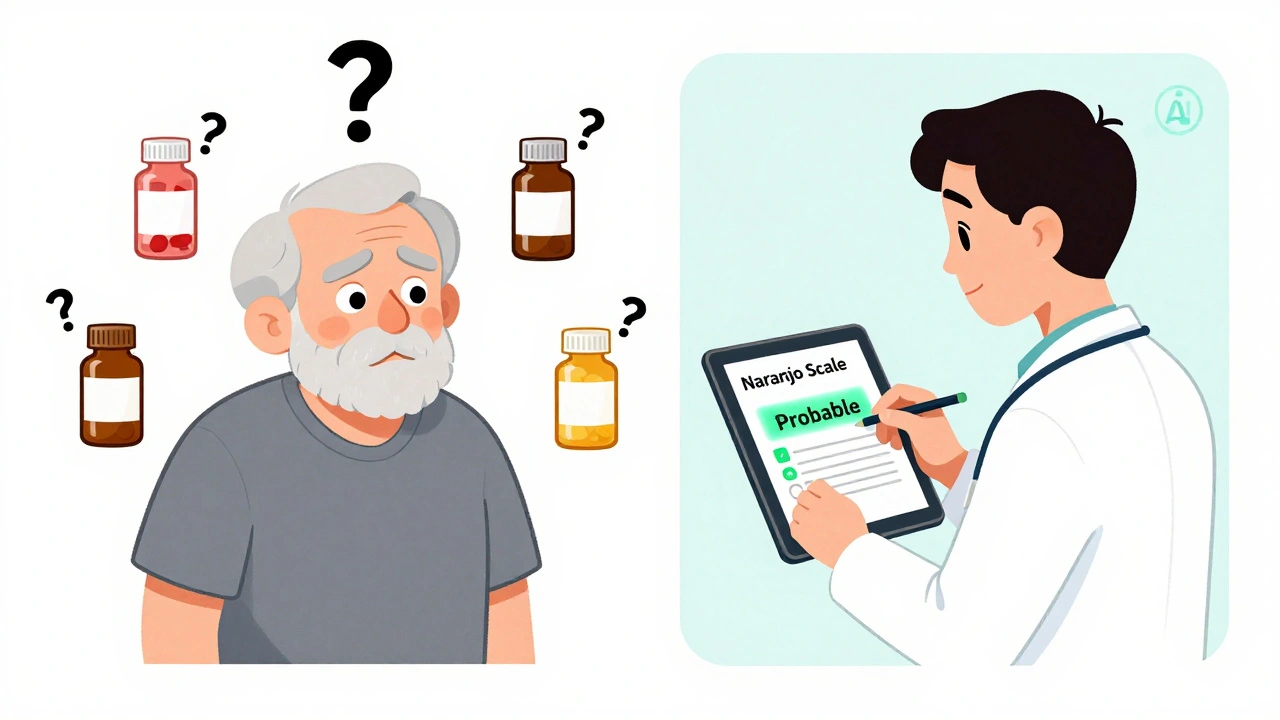
The biggest problem? Polypharmacy. Most older patients take five, six, or seven drugs. The Naranjo Scale was designed for one drug at a time. If a 72-year-old with heart disease, diabetes, and arthritis gets dizzy after starting a new blood pressure pill-but is also on a new statin and a new painkiller-there’s no way to tell which one caused it. The scale can’t handle that.
That’s why tools like the Liverpool ADR Probability Scale were developed. It’s designed for multiple drugs. But it’s not as widely used. The Naranjo Scale is still the default.
Another issue? Modern drugs. The scale was built for antibiotics, statins, and blood pressure pills. But what about immunotherapy? Or gene therapies? These drugs can cause side effects months after stopping. The Naranjo Scale’s logic-“did it get better when you stopped?”-doesn’t fit. A reaction that shows up 6 months later? The scale might call it “doubtful.” But it’s not.
And then there’s Question 6: the placebo challenge. It’s a relic. No ethical doctor would give a patient a fake pill to see if they get sick again. Most people just mark “don’t know,” which lowers the score and makes the reaction seem less likely than it might be.
What’s Used Instead?
There are other tools, but none have replaced Naranjo.
- WHO-UMC Scale: Simpler. Just says “probable,” “possible,” or “unlikely.” No numbers. Less precise. Used more in developing countries.
- ALDEN: A scoring system for antibiotics only. More accurate for those drugs, but not general-purpose.
- PADRAT: Designed for kids. Naranjo doesn’t account for how children process drugs differently.
Still, in academic papers, hospital reports, and regulatory filings, Naranjo is the standard. It’s the baseline everyone compares to.
How to Use It Right
If you’re using the Naranjo Scale, here’s what you need to know:
- Don’t guess. If you’re not sure about a question, write “don’t know.” Don’t pick the answer that makes the score higher.
- Check the chart. Look at lab results, medication logs, and symptom timelines. Don’t rely on memory.
- Use a template. Many hospitals have printable forms or digital versions built into their EHR systems. Use them.
- Get trained. It sounds simple, but 35% of clinicians disagree on how to score Question 5. A 2-hour training session cuts errors in half.
- Know when to stop. If the patient had a severe reaction-like anaphylaxis or liver failure-don’t try to rechallenge. Mark “not done” and move on.
One pharmacist in Boston told me: “We use it not because it’s perfect, but because it stops us from being lazy. It makes us ask the hard questions we’d otherwise skip.”
What’s Next for the Naranjo Scale?
The scale isn’t going away. But it’s changing.
In 2024, the International Council for Harmonisation (ICH) proposed replacing Question 6 with a question about therapeutic drug monitoring. That’s a big step. It’s adapting to modern ethics.
AI is also stepping in. The FDA’s Sentinel Initiative uses machine learning to predict drug reactions by analyzing millions of electronic health records. It doesn’t use Naranjo-but it uses the same principles: timing, dose, history, and exclusion of other causes.
Experts agree: Naranjo won’t be replaced. But it will be augmented. Digital tools will auto-fill the easy questions. AI will flag cases that need human review. And clinicians will still use the scale to document their reasoning.
For now, it’s the most trusted tool we have. Not because it’s perfect. But because it’s clear, consistent, and forces us to think before we blame a drug.
Real-World Example
Imagine a 68-year-old woman starts taking lisinopril for high blood pressure. Three days later, she develops a dry cough. She’s not sick. No cold. No allergies.
She fills out the Naranjo Scale:
- Previous reports? Yes. Cough is a known side effect. (+1)
- Timing? Cough started 3 days after starting the drug. Clear. (+2)
- Improved after stopping? Yes. Cough gone 2 days after stopping lisinopril. (+1)
- Rechallenge? Not done. Too risky to restart. (0)
- Alternative causes? No other meds changed. No lung infection. (+2)
- Placebo challenge? Not ethical. (0)
- Toxic levels? Not tested. (0)
- Dose-response? She took the standard dose. No change. (0)
- Previous similar reaction? No. (0)
- Objective evidence? No lung scan needed. Clinical diagnosis is enough. (+1)
Total score: 7.
Result: Probable adverse drug reaction.
That’s it. No fancy tech. No guesswork. Just a checklist that turns a hunch into evidence.
Is the Naranjo Scale used in the UK?
Yes. The Naranjo Scale is widely used across NHS hospitals, especially in pharmacovigilance departments and academic medical centers. It’s referenced in UK pharmacovigilance guidelines and is the default tool for reporting suspected adverse drug reactions to the Medicines and Healthcare products Regulatory Agency (MHRA).
Can I use the Naranjo Scale for my own symptoms?
You can try, but it’s not meant for self-diagnosis. The scale requires access to medical records, lab results, and knowledge of drug mechanisms. If you suspect a side effect, talk to your doctor or pharmacist. They can use the scale properly and report it if needed.
Why is rechallenge rarely done?
Rechallenge means giving the drug again to see if the reaction returns. It’s risky. If the reaction was severe-like anaphylaxis, liver failure, or a dangerous skin rash-it’s unethical and potentially life-threatening to repeat it. Most clinicians mark “not done” or “don’t know” for safety.
Does the Naranjo Scale work for children?
Not well. The original scale doesn’t account for how kids metabolize drugs differently, or how side effects present in children. A newer tool called PADRAT (Paediatric Adverse Drug Reaction Assessment Tool) was created in 2015 specifically for children and is more accurate in that population.
Can AI replace the Naranjo Scale?
Not yet. AI can analyze huge datasets and flag potential reactions faster, but it can’t replace clinical judgment. The Naranjo Scale gives structure to human reasoning. AI might help fill it out or suggest scores, but doctors still need to interpret the context-like a patient’s history, other meds, or underlying conditions.
How long does it take to learn the Naranjo Scale?
Most people get the basics in 1-2 hours. But becoming confident takes practice. Studies show it takes 5-10 supervised assessments to use it accurately. After 20-30 cases, most clinicians can complete it in under 5 minutes without help.
What if two doctors give different scores?
That’s normal. Inter-rater reliability is moderate-around 0.5. Disagreements usually happen on Question 5 (alternative causes) or Question 6 (placebo). If scores differ by more than 3 points, it’s best to discuss the case with a pharmacist or clinical toxicologist. The goal isn’t perfect agreement-it’s consistent reasoning.
Comments (9)
nina nakamura
December 13, 2025 AT 00:29This scale is a joke. Question 6 is literally unethical and outdated. If you're still using it like it's 1985 you're part of the problem. I've seen patients get misclassified as 'possible' when it was clearly the drug. Lazy medicine.
sharon soila
December 14, 2025 AT 15:33I appreciate how this breaks down something complex into simple steps. In my clinic, we use this to teach residents how to think, not just react. It’s not perfect, but it stops us from jumping to conclusions. Thank you for the clarity.
Sheldon Bird
December 14, 2025 AT 17:47Love this. 🙌 Seriously, in a world of AI overkill, it's refreshing to see a tool that works with pen and paper. I used it last week on a patient with a rash after starting metformin. Scored 6 - probable. We stopped it. Rash gone in 48 hours. No fancy tech needed. Just good thinking.
Willie Onst
December 15, 2025 AT 23:11Honestly, this is the kind of thing that makes me proud to be in healthcare. No corporate software, no $$$ AI model - just a thoughtful checklist that lets a nurse in rural Ohio make the same call as a specialist in Boston. Simple doesn’t mean stupid. It means human.
Jennifer Taylor
December 16, 2025 AT 08:49Wait… so you’re telling me the FDA and WHO are still using a 40-year-old paper form? And you’re not worried? What if Big Pharma is manipulating the scoring? What if Question 5 is rigged to protect drug companies? I’ve seen reports where ‘alternative causes’ were ignored because the drug was ‘too profitable.’ This isn’t science - it’s a cover-up. 🕵️♀️
Shelby Ume
December 16, 2025 AT 17:32One thing I’d add: training matters more than the tool itself. I’ve seen teams score the same case and get results from 'doubtful' to 'definite' because they didn’t review the med list properly. The scale is only as good as the person using it. Always cross-check with the pharmacy log. Always. Don’t trust memory.
Jade Hovet
December 16, 2025 AT 23:17OMG YES THIS!! 😍 I use this every day at my hospital and honestly? It’s saved my butt more than once. I used to guess, then I started using the template. Now I’m the one training new pharmacists. Also, typo on Q6? I wrote ‘placebo’ as ‘placobo’ once and my boss laughed but it still worked lol 💪
nithin Kuntumadugu
December 18, 2025 AT 23:12LMAO naranjo scale? bro its 2025 and you still use paper forms? this is why us in india have better systems. we use ai to cross check 1000s of cases in seconds. this scale is like using a typewriter to file taxes. and question 6? lol who even does placebo challenge anymore? this is why pharma gets away with murder. #pharmabrainwash
John Fred
December 20, 2025 AT 11:56The Naranjo Scale is the gold standard for causality assessment because it operationalizes clinical reasoning. In polypharmacy cases, it’s not the tool’s fault - it’s the clinical context. We augment it with pharmacokinetic modeling and EHR mining, but the human judgment anchor remains irreplaceable. That’s why it endures.