
Imagine you are a hospital administrator staring at a budget that needs to stretch further. You have two options for treating a common condition: the original brand-name drug and a generic version. The generic is significantly cheaper, but does it deliver the same health outcome? This is where cost-effectiveness analysis (CEA) steps in. It is not just about counting pennies; it is about measuring the value of every dollar spent on healthcare by comparing costs against tangible health benefits. For generic pharmaceuticals, CEA helps decide if substituting branded drugs with generics-or choosing between different generic alternatives-provides the best value for insurers, patients, and the healthcare system.
The concept gained real traction after the 1984 Hatch-Waxman Act in the United States. This legislation created the abbreviated new drug application (ANDA) pathway, making it easier and faster to approve generic drugs. Since then, generics have become the backbone of prescription medicine. In 2022, they accounted for 90% of all prescriptions dispensed in the U.S., yet they represented only 17% of total prescription drug expenditure. That gap highlights why understanding their economic value is critical.
What Is Cost-Effectiveness Analysis for Generics?
Cost-effectiveness analysis is a systematic method in health economics that compares the relative costs and outcomes of two or more courses of action. When applied to generic drugs, CEA evaluates whether switching from a branded medication to a generic, or from one generic to another, yields better health outcomes per dollar spent. The core metric here is the incremental cost-effectiveness ratio (ICER). An ICER measures the additional cost required to achieve one additional unit of health benefit, typically measured in quality-adjusted life years (QALYs).
To calculate this accurately, analysts need precise cost data. Different pricing metrics are used depending on the context. For example, the Veterans Affairs (VA) system uses specific adjustments: brand-name drugs might be priced at 152% of VA pricing, while generic drugs are often valued at 27% of the Average Wholesale Price (AWP). These specific values matter because they directly influence the final ICER calculation. If the cost input is wrong, the entire value proposition falls apart.
The Price Drop: Why Generics Are Economically Powerful
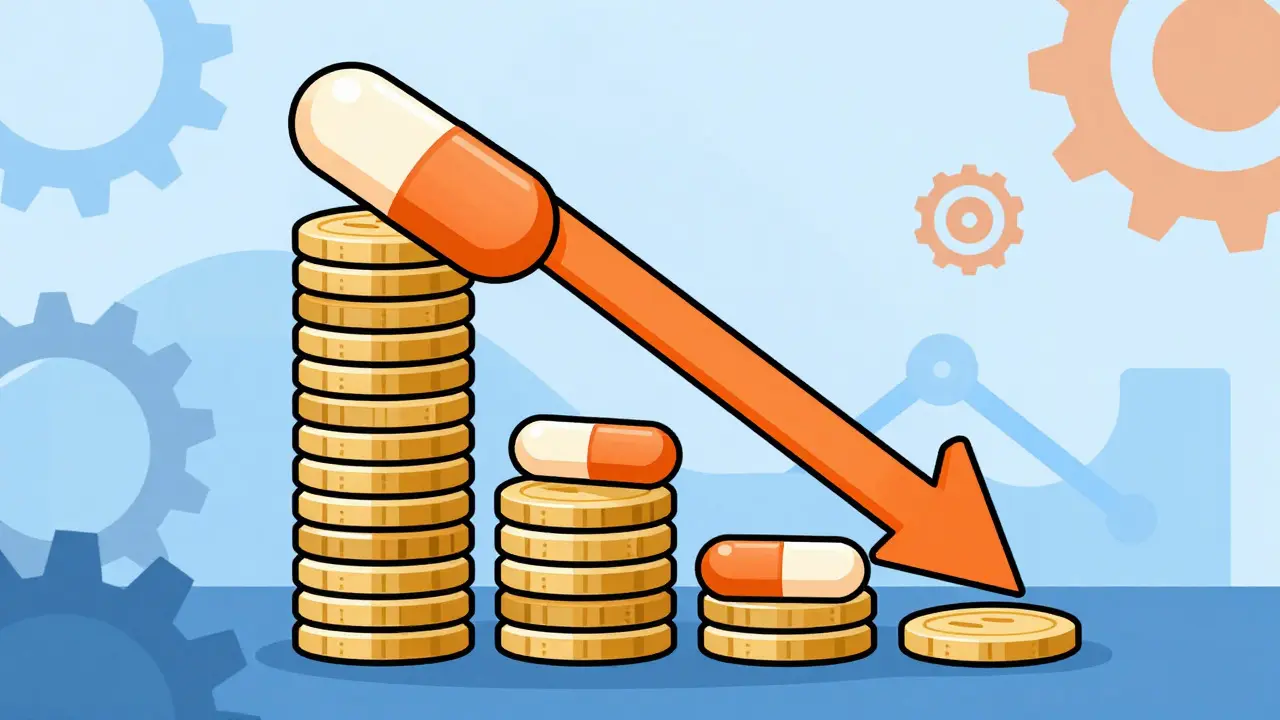
The primary driver of generic value is price reduction. According to FDA analyses, the entry of the first generic competitor triggers an average price drop of 39% compared to the brand-name drug. But the savings accelerate as competition increases. When six or more generic competitors enter the market, prices can fall more than 95% below the original brand price. A 2021 NIH publication noted that pharmaceuticals with two generic competitors show average prices 54% lower than pre-entry brand prices, rising to 79% lower with four competitors.
This competitive pressure has had a massive impact on national spending. The FDA estimates that generic drugs saved the U.S. healthcare system approximately $1.7 trillion over the decade ending in 2017, with annual savings exceeding $250 billion. However, price isn't the only factor. Clinical equivalence is essential. A generic must be therapeutically equivalent to the brand-name drug to be considered a valid substitute in most CEA models. This means similar safety profiles, dosages, strengths, routes of administration, and indications.
Beyond Basic Substitution: Therapeutic Alternatives
While swapping a brand for its direct generic is straightforward, there is a more complex layer: therapeutic substitution. This involves replacing a high-cost generic with a lower-cost drug from the same therapeutic class that offers equivalent clinical value. A 2022 study published in JAMA Network Open analyzed the top 1,000 CO-APCD generics and found 45 high-cost products that had lower-cost therapeutic alternatives. The median price of these high-cost generics was 15.6 times higher than their alternatives. By substituting them, total spending could have been reduced from $7.5 million to just $873,711-a savings of nearly 90%.
The price differential varies based on how similar the alternatives are. The study found that generics substituted by different drugs in the same therapeutic class had 20.6 times higher prices than their alternatives. In contrast, identical drugs from different manufacturers showed the smallest difference, with mean prices only 1.4 times higher. This suggests that the more distinct the formulation or manufacturer, the greater the potential for savings through strategic formulary design.
| Scenario | Average Price Reduction vs. Brand | Key Driver |
|---|---|---|
| First generic entry | 39% | Initial market competition |
| Two generic competitors | 54% | Increased supplier choice |
| Four generic competitors | 79% | Intense price competition |
| Six or more competitors | >95% | Saturated market |
Methodological Challenges and Pitfalls
Conducting a robust CEA for generics is not without its hurdles. One major issue is the failure to account for future price changes. A report from the ISPOR 2021 conference revealed that 94% of published cost-effectiveness analyses failed to incorporate assumptions about future generic prices for intervention drugs. This is a significant blind spot because patent expiration timelines dramatically affect long-term costs. If an analyst assumes a drug will remain expensive for ten years, but it goes generic in three, the ICER will be misleadingly high, potentially leading to poor coverage decisions.
Another challenge comes from market distortions created by Pharmacy Benefit Managers (PBMs). PBMs often use "spread pricing," profiting from the difference between what they negotiate with pharmacies and what insurers pay. This can keep higher-priced generics on formularies even when lower-cost alternatives exist. Additionally, industry-funded studies sometimes report more favorable results than independent ones, introducing bias into the data. To mitigate this, experts like Dr. Steven Garber argue that conventional CEA should include long-run marginal costs, including R&D expenses, rather than just manufacturing costs, to provide a fuller picture of value.
Practical Implementation Steps
If you are tasked with evaluating generic options, here is a practical framework to follow:
- Define the Comparator: Identify the current standard of care. Is it the brand-name drug or an existing generic? Ensure the comparator is clinically appropriate.
- Gather Accurate Cost Data: Use reliable pricing sources like Federal Supply Schedule (FSS), VA pricing, or AWP. Apply the correct adjustment factors for brand vs. generic status.
- Estimate Health Outcomes: Determine the expected QALYs or other health metrics for both options. For generics, this is often assumed to be equal to the brand unless bioequivalence data suggests otherwise.
- Calculate the ICER: Divide the difference in costs by the difference in outcomes. If outcomes are identical, the ICER simplifies to the cost difference divided by zero (or effectively, any cost saving is infinitely valuable in terms of efficiency).
- Model Future Scenarios: Incorporate patent expiration dates and expected generic entry timelines. Sensitivity analysis should test how changes in future pricing affect the result.
- Consider Therapeutic Substitutions: Look beyond direct generics. Are there lower-cost drugs in the same class that offer similar efficacy? Include these in a multi-comparator analysis.
The Future of Generic Valuation
As more small-molecule drugs lose patent protection-with over 300 expiring between 2020 and 2025-the ability to model generic pricing dynamics becomes increasingly critical. Recent frameworks from the NIH emphasize that pharmaceutical pricing is "endogenous" to the health technology assessment process. Manufacturers set prices such that the ICER stays just below the decision threshold. As generic competition reshapes these landscapes, CEA methodologies will need to evolve to handle multi-comparator indications with evolving evidence. The goal remains the same: ensuring that every healthcare dollar buys the maximum possible health benefit.
What is the main difference between cost-minimization and cost-effectiveness analysis?
Cost-minimization assumes that the health outcomes of two treatments are identical and focuses solely on finding the least expensive option. Cost-effectiveness analysis, however, accounts for differences in health outcomes, measuring the cost per unit of health gain (like a QALY). For generics, if bioequivalence is established, cost-minimization is often sufficient, but CEA is preferred when comparing across different therapeutic classes.
How much do generic drugs save the healthcare system annually?
According to FDA estimates, generic drugs saved the U.S. healthcare system more than $250 billion annually in recent years. Over the decade ending in 2017, total savings reached approximately $1.7 trillion.
Why do some generic drugs cost more than others?
Price variations among generics stem from several factors, including the number of competitors, manufacturing costs, marketing strategies, and PBM spread pricing. High-cost generics may persist on formularies due to lack of awareness of lower-cost therapeutic alternatives or contractual arrangements with PBMs.
What role does the Hatch-Waxman Act play in generic drug economics?
The 1984 Hatch-Waxman Act created the ANDA pathway, allowing generic manufacturers to prove bioequivalence rather than repeating full clinical trials. This reduced development time and costs, accelerating market entry and driving down prices through increased competition.
How should analysts handle patent expiration in CEA?
Analysts must model the timeline of patent expiration and expected generic entry. Failing to account for future price drops biases the analysis against the intervention. Sensitivity analyses should test various scenarios for post-patent pricing to ensure the ICER remains robust under different market conditions.