
Side Effect Reporting Calculator
How Many Side Effects Go Unreported?
Based on the article, only 1% to 10% of actual side effects get reported. This calculator estimates how many cases might go unreported based on the number of users taking a medication.
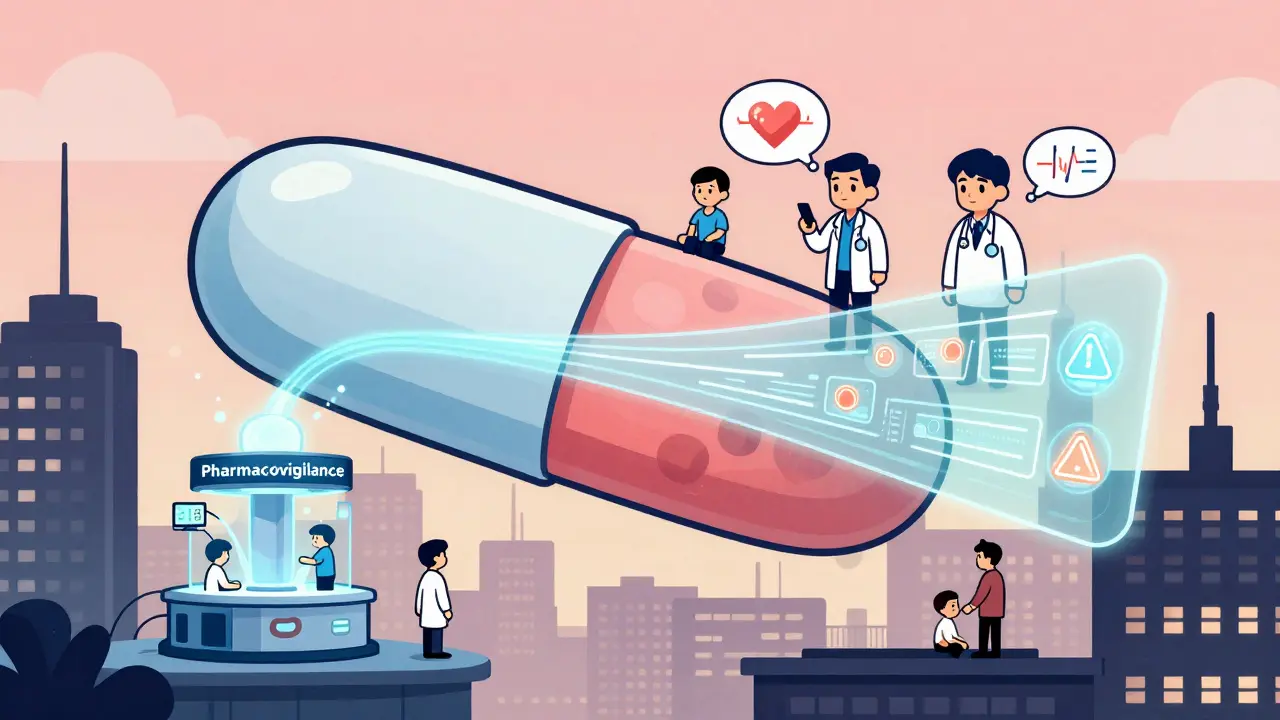
When a new drug hits the market, everyone assumes it’s safe - after all, it passed clinical trials. But here’s the truth: post-marketing pharmacovigilance is where the real safety story begins. Clinical trials involve a few thousand people over months or a couple of years. Real life? Millions of people take the drug for years, with different health conditions, other medications, genetics, and lifestyles. That’s when hidden side effects show up - and that’s why pharmacovigilance isn’t optional. It’s essential.
Why Clinical Trials Miss the Real Risks
Clinical trials are tightly controlled. Participants are carefully selected: no major liver disease, no pregnancy, no other drugs that might interfere. They’re monitored closely. But in the real world? A 72-year-old with kidney problems takes the same pill as a 28-year-old on birth control. One might have a rare reaction the trial never saw. Take Vioxx, for example. Approved in 1999 after testing on 5,000 people, it seemed fine. But once over 80 million people used it, the data screamed: heart attack risk doubled. Merck pulled it in 2004. That delay cost lives. The problem wasn’t bad science - it was limited scope. Trials can’t capture every possible interaction, every genetic quirk, every long-term effect.How Side Effects Are Caught After Approval
Post-marketing pharmacovigilance uses five main tools to catch these hidden dangers:- Spontaneous Reporting Systems - Doctors, pharmacists, and patients report unusual reactions. The UK’s Yellow Card Scheme has been running since 1964. In 2022 alone, it got 87,000 reports. The FDA’s MedWatch got 1.2 million. But here’s the catch: experts estimate only 1% to 10% of actual side effects get reported.
- Electronic Health Records (EHR) Mining - Systems like the FDA’s Sentinel Initiative scan data from over 300 million patient records. It doesn’t wait for reports - it digs through prescriptions, lab results, and hospital visits to find patterns. If a drug shows up more often in patients who later had liver failure, that’s a red flag.
- Prescription Event Monitoring (PEM) - Used heavily in the UK and EU, this tracks every prescription for a new drug. Researchers follow up with patients to see what happens. No waiting for complaints - they proactively check in.
- Patient Registries - These follow specific groups over time. For example, patients with rheumatoid arthritis on a new biologic might be tracked for five years to watch for infections or cancer.
- Record Linkage - Health databases are connected. In the UK, the Clinical Practice Research Datalink links prescriptions, hospital stays, and death records. If a drug is linked to higher-than-expected heart failure deaths, regulators get alerted.
Who’s Watching - And How It Varies by Country
Different countries run their systems differently. The U.S. leans on passive reporting (MedWatch) but also uses active surveillance (Sentinel). The EU has EudraVigilance, which collected 28.5 million reports from 108 countries by 2022. Japan requires mandatory re-examination for 4 to 10 years after approval. The UK’s Yellow Card Scheme is the oldest in the world - and still one of the most trusted. But gaps exist. In the U.S., doctors say reporting takes 22 minutes on average - too long for busy clinics. A 2022 survey found 68% found the system cumbersome. In the EU, while rules are standardized, implementation varies. Some countries have strong systems; others lag. And in low-income countries? Only 38 national pharmacovigilance centers serve 54 African nations. Reporting rates there? Just 0.2 reports per 100,000 people. In the EU? 182.7.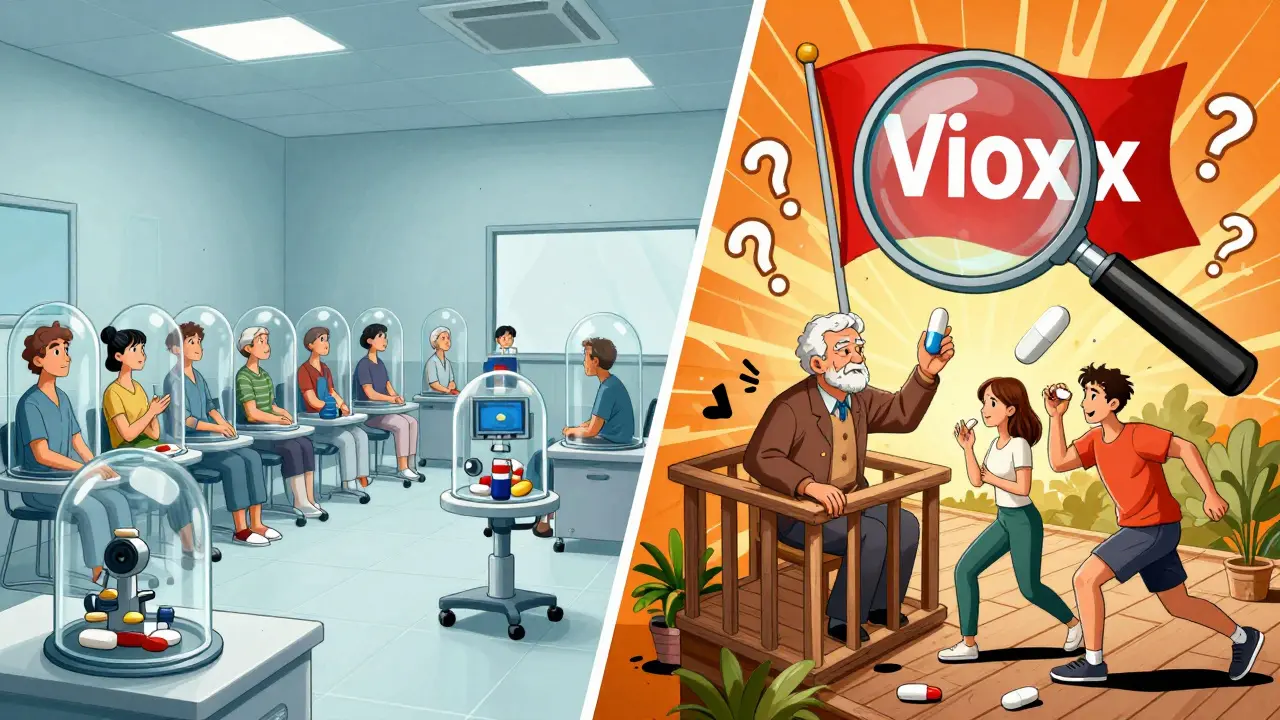
The Real-World Success Stories
It’s not all about catching dangers. Sometimes, pharmacovigilance saves lives in smarter ways. Take carbamazepine, an epilepsy drug. In Southeast Asia, some people with a specific gene - HLA-B*15:02 - had a deadly skin reaction called Stevens-Johnson syndrome. Pharmacovigilance data showed the pattern. Doctors started screening for the gene before prescribing. Result? A 95% drop in cases. That’s not just safety - that’s precision medicine born from real-world data. Another win: thalidomide. After the 1960s tragedy, it was banned. But later, researchers found it helped with leprosy and multiple myeloma. So it came back - but with strict rules. Only pharmacies that train staff can dispense it. Patients must sign forms. Men must use contraception. This is called a Risk Management Plan (RMP). Over 90% of new drugs approved since 2015 now have one.What’s Changing - And Fast
The system is evolving. In 2023, the FDA launched Sentinel 3.0 - an AI-powered system that scans 5 million new records daily. It reads doctor’s notes, lab results, and even discharge summaries. It finds signals 73% faster than before. The EU is building a single database to replace 27 national systems by 2025. IBM Watson Health is testing AI that scans Reddit, Twitter, and patient forums to predict side effects before regulators even get a report. Apple and Pfizer are testing wearables that track irregular heart rhythms in patients on new heart drugs. And the numbers are climbing. The global pharmacovigilance market is now $3.2 billion and growing at nearly 9% a year. Big pharma has teams of 50+ people. Small biotechs? Often just three. That’s a problem. If a small company misses a signal, it’s not just their drug at risk - it’s public trust.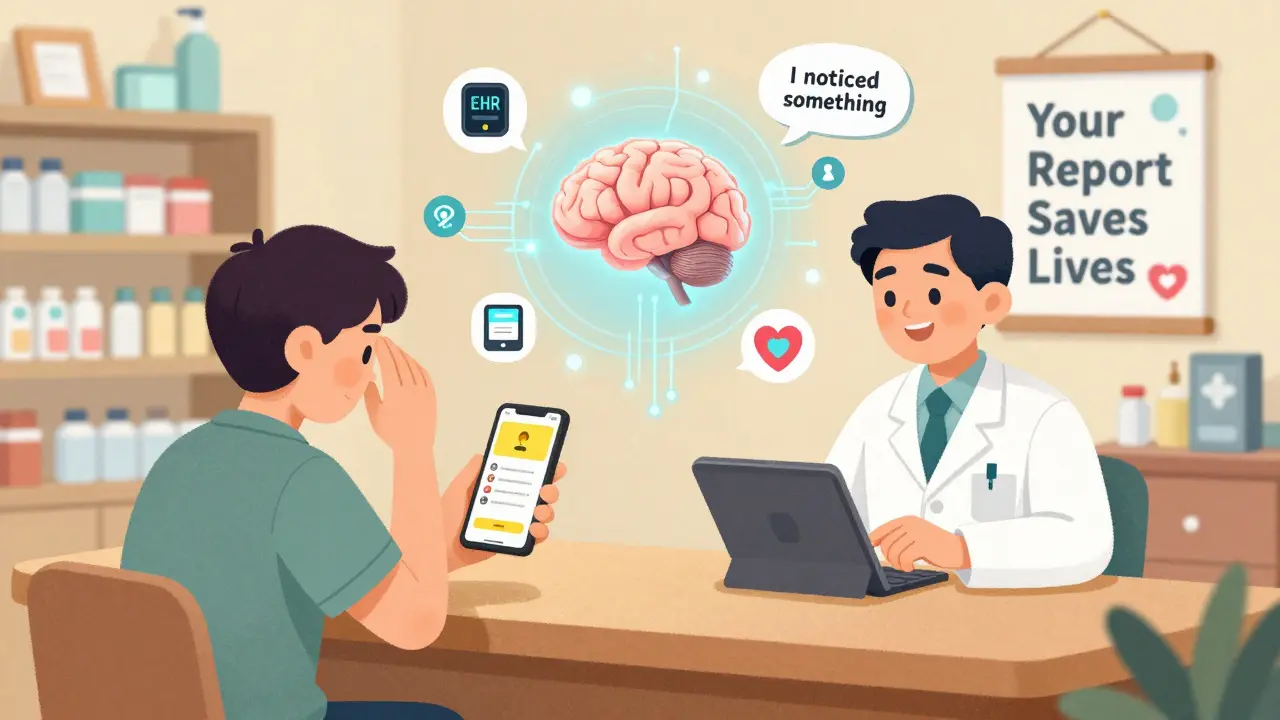
What Patients and Providers Need to Know
You don’t need to be a scientist to help. If you notice something unusual - a rash after starting a new pill, dizziness that didn’t happen before, or a weird change in mood - report it. In the U.S., MedWatch is online. In the UK, the Yellow Card app lets you report in under five minutes. But awareness is low. Only 12% of patients know about reporting systems. Yet 83% say they’d report if it was easier. That’s the gap. Simplify the process. Educate patients. Train nurses to ask: “Has anything changed since you started this new medicine?” Doctors and pharmacists? You’re the frontline. A 2023 UK study found 61% of pharmacists weren’t sure what counted as reportable. That’s not ignorance - it’s unclear guidance. Clearer rules, better tools, and less paperwork could turn every pharmacy into a safety sensor.The Bottom Line
Drugs aren’t safe just because they got approved. They become safer because people - doctors, patients, data systems - keep watching. Post-marketing pharmacovigilance isn’t bureaucracy. It’s the quiet, relentless system that catches what trials miss. It’s how we find out that a drug causes sudden liver failure in one in 50,000 people. It’s how we learn that a genetic marker makes a drug deadly for some. It’s how we turn a mistake into a safeguard. The next time you hear about a drug being pulled from the market, don’t think, “Why wasn’t this caught earlier?” Think: “This system worked - because someone reported it.”What’s the difference between pre-market and post-marketing pharmacovigilance?
Pre-market pharmacovigilance happens during clinical trials - testing on a few thousand people under strict conditions. Post-marketing pharmacovigilance kicks in after the drug is sold to the public. It monitors millions of real-world users, catching rare, long-term, or interaction-based side effects that trials simply can’t detect.
How long after approval do side effects usually appear?
Some show up within months. Others take years. The FDA found that 31% of serious safety issues for drugs approved between 2001 and 2010 didn’t emerge until more than five years after approval. That’s why ongoing monitoring isn’t optional - it’s a long-term responsibility.
Can patients report side effects themselves?
Yes. In the U.S., patients can report directly to the FDA’s MedWatch system online. In the UK, anyone can use the Yellow Card app or website. These reports are vital. Studies show patient reports often catch different issues than healthcare professional reports - like fatigue, mood changes, or sleep problems that doctors might overlook.
Why do so few side effects get reported?
Time, complexity, and confusion. Doctors are busy - filling out a 22-minute report isn’t a priority. Many aren’t sure what counts as reportable. Patients don’t know reporting exists. And in some countries, there’s no easy way to report at all. That’s why tools like mobile apps and automated EHR alerts are changing the game.
Are new drugs safer now because of better pharmacovigilance?
Yes - but not because drugs are safer to begin with. They’re safer because we catch problems faster. Systems like the FDA’s Sentinel and the EU’s EudraVigilance now use AI to find signals in seconds instead of months. Real-world data from millions of patients helps regulators act before harm spreads. The result? Fewer late-stage withdrawals and more targeted safety measures.
Comments (11)
Kendrick Heyward
March 17, 2026 AT 05:30This is why I hate how pharma companies act like they're heroes. They get billions in profits, then act shocked when something goes wrong. 😒 People die because they rushed approval for stock prices. I reported a side effect last year and got a form letter. Thanks, FDA. 🤬
Ryan Voeltner
March 17, 2026 AT 17:38The core insight here is correct. Clinical trials are necessary but insufficient. Real-world data reveals what controlled environments obscure. The evolution from passive reporting to active surveillance using EHRs and AI represents a paradigm shift. This is not bureaucracy. It is adaptive science.
Lauren Volpi
March 19, 2026 AT 14:17So let me get this straight. We let Big Pharma sell drugs to millions, then act surprised when people get sick? Meanwhile, the FDA is still using 1990s software. And we wonder why people don't trust medicine. 🤦♀️
Shameer Ahammad
March 21, 2026 AT 09:05In India, pharmacovigilance is virtually nonexistent outside major cities. I work in a rural clinic. Last month, a patient developed Stevens-Johnson syndrome after taking a new NSAID. We had no reporting mechanism. The patient died. No one was notified. The system is broken globally, not just in the U.S.
Alexander Pitt
March 21, 2026 AT 20:57I've worked in pharmacovigilance for 18 years. The most effective tool isn't AI or fancy databases. It's the pharmacist who asks, 'Have you noticed anything different?' That simple question catches more adverse events than all automated systems combined. Human curiosity is still the best signal detector.
Manish Singh
March 22, 2026 AT 23:45In India, we don't have the infrastructure of the U.S. or EU. But we have something they lost: community. When a new drug hits our town, people talk. Grandmas tell their daughters. Cousins warn cousins. It's messy, but it works. Maybe we need less tech and more trust in local networks.
Jeremy Van Veelen
March 23, 2026 AT 23:50I read this and cried. Not because I'm emotional - because this is the most profound public health story of the 21st century and no one is talking about it. We are living in an era where algorithms watch us, but our medicines? They're watched by overworked nurses and exhausted doctors. This is civilization's quiet heartbeat - and we're ignoring it. 🥹
Kyle Young
March 25, 2026 AT 05:21There is an epistemological tension here. Clinical trials generate knowledge through controlled isolation. Post-marketing surveillance generates knowledge through chaotic integration. The former seeks certainty. The latter embraces uncertainty. Perhaps the true advancement is not in technology, but in accepting that safety is not a state - it is a process.
Aileen Nasywa Shabira
March 25, 2026 AT 09:47Oh wow, a whole article about how drugs are dangerous? Groundbreaking. Next you'll tell me water can drown people. 🙄
lawanna major
March 26, 2026 AT 20:26I want to highlight something beautiful: carbamazepine and HLA-B*15:02. This is the moment pharmacovigilance became medicine’s highest art. It didn’t just prevent death - it transformed a risk into a personalized insight. That’s not just safety. That’s justice. Every patient deserves to know their biology before a pill is prescribed. This is how science serves humanity.
Suchi G.
March 26, 2026 AT 23:23I work in a pharmacy in Delhi. We get new drugs every week. No one trains us. No one gives us guidelines. Last month, a 34-year-old woman came in with a fever after starting a new antiviral. She didn’t know to report it. I didn’t know what to do. We just gave her paracetamol. I feel sick thinking about it. The system fails at the front line - not because people are careless, but because no one cares enough to make it easy. I’m not angry. I’m just... tired.