
Penicillin Allergy Risk Calculator
Your Penicillin Allergy Profile
Estimated C. diff Risk Reduction
Potential Savings
Important: This calculator is for educational purposes only. Consult your doctor about penicillin allergy testing.
More than 10% of people in the U.S. say they’re allergic to penicillin. But here’s the problem: 90% of them aren’t. That’s not a typo. Most people who think they’re allergic to penicillin can safely take it - if they get tested. This isn’t just about avoiding a rash. It’s about preventing dangerous infections, saving money, and stopping the rise of superbugs.
Why So Many People Think They’re Allergic (And Why They’re Wrong)
People get labeled with a penicillin allergy all the time. Maybe they got a rash as a kid after taking amoxicillin for an ear infection. Maybe their mom said they were allergic, so it stuck. Maybe they had nausea or a headache after a dose and called it an allergy. But a rash isn’t always an allergy. Nausea isn’t an allergy. Headache? Definitely not. Real penicillin allergies are IgE-mediated. That means your immune system overreacts within minutes to hours, causing hives, swelling, trouble breathing, or even anaphylaxis. Most people who report a penicillin allergy never had that kind of reaction. In fact, studies show that after proper testing, 90 to 95% of people who think they’re allergic can take penicillin without any problem. The trouble is, once that label gets into your medical record, it stays there. Doctors avoid penicillin and its cousins - amoxicillin, ampicillin, cephalexin - even when they’re the best, safest, cheapest option. Instead, they reach for broader antibiotics like clindamycin, vancomycin, or fluoroquinolones. And those come with serious downsides.The Hidden Cost of Avoiding Penicillin
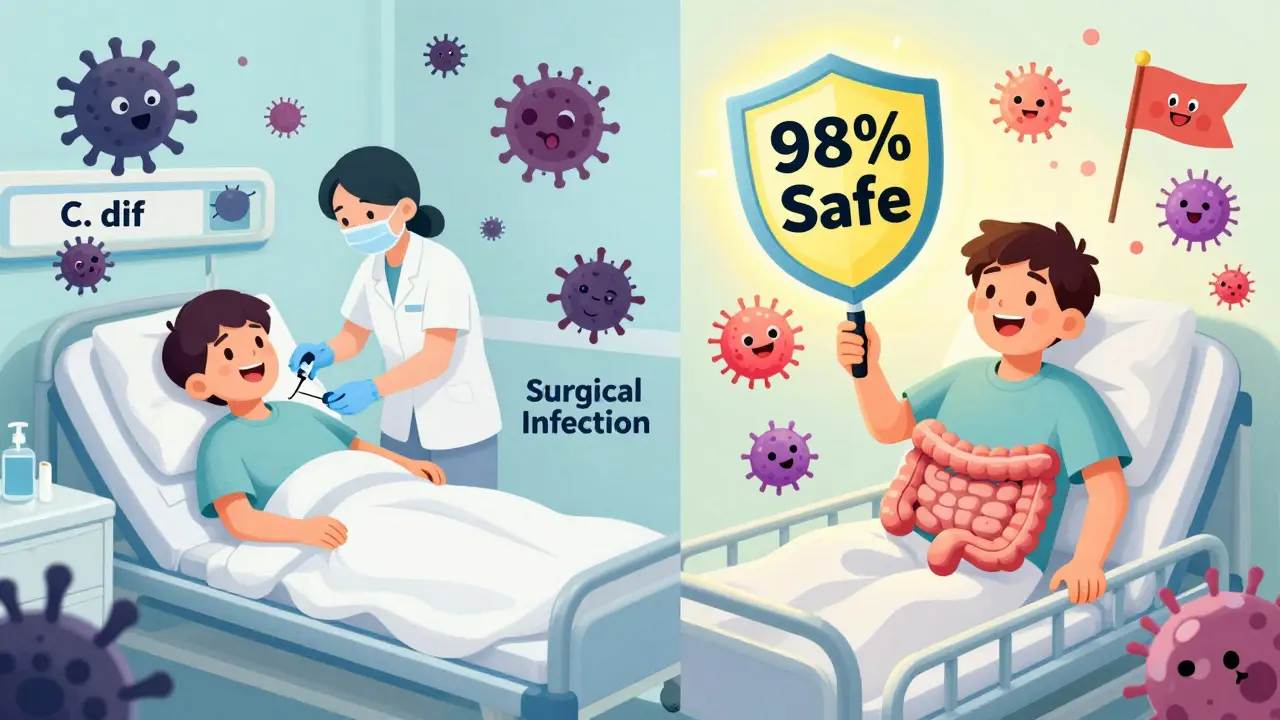
When you avoid penicillin because of a mislabeled allergy, you’re not just avoiding a drug. You’re accepting higher risks. - People with a penicillin allergy label are 69% more likely to get a Clostridioides difficile (C. diff) infection - a severe, sometimes deadly gut infection caused by antibiotics wiping out good bacteria. - They have a 50% higher chance of surgical site infections after operations. - Treatment fails more often. For common infections like pneumonia or strep throat, alternative antibiotics are less effective. And it’s not just about health. It’s about money. A course of amoxicillin costs around $34. The alternatives? Often over $95. That’s a $60+ difference per prescription. Multiply that across millions of patients, and you’re talking about billions in wasted healthcare spending.How Penicillin Allergy Testing Actually Works
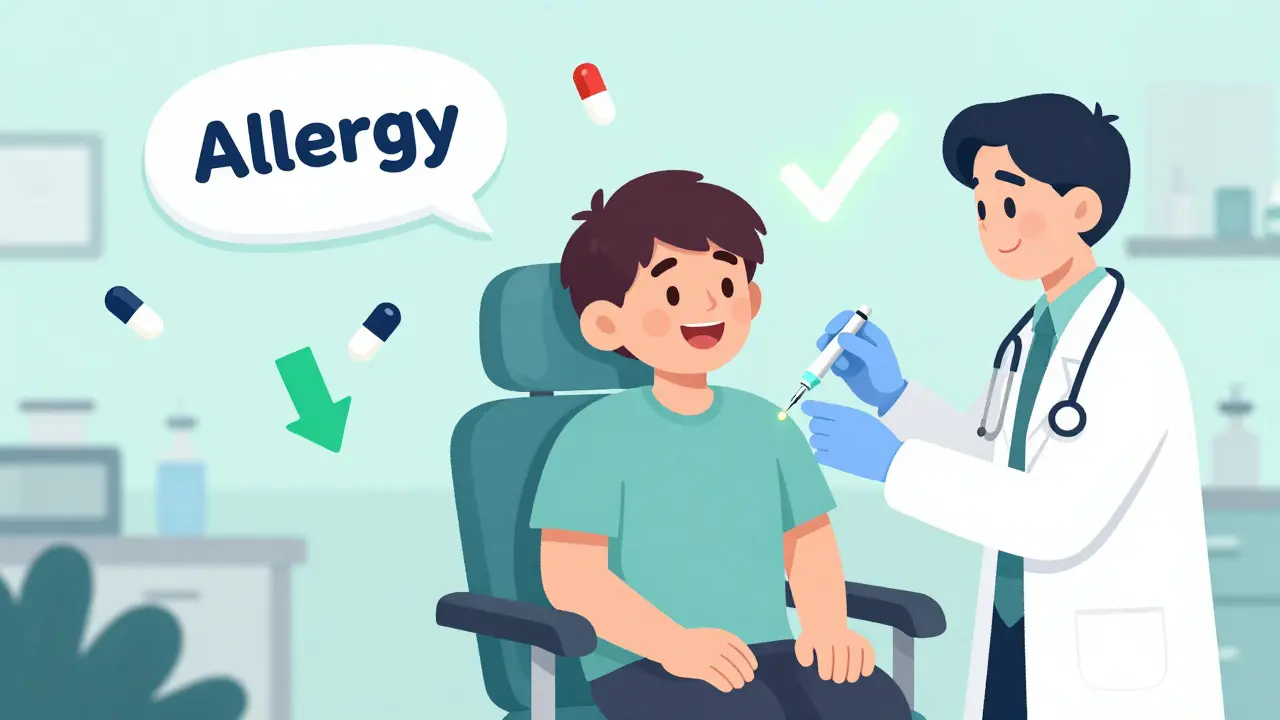
Penicillin allergy testing isn’t complicated. It’s simple, safe, and fast. Here’s how it works:- Skin testing first. A tiny amount of penicillin reagent (called Pre-Pen, or penicilloyl-polylysine) is placed on your skin. A small prick or injection follows. If you’re truly allergic, you’ll get a red, itchy bump within 15-20 minutes.
- If the skin test is negative, you move to an oral challenge. You swallow a small dose of amoxicillin - usually 250 mg - and are watched for one hour.
- If you pass both, you’re officially de-labeled. Your medical record is updated. You can now safely take penicillin-based antibiotics for life.
Who Should Get Tested?
Not everyone needs testing. But if you’ve ever said “I’m allergic to penicillin,” you should consider it - especially if:- The reaction happened more than 10 years ago
- You only had a rash (not hives, swelling, or trouble breathing)
- You were a child when it happened
- You’ve taken penicillin since without issue
- You’ve never had anaphylaxis or a life-threatening reaction
Why Isn’t Everyone Getting Tested?
The science is clear. The guidelines are solid. So why aren’t more people getting tested? The biggest barrier? Access. As of 2022, only 44% of U.S. hospitals had allergists available for inpatient testing. Only 39% offered penicillin skin testing at all. That’s changing fast, but slowly. Now, hospitals are training pharmacists, nurses, and even non-allergist doctors to do the testing. In academic centers, pharmacists now handle nearly half of all penicillin allergy assessments - up from just 12% in 2017. That’s a game-changer. Another issue? Misinformation. Some doctors still think penicillin allergy testing is risky or too complex. It’s not. The protocol has been used since the 1960s. It’s been refined, studied, and proven safe thousands of times over.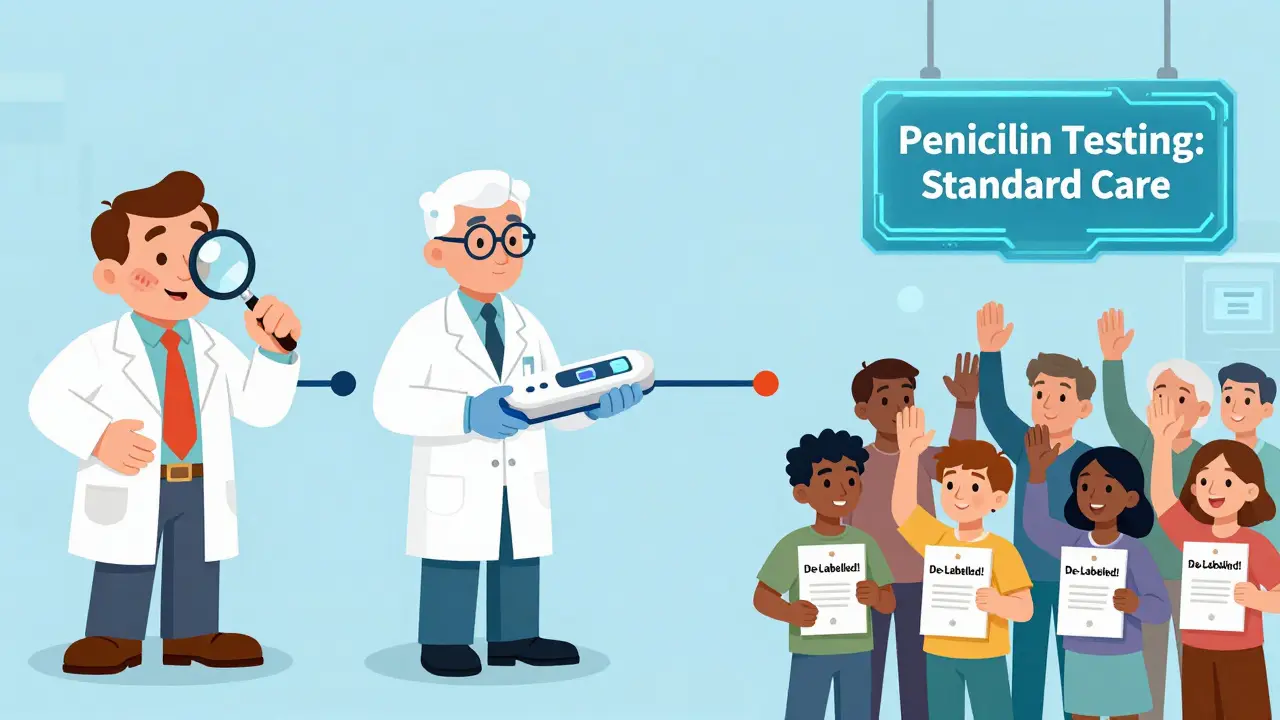
What’s Next for Penicillin Testing?
The future is looking bright. A new, all-in-one skin test kit - combining the major and minor penicillin reagents plus amoxicillin - is under FDA review. Early results from 455 patients showed a 98% negative predictive value. If approved, it could eliminate the need for the oral challenge in most cases. Some hospitals are already testing rapid protocols that cut the process down to under 30 minutes. Mayo Clinic, Johns Hopkins, and UCSF are piloting these. Early accuracy? 96.5% - nearly matching the gold standard. The CDC predicts that by 2027, 85% of U.S. hospitals will have penicillin allergy testing built into their routine antibiotic stewardship programs. That could prevent 50,000 to 70,000 C. diff infections every year - and save billions in costs.What You Can Do
If you’ve been told you’re allergic to penicillin:- Don’t assume it’s true. Ask your doctor about testing.
- Check your medical records. Is the allergy listed with details? Or just “penicillin allergy” with no description?
- If you’ve never had a severe reaction, testing is likely safe and beneficial.
- If you’re scheduled for surgery, a dental procedure, or treatment for an infection - ask if you can be tested first.
Penicillin is one of the oldest, safest, and most effective antibiotics we have. If you’re one of the 90% who aren’t truly allergic, you deserve to use it.
Comments (8)
Jay Tejada
January 3, 2026 AT 16:01Man, I thought I was allergic till I got tested last year. Turned out I just had a weird rash from a virus. Now I take amoxicillin like it’s candy. Saved me $80 on my sinus infection last month.
Allen Ye
January 5, 2026 AT 06:58It’s fascinating how deeply embedded medical myths become-like penicillin allergies are some kind of ancestral badge of honor. We’ve got entire generations raised on the idea that ‘a rash means allergy,’ when in reality, we’re just bad at distinguishing side effects from true immunological responses. The fact that we still treat this like a binary label instead of a spectrum of risk says more about our healthcare system’s inertia than about the science. We don’t just need testing-we need a cultural shift in how we document and interpret patient histories. And yet, here we are, still using 1970s-era record-keeping while expecting 2020s-level precision.
Justin Lowans
January 6, 2026 AT 23:35As someone who works in clinical pharmacy, I can tell you that the shift toward pharmacist-led penicillin de-labeling has been one of the most impactful, low-hanging-fruit interventions in antibiotic stewardship. The data speaks for itself: fewer C. diff cases, shorter hospital stays, lower costs. What’s remarkable is how simple the protocol is-yet so few facilities implement it. It’s not about resources; it’s about willpower. We have the tools. We just need to stop treating allergies like sacred text and start treating them like clinical hypotheses.
Michael Rudge
January 8, 2026 AT 02:42Oh wow, so now we’re supposed to believe that your grandma’s anecdote about your cousin’s cousin getting a rash in 1992 is somehow a valid medical diagnosis? Please. The fact that people still cling to this nonsense like it’s a religious doctrine is why we’re drowning in superbugs. If you can’t tell the difference between a stomach ache and anaphylaxis, maybe you shouldn’t be self-diagnosing. And yes-I’m looking at you, 20-somethings who say ‘I’m allergic’ because you got a little red spot after a pill.
Jack Wernet
January 9, 2026 AT 10:16While the clinical evidence supporting penicillin allergy testing is robust and well-documented, the broader implications extend beyond individual patient care. This issue reflects a systemic failure in medical education and communication. Patients are not trained to distinguish between adverse reactions and true allergies, and providers often lack the time or incentive to challenge outdated labels. A coordinated effort-between primary care, pharmacy, and public health-is required to reframe this narrative from one of fear to one of evidence-based empowerment.
bob bob
January 10, 2026 AT 23:13I got tested last year after my dentist refused to give me amoxicillin. Turned out I was fine. Now I feel like a superhero. Also, my insurance paid for it. So if you think you’re allergic-just ask. No judgment. Just do the thing.
Abhishek Mondal
January 11, 2026 AT 06:33Let’s be honest: this whole ‘90% aren’t allergic’ statistic is statistically misleading-because it assumes that all self-reported allergies are equally invalid. What about those who had a true IgE reaction as a child, but outgrew it? Or those who had a delayed hypersensitivity that wasn’t IgE-mediated? You’re conflating ‘not anaphylactic’ with ‘not allergic.’ That’s sloppy. Also, why are we still using penicillin at all? It’s 2024. We’ve got better drugs.
Oluwapelumi Yakubu
January 11, 2026 AT 09:02Bro, I live in Lagos and we don’t even have penicillin testing centers here-but guess what? We still use it all the time because we can’t afford the fancy antibiotics. My uncle took amoxicillin for 30 years straight after a childhood rash and never missed a beat. Meanwhile, rich folks in the States are paying $200 for skin tests because they’re scared of a little red dot. Sometimes, the real allergy is to common sense.