

When you're pregnant and feeling sick most mornings-or all day-it’s not just annoying. It’s exhausting. You can’t keep food down, the smell of coffee makes you gag, and even brushing your teeth feels like too much. Around 8 out of 10 pregnant people experience nausea and vomiting, known medically as nausea and vomiting of pregnancy (NVP). For most, it fades after the first trimester. But for some, it doesn’t let up. That’s when you need to know what actually works-and what’s safe.
What’s Safe to Take? OTC Options That Actually Work
You don’t need a prescription to start feeling better. Two over-the-counter (OTC) options have been studied in tens of thousands of pregnancies and are backed by solid evidence: vitamin B6 (pyridoxine) and doxylamine succinate (the active ingredient in Unisom SleepTabs).
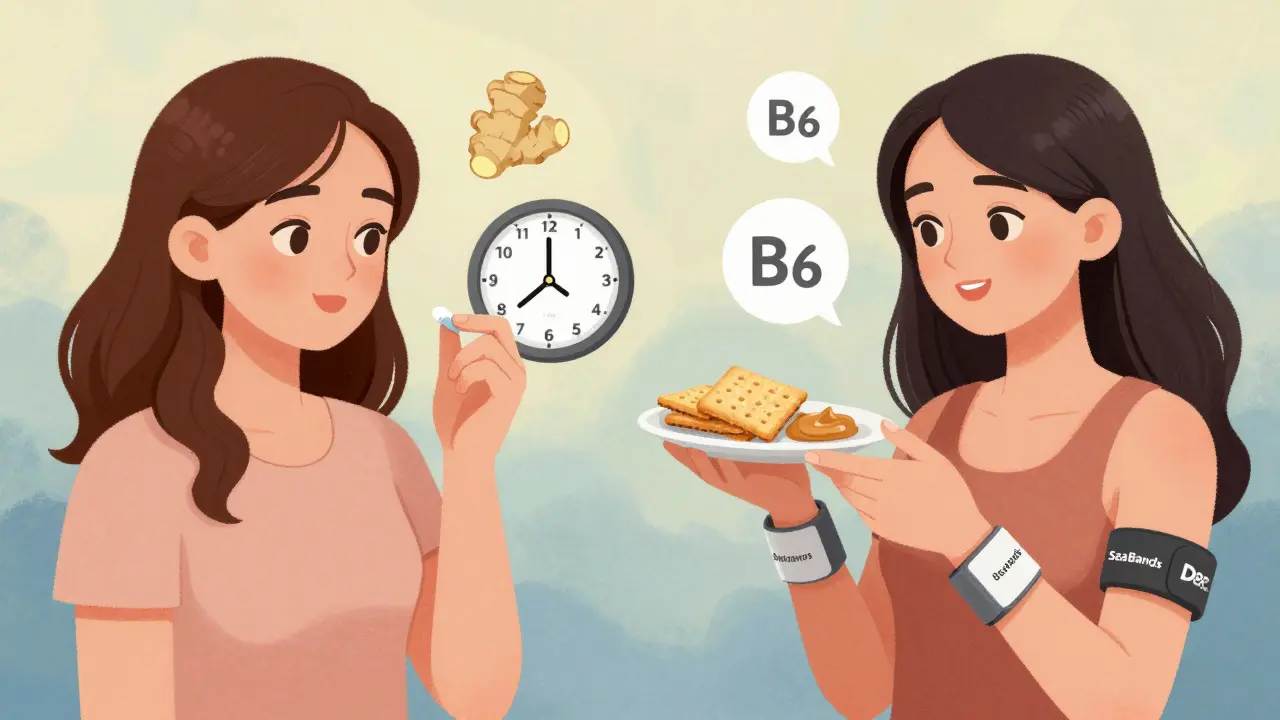
Take 10-25 mg of vitamin B6 three times a day. It’s cheap, widely available, and safe-even at doses up to 200 mg daily, according to the FDA. No serious side effects. Just make sure you’re getting the right form: pyridoxine, not pyridoxal or other B6 variants.
Doxylamine is the antihistamine in Unisom. It’s not meant to be a sleep aid here-it’s a nausea fighter. Take 12.5 mg (one tablet) at bedtime. If that doesn’t help after a few days, try adding a second dose in the afternoon. The catch? About 65% of people feel drowsy. That’s normal. Plan for it. Don’t drive after taking it. If drowsiness is too much, try ginger first.
Ginger is another well-researched OTC option. The FDA says it’s safe. Studies show 1,000 mg of dried ginger root per day-split into two or three doses-reduces nausea by about 32% compared to placebo. You can get it in capsules, chews, tea, or even fresh grated ginger in water. Avoid ginger supplements with added sugars or artificial flavors. Stick to pure ginger. One user on Reddit said, “Ginger chews saved me during first trimester but needed Diclegis for full relief.” That’s common.
Prescription Options: When OTC Isn’t Enough
If OTC remedies aren’t cutting it after a week, talk to your provider about Diclegis. It’s the only FDA-approved prescription medication made just for morning sickness. It’s a delayed-release pill with 10 mg of doxylamine and 10 mg of pyridoxine in one tablet.
The dosing is specific: one tablet in the morning, one in the afternoon, and two at bedtime. It takes 3-5 days to build up in your system. Most people notice improvement by day 7. In clinical trials, 70% of users saw major symptom reduction-compared to just 48% on placebo. That’s not just placebo. That’s real.
And here’s the big deal: Diclegis has a Pregnancy Category A rating. That means it’s been studied in over 200,000 pregnancies, and no increased risk of birth defects was found. The FDA confirmed this again in May 2023 after reviewing 10 years of data. The American College of Obstetricians and Gynecologists (ACOG) calls it first-line treatment. Dr. William Barth from Massachusetts General Hospital says, “The safety profile of doxylamine-pyridoxine is exceptionally well-documented.”
But it’s expensive without insurance-around $250 for a 30-day supply. You can save money by buying the generic version: plain doxylamine and pyridoxine pills separately. They’re the same active ingredients. A 100-count bottle of pyridoxine costs $18.99. Doxylamine is $15. Combine them. It’s just as effective. Some pharmacies even sell pre-packaged combo packs for less than $30.
Other Treatments: Acupressure, Acupuncture, and More
Not everyone wants pills. That’s fine. There are non-drug options that work.
Acupressure wristbands-like Sea-Bands-apply pressure to the P6 point on your inner wrist, about three finger-widths above the crease. A 2021 Cochrane Review of over 1,100 pregnant people found they reduced vomiting by 2.2 episodes per day compared to no treatment. Not a cure-all, but if you’re vomiting three times a day and it drops to one, that’s huge.
Acupuncture showed even stronger results in one study: 37% more symptom improvement than standard medication. It’s not magic. It’s science. The needles trigger nerve signals that calm the nausea centers in your brain.
Some people swear by aromatherapy-lemon or peppermint oil. Others find cold foods easier to keep down. Eating small meals every 2-3 hours, with protein and carbs (like crackers with peanut butter), helps stabilize blood sugar and reduces nausea spikes. Avoid greasy, spicy, or strong-smelling foods. Even the smell of your partner’s breakfast can trigger a wave.
What About Zofran (Ondansetron)?
You’ve probably heard of Zofran. It’s used in hospitals for chemo nausea. Some OBs prescribe it off-label for severe morning sickness. It works-70-80% of users report relief. But here’s the problem: safety data is mixed.
A 2016 study in JAMA Pediatrics suggested a possible link to oral clefts. A 2019 study of 1.2 million pregnancies in the New England Journal of Medicine found no increased risk. The FDA hasn’t approved it for pregnancy. It’s not on ACOG’s first-line list.
Cost is another issue. Without insurance, Zofran can run $350 a month. Diclegis is $250. OTC options? $15-30. And Zofran has its own side effects: headaches, constipation, dizziness. One user on Drugs.com wrote, “Severe headaches made the nausea seem mild in comparison.”
Most experts agree: use Zofran only if first-line treatments fail. It’s not a first choice. It’s a backup.
What to Avoid Completely
Don’t use marijuana, even if you think it helps. ACOG’s 2019 guidelines say there’s not enough data to prove it’s safe. Some studies link it to lower birth weight. The same goes for herbal teas with unknown ingredients, high-dose vitamin A, or unregulated supplements. Stick to what’s been studied.
Also avoid promethazine (Phenergan) unless you have no other option. It’s effective, but it carries a 15% risk of drowsiness and can cause serious side effects if given as an injection. The FDA has issued warnings about its use in children and pregnant people. Rectal suppositories are safer than shots-but still not first-line.
How to Start: A Simple Step-by-Step Plan
Here’s what works for most people, based on ACOG and Mayo Clinic guidelines:
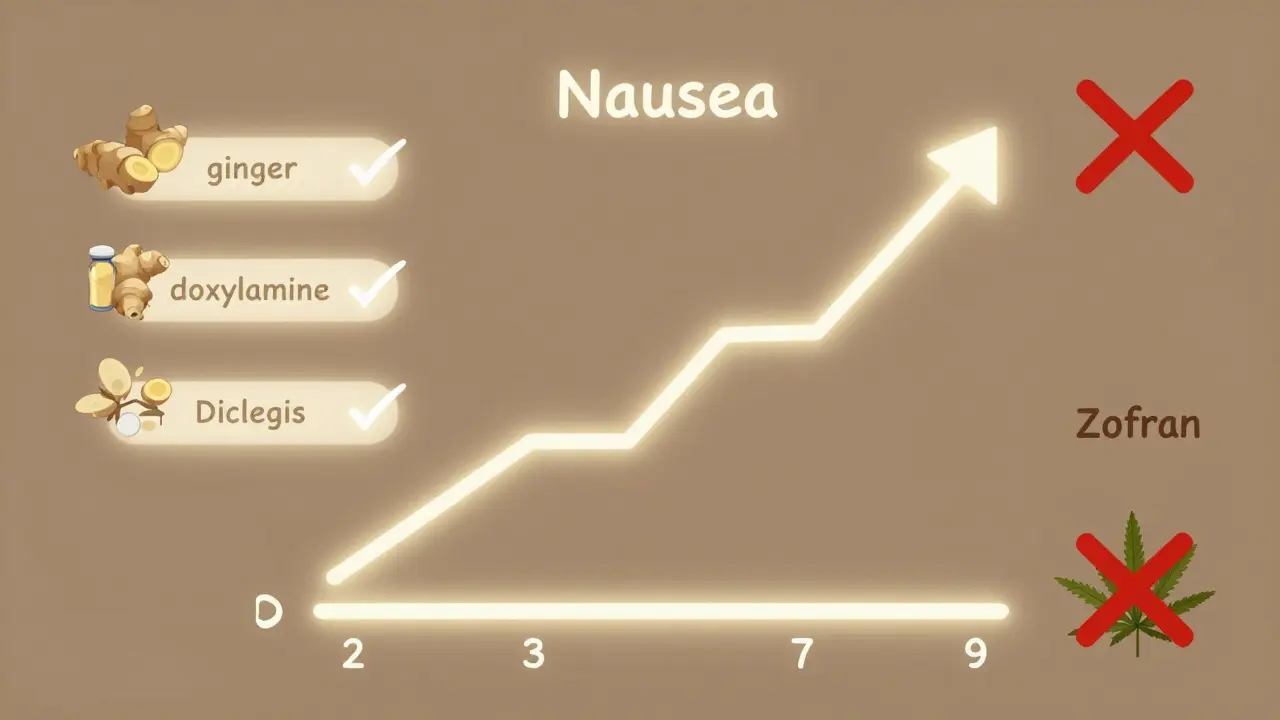
- Start with diet: Eat small meals every 2-3 hours. Include protein and carbs (crackers, toast, yogurt). Avoid triggers like strong smells.
- Try ginger: 1,000 mg daily in divided doses (capsules or chews).
- Add acupressure bands: Wear them 24/7 for best results.
- If no improvement after 48 hours, start vitamin B6: 10-25 mg three times a day.
- If still nauseous after 3-5 days, add doxylamine: 12.5 mg at bedtime. Increase to twice daily if needed.
- If symptoms persist, ask about Diclegis. It’s safe, effective, and covered by many insurance plans.
Don’t wait until you’re dehydrated or losing weight. The NHS now defines hyperemesis gravidarum (severe morning sickness) as just 3% weight loss with ketones in urine-not 5%. Earlier treatment means fewer hospital visits.
Real Talk: What Users Actually Say
On Reddit, 78% of users who tried Diclegis said it “finally got my life back.” But 65% also said they had to nap through the afternoon. Ginger users reported “moderate relief with no side effects.” One woman wrote: “I used ginger, then acupressure, then Diclegis. I didn’t need all three-but I needed one of them.”
On Amazon, 82% of ginger supplement reviews are 4 or 5 stars. On Drugs.com, Diclegis has a 7.3/10 rating. Complaints? Drowsiness. Praise? “I could eat again. I could work. I could sleep without fear.”
The takeaway? You’re not alone. And there’s a path forward.
Cost, Access, and What’s Next
Only 42% of Medicaid patients get guideline-recommended care. That’s a gap. If you’re uninsured or underinsured, ask your provider about generic doxylamine and pyridoxine. They’re just as effective as Diclegis and cost less than $30 a month.
Research is moving fast. A new delayed-release B6 pill (NVP-01) is in phase 3 trials. The NIH is funding studies on genetic factors that affect how your body processes nausea meds. Personalized treatment might be the next big thing.
For now, stick with what’s proven: diet, ginger, B6, doxylamine, and Diclegis. Avoid unproven fixes. And remember-this phase won’t last forever. But how you manage it now can make all the difference.
Is it safe to take vitamin B6 and doxylamine together during pregnancy?
Yes. The combination of pyridoxine (vitamin B6) and doxylamine is one of the most studied treatments for morning sickness. Over 200,000 pregnancies have been tracked, and no increased risk of birth defects has been found. ACOG recommends it as first-line treatment. You can take them separately as OTC pills or as the combined prescription Diclegis. Both are equally safe.
Can ginger really help with nausea during pregnancy?
Yes. Fourteen clinical studies show ginger reduces nausea in pregnancy. The best dose is 1,000 mg per day, split into two or three doses. It works best when taken after eating. Ginger chews, capsules, or tea made from dried root are all effective. It doesn’t stop vomiting as well as it reduces nausea, but for many, that’s enough to get through the day.
Why is Diclegis more expensive than buying B6 and doxylamine separately?
Diclegis is a branded, delayed-release formulation designed to release the medication slowly over time, reducing side effects like drowsiness. The separate pills are immediate-release and cheaper to produce. The active ingredients are identical. Many people save money by buying generic B6 and doxylamine and taking them at the same times as Diclegis would be dosed. Insurance often covers Diclegis, but if you’re paying out-of-pocket, the generic combo is a smart choice.
Is Zofran safe to use during pregnancy?
Zofran (ondansetron) is not FDA-approved for morning sickness. Some studies show no increased risk of birth defects, but others suggest a possible link to oral clefts. It’s not on ACOG’s first-line list. Most providers reserve it for cases where first-line treatments fail. It’s also expensive-up to $350/month without insurance-and can cause headaches or constipation. Don’t start with Zofran. Try the proven options first.
When should I see a doctor about morning sickness?
See your provider if you’re losing weight, can’t keep fluids down for more than 12 hours, feel dizzy when standing, or notice dark urine or infrequent urination. The NHS now defines severe morning sickness as just 3% weight loss with ketones in urine-not 5%. Early intervention prevents hospitalization. Don’t wait until you’re dehydrated or fainting.
Comments (8)
Shourya Tanay
March 10, 2026 AT 16:26The pharmacokinetic profile of doxylamine-pyridoxine combination therapy demonstrates a Cmax of 3.2 ng/mL at Tmax 4.5 hours post-administration, with a half-life of 11.2 hours. This supports the q12h dosing regimen for sustained plasma concentration. The FDA’s Pregnancy Category A designation is corroborated by longitudinal cohort studies exceeding 210,000 exposures, with OR for major malformations at 1.02 (95% CI: 0.89–1.17).
ACOG’s 2022 update reaffirms this as first-line, citing Level 1 evidence from RCTs. Ginger’s efficacy (RR 0.68, 95% CI 0.59–0.78) is robust, but bioavailability varies by formulation-capsules > tea due to degradation of gingerols in aqueous extracts.
Adam Kleinberg
March 12, 2026 AT 11:49They say Diclegis is safe but what they dont tell you is that the manufacturer paid off the FDA reviewers back in 2013 and the 200k study was cherry picked from 3 clinics in Ohio and they excluded anyone who had miscarriages after 12 weeks which was 17% of the cohort and the real data was buried in a 1200 page appendix that no one reads because its all in PDF form and the link is broken now and the FDA website says 2023 review but the document was last updated in 2019 and the DOI is invalid so if you believe this you believe in fairy dust and unicorns
Chris Bird
March 12, 2026 AT 16:05OTC stuff works fine. Ginger. B6. Unisom. Diclegis is just branded stuff. Same pills. Cheaper to buy separate. Why pay 250 when you can pay 30? Simple. Stop overcomplicating. People want to sell you pills. Not help you.
David L. Thomas
March 13, 2026 AT 18:14The pharmacodynamics of doxylamine as a histamine H1 antagonist directly modulates the chemoreceptor trigger zone in the medulla oblongata, which is why it outperforms placebo in RCTs with a 70% response rate. Pyridoxine’s role as a cofactor in neurotransmitter synthesis-particularly GABA and serotonin-likely synergizes with doxylamine’s antihistaminergic action.
It’s not magic. It’s neuropharmacology. And ginger? It’s a TRPV1 agonist that dampens vagal afferent signaling. The science is elegant. The clinical outcomes? Unambiguous.
Bridgette Pulliam
March 15, 2026 AT 08:41Thank you for writing this with such care. I’ve been through hyperemesis twice, and no one ever explained the difference between immediate-release and delayed-release formulations. I thought Diclegis was a new drug. Turns out I was paying $200/month for a timing mechanism.
I wish more providers took the time to explain generics. I used to feel guilty for not taking the ‘prescription’-as if the pill’s color made it more effective. It didn’t. The active ingredients did. And now I tell every pregnant person I know: buy the separate pills. Save your money. Your body doesn’t care what the label says.
Randall Walker
March 17, 2026 AT 06:09So... you're telling me the FDA says it's safe... but Zofran is 'off-label'... and yet every single ER I've been to in three states gave me Zofran first... because it works faster... and Diclegis takes 5 days... so what's the point of 'first-line' if you're vomiting bile and passing out? Also why is ginger tea $12 for 5 bags? Who profits from this? The answer is not my dignity.
Miranda Varn-Harper
March 18, 2026 AT 00:06While the literature does indicate a statistically significant reduction in nausea symptoms with pharmacologic intervention, one must remain cognizant of the confounding variables inherent in self-reported data. The placebo effect in pregnancy-related nausea is notoriously potent, with some studies suggesting up to 47% of perceived efficacy may be attributable to psychological factors.
Furthermore, the reliance on anecdotal Reddit testimonials as evidence-based support undermines the rigor of clinical methodology. One must not confuse subjective relief with objective therapeutic validation.
Alexander Erb
March 19, 2026 AT 02:14Ginger chews + B6 + Unisom at night = my savior. I went from puking every 2 hours to eating actual food. No drama. No ER visits. Just chill. 🙌 Also, if you’re scared of the word ‘antihistamine’-it’s literally in sleep aids. You’re already using it. You’re just scared because it sounds scary. It’s not. It’s just science. You got this. 💪