
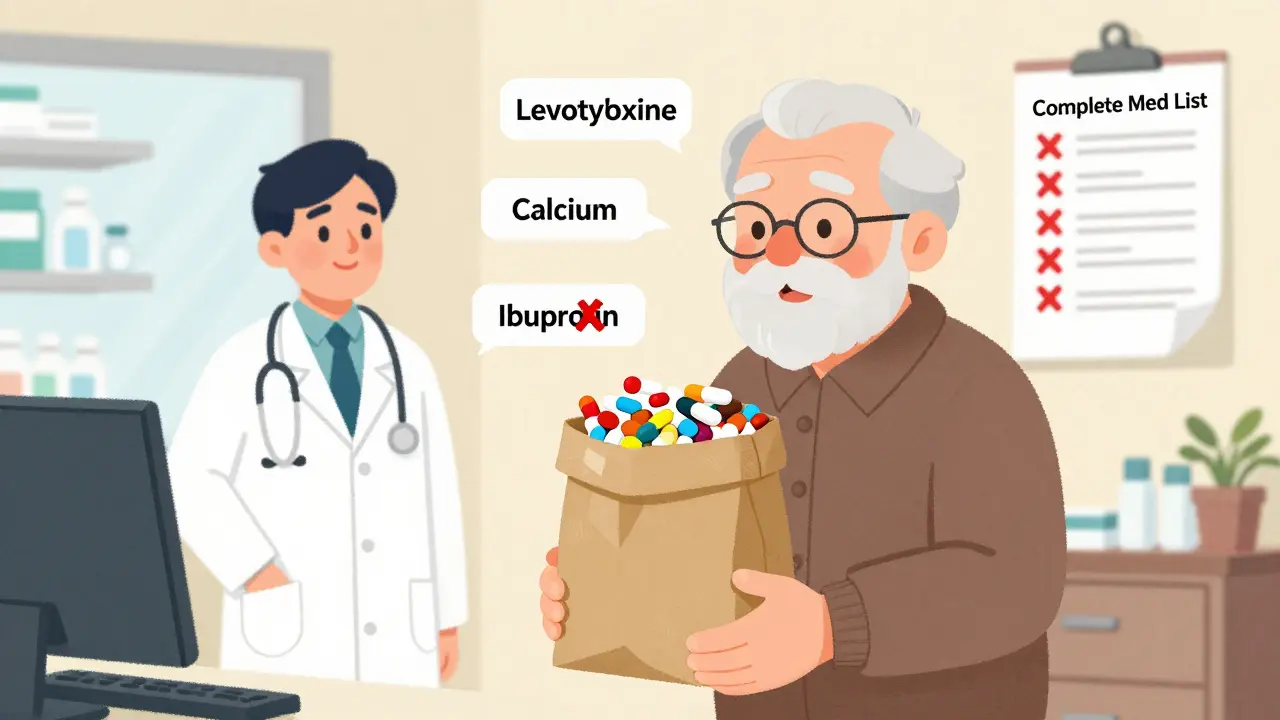
Getting multiple medications right isn’t just about remembering to take them-it’s about taking them at the right time, in the right order, and without clashing with each other. If you’re juggling five or more prescriptions, supplements, or over-the-counter drugs, you’re not alone. Nearly 40% of adults over 65 in the U.S. are on five or more medications daily. And here’s the scary part: studies show that up to 82% of people in this group experience at least one harmful drug interaction. But it doesn’t have to be this way. A well-designed medication schedule can cut those risks dramatically-and it’s simpler than you think.
Start with a Complete Medication List
Before you even think about timing, you need to know exactly what you’re taking. This includes every prescription, every OTC painkiller, every vitamin, herb, or supplement. Don’t forget the ones you only take "as needed," like antacids or sleep aids. Many people leave these out, assuming they don’t count. They do. A brown bag review-where you bring all your meds to your doctor or pharmacist-reveals an average of 3.2 discrepancies per person. That means nearly one in three people are taking something they didn’t realize they were on, or missing something they should be. Write everything down: name, dose, frequency, reason for taking it, and who prescribed it. Update this list every time you see a new provider. Keep a printed copy in your wallet and a digital version on your phone. This isn’t just good practice-it’s your safety net.Use the Universal Medication Schedule (UMS) Framework
Forget vague instructions like "take twice daily" or "with meals." These lead to confusion. A 2016 study found that 34% of patients misinterpreted these kinds of directions. The solution? The Universal Medication Schedule (UMS). It breaks dosing into four clear windows:- Morning: 6-10 a.m.
- Noon: 10 a.m.-2 p.m.
- Evening: 2-6 p.m.
- Bedtime: 8 p.m.-12 a.m.
Group Medications by Timing, Not by Pill
Don’t organize your schedule by pill type. Organize it by time. Think of your day as four slots. Fill each slot with the meds that belong there. This is where interactions get managed. Some meds need space between them. For example:- Levothyroxine (thyroid med) must be taken on an empty stomach, at least 30-60 minutes before breakfast. Don’t take it with calcium, iron, or antacids-those block absorption.
- Statins like atorvastatin work best taken at night, when your liver makes the most cholesterol.
- Calcium supplements should be spaced at least 2 hours apart from thyroid meds or antibiotics like ciprofloxacin.
- NSAIDs like ibuprofen can increase bleeding risk when taken with blood thinners like warfarin. Avoid taking them together.
Use a Pill Organizer with Clear Compartments
A simple plastic box with AM/PM slots or a 7-day, 4-times-a-day divider is one of the most effective tools you can use. A 2018 meta-analysis found that using these reduces dosing errors by 45%. Why? Because you see what you’ve taken-and what you haven’t. Pick one with large, labeled compartments. Color-code if it helps: red for heart meds, blue for blood pressure, green for supplements. Stick a printed schedule next to it. Many people keep theirs taped to the bathroom mirror or the fridge. Visual cues stick better than memory.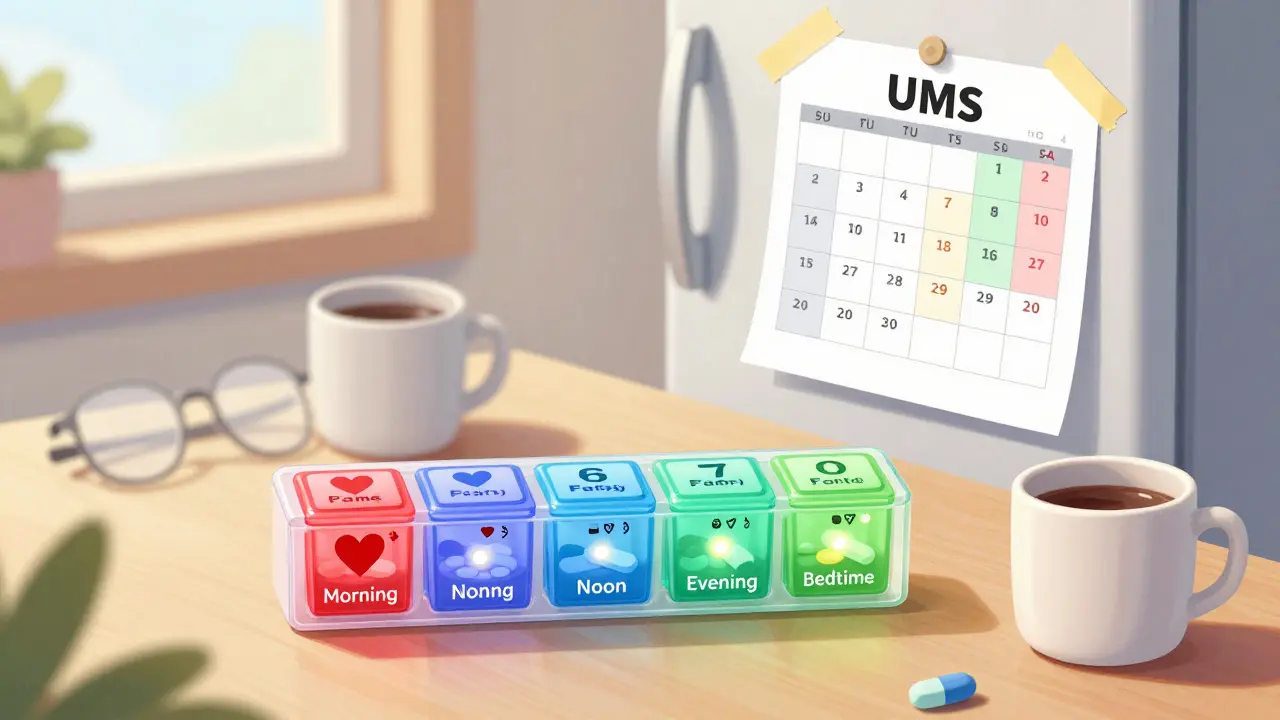
Synchronize Refills to Reduce Chaos
If your prescriptions are due on different days, you’re constantly running to the pharmacy. That’s stressful, and it leads to missed doses. The "90 x 4" method solves this: ask your doctor to prescribe 90-day supplies, filled four times a year. That means all your meds can be refilled on the same day-say, the first Monday of every quarter. This isn’t just convenient. It saves doctors up to two hours per day in administrative work. For you, it means fewer trips, fewer mix-ups, and fewer chances to run out. Talk to your pharmacist. Most can help you coordinate this-even if your doctors didn’t suggest it.Track Your Schedule-But Not Just on Your Phone
Digital apps like Medisafe or MyTherapy help 20-35% more people stay on track than paper lists. But here’s the catch: only 38% of people over 65 use them consistently. If you’re not tech-savvy-or if your phone dies, or you forget to check it-paper still wins. Use both. Keep a printed weekly calendar next to your pill box. Mark each dose with a check or an X. Include notes: "took with food," "felt dizzy after," "missed due to doctor’s visit." This isn’t just for you. It’s gold for your pharmacist when they review your meds.Know the Red Flags for Interactions
You don’t need to memorize every drug interaction. But you do need to recognize when something’s off. Common signs of a bad interaction include:- Sudden dizziness or lightheadedness
- Unusual bruising or bleeding
- Severe stomach pain or nausea
- Confusion or memory lapses
- Unexplained fatigue or weakness
Get Help from Your Pharmacist
Your pharmacist isn’t just the person who hands you the bottle. They’re your medication detective. Ask for a free Medication Therapy Management (MTM) session. Pharmacists who run these reviews reduce drug interactions by 32% and cut ER visits by 24%. Bring your full list. Ask: "Are any of these known to clash?" "Is there a simpler way to take these?" "Can any of these be combined into one pill?" Many drug combinations-like blood pressure meds-now come in single tablets. Fewer pills = fewer chances for error.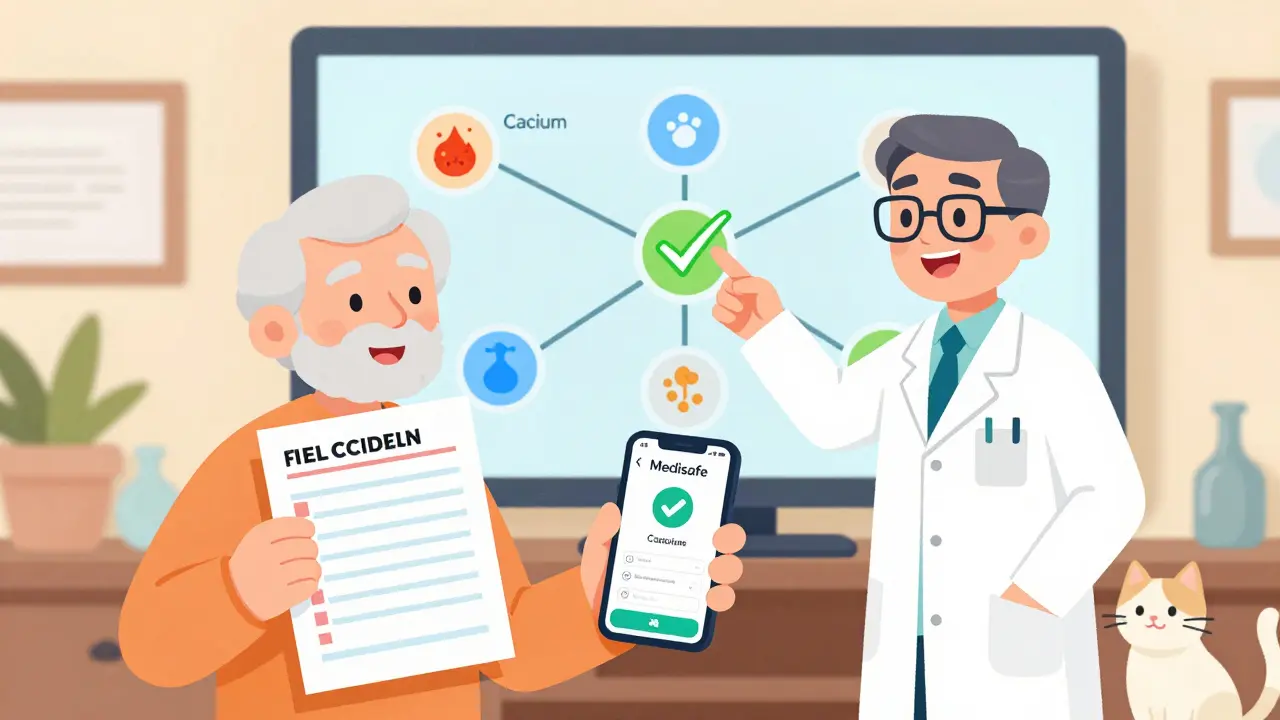
Update Your Schedule After Every Change
New prescription? Stopped one? Changed the dose? Updated your schedule the same day. Don’t wait. Don’t assume your doctor told your pharmacist. Don’t assume your app auto-updates. If you don’t update it, it’s wrong. And a wrong schedule is a dangerous one. Keep your list in three places: your phone, your wallet, and your pill organizer station. If you’re in the hospital, give them a copy. If you’re seeing a new specialist, bring it. This is your responsibility-and it’s the most powerful tool you have.What About Supplements and Herbal Products?
They’re not harmless. St. John’s Wort can make birth control, antidepressants, and blood thinners ineffective. Garlic and ginkgo increase bleeding risk with aspirin or warfarin. Vitamin K can undo the effects of warfarin. Green tea can interfere with some chemotherapy drugs. Treat supplements like real medicine. List them. Ask your pharmacist about each one. Don’t assume "natural" means "safe."Why This Works: Real Stories
One woman in Alabama took 12 medications. She was dizzy, nauseous, and falling. Her doctor didn’t know why. After a pharmacist reviewed her list, they found she was taking calcium with her thyroid med-blocking absorption. She was also taking ibuprofen with her blood thinner. Once she spaced them out and switched to acetaminophen, her dizziness vanished. Another man in Ohio used a color-coded pill box and UMS timing. He went from missing 3-4 doses a week to taking every pill on time. His A1C dropped. His blood pressure stabilized. He said, "I finally feel like I’m in control."Final Tip: Start Small, Stay Consistent
Don’t try to fix everything at once. Pick one thing to change this week. Maybe it’s switching to a pill organizer. Or writing down your meds. Or asking your pharmacist for a review. Do that. Master it. Then move to the next step. Medication safety isn’t about perfection. It’s about progress. One less interaction. One fewer hospital visit. One more day feeling like yourself.What’s the most common medication interaction mistake?
The most common mistake is taking calcium, iron, or antacids at the same time as thyroid medication (levothyroxine). These substances block absorption, making the thyroid drug ineffective. The fix? Take thyroid meds on an empty stomach, at least 30-60 minutes before food or supplements-and wait at least 4 hours before taking calcium or iron.
Can I use my phone app instead of a pill organizer?
Apps are great for reminders, but they’re not foolproof. Phones die, notifications get silenced, and many older adults don’t use them consistently. A pill organizer gives you a physical, visual check-what you’ve taken, what’s left. Use both: the app for alerts, the organizer for confirmation.
How do I know if a new medication will interact with my current ones?
Always ask your pharmacist before starting any new drug-even an OTC one. Pharmacists use tools like Lexicomp that screen for over 150 common interactions in under 15 minutes. Don’t rely on Google. Your pharmacist has the training and tools to give you accurate, personalized advice.
Is it safe to take all my meds at once if I forget?
Never double up unless your doctor or pharmacist says so. Taking too much of certain drugs-like blood thinners, diabetes meds, or painkillers-can cause serious harm. If you miss a dose, check the instructions or call your pharmacist. Most times, skip the missed dose and go back to your regular schedule.
What should I do if I’m seeing multiple doctors?
Bring your complete, updated medication list to every appointment-no exceptions. Ask each provider: "Is this new prescription safe with everything else I’m taking?" If you feel like you’re getting conflicting advice, ask for a medication reconciliation review. Many hospitals and clinics offer this service for free.
Comments (13)
Annette Robinson
January 8, 2026 AT 05:07I wish more people knew how vital it is to talk to your pharmacist-not just your doctor. I had a neighbor who was taking iron with her thyroid med and was constantly exhausted. Once she spaced them out, she said she felt like a new person. It’s not rocket science, but nobody tells you this stuff unless you ask.
Keep that list updated. Write it down. Keep it in your wallet. It’s the simplest thing that saves lives.
Luke Crump
January 9, 2026 AT 05:27Oh wow, another ‘trust your pharmacist’ sermon. Tell me, does the FDA also recommend we all bow to the white-coated priests of Walgreens? I mean, sure, they’re great at counting pills-but do they really understand the deeper metaphysics of pharmacology? Or are we just outsourcing our autonomy to corporate pharmacy chains while pretending it’s ‘care’?
What if the real problem isn’t the schedule… it’s that we’re medicating ourselves into oblivion to survive a broken system? Just saying.
Manish Kumar
January 9, 2026 AT 18:36Listen, I’ve seen this in my own family-my uncle in Jaipur was on eight different meds, including turmeric capsules, ashwagandha, and some ayurvedic syrup he swore by. He didn’t tell his doctor because he thought ‘natural’ meant ‘safe.’ Then he started bleeding internally after starting warfarin. Turns out, ashwagandha and ginkgo both thin the blood. He almost died.
It’s not just Western medicine that’s dangerous-it’s the blind trust in traditional remedies without checking interactions. Your grandmother’s herbal tea could be killing you, and no one’s telling you because it’s ‘culture.’ We need to stop romanticizing ‘natural’ and start treating every substance like it’s a chemical weapon-because some of them are.
Also, why does everyone assume Americans are the only ones with polypharmacy problems? We’ve got 70-year-olds in rural India on 10 pills a day too. And no one’s giving them pill organizers. They just take them all together with chai. It’s terrifying.
Aubrey Mallory
January 10, 2026 AT 08:43Let me be clear: if you’re over 65 and on five or more meds and you haven’t had a Medication Therapy Management session, you’re playing Russian roulette with your life. This isn’t advice-it’s a survival protocol.
You don’t get to say ‘I’m too busy’ or ‘I don’t trust pharmacists.’ Your life is not negotiable. Go to the pharmacy. Bring your brown bag. Sit down. Ask the questions. Write it down. Do it today. Not tomorrow. Today.
If you need help, call your local Area Agency on Aging. They’ll send someone to your house. They’ll help you organize. They won’t judge you. But they will save your life. Stop waiting for someone else to fix this. You’re the only one who can.
Dave Old-Wolf
January 11, 2026 AT 08:37So I tried the UMS thing last month. Took my blood pressure med in the morning, my statin at night, and my calcium at lunch. Used a pill box with red, blue, green compartments. I even stuck a sticky note on my mirror.
And guess what? I haven’t missed a dose in 42 days. I used to forget half the time. Now I feel like I’ve got my brain back.
It’s not magic. It’s just structure. And structure beats memory every time.
Prakash Sharma
January 13, 2026 AT 03:55Why are we letting American pharmaceutical companies dictate how we take medicine? In India, we’ve been managing multiple drugs for generations without pill organizers or apps. We use our memory, our family, our tradition.
And yet, you come here with your fancy UMS and your color-coded boxes like we’re children who can’t count to four? This isn’t innovation-it’s cultural imperialism disguised as healthcare.
My grandmother took 11 pills a day without a single organizer. She lived to 94. Maybe the real problem isn’t the schedule-it’s your lack of faith in human resilience.
Donny Airlangga
January 14, 2026 AT 10:12My dad took 14 pills a day. He forgot half of them. Then we got him a 7-day, 4-slot organizer. He started marking each one with a Sharpie. He’d say, ‘Check. Check. Check.’
Two months later, his doctor said his cholesterol was down and his blood pressure was perfect. He cried. Said he finally felt like he wasn’t a burden.
It’s not about the tech. It’s about dignity. This system gives people back control. And that’s worth more than any app.
Kristina Felixita
January 14, 2026 AT 15:46OMG YES!! I just started using the UMS and a pill box with labels like ‘AM: Heart Stuff’ and ‘PM: Brain Stuff’ and I feel like a genius!! I even made a little sticker chart and taped it to my fridge!!
Also, I put my levothyroxine in a tiny container with a red dot and I only touch it with my left hand now. It’s my ritual!! I swear, I feel so much calmer!!
PS: I spelled ‘levothyroxine’ wrong the first three times. But I still got it right!! 😊
Lois Li
January 16, 2026 AT 11:17I’ve been managing my mom’s meds for three years. She has dementia. She doesn’t remember names, doses, or times. We use a printed calendar with checkboxes, a pill box, and a phone alarm that plays her favorite song when it’s time.
She doesn’t know what’s in each pill. But she knows the song. And when she hears it, she reaches for the box.
It’s not perfect. But it’s ours. And it works.
Don’t let anyone tell you there’s only one way to do this. Find what fits your life. Even if it’s messy. Even if it’s imperfect. Just do it.
Joanna Brancewicz
January 17, 2026 AT 23:59Levothyroxine absorption is inhibited by divalent cations: Ca²⁺, Fe²⁺, Al³⁺, Mg²⁺. Administer on empty stomach, 30–60 min pre-prandial. Avoid concomitant use with antacids, sucralfate, or iron supplements. Serum TSH monitoring required post-adjustment.
Also, statins are hepatically metabolized via CYP3A4. Grapefruit juice = contraindicated. Warfarin + NSAIDs = increased INR risk. Always check CYP450 interactions.
Pharmacist MTM = gold standard.
Evan Smith
January 19, 2026 AT 13:46Wait-you’re telling me I don’t have to take my 17 pills at 7 a.m. like a zombie? I can just spread them out? And use a box? And talk to my pharmacist? And I won’t die?
Wow. I feel like I just discovered fire.
Also, I just Googled ‘can I take ibuprofen with warfarin’ and my phone gave me a warning. So I called my pharmacist. She laughed and said, ‘Dude, you’re lucky you’re still alive.’
Thanks, internet. And thanks, pharmacist. You’re the real MVPs.
swati Thounaojam
January 19, 2026 AT 18:38i just started using the ums and a pillbox and its been 2 weeks and i havent missed a dose. i used to take everything at once and felt awful. now i feel like a human again. thanks for the post.
Ken Porter
January 21, 2026 AT 02:36Look, this whole post is just corporate pharma marketing wrapped in a ‘personal care’ bow. We’re being sold a solution to a problem they created. Why are we on five meds in the first place? Because we eat processed food, sit all day, and get paid to be sick.
Fix the system. Not the pill organizer.