
When a brand-name drug’s patent expires, you’d expect generic versions to flood the market-cheaper, just as effective, and available to patients who need them. But in reality, that’s rarely what happens. Instead, a complex legal battle unfolds behind the scenes, often delaying generic entry for years. This isn’t just about lawyers and courtrooms. It’s about whether a diabetic in Ohio can afford insulin, or a cancer patient in Texas can get their treatment without bankruptcy.
The Hatch-Waxman Act: A System Designed to Balance Innovation and Access
The foundation of today’s generic drug litigation system is the Hatch-Waxman Act of 1984. It was meant to be a compromise: reward innovation by giving brand companies patent protection, while creating a fast track for generics to enter after those patents expire. The law let generic manufacturers file an Abbreviated New Drug Application (ANDA), skipping costly clinical trials because they only needed to prove their version worked the same as the brand drug.
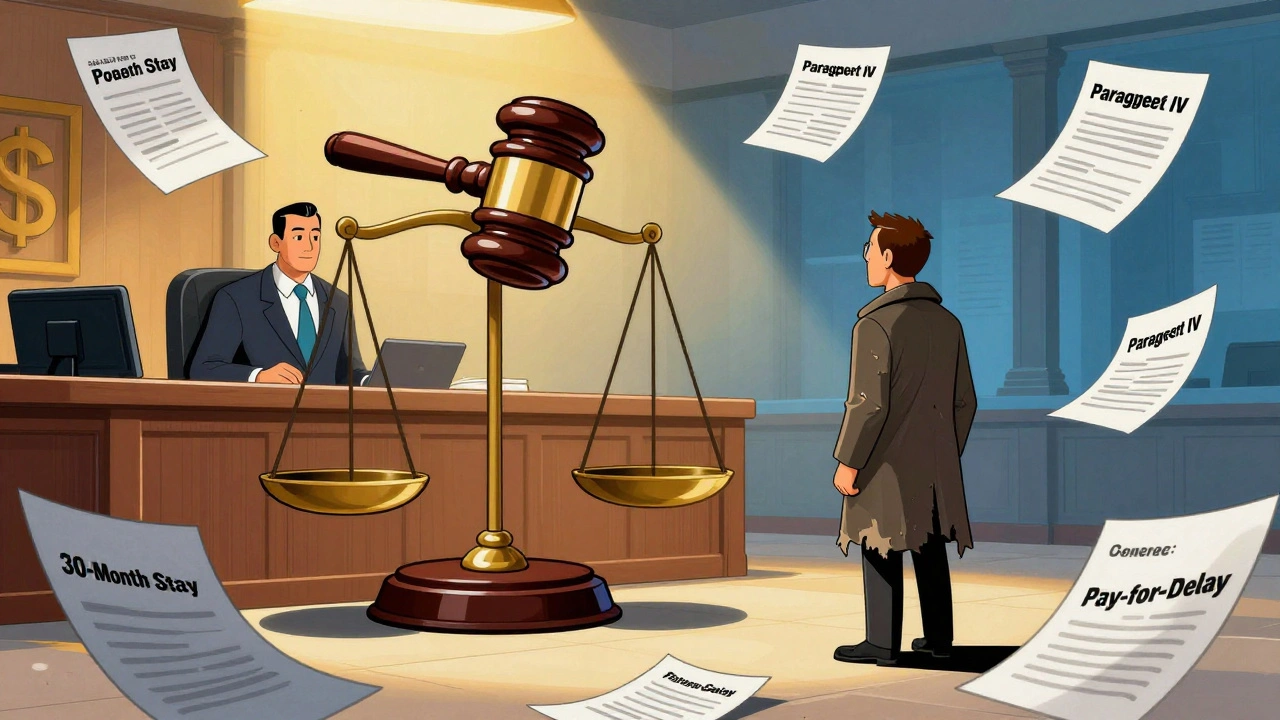
But there’s a catch. If a generic company believes a brand-name patent is invalid or won’t be infringed, it can file a Paragraph IV certification. This is a legal challenge. It’s essentially saying: ‘Your patent doesn’t block us.’ Once that happens, the brand company has 45 days to sue. And if they do, the FDA can’t approve the generic for up to 30 months-no matter how clear the case is.
This 30-month stay isn’t a trial. It’s a pause button. It gives the brand company time to litigate, but it also gives them leverage. Even if the patent is weak, the delay alone can kill a generic’s business case. The system was supposed to encourage competition. Instead, it became a tool for prolonging monopoly prices.
The Orange Book: Where Patents Are Listed-And Sometimes Abused
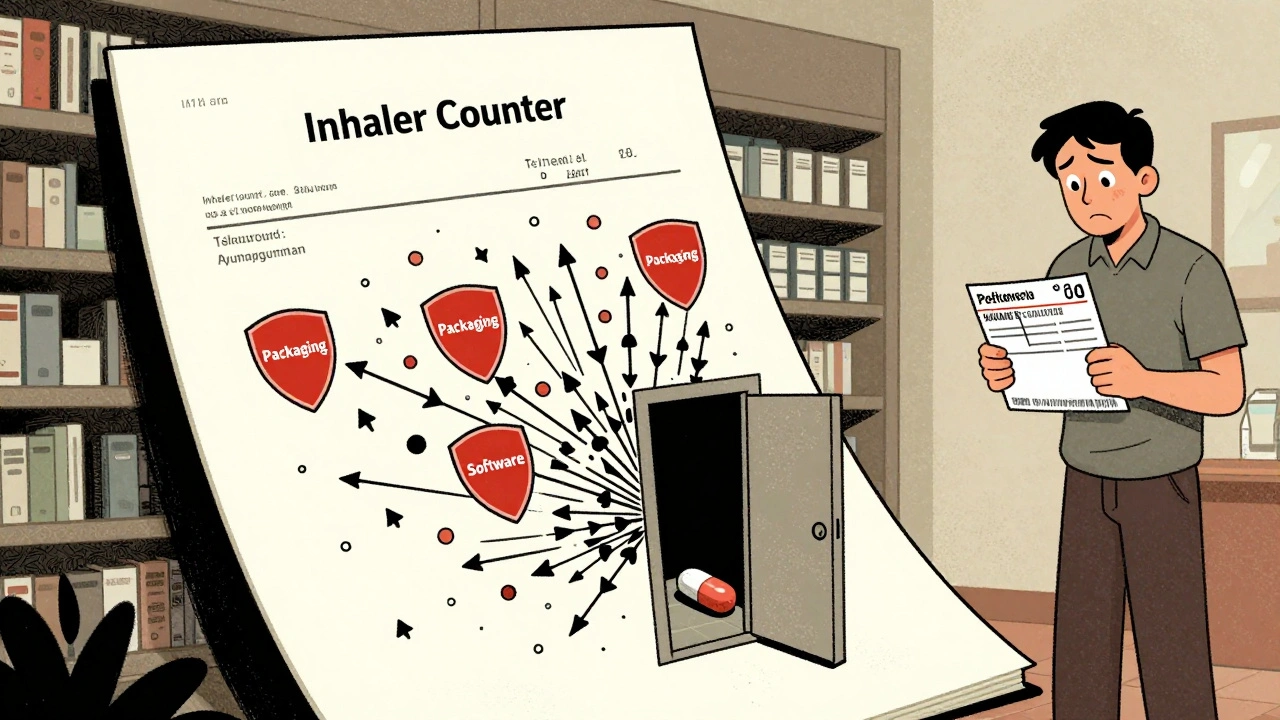
The Orange Book is the FDA’s official list of patents tied to brand-name drugs. It’s supposed to include only patents covering the active ingredient, how the drug is made, or how it’s used. But in practice, companies list patents that have nothing to do with the drug’s effectiveness.
In 2025, Judge Chesler in New Jersey ruled in Teva v. Amneal that patents on the dose counter in an inhaler didn’t qualify for Orange Book listing. Why? Because the drug is albuterol sulfate-not the inhaler’s mechanical parts. That ruling was a win for generics. But it’s not the norm. According to the Association for Accessible Medicines, brand companies routinely list patents on packaging, delivery devices, or even software used in the product. These aren’t about the medicine. They’re about extending control.
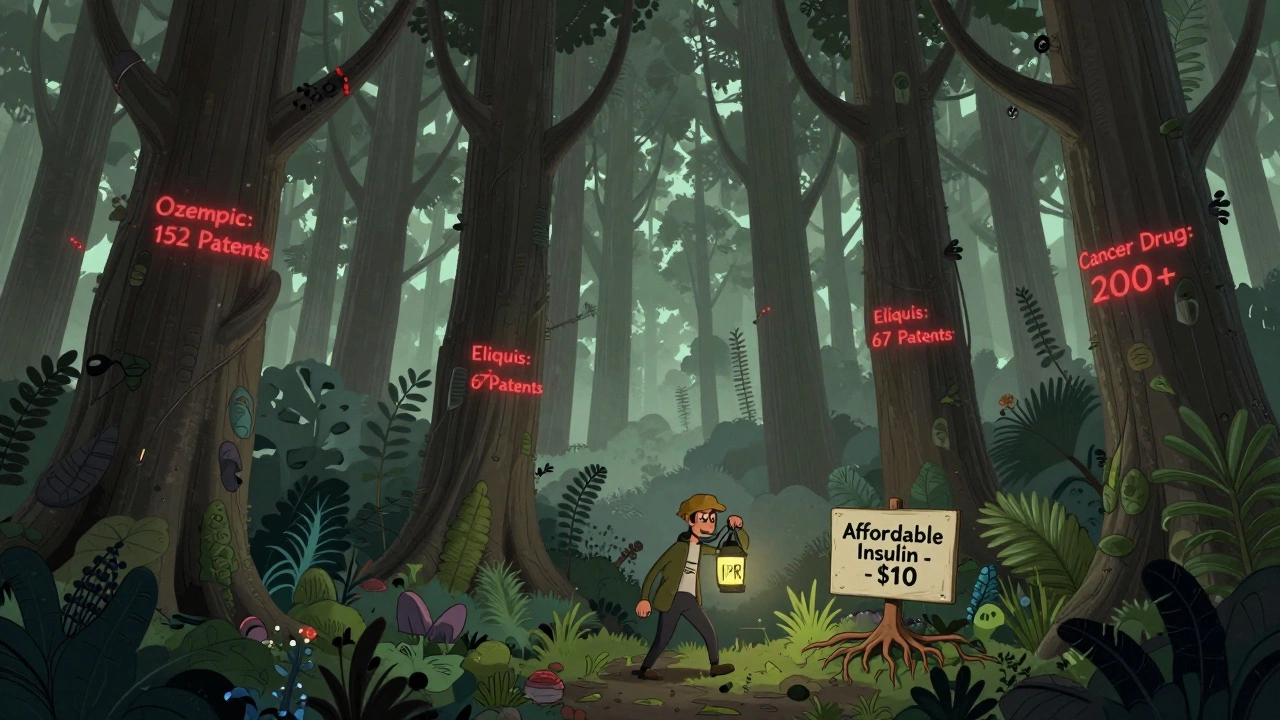
One drug, Eliquis (apixaban), has 67 patents. Ozempic and its cousins have 152. That’s not innovation. That’s a patent thicket-a dense forest of overlapping claims designed to confuse and exhaust generic challengers. The average brand drug now has 140 patents. For cancer drugs, it’s over 200.
Serial Litigation: The Slow-Motion Blockade
Brand companies don’t just file one lawsuit. They file many. One after another. This is called serial patent litigation. When the first patent expires, they sue again using a second patent they held back. Then a third. Then a fourth.
AAM’s 2025 report documented ten cases where generic entry was blocked for 7 to 10 years past the original patent’s expiration. One drug saw five separate lawsuits over five years. Each time, the 30-month stay kicked in. Each time, the generic manufacturer had to start over-spending millions on legal fees, delaying production, losing investor confidence.
It’s not just about winning cases. It’s about making the process so expensive and unpredictable that generics give up. Some never file a Paragraph IV challenge at all. Others wait years, hoping the legal storm will pass. Meanwhile, patients pay hundreds of dollars a month for drugs that could cost $10.
Pay-for-Delay: Settlements That Don’t Help Patients
Some cases don’t go to trial. They settle. And some of those settlements are called pay-for-delay. In these deals, the brand company pays the generic manufacturer to stay out of the market. The generic gets a cut of the profits. The brand keeps its monopoly. Patients pay more.
The FTC has challenged over 300 improper Orange Book listings in 2024 alone. In May 2025, they sent warning letters to 200 more patents across 17 drugs. They argue these settlements are anti-competitive. But industry groups like IQVIA say settlements actually speed up generic entry-by more than five years on average.
Here’s the contradiction: if settlements help generics get to market faster, why are they so often tied to cash payments? And why do those same generics rarely enter until months or years after the patent expires? The FTC’s data shows these deals rarely benefit patients. They benefit shareholders.
Why the Eastern District of Texas Is the New Patent Battlefield
Where do these lawsuits happen? The Eastern District of Texas is now the top venue for patent cases, with 38% of all filings in 2024. It’s not because it’s the most convenient. It’s because it’s known for being plaintiff-friendly. Juries there have a history of favoring patent holders. Judges are experienced in complex tech cases. The process is predictable-for the brand companies.
Before 2017, this district was the go-to for patent trolls. After the TC Heartland decision, activity dropped. But by 2024, it was back on top. Generic manufacturers hate it. They call it forum shopping. But with no national patent court, they have to play the game where it’s played.
The Rise of IPRs and the Supreme Court’s Curveball
Generic companies are turning to the Patent Trial and Appeal Board (PTAB) for help. Inter Partes Review (IPR) lets them challenge patents outside of court. It’s faster, cheaper, and often more effective. IPR filings against pharma patents jumped 47% from 2023 to 2024.
But in April 2025, the Supreme Court ruled in Smith & Nephew v. Arthrex that only parties directly harmed by a patent can challenge it. That’s a problem for generics. If they haven’t launched yet, they might not have standing. The ruling didn’t ban IPRs, but it made them harder to use-just when they were becoming the best tool to break through patent thickets.
What’s Changing? Regulatory Pressure and New Rules
The FTC and DOJ held joint hearings in March 2025, listening to generic manufacturers describe how Orange Book abuses delay care. The FDA is now proposing new rules: brand companies must certify under penalty of perjury that every patent they list actually meets legal requirements. That change could hit 15-20% of current listings. Implementation is expected in Q2 2026.
That’s not enough. The system still lets companies stack patents, delay entry, and pay off competitors. Congress has heard the complaints. But no major reform has passed. Meanwhile, the cost to the healthcare system? $13.9 billion a year-just from delayed generic access.
What’s Next? The Numbers Don’t Lie
The average time from brand drug approval to first generic entry has doubled since 2005-from 14 months to 28 months. For oncology drugs, it’s now 5.7 years after patent expiry. Law firms like Fish & Richardson and Quinn Emanuel are seeing 35-40% revenue growth in patent litigation. That’s not because they’re doing more good work. It’s because the system is broken, and the stakes are higher than ever.
Patents were meant to protect innovation. Now, they’re being used to protect profits. And the people who pay the price aren’t shareholders. They’re the ones holding a prescription, wondering if they can afford the medicine they need to live.
Why don’t generic drugs enter the market right after a patent expires?
Even after a patent expires, generic manufacturers can be blocked by other patents listed in the FDA’s Orange Book. Brand companies often file multiple patents covering minor aspects like packaging or delivery devices. If a generic challenges any of these, the brand can sue and trigger a 30-month FDA approval delay. This process can be repeated with new patents, pushing generic entry years past the original patent’s end.
What is a Paragraph IV certification?
A Paragraph IV certification is a legal statement filed by a generic drug manufacturer with the FDA, claiming that a brand-name drug’s patent is invalid, unenforceable, or won’t be infringed. This triggers a 45-day window for the brand company to sue. If they do, the FDA cannot approve the generic for up to 30 months, regardless of whether the patent is strong or weak.
Are pay-for-delay settlements illegal?
Pay-for-delay settlements are not automatically illegal, but they’re heavily scrutinized by the FTC. If a brand company pays a generic manufacturer to delay market entry, it can be considered an anti-competitive agreement. The FTC has challenged over 300 such deals since 2020, arguing they harm consumers by keeping drug prices high. Courts have ruled some of these settlements unlawful, but enforcement remains inconsistent.
How do patents on inhalers or packaging affect drug access?
Patents on delivery devices, packaging, or software aren’t about the drug’s chemical effect-they’re about controlling how the product is used. Brand companies list these in the Orange Book to trigger litigation stays. In 2025, a court ruled that patents on an inhaler’s dose counter didn’t qualify because they didn’t claim the drug itself. That decision may invalidate thousands of similar listings, but until regulations change, these tactics continue to delay generics.
Why is the Eastern District of Texas so popular for patent lawsuits?
The Eastern District of Texas has become a favored venue because its judges are experienced in patent law, procedures are predictable for plaintiffs, and juries have historically awarded higher damages. After a 2017 Supreme Court ruling temporarily reduced its dominance, brand companies returned in large numbers. In 2024, it handled 38% of all patent cases-more than any other district. Generic manufacturers often oppose it as a form of forum shopping that tilts the legal playing field.
What’s the impact of patent thickets on generic drug development?
Patent thickets-hundreds of overlapping patents on a single drug-make it nearly impossible for generics to navigate without legal risk. For example, oncology drugs can have over 200 patents. Even if one patent is invalid, another might still block entry. This forces generics to spend years in litigation or abandon attempts entirely. The result? Fewer generics, higher prices, and delayed patient access to affordable treatment.
Comments (9)
Joel Deang
December 2, 2025 AT 16:10bro this is wild i just found out my insulin costs 3x what it should ngl 😭
Roger Leiton
December 3, 2025 AT 02:19yeah i read this whole thing and it’s insane how the system is rigged 🤯 like why do we even have patents if they’re just being used as legal shields for profit? i thought the whole point was to encourage innovation not create monopoly traps. the orange book abuse is straight up predatory and the fact that courts let this slide is criminal. also the eastern district of texas thing? that’s not justice that’s corporate lobbying with robes.
मनोज कुमार
December 3, 2025 AT 14:01Paragraph IV certification is a joke. Brand firms game the 30-month stay like it’s a free pass to extend monopolies. No real innovation just legal theater. The system is broken and everyone knows it. Why are we still pretending this is fair? 🤷♂️
Paul Keller
December 4, 2025 AT 22:19It is an undeniable fact that the current regulatory framework governing generic pharmaceutical entry has been systematically subverted by strategic patent litigation. The Hatch-Waxman Act, while well-intentioned, has been weaponized by incumbent firms to delay market competition. The aggregation of non-essential patents in the Orange Book constitutes a form of regulatory arbitrage that directly undermines public health objectives. Furthermore, the proliferation of serial litigation and forum shopping in jurisdictions such as the Eastern District of Texas indicates a structural failure in the judicial system’s ability to enforce equitable access to therapeutics. The financial burden on patients is not incidental-it is a direct consequence of institutional capture.
Shannara Jenkins
December 5, 2025 AT 14:39My dad’s on Ozempic and he can’t afford the generic even after 5 years. I just cried reading this. We need to fix this. Like, now. 💔
Steve Enck
December 7, 2025 AT 05:14One must interrogate the epistemological foundations of intellectual property in the pharmaceutical sphere. Are patents truly incentives for innovation, or have they become instruments of rent extraction under the guise of legal protection? The empirical data suggests the latter. The patent thicket phenomenon-particularly evident in oncology-is not an accident of market dynamics but a deliberate strategy of obfuscation. When 200+ patents are layered atop a single molecule, the notion of ‘invention’ dissolves into a computational exercise in legal engineering. The Supreme Court’s recent standing restriction in Smith & Nephew v. Arthrex merely codifies this decay. We are not witnessing a failure of policy-we are witnessing the triumph of capital over care.
Jay Everett
December 8, 2025 AT 21:48bro the fact that Eliquis has 67 patents and Ozempic has 152 is wild 😤 like imagine if you made a car and then patented the color of the seatbelt buckle. that’s what’s happening here. the whole system is built on loopholes and lawyers getting rich while people skip doses. i’m not mad, i’m just disappointed. 🙃 the FTC’s pushing back but they’re fighting a war with napkins. we need a full overhaul. #GenericJustice
Elizabeth Grace
December 9, 2025 AT 02:09my sister had to choose between her chemo and her rent last year. i can’t even type this without crying. how is this still a thing in 2025? someone please fix this. please.
Lynn Steiner
December 10, 2025 AT 03:21These foreign generics are stealing our innovation. We built this system, and now the world wants to tear it down. Americans deserve protection. This isn’t about drugs-it’s about sovereignty. 🇺🇸