
Decongestant Safety Calculator
Check Your Safety
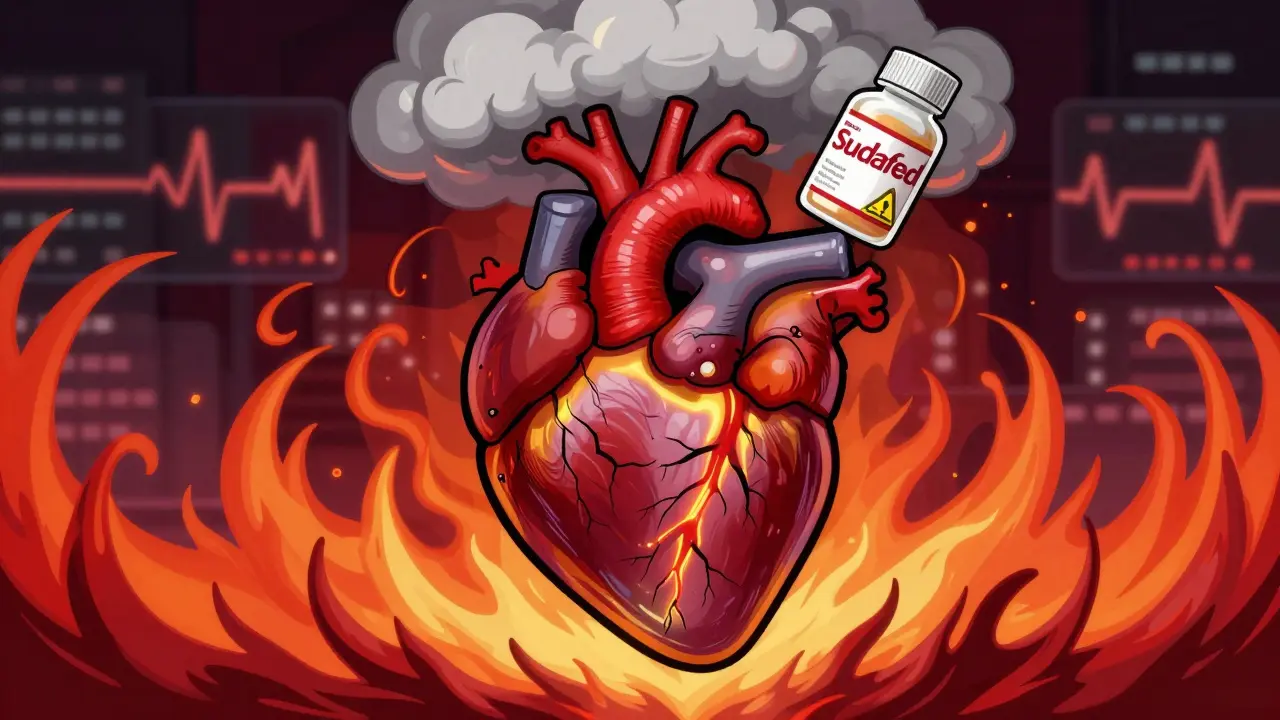
If you have heart disease or high blood pressure, a stuffy nose isn’t just annoying-it could be dangerous. Over-the-counter decongestants like Sudafed or Afrin might seem like a quick fix for cold symptoms, but for people with heart conditions, these meds can push blood pressure to dangerous levels, trigger irregular heartbeats, or even lead to a heart attack or stroke. The problem isn’t just the dose-it’s how these drugs work in your body.
How Decongestants Really Work
Decongestants like pseudoephedrine and phenylephrine are designed to shrink swollen blood vessels in your nose. That’s why your nose clears up fast. But here’s the catch: these drugs don’t just target your nasal passages. They tighten blood vessels everywhere-including those around your heart and throughout your body. That’s how they raise your blood pressure.
Pseudoephedrine, the active ingredient in Sudafed, has been around since the 1920s. It’s an alpha-adrenergic agonist, meaning it mimics adrenaline. That’s great for opening up your sinuses, but bad news if your heart is already working too hard. Even a small increase in blood pressure can be risky if you have uncontrolled hypertension or a history of heart failure.
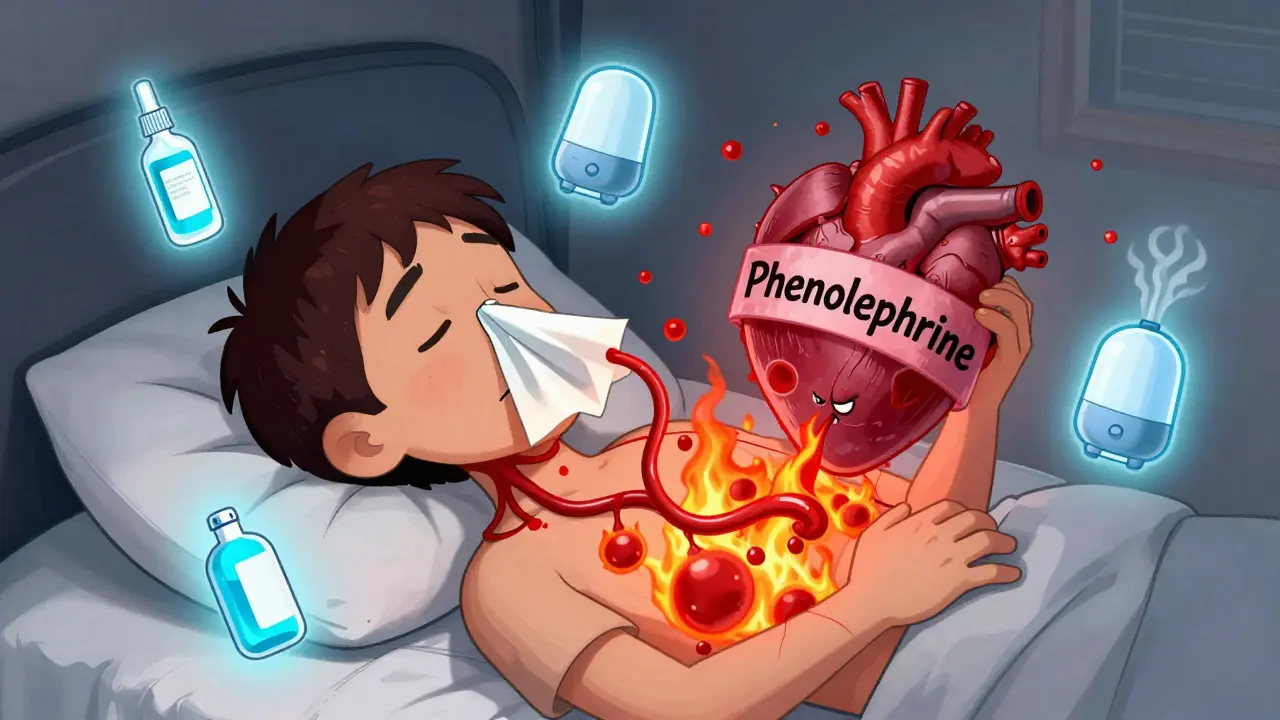
Topical sprays like oxymetazoline (Afrin) were thought to be safer because they’re applied locally. But that’s not always true. A 2015 case report in PubMed described a 40-year-old man who developed life-threatening heart failure after using too much naphazoline nasal spray. He didn’t take an overdose-he just used it longer than recommended. His body absorbed enough of the drug to trigger a malignant hypertensive crisis. That’s not rare. It’s a warning.
Who’s at Risk?
Not everyone with heart disease needs to avoid decongestants completely-but some people absolutely should. The American Heart Association says you should steer clear if you have:
- Uncontrolled high blood pressure
- Heart failure
- History of heart attack or stroke
- Irregular heartbeat (like atrial fibrillation or ventricular tachycardia)
- Prinzmetal’s angina (spasms in heart arteries)
Even if your blood pressure is usually stable, getting sick puts extra stress on your heart. A cold or flu raises your heart rate and causes inflammation. Add a decongestant on top of that, and your heart has to work twice as hard. A 2017 study of nearly 10,000 heart attack patients found that those who took NSAIDs while sick were more than three times as likely to have another heart attack within a week. Decongestants aren’t NSAIDs, but they do the same kind of damage under stress.
Children aren’t immune either. A documented case involved a 5-year-old girl who developed high blood pressure after taking the recommended dose of phenylephrine for four days. Her blood pressure didn’t return to normal until the medicine was stopped. No other cause was found. That’s not an outlier-it’s a red flag.
Oral vs. Nasal: Which Is Worse?
Oral decongestants like pseudoephedrine and phenylephrine hit your bloodstream fast and hard. A 2005 meta-analysis confirmed they cause a small but measurable rise in systolic blood pressure-especially with immediate-release formulas. That’s why pseudoephedrine is kept behind the pharmacy counter in the U.S. and UK. Pharmacists are supposed to ask if you have heart disease or high blood pressure before selling it.
Nasal sprays like oxymetazoline and naphazoline seem safer because they’re applied locally. But studies show they still affect your heart. One study of 100 patients found their heart rate jumped from 81 to 84 beats per minute after just seven days of use. That might sound small, but for someone with heart failure, even a few extra beats can strain the system. And if you use them longer than three days? You risk rebound congestion-and higher absorption of the drug into your blood.
There’s no safe nasal spray for someone with heart disease. The labels say so. The science says so. And the cases in medical journals confirm it.
What About Alternatives?
You don’t need decongestants to feel better. There are safer ways to manage congestion if you have heart problems:
- Saline nasal sprays-salt water rinses flush out mucus without affecting your blood pressure. Use them as often as needed.
- Humidifiers-adding moisture to the air helps thin mucus and reduces nasal swelling naturally.
- Guaifenesin (Mucinex)-this expectorant helps loosen phlegm. It doesn’t constrict blood vessels, so it’s safe for heart patients.
- Elevating your head-sleeping with an extra pillow reduces nighttime congestion without drugs.
- Steam inhalation-a hot shower or bowl of hot water with a towel over your head can open up your airways safely.
These don’t work as fast as pseudoephedrine-but they don’t risk your heart either. And if your symptoms are mild? The European Journal of General Medicine says skipping decongestants altogether is often the wisest choice. They treat symptoms, not the illness. And for people with heart disease, avoiding unnecessary stress on the heart is more important than feeling a little less stuffy.
What the Labels Don’t Tell You
Most decongestant bottles say “Do not use if you have high blood pressure or heart disease.” But people still take them. Why? Because they don’t realize how serious it is. They think, “I’ve taken this before, it’s fine.” Or, “It’s just one pill.”
But here’s the truth: the risk isn’t about how often you take it-it’s about your baseline health. If your blood pressure is already high, even a small boost from a decongestant can push you into danger. If your heart is weak, extra strain can trigger heart failure. If you have a history of arrhythmias, adrenaline-like drugs can set off a dangerous rhythm.
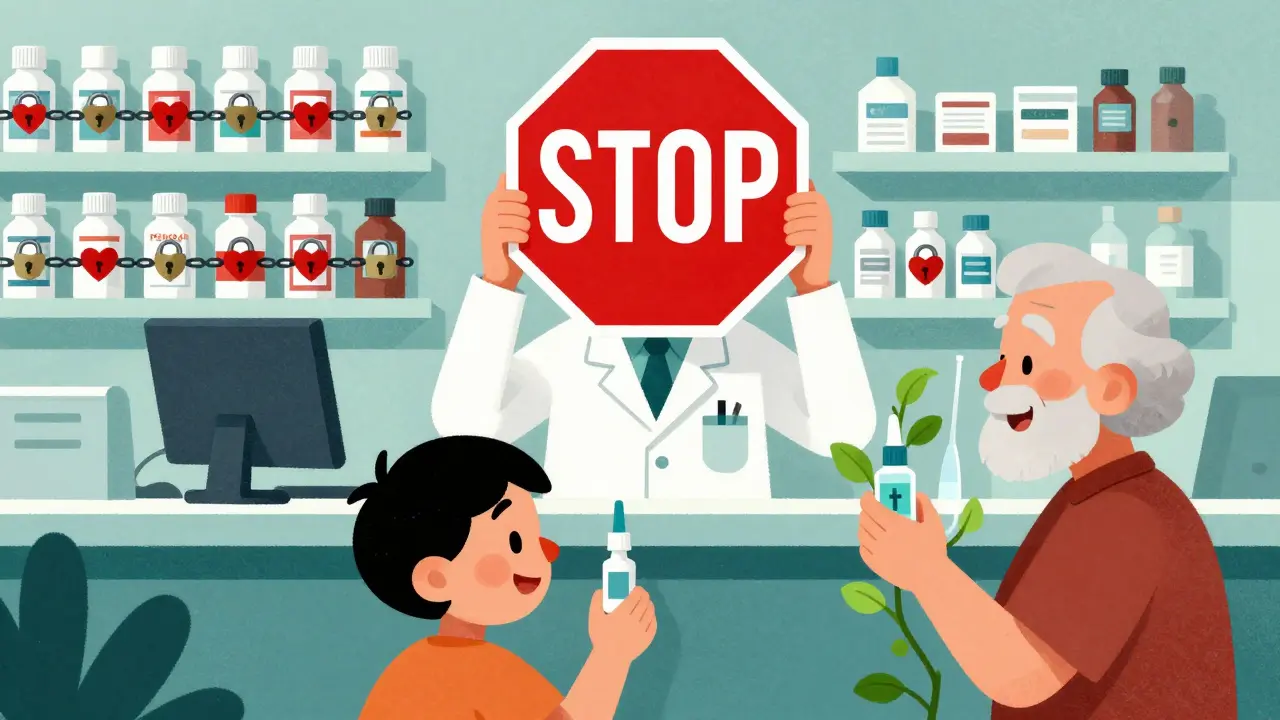
Pharmacists are trained to catch this. That’s why pseudoephedrine is behind the counter. They ask questions. They check your meds. They know the risks. If you’re buying it, they’re supposed to ask if you have heart disease. If they don’t, speak up. Tell them yourself.
What to Do If You’ve Already Taken One
If you have heart disease and you’ve taken a decongestant, watch for these signs:
- Headache you can’t explain
- Chest tightness or pressure
- Rapid or irregular heartbeat
- Dizziness or lightheadedness
- Shortness of breath
Stop taking the medicine immediately. Call your doctor. If symptoms are severe-like chest pain or trouble breathing-go to the emergency room. Don’t wait. These aren’t side effects you can ignore. They’re warning signs your heart is under stress.
Even if you feel fine, it’s worth checking your blood pressure. If it’s higher than usual-even by 10 or 15 points-that’s a signal. Don’t assume it’s just stress from being sick. The drug could be the cause.
Bottom Line
Decongestants are not harmless. For people with heart disease or high blood pressure, they’re a gamble with your life. The relief they offer is temporary. The risks are real-and sometimes deadly.
There’s no safe decongestant if you have uncontrolled hypertension, heart failure, or a history of heart attack. Even “mild” cases aren’t risk-free. The science is clear. The warnings are on the bottle. The cases in medical journals prove it happens.
Stick to saline sprays, humidifiers, and rest. Let your body heal naturally. If your symptoms last more than a week or get worse, see your doctor-not the pharmacy shelf. Your heart doesn’t need another burden. It’s already doing enough.
Comments (9)
Elaine Douglass
December 20, 2025 AT 08:09I had no idea decongestants could do this to your heart
My grandma takes Sudafed every winter and I always thought she was being dramatic about avoiding it
Now I get why she refuses
She’s got atrial fibrillation and she’s stubborn but smart
I’m gonna print this out and leave it on her kitchen counter
Takeysha Turnquest
December 22, 2025 AT 00:18We treat symptoms like they’re enemies to be crushed not signals to be listened to
Our medicine is built on domination not harmony
Decongestants don’t cure congestion they force it into submission
And the body pays the price in blood pressure spikes and arrhythmias
When did we stop trusting the body to heal itself
And start trusting chemicals to override it
Alex Curran
December 22, 2025 AT 00:26The 2015 case with the naphazoline spray is terrifying
One guy used it for 10 days instead of three and ended up in heart failure
That’s not an overdose that’s a systemic failure of how we teach people to use OTC meds
Pharmacists aren’t always there to ask questions
And most people just assume if it’s on the shelf it’s safe
Saline sprays work fine
Humidifiers cost less than a box of Sudafed
Why are we still doing this to ourselves
Lynsey Tyson
December 23, 2025 AT 00:20I used to take pseudoephedrine like it was candy until my BP spiked after a cold
My doctor looked at me like I’d just confessed to something dumb
Turns out I had borderline hypertension and didn’t even know it
Now I use saline rinses and sleep with two pillows
It’s slower but I feel better overall
Also my nose doesn’t feel like it’s been sandblasted
Edington Renwick
December 24, 2025 AT 13:11People don’t read labels because they’re lazy
And now they want the world to bend to their convenience
There’s a reason pseudoephedrine is behind the counter
It’s not because the government hates you
It’s because you’re a walking liability
Stop blaming the system when you ignore the warning on the bottle
And then wonder why your heart is acting up
Sarah McQuillan
December 26, 2025 AT 05:15This is all just Big Pharma fearmongering
They want you to buy saline sprays because they make more money off them
Decongestants have been around for 100 years
Millions of people use them
Where are the real stats on heart attacks caused by Sudafed
Not one case study from 2015
That’s not science that’s clickbait
My uncle took Afrin for 20 years and he’s 82 and still runs marathons
Aboobakar Muhammedali
December 26, 2025 AT 07:36I’m from India and we don’t even have pseudoephedrine over the counter here
It’s prescription only
My cousin had heart issues and his doctor told him if he takes decongestants he might not wake up
So we use steam and salt water
Simple stuff
And it works
Why do Americans think everything needs a chemical fix
Our grandparents healed with turmeric and rest
Maybe we lost something
Laura Hamill
December 27, 2025 AT 21:11I think this is all a lie to sell humidifiers
Also I saw a video on TikTok where a guy said decongestants are linked to the CIA
And now I’m scared
But also I think the government wants us to be congested so we’re less productive
Also I’ve been using Afrin for 6 months and I feel fine
My BP is 110/70
So what’s the problem
Alana Koerts
December 28, 2025 AT 03:52This post is just fear porn
Look at all the case reports
So what
One in a million
Meanwhile NSAIDs kill 100,000 people a year
But nobody bans ibuprofen
Why is this different
Because it’s easier to scare people than to fix the real problems
Like how the healthcare system doesn’t teach basic physiology
Also your alternatives are just common sense
Not news