
When you pick up a prescription, you probably don’t think about who made it or how much it cost to produce. But behind every pill, capsule, or injection is a complex system of labor, regulation, and economics - and the difference between a generic and a brand-name drug isn’t just in the price tag. It’s in the people, the processes, and the pressure to cut costs without cutting corners.
Why Generic Drugs Are So Much Cheaper
Generic drugs cost 80-85% less than their brand-name counterparts. That’s not because they’re made from cheaper ingredients. The active pharmaceutical ingredient (API) is identical. The difference lies in what happens after the molecule is created. Brand-name drugs carry the weight of a $2.6 billion R&D bill - a decade-long journey from lab to pharmacy shelf. Generic manufacturers skip all that. They don’t pay for clinical trials, patent filings, or marketing campaigns. Their biggest challenge? Making the same drug as cheaply as possible - and still meeting strict FDA standards.Labor Costs: The Hidden Split
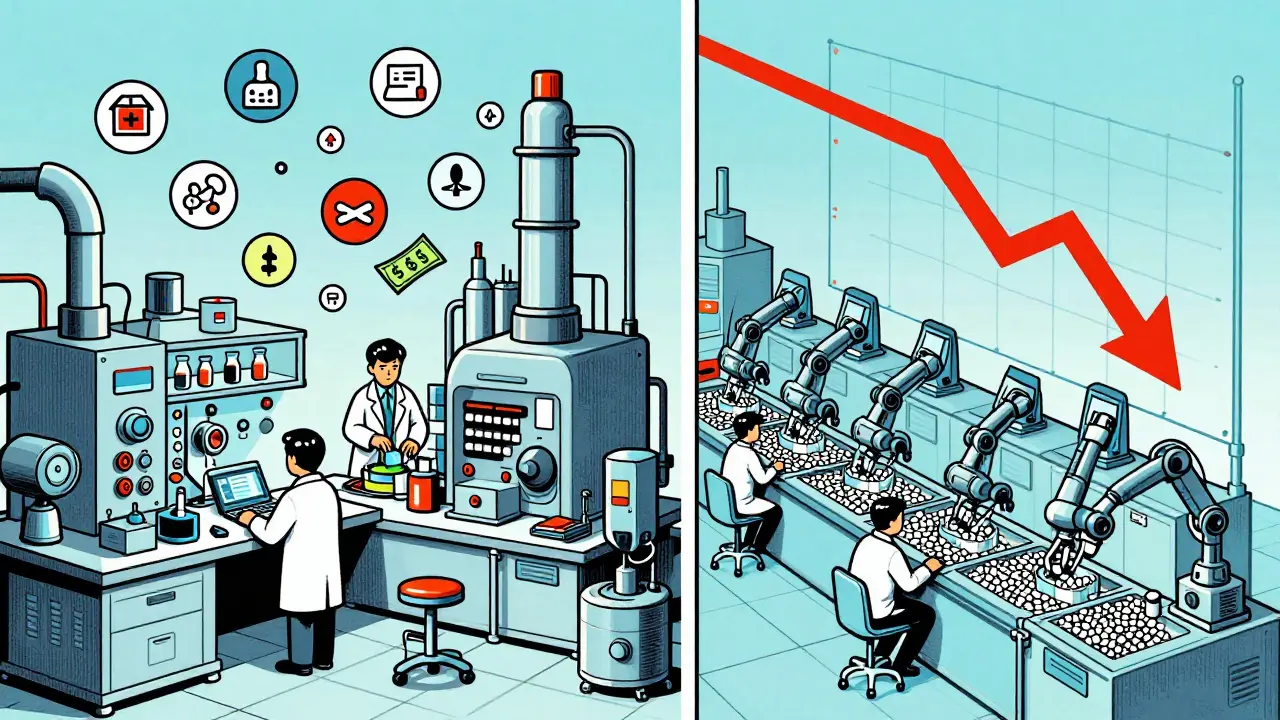
Labor makes up a big chunk of production costs. For brand-name drugs, it’s 30-40%. For generics, it’s 15-25%. Why such a gap? Brand-name manufacturers run small batches. Each batch is unique. They need highly trained chemists, pharmacists, and quality control specialists to tweak formulas, test stability, and document every step. A single change in a manufacturing process can trigger a new FDA review. That means more hands on deck - and more hours logged. Generic manufacturers? They run the same recipe, over and over. One production line might make millions of tablets a day. That kind of volume changes everything. When output doubles, labor costs per unit drop by 27% - more than twice the efficiency gain seen in brand-name production. It’s not that generic workers are paid less. It’s that one worker can produce far more.Quality Control: The Biggest Labor Drain
You’d think cheaper drugs mean looser standards. But that’s not true. In fact, quality control eats up more than 20% of total generic production costs. Every batch of generic medicine must be tested for purity, potency, dissolution rate, and contamination. Each test requires trained technicians. Each result must be documented, signed off, and stored for years. A medium-sized generic maker spends about $184,000 a year just on compliance systems. Add in $1.9 million for regulatory programs and $320,000 per new drug application - and you’re looking at a labor-heavy infrastructure that never stops. The FDA doesn’t cut slack just because the drug is generic. In fact, they inspect generic plants just as often as brand-name ones.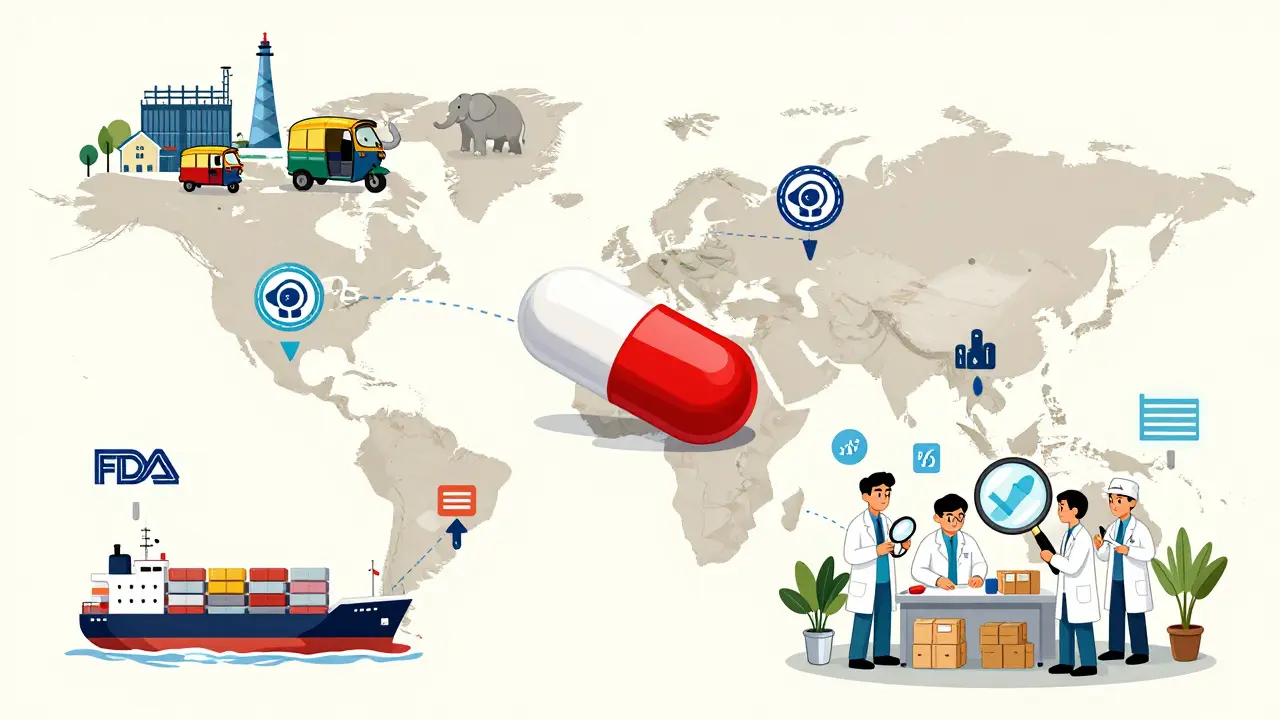
Where the Work Happens: Global Labor Arbitrage
The cheapest place to make a drug isn’t in the U.S. or Europe. It’s in India and China. API production there is 42% cheaper than in the U.S. That’s not because workers are more skilled - it’s because wages are lower, environmental rules are looser, and governments offer subsidies. About 36% of the total cost of a generic drug comes from production and manufacturing. Of that, a big slice goes to overseas suppliers. That’s why your $5 generic blood pressure pill might have been made in Hyderabad, shipped to a U.S. packaging facility, and then sent to your pharmacy. The labor cost isn’t gone - it’s just moved across an ocean.Contract Manufacturing: Outsourcing the Labor
More and more generic companies are turning to contract manufacturers (CMOs). Instead of owning factories, they outsource production. In biosimilars - a growing segment of generics - nearly 42% of manufacturing costs go to CMOs. That’s up from 28% for traditional small-molecule generics. Why? Because it’s flexible. If demand drops, you don’t lay off workers - you just order less. If demand spikes, you scale up without buying new equipment. It turns fixed labor costs into variable ones. But it also means less control. If a CMO cuts corners on staffing or training, the ripple effect hits patients.The Pressure Cooker: Competition and Cost-Cutting
Nine out of ten prescriptions in the U.S. are for generics. That sounds like a good thing - and it is. But with so many companies making the same drug, prices get crushed. When a third or fourth generic enters the market, the price can drop by 50% in months. That pressure forces manufacturers to find savings - and labor is the easiest target. Some companies reduce shifts. Others hire less experienced staff. Some cut back on training. The FDA has warned that this could lead to supply shortages and quality issues. A 2023 report noted: “Increasing attention is being paid to whether the lower cost of generic drugs may place pressure on companies to adopt strategies that lower the cost of manufacturing.”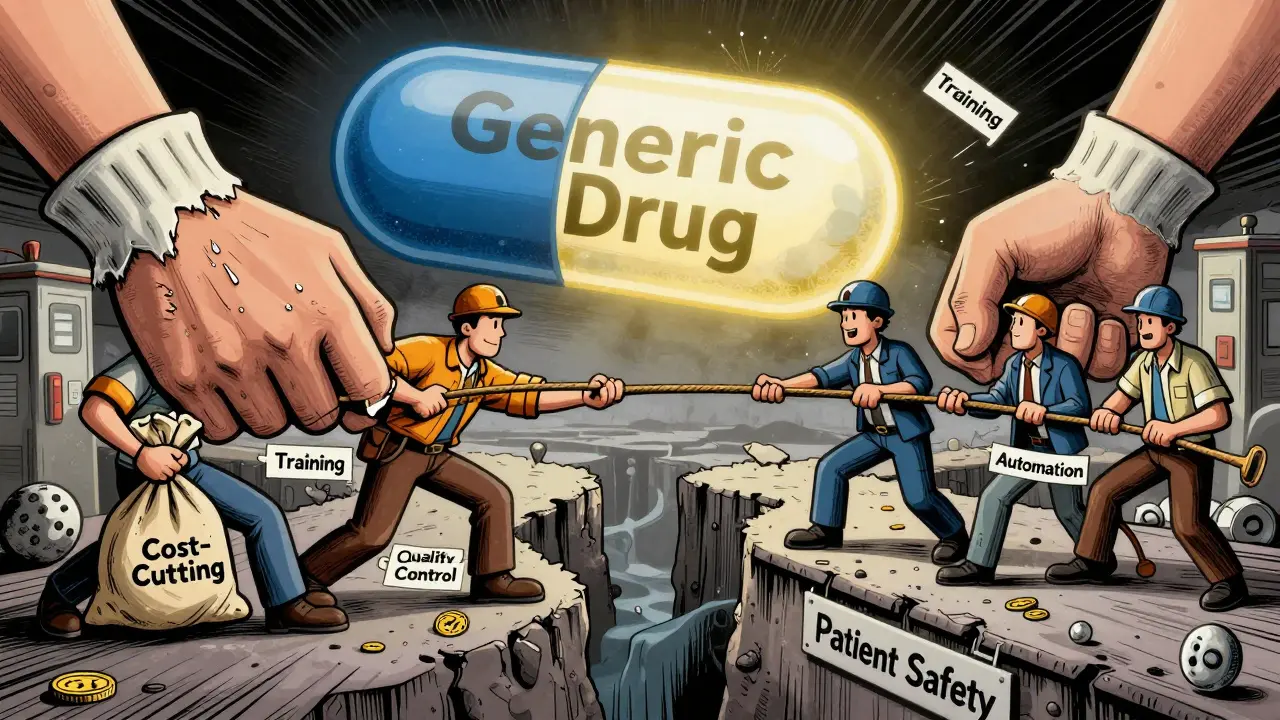
What Keeps Generic Manufacturing Alive
Despite the pressure, the best generic manufacturers aren’t cutting corners - they’re investing smarter. They spend on prevention: better training, automated testing, digital record-keeping. One company reduced rework by 40% by training staff to spot errors before they happened. That saved more money than hiring cheaper labor ever could. The key insight? Labor efficiency isn’t about paying less. It’s about making every hour count. A well-trained team that produces fewer defective batches saves more than a dozen underpaid workers who need constant retesting.Brand Drugs: Why Labor Costs Stay High
Brand-name manufacturers aren’t wasteful. They just have different priorities. Their labor isn’t focused on volume. It’s focused on innovation. A single new drug might require 150 scientists working for years. They’re not making pills - they’re designing new ways to deliver medicine, testing combinations, and solving side effects. Their labor costs are high because they’re solving problems no one else has solved. Generic makers don’t need that. They need consistency. Speed. Scale. And that’s why their labor model looks so different.What This Means for You
When you choose a generic, you’re not just saving money. You’re supporting a system that’s built on efficiency, not innovation. You’re benefiting from economies of scale, global supply chains, and fierce competition. But you’re also relying on a fragile balance - one where cost-cutting can quickly turn into risk. The next time you refill a prescription, remember: that low price isn’t magic. It’s the result of thousands of hours of labor, tightly managed, globally coordinated, and constantly pressured. And the people making it - whether in Birmingham, Bangalore, or Beijing - are the real engine behind the savings.Why are generic drugs cheaper if they’re the same as brand-name drugs?
Generic drugs are cheaper because they don’t carry the cost of research, development, marketing, or patent protection. Brand-name companies spend billions to discover and test a new drug. Generic manufacturers skip all that and copy the formula once the patent expires. Their main expenses are manufacturing, quality control, and compliance - and they achieve lower costs through high-volume production and global sourcing.
Do generic drugs use lower-quality labor?
Not necessarily. The FDA holds generic and brand-name manufacturers to the same quality standards. But the pressure to cut costs can lead some companies to reduce staff, hire less experienced workers, or cut training. This doesn’t mean the drugs are unsafe - regulators still inspect facilities - but it increases the risk of errors or shortages. The best generic producers invest in skilled labor and automation to avoid these pitfalls.
Is labor the biggest cost in generic drug production?
No. Labor is a major component, but not the biggest. Quality control - including testing, documentation, and compliance - accounts for over 20% of total costs. Raw materials (APIs and excipients) are the largest expense. Labor makes up 15-25% of total manufacturing costs, compared to 30-40% for brand-name drugs, thanks to economies of scale and streamlined processes.
Why do some generic drugs have supply shortages?
Supply shortages happen when manufacturers can’t make enough at a profit. Low prices, combined with rising regulatory and labor costs, squeeze margins. Some companies stop making low-margin drugs. Others outsource to unreliable suppliers. When one plant shuts down or fails an inspection, it can trigger a nationwide shortage - especially for drugs with only one or two manufacturers.
Are generic drugs made in the U.S.?
Yes, but not as often as you might think. About 80% of the active ingredients in U.S. generic drugs come from India and China. Final packaging and testing often happen in the U.S. or Europe. Some U.S.-based companies still manufacture generics domestically, but they face stiff competition from lower-cost overseas producers. The trend is toward outsourcing, not reshoring.
Does outsourcing labor to other countries hurt quality?
Not inherently. Many overseas manufacturers meet or exceed U.S. standards. The FDA inspects foreign plants just like domestic ones. But cost pressure can lead to corners being cut - in staffing, training, or maintenance. The real risk isn’t location - it’s whether the company prioritizes profit over reliability. The best generic makers, whether in the U.S. or abroad, invest in quality systems that prevent errors before they happen.
Comments (12)
Sarah Mailloux
January 14, 2026 AT 23:58Just had my generic blood pressure med refill and thought about this post. I don’t care who made it as long as it works. My pharmacist says the same batch hits shelves in 3 countries. If it saves me $40 a month, I’m not gonna lose sleep over it.
Jami Reynolds
January 16, 2026 AT 14:50Let’s be real - the FDA is a puppet of Big Pharma. They inspect generic plants ‘just as often’? Ha. The inspections are scheduled weeks in advance, and the inspectors are hired by the same contractors who work for the big pharma lobby. You think they’d let a plant with 15% labor costs pass if it wasn’t rigged? The ‘same standards’ are a myth.
Nat Young
January 17, 2026 AT 21:20Everyone’s missing the point. Labor cost % isn’t the story - it’s the inverse relationship between volume and defect rate. Generic plants have lower labor cost % because they’re optimized for zero variation. Brand-name plants have higher labor cost % because they’re optimized for variation. One’s a factory. The other’s a research lab with a pill press. Comparing them like they’re the same thing is like comparing a Tesla assembly line to a Ferrari hand-build shop. Different goals, same output.
Niki Van den Bossche
January 19, 2026 AT 15:19There’s a metaphysical truth here, buried beneath spreadsheets and FDA guidelines. The generic drug is not merely a chemical compound - it is a cultural artifact of late-stage capitalism’s surrender to efficiency. We’ve commodified healing. The pill, once a symbol of scientific triumph, is now a statistical optimization - a ghost of intention, manufactured by hands we’ll never see, in factories where dignity is measured in units per hour. And we call it progress.
But let’s not pretend we’re innocent. We’re the ones demanding $5 prescriptions while scrolling past news of Indian workers collapsing from heat exhaustion. We’re the beneficiaries of a silent, global extraction. The real question isn’t ‘how?’ - it’s ‘at what cost to the human soul?’
Arjun Seth
January 20, 2026 AT 00:36India makes 40% of the world’s generics - and we’re proud of it! Our workers are disciplined, hardworking, and follow every rule. Why do you think the FDA keeps approving us? Because we don’t cut corners - we work smarter! You Americans think you’re the only ones who care about quality. But we’ve been making life-saving medicine for decades, at prices you can’t even imagine. Don’t act like you’re saving money - we’re saving you.
Ayush Pareek
January 20, 2026 AT 05:54Really appreciate this breakdown. A lot of folks think cheaper = worse, but the truth is, the best generic makers are the ones investing in training and automation. I know a guy who works at a plant in Gujarat - they got a $2M grant to install AI-powered QC cameras. Now their defect rate is lower than some U.S. brand-name plants. It’s not about cheap labor - it’s about smart systems.
Amy Ehinger
January 21, 2026 AT 23:23I used to work in pharma logistics and saw firsthand how these supply chains work. One time, a shipment of metformin from India got stuck in customs for 3 weeks because the paperwork had a typo in the batch number. Meanwhile, people in rural Ohio were running out. It’s wild to think that something so small - a misplaced comma on a form - can cause a nationwide shortage. The system is so fragile, and nobody talks about it. We just assume the pills will be there.
And yet, we still get mad when the price goes up 10 cents. We’re the problem.
Crystel Ann
January 22, 2026 AT 04:23I’ve been on generics for 12 years. Never had an issue. My dad was on brand-name insulin for 20 years until it got too expensive - switched to generic, same result. The system works. The fear-mongering about quality is just noise. If you’re worried, talk to your pharmacist. They know which manufacturers are reliable. Don’t let fear drive your choices.
Iona Jane
January 22, 2026 AT 21:13They’re lying. All of them. The FDA doesn’t inspect foreign plants - they inspect the paperwork. The real factories? They’re hidden behind gated compounds. Workers are paid $1.50 an hour. They’re not allowed to talk to outsiders. The pills? They’re shipped in unmarked containers. And you think your $3 pill is safe? It’s a Russian roulette pill. One batch, one bad lot, and you’re dead. They’re not testing every pill. They’re testing one per 10,000. That’s not quality - that’s gambling with your life.
Jaspreet Kaur Chana
January 24, 2026 AT 15:29Bro, you gotta understand - in India, making medicine isn’t just a job, it’s a legacy. My uncle worked at a plant in Vadodara for 37 years. He taught his son how to calibrate the machines. His grandson now runs the QC team. This isn’t some sweatshop - it’s a family craft. We don’t cut corners because we know someone’s life depends on it. You think your grandma’s blood pressure pill was made by some faceless robot? Nah. It was made by a man who’s been doing this since before you were born.
And yeah, we make it cheap. But we make it right. Because we’re not just selling pills - we’re selling trust.
Tom Doan
January 26, 2026 AT 09:35So let me get this straight - you’re telling me that the entire U.S. healthcare system is built on the backs of underpaid Indian laborers, while American consumers celebrate their $5 prescriptions as if they’ve won the lottery? And you call this ‘efficiency’? This isn’t capitalism - it’s colonialism with a pharmacy receipt.
Sohan Jindal
January 27, 2026 AT 21:25Let’s cut the BS. We import 80% of our medicine from China and India because we’re weak. We gave up making stuff. We gave up our factories. We gave up our workers. Now we’re shocked when the pills stop coming? This isn’t about labor costs - it’s about national suicide. We used to make everything. Now we make memes. And we wonder why we’re falling behind.