
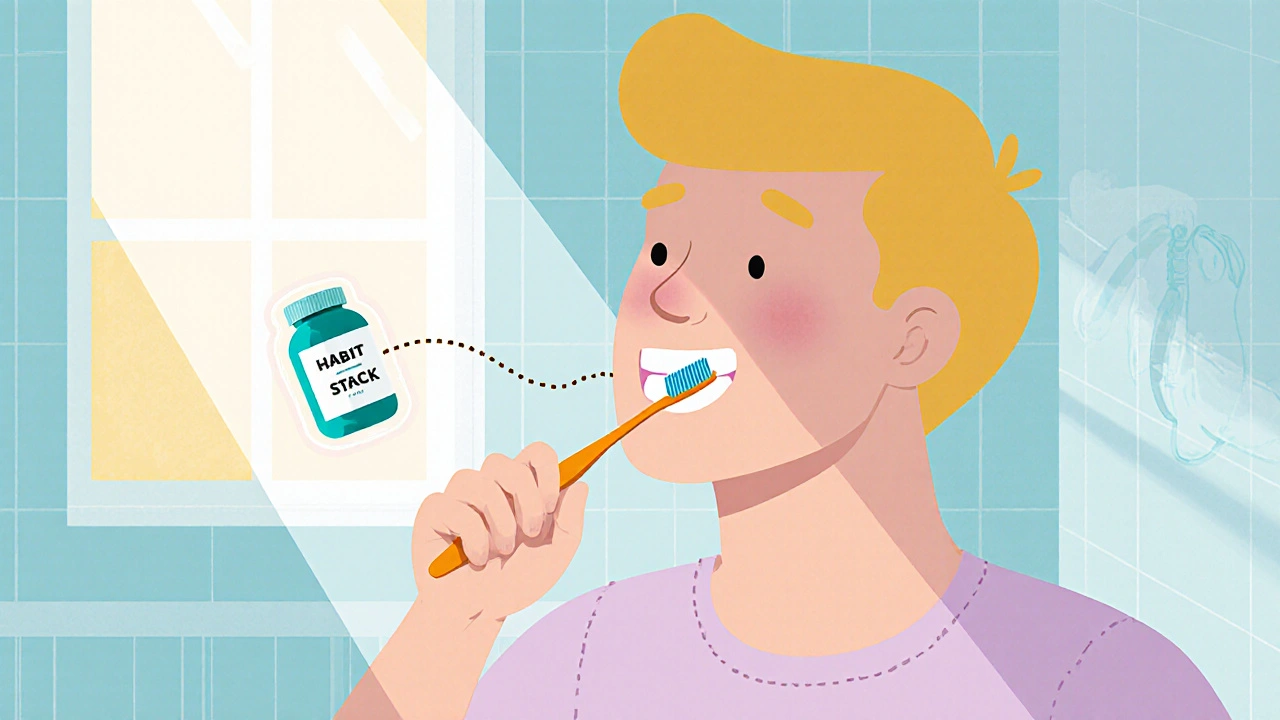
Taking your medicine every day shouldn’t feel like a battle. Yet for millions, it is. Whether it’s high blood pressure, diabetes, depression, or asthma, missing doses isn’t just inconvenient-it’s dangerous. The medication adherence problem isn’t about forgetfulness alone. It’s about willpower running out, routines breaking down, and life getting in the way. But here’s the good news: you don’t need to rely on willpower. You need better habits. And habits? They’re built with tricks-simple, proven behavioral tricks that turn taking pills into something automatic, like brushing your teeth.
Start with the simplest trick: tie it to something you already do
Your brain loves routines. It’s wired to link new actions to existing ones. That’s why pairing your medication with a daily habit works better than setting an alarm alone. If you brush your teeth every morning and night, take your pills right after. Same with breakfast, coffee, or bedtime. This is called habit stacking, and it’s one of the most effective tools in behavioral science. A 2020 study in Patient Preference and Adherence found that people who tied their medication to an existing routine improved adherence by 15.8%. Why? Because the cue-brushing your teeth-triggers the behavior without you having to think about it. No decision-making. No effort. Just action.Use a pill organizer-not as a backup, but as your main system
Pill organizers aren’t just for seniors. They’re for anyone who’s ever stared at a medicine bottle wondering, “Did I take it today?” A weekly pill box with morning, afternoon, and evening compartments turns abstract reminders into visible proof. If the compartment is empty, you took it. If it’s full, you didn’t. Simple. Visual. Hard to ignore. A 2021 study in the Journal of the American Geriatrics Society showed elderly patients using pill organizers missed 27% fewer doses. Even better? Choose one with a lock or a compartment that only opens at the right time. That’s not just organization-it’s behavioral design.Let your phone remind you-but make it personal
Smartphone reminders work. A 2021 meta-analysis in JMIR mHealth and uHealth found they boost adherence by 28.7%. But generic alarms? They get ignored. The trick is customization. Set the alarm to play a sound you actually respond to-not the default beep. Name the alert: “Take BP meds” instead of “Reminder 3.” Add a motivational note: “Your heart thanks you.” Some apps even let you track streaks. Seeing seven days in a row? That’s a dopamine hit. Your brain starts to crave the win. Apps that sync with your electronic health record and show progress over time improve adherence by 27.4%, according to the American Heart Association’s 2023 Digital Health Guidelines. Pick one that shows you how far you’ve come-not just what you need to do.Make it easier to refill than to run out
Running out of pills is one of the biggest reasons people stop taking them. And it’s often not because they forgot-it’s because refilling felt like too much work. Pharmacy auto-refill programs cut through that. When your prescription auto-renews and ships to your door, you remove the friction. A 2022 study in Medical Care found patients enrolled in auto-refill programs improved medication continuity by 33.4%. No calls. No trips. No delays. This isn’t just convenient-it’s behavioral engineering. You’re not asking yourself, “Should I refill?” You’re just receiving what you need. It’s like subscription coffee-except it’s keeping you alive.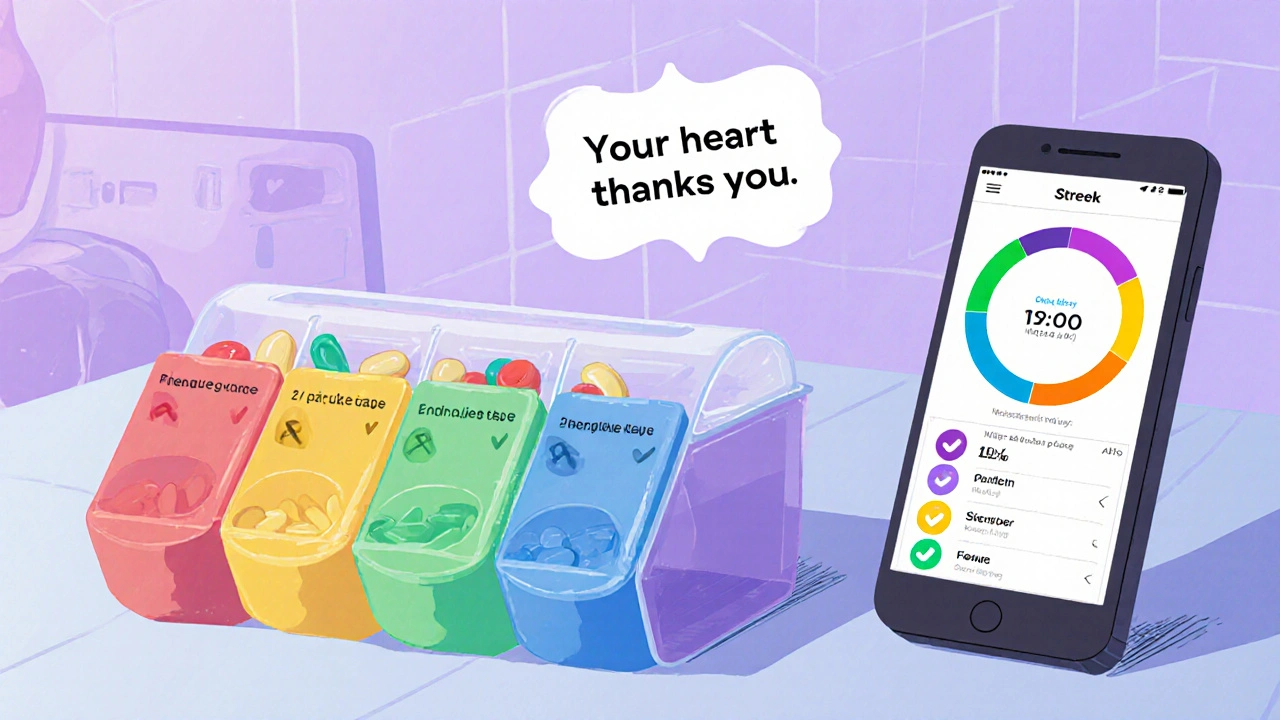
Track it. Not to judge yourself-to see your progress
Self-monitoring changes behavior. Writing down when you take your pills isn’t about guilt. It’s about awareness. A daily checklist-even just a sticky note on your fridge-increases adherence by 19.3% in people with bipolar disorder, according to research by Cochran in 2005. Use a calendar. Mark an X for each day you take your meds. After a week, you’ll see a chain. And humans hate breaking chains. That’s the “Seinfeld Strategy”-don’t break the streak. You don’t need fancy apps. A paper calendar and a pen work just as well. The act of marking it reinforces the habit. And when you miss a day? Don’t panic. Just restart. Progress isn’t perfect. It’s persistent.Reduce the number of pills you take
The more pills you have to take, the harder it is to remember them all. That’s not weakness-it’s math. A 2011 meta-analysis in the American Journal of Managed Care found that single-pill combinations (like a blood pressure pill that includes a diuretic) increased adherence by 26%. If your doctor prescribes three separate pills for the same condition, ask if a combo exists. Fewer pills = fewer decisions = fewer chances to slip up. Even cutting from four doses a day to two can make a huge difference. Dr. Jonathan Keigher, a clinical psychologist, says simplifying regimens reduces missed doses by up to 40% in his practice. Don’t assume you need to take everything as-is. Ask for options.Use incentives-small rewards for big results
Motivation isn’t just about fear of getting sick. It’s also about reward. Financial incentives work-especially for people struggling with cost. A 2022 study in Health Affairs showed low-income patients given small cash rewards for taking meds improved persistence by 34.2%. But you don’t need money. Create your own. After seven days of perfect adherence, treat yourself to a movie. After 30 days, buy that book you’ve been ignoring. Reward systems activate the brain’s reward pathway, making the habit more enjoyable. The key? Make the reward immediate and personal. Not “I’ll be healthier in six months.” But “I get to watch my favorite show tonight because I took my pills.”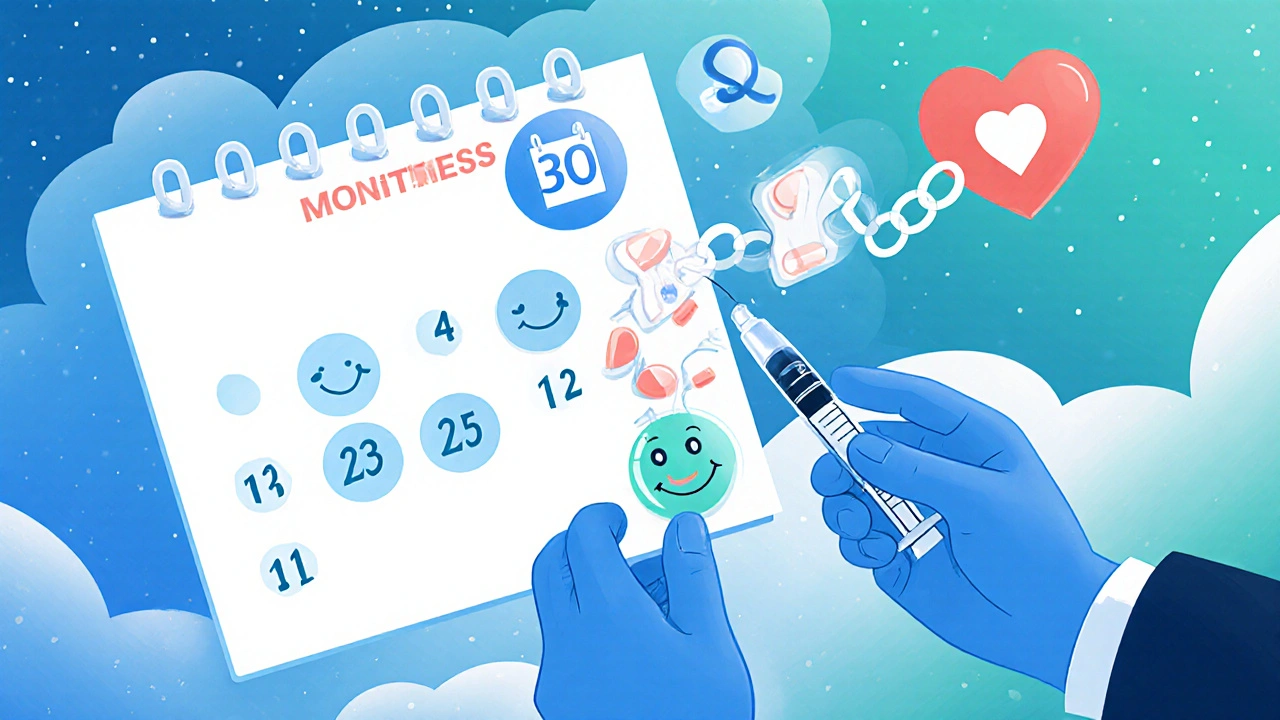
For tough cases: Talk to someone who gets it
Sometimes, the problem isn’t forgetfulness-it’s fear, shame, or anger. Maybe you hate how the meds make you feel. Maybe you don’t believe they work. Maybe you’re tired of being told what to do. That’s when motivational interviewing helps. It’s not about being lectured. It’s about having a conversation where you explore your own reasons for taking-or not taking-your meds. A 2020 review in Patient Education and Counseling found this approach improved adherence by 22.1%. A trained counselor doesn’t push. They listen. They help you find your own motivation. If you’re struggling emotionally, ask your doctor for a referral. This isn’t therapy for “mental health issues.” It’s therapy for sticking to your health.When nothing else works, consider long-acting options
If daily pills feel impossible, ask about long-acting injectables (LAI). These are shots given every few weeks or months instead of daily pills. For people with schizophrenia, bipolar disorder, or severe hypertension, LAIs have reduced non-adherence by 57% compared to oral meds, according to a 2022 meta-analysis in Schizophrenia Bulletin. Newer versions even have embedded sensors that tell your doctor if you’ve taken your dose. The first “smart” LAI, launched in 2023, showed 82% adherence in early trials-compared to 54% with standard LAIs. This isn’t for everyone. But if you’ve tried everything else and still struggle, it’s worth discussing. Sometimes, the best behavioral trick is removing the daily decision entirely.It’s not about being perfect. It’s about being consistent.
You’re not going to get it right every day. That’s normal. The goal isn’t 100% perfection. It’s 80% consistency. Even a 10% improvement in adherence can mean the difference between hospitalization and staying home. The most effective interventions combine multiple tricks: habit stacking, reminders, simplified regimens, and tracking. No single trick works for everyone. But when you layer them, they build on each other. Start with one. Master it. Then add another. Your body doesn’t need perfection. It just needs you to show up. And with these tricks, showing up becomes easier than skipping.What’s the #1 behavioral trick for medication adherence?
The most effective single trick is habit stacking-tying your medication to an existing daily routine like brushing your teeth or eating breakfast. Research shows this improves adherence by 15.8% because it turns the action into an automatic habit, not a conscious choice.
Do pill organizers really help?
Yes. A 2021 study found elderly patients using weekly pill organizers missed 27% fewer doses. The visual cue-seeing whether a compartment is empty or full-makes it impossible to forget. It’s not just storage; it’s a behavioral tool that reduces decision fatigue.
Are smartphone reminders effective?
Yes, but only if they’re personalized. Generic alarms get ignored. Customized alerts with your own voice note, a specific name like “Take BP meds,” and progress tracking improve adherence by 28.7%. Apps that sync with your health record and show streaks work best.
Can financial incentives help me take my meds?
Absolutely. A 2022 study showed low-income patients given small cash rewards improved medication persistence by 34.2%. Even non-monetary rewards-like a favorite snack or an episode of your show-work by linking the behavior to a positive feeling.
What if I hate taking pills?
Talk to your doctor about long-acting injectables (LAI). These are shots given every few weeks or months instead of daily pills. For people with serious mental illness or chronic conditions, LAIs have reduced non-adherence by 57%. Newer versions even track if you’ve taken your dose. It removes the daily burden entirely.
Why do I keep forgetting even when I set alarms?
Alarms alone don’t create habits-they just interrupt. The brain ignores constant interruptions. Combine alarms with habit stacking (taking meds right after brushing teeth) and visual tracking (a checklist or pill box). That’s when behavior changes. It’s not about remembering-it’s about making it automatic.
If you’ve been struggling with your meds, know this: it’s not your fault. The system isn’t designed for humans to remember things every day. But with these behavioral tricks, you’re not fighting your brain-you’re working with it. Start small. Pick one trick. Try it for a week. Then add another. You don’t need to be perfect. You just need to be consistent. And consistency? That’s what keeps you healthy.
Comments (15)
Jessica Healey
November 17, 2025 AT 11:05Just started tying my pills to my morning coffee and holy crap it’s working. No more panic-checking my pill bottle at 2pm. I used to forget like clockwork, now it’s automatic. Like brushing my teeth but less minty.
Gordon Mcdonough
November 18, 2025 AT 02:18Y’all are making this sound like some magical life hack but let me tell you-my mom’s on 12 meds and she still forgets half of them. Habit stacking? She brushes her teeth and then goes back to bed. No magic here. Just chaos. And no, she doesn’t have a phone. Or a pillbox. Or a clue.
Levi Hobbs
November 20, 2025 AT 00:39I’ve been using a pill organizer with a lock for six months now-and I can’t believe how much less mental energy it takes. I used to spend 10 minutes every morning stressing over whether I took my BP meds. Now? I open the compartment, see it’s empty, and move on. No guilt. No drama. Just efficiency. Also, the one I got has a little LED that glows at the right time. It’s weirdly satisfying.
Kelsey Robertson
November 21, 2025 AT 04:05Oh wow, another ‘behavioral trick’ article. Let me guess-next you’ll tell us to ‘visualize our pills’ or ‘hug our medication bottle for emotional support’. This isn’t self-help, it’s medicine. If you’re forgetting your pills, maybe you’re not supposed to be taking them. Or maybe your doctor’s prescribing too many. Stop blaming your brain and start questioning the system.
Sridhar Suvarna
November 21, 2025 AT 14:37From India, I can say-auto-refill is a game-changer. Here, pharmacies don’t even remind you. You have to go back yourself. But when I signed up for auto-refill through my insurer, my BP readings dropped within a month. No hype. Just science. And yes, it’s cheaper than driving to the pharmacy every 15 days. Especially with traffic.
Joseph Peel
November 22, 2025 AT 16:54For those dismissing reminders: they’re not the solution, they’re the scaffolding. The real work is building the habit. I used to set 5 alarms a day. Now I take my meds after my first sip of tea. The alarm? Still there. But I don’t need it anymore. That’s the goal-not more notifications, but fewer decisions.
Joseph Townsend
November 23, 2025 AT 19:36I tried the ‘Seinfeld Strategy’ with my antidepressants. Seven days in a row? I bought myself a $12 artisanal chocolate bar. 30 days? Got a new pair of sneakers. Now I’m at 89 days and I’ve started a ‘meds streak’ Instagram account. People are asking me for advice. I didn’t think my pills could be this… iconic.
Bill Machi
November 24, 2025 AT 11:11Let’s be real-none of this works if you’re poor. My cousin takes insulin. She skips doses because she can’t afford to refill. You think a pillbox helps when you’re choosing between food and meds? This article reads like a luxury blog. Real people aren’t ‘stacking habits.’ They’re choosing which organ to let fail first.
Kathryn Ware
November 24, 2025 AT 12:55Okay, I’ve tried almost all of these and the combo that actually stuck for me was: habit stacking + visual tracker + weekly reward. I use a giant wall calendar with red X’s, my meds go right after I pour my oatmeal, and every Sunday I treat myself to a 30-minute bubble bath with lavender salts. It’s not about being perfect-it’s about creating a ritual that feels like care, not punishment. I used to hate taking my meds. Now? I look forward to that quiet 2 minutes in the morning. It’s my tiny act of self-love.
henry mariono
November 25, 2025 AT 16:55I’m not sure if this is helpful, but I started using a dumb phone just for reminders. No social media. No games. Just one alarm labeled ‘PILLS’. It’s been 4 months. No missed doses. I didn’t need apps. I didn’t need streaks. I just needed silence.
Elia DOnald Maluleke
November 25, 2025 AT 22:08In my village in South Africa, we don’t have pill organizers. We have grandmothers. When my uncle started taking his antiretrovirals, his mother began sitting with him every morning at 7am, sipping tea while he swallowed his pills. No alarms. No apps. Just presence. The ritual became sacred. Adherence? 100%. Sometimes the oldest trick is the most human one.
satya pradeep
November 27, 2025 AT 10:04Guys i tried the pill box but i kept forgetting to fill it so i just started keeping my pills in my wallet next to my id. now i see em every time i pull out cash. works like a charm. also i use a free app called MedTrack (no ads) that just shows a big green check when you log it. no fancy charts. just check. boom. done.
Prem Hungry
November 29, 2025 AT 03:25As a healthcare worker in rural India, I’ve seen patients abandon treatment because the regimen is too complex. One man took 8 pills a day. We switched him to a combo tablet-now he takes two. His BP dropped, his mood improved, and he started showing up for follow-ups. Simplification isn’t a trick-it’s dignity.
Leslie Douglas-Churchwell
November 29, 2025 AT 13:45Let’s not pretend this isn’t Big Pharma’s new marketing ploy. Pill organizers? Apps? Auto-refill? All designed to keep you dependent on the system. What if the real solution is detoxing from pharmaceuticals altogether? Or maybe… you don’t need meds at all? Just eat clean, meditate, and trust your body. These ‘tricks’ are just shiny wrappers on the same poison.
Gordon Mcdonough
December 1, 2025 AT 01:18So you guys are all like ‘oh I use habit stacking’-but what about the people who don’t have routines? My life is chaos. I work nights. I sleep when I can. I don’t brush my teeth every day. I don’t even have a coffee habit. What’s my trick? The one that works for the broken ones?