
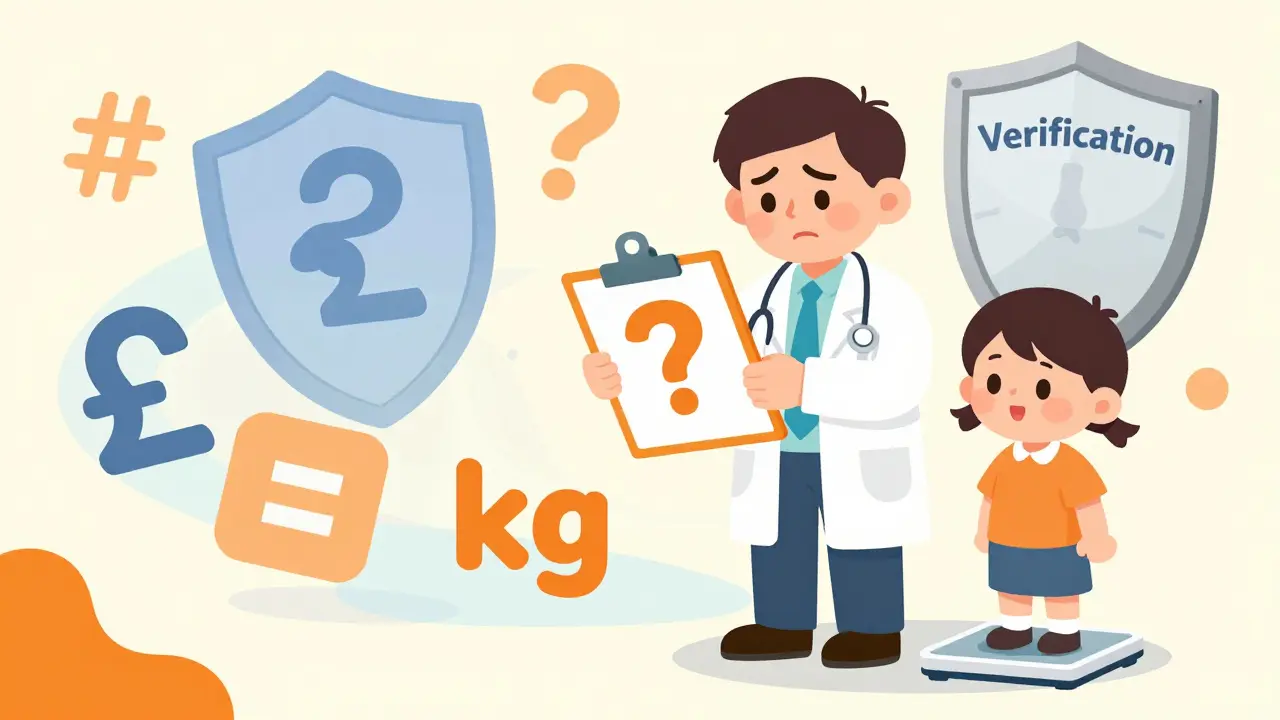
Imagine a child needing a life-saving antibiotic. The dose isn't fixed; it depends entirely on their body weight. A small calculation mistake-like confusing pounds for kilograms or using an outdated weigh-in-can turn that medicine into a danger. This is the reality of pediatric dispensing errors, a critical issue where children are three times more likely than adults to experience medication mistakes (WHO, 2016). The good news? We have powerful tools to stop this. By implementing strict weight-based verification systems, healthcare teams can catch these errors before they reach the patient.
Why Children Are at Higher Risk
Unlike adults, who often take standard pill doses, children require precise calculations based on their weight in milligrams per kilogram (mg/kg) or sometimes body surface area (mg/m²). This complexity creates multiple opportunities for error. According to the American Society of Health-System Pharmacists (ASHP), 15-20% of all pediatric medication errors stem directly from weight conversion miscalculations or using old weight data (ASHP Guidelines, 2018).
The stakes are high. A 2021 systematic review published in Frontiers in Pediatrics analyzed studies across 15 countries and found that 32.7% of dispensing errors involved incorrect weight-based math. Of those, 8.4% caused measurable harm to the child (Chua et al., 2021). For parents and clinicians alike, preventing these slips is not just about efficiency-it’s about survival.
- Conversion Errors: Mixing up pounds and kilograms is the most common culprit.
- Outdated Data: Using a weight from weeks ago when the child has grown or lost fluid.
- Decimal Mistakes: Misplacing a decimal point in manual calculations.
The Core Solution: Weight-Based Verification Systems
To combat this, we need a system that doesn’t rely on human memory alone. Weight-based verification systems are technology-driven protocols that force a check against the patient's current weight before any drug is dispensed. These aren't just optional add-ons; they are now considered a fundamental safety requirement.
The core principle is simple: if the system knows the child weighs 15 kg, and the order is for a drug dosed at 10 mg/kg, the system should automatically calculate 150 mg. If the pharmacist types 1500 mg, the system blocks it. This removes the mental math burden from busy staff and eliminates human calculation fatigue.
| Method | Error Reduction Rate | Key Limitation |
|---|---|---|
| EHR with Clinical Decision Support (CDSS) | 87.3% | Alert fatigue if poorly configured |
| Standalone Paper Protocols | 36.5% | Relies on human compliance |
| Barcode Medication Administration (BCMA) | 74.2% | Requires integration with EHR |
| Automated Dispensing Cabinets | 68.9% | Increases workflow time by ~2.3 mins |
Technology That Saves Lives: EHR and CDSS
The backbone of modern safety is the Electronic Health Record (EHR) integrated with Clinical Decision Support Systems (CDSS). When properly set up, these systems act as a safety net. A 2022 study in the Journal of the American Medical Informatics Association showed that EHR-integrated CDSS with weight-based alerts reduced dosing errors by 87.3% (Wong et al., 2022).
However, technology must be smart. Generic alerts lead to "alert fatigue," where clinicians ignore warnings because too many are false alarms. Recent updates, like Epic Systems' "Pediatric Safety Module 4.0" released in January 2024, use adaptive dosing limits based on growth percentiles rather than fixed weights. This reduced inappropriate alerts by 63.2% in testing (Epic Release Notes, 2024). The goal is to warn only when the dose is truly outside the expected range for that specific child's age and size.

Standardizing Measurements: Kilograms Only
One of the simplest yet most effective changes is eliminating unit confusion. The ASHP mandates that all pediatric facilities document weight in kilograms only. This single rule prevents the 12.6% of miscalculations that come from converting pounds to kilograms manually (ASHP Guidelines, 2018).
Hospitals must also upgrade their physical tools. The American Academy of Pediatrics (AAP) recommends digital scales that display only in kilograms, with precision to 0.1 kg for infants and 0.5 kg for older children (AAP Policy Statement, Dec 2021). If the scale shows pounds, you have already introduced a risk.
- Weigh the patient: Use a calibrated digital scale.
- Enter in kg: Input the weight directly into the EHR.
- Verify freshness: Ensure the weight is within 24 hours for acute care or 30 days for outpatient settings (ISMP, 2023).
The Human Factor: Training and Culture
Even the best software fails if people bypass it. Dr. Matthew Grissinger of the Institute for Safe Medication Practices (ISMP) emphasizes that mandatory weight-based verification must happen at three points: prescription entry, pharmacy verification, and bedside administration (ISMP Alert, March 2022).
Training is crucial. The ASHP recommends 40 hours of staff training per clinician during implementation (ASHP Implementation Guide, 2022). Staff need to understand why the alerts exist. Without this cultural shift, override rates skyrocket. In fact, a 2021 study found that 41.7% of weight-based alerts were overridden by clinicians, and 18.3% of those overrides were actual errors that should not have been ignored (JAMIA, 2021).
Pharmacist-led verification programs are particularly effective. Research shows they reduce administration errors by 15.8 percentage points, though they require adequate staffing-roughly 2.5 full-time equivalent pharmacists per 100 beds (Chua et al., 2021).

Real-World Challenges and Solutions
Implementation isn't always smooth. Boston Children’s Hospital saw weight conversion errors drop from 14.3 to 0.8 per 10,000 doses after switching to mandatory kilogram-only documentation, but pharmacist verification time initially rose by 37% (AJHP Case Study, 2022). This trade-off between speed and safety is real.
Community pharmacies face different hurdles. Many lack integrated EHR access, making it hard to verify a child's weight remotely. A survey noted that 28.4% of community pharmacists reported at least one weight-related near-miss monthly due to this gap (APhA Forum, Jan 2023). To mitigate this, standardized concentration protocols help. For example, standardizing vancomycin to 5 mg/mL simplifies the math significantly, reducing calculation errors by 72.4% compared to variable concentrations (Pediatric Drugs, 2023).
Future Directions: AI and Smart Verification
The future of pediatric safety involves smarter data. The FDA’s 2023 draft guidance proposes integrating growth charts into EHRs to flag doses that don't match a child's expected development (FDA Docket No. FDA-2023-D-1245). Meanwhile, ISMP is piloting "Smart Weight Verification" using AI to predict expected weight ranges based on historical data, achieving 92.4% accuracy in spotting documentation errors (ISMP Pilot Report, March 2024).
Despite these advances, experts like Dr. Robert Wachter remind us that technology is only part of the equation. A culture of safety, where staff feel safe reporting near-misses without fear of punishment, remains essential for any verification system to succeed (NEJM Commentary, Feb 2024).
What is the most common cause of pediatric dispensing errors?
The most common cause is weight conversion errors, specifically mixing up pounds and kilograms, followed closely by using outdated weight documentation. According to ASHP guidelines, these issues account for 15-20% of all pediatric medication errors.
How much do EHR systems reduce medication errors?
When properly configured with clinical decision support (CDSS), Electronic Health Record systems can reduce dosing errors by up to 87.3%. However, effectiveness drops significantly if the system generates too many false alarms, leading to alert fatigue.
Why is documenting weight in kilograms important?
Documenting weight exclusively in kilograms eliminates the need for manual conversion from pounds, which is a major source of calculation errors. Studies show that pound-to-kilogram conversion mistakes account for over 12% of pediatric dosing miscalculations.
What is "alert fatigue" in pediatric pharmacy?
Alert fatigue occurs when clinicians receive so many non-critical warnings from computer systems that they start ignoring them. In weight-based verification, 41.7% of alerts are often overridden, with nearly 20% of those overrides being actual errors that went unchecked.
How often should a child's weight be verified?
For acute care settings, weight should be measured and verified within 24 hours. For outpatient settings, the Institute for Safe Medication Practices recommends verifying weight every 30 days to ensure dosing remains accurate as the child grows.