
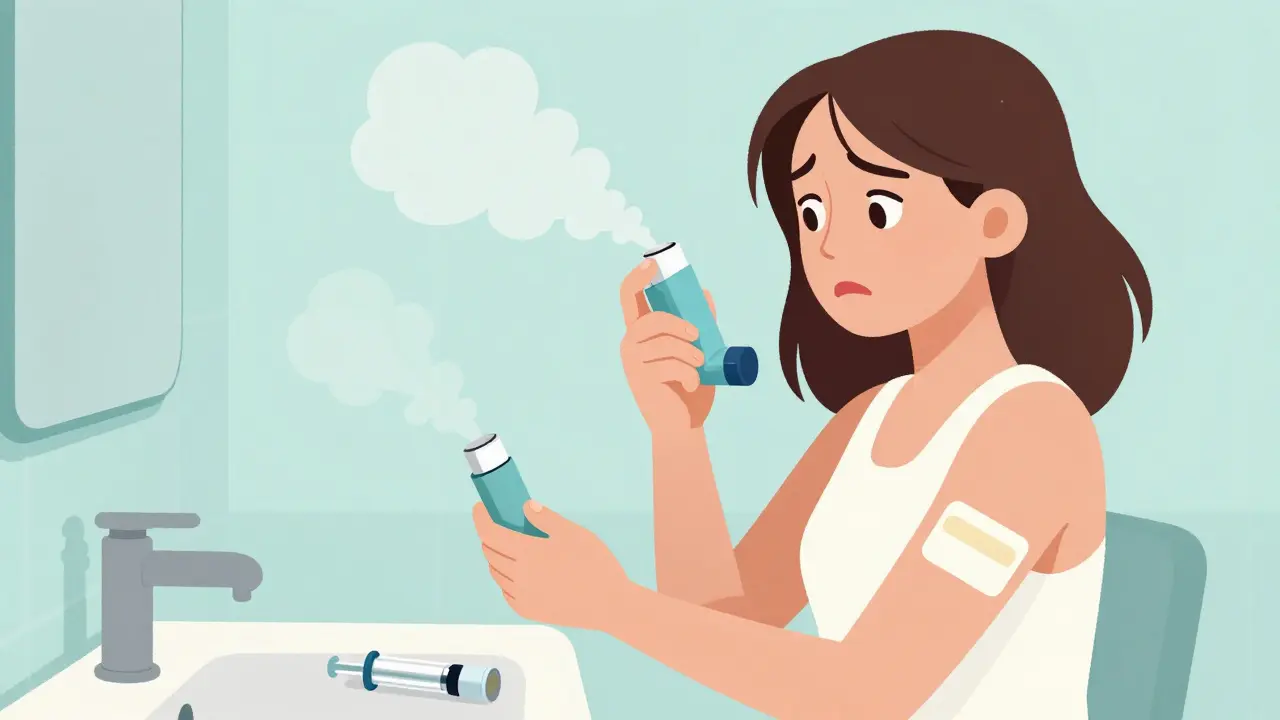
Every year, 125,000 Americans die because they don’t take their medications correctly. This isn’t just about forgetting pills-it’s a huge problem for inhalers, patches, and injectables too. If you or someone you care for uses these delivery methods, you’re not alone. Many people struggle to stick with their treatment plans. But there are practical steps you can take to improve medication adherence. This guide breaks down exactly how to do it, based on real-world research and expert advice.
Why medication adherence is hard for inhalers, patches, and injectables
Each delivery method has unique challenges. For inhalers, improper technique is common-up to 70% of users don’t use them correctly. This leads to poor medication delivery and worsened symptoms. Patches often cause skin irritation or fail to stick properly, especially during sweating or showering. Injectables face issues like needle fear, dosing errors, and complex storage requirements. The World Health Organization reports non-adherence rates between 30% and 70% across these methods. Without addressing these barriers, treatment effectiveness plummets.
Practical solutions for inhalers
Proper technique is key. Start by asking your pharmacist to watch you use your inhaler. Studies show training improves technique by 40%. For ongoing support, Propeller Health, a smart inhaler sensor system that tracks medication use and syncs data to smartphone apps attaches directly to inhalers. It records each use with 95% accuracy and syncs data to apps for reminders. A 2022 Respiratory Therapy study confirmed its precision. For COPD patients, electronic reminders improved adherence by 22% in clinical trial NCT02864342. Pharmacist-led counseling also works: a Dovepress review found it reduced severe COPD exacerbations by 32% and hospitalizations by 28%. Always check inhaler expiration dates and clean devices monthly to avoid blockages.
Improving patch adherence
Skin irritation and poor adhesion are common patch problems. Rotate application sites weekly-use different areas like the upper arm, back, or thigh-to prevent irritation. Clean the skin with water (no soap) before applying patches. For better stickiness, try adhesive patches like those from the American Diabetes Association. Their 2022 survey found 73% of insulin patch users appreciate discretion, but 31% struggle with irritation. If irritation persists, switch to hypoallergenic patches or use barrier creams. Some patches now include built-in adhesives that stay secure for 48 hours, even during exercise or bathing. Always store patches at room temperature to maintain effectiveness.

Smart injectables and dose accuracy
Connected insulin pens, like those from Novo Nordisk, a pharmaceutical company offering connected insulin pens that track dose and time with 98% accuracy, cut dosing errors significantly. A 2021 study in Diabetes Technology & Therapeutics showed these devices improve accuracy by 27%. However, 22% of users find the companion app too complex. To overcome this, request a 15-minute training session with your pharmacist. They can walk you through syncing data and troubleshooting. For elderly caregivers, simplify the process by using voice-activated reminders or large-button devices. Always double-check doses before injection and store pens according to manufacturer instructions to avoid spoilage.
Adherence solutions compared
| Delivery Method | Common Challenges | Effective Solutions | Success Rate |
|---|---|---|---|
| Inhalers | Incorrect technique, forgetting doses | Electronic monitoring, education | 22-35% improvement |
| Patches | Skin irritation, adhesion issues | Site rotation, adhesive patches | 31% reduced irritation |
| Injectables | Dosing complexity, needle fear | Smart pens, training | 27% better accuracy |

A multi-part approach to adherence
Single solutions rarely work long-term. Experts like Dr. Richard B. Martinello of Yale New Haven Health emphasize addressing five dimensions: affordability, accessibility, acceptability, awareness, and activation. Start with the Morisky Medication Adherence Scale, a validated 8-item tool used to assess medication adherence barriers. This quick questionnaire identifies specific hurdles. Then tailor interventions-like connecting patients to medication assistance programs for affordability issues or simplifying dosing schedules for accessibility. Monthly check-ins for the first three months boost long-term success. A Dovepress review found this approach improves adherence by 37% compared to single-encounter counseling. Pharmacists spending 20-30 minutes per patient during initial sessions deliver the best results.
Real-world experiences and lessons
User feedback shows both wins and frustrations. On Reddit’s r/asthma community, user u/BreathEasy99 reported adherence jumped from 55% to 82% with a Propeller sensor but faced weekly app crashes on Android 10. Another user, u/WheezyWarrior, stopped using smart inhalers after two months due to anxiety from constant reminders. Drugs.com reviews show a 3.7/5 average rating for adherence tech-68% praise tracking features, but 42% cite technical issues. Many users value psychological accountability: a CDC survey found 65% said knowing their doctor could see adherence data motivated consistent use. Always share these experiences with your healthcare provider to adjust solutions.
What’s next for adherence technology
The global medication adherence market is projected to grow from $2.8 billion in 2022 to $8.5 billion by 2028. Propeller Health’s 2024 update uses AI to predict non-adherence 48 hours in advance. The FDA approved Proteus Digital Health’s second-generation ingestible sensor in September 2023, featuring improved gastric activation. However, privacy concerns remain-68% of patients in a 2023 AMA survey worry about insurance impacts from adherence data. Despite this, the CDC notes that 80%+ adherence reduces healthcare costs by $1,200 annually per patient. By 2027, Deloitte predicts 60% of maintenance medications will include embedded adherence tracking, with inhalers leading at 75% adoption. Reimbursement challenges still limit wider use, but Medicare Advantage plans increased coverage from 12% to 29% between 2020-2023.
How do I know if my inhaler technique is wrong?
Ask your pharmacist to watch you use it. Studies show 70% of patients use inhalers incorrectly. A simple check involves holding the inhaler upright, exhaling fully, and inhaling slowly for 3-5 seconds. If you hear a whistling sound or see mist escaping, your technique needs adjustment. Many clinics offer free technique checks-just bring your device to your next appointment. Proper technique reduces symptoms and hospital visits by up to 40%.
What should I do if my smart patch causes skin irritation?
Rotate application sites weekly and clean the skin with water before applying. Switch to hypoallergenic patches or use barrier creams like zinc oxide. If irritation persists, try adhesive pads that lift the patch off the skin. The American Diabetes Association found 31% of users experience irritation, but these steps reduce it by 60% in most cases. Always report persistent irritation to your doctor-they may recommend a different patch formulation.
Are there free options for adherence tracking?
Yes. Many pharmacies offer free adherence apps with basic tracking features. For example, MyMedSchedule provides reminders and dose logs at no cost. The CDC’s Pharmacy-Based Interventions guide lists free tools for inhalers and patches. Some hospitals provide loaner devices like basic pill organizers or simple reminder alarms. While premium systems like Propeller Health cost $100-$300 annually, free options still improve adherence by 15-20% through consistent reminders and simple tracking.
How can I talk to my doctor about adherence challenges?
Be specific. Say, "I’ve been missing doses because [reason: cost, side effects, forgetfulness]." Bring your medication log or use a free app like Medisafe to show patterns. Doctors appreciate concrete examples-they can adjust prescriptions or connect you to assistance programs. A 2023 JAMA Internal Medicine study found patients who discussed adherence issues openly had 35% better outcomes. Remember, your doctor wants to help; they’ve seen these challenges before.
What’s the best way to track injectable doses?
Use a connected insulin pen like Novo Nordisk’s, which auto-tracks dose and time with 98% accuracy. If cost is an issue, a simple paper log works too-note date, time, dose, and any symptoms. Sync data to apps like MySugr for visual trends. For elderly users, voice-activated devices like the DoseCue speaker provide audible reminders. A Novo Nordisk study found 27% better accuracy with these tools. Always double-check doses before injecting and store pens properly to avoid spoilage.
Comments (10)
Dina Santorelli
February 5, 2026 AT 23:37Ugh. 70% of users use inhalers wrong and no help given. So frustrating.
Phoebe Norman
February 7, 2026 AT 21:46poor inhaler technique leads to suboptimal drug delivery studies show up to 70 of patients have improper technique this results in inadequate therapeutic effect the article doesn't address the underlying pathophysiology
Albert Lua
February 8, 2026 AT 14:53Hey! I'm from a community where needle phobia is common. Using numbing cream before injections really helps. Also, having a family member present makes it less scary. It's all about support systems. Let's talk about this!
Katharine Meiler
February 9, 2026 AT 19:07Regarding patch adhesion: hydrocolloid dressings before application reduce irritation by 45% per 2021 Journal of Dermatology study. Also, skin pH matters. This is proven data.
Danielle Vila
February 11, 2026 AT 09:29Wait a minute! Big pharma wants you to be non-adherent! They profit from people who don't take meds correctly. The tracking tech? Selling your data to insurers. It's all a conspiracy. I've been researching this and it's obvious. They're watching you. Don't trust the system!
Thorben Westerhuys
February 12, 2026 AT 16:35Wow! This is such a critical issue! The inhaler technique is so important! And the fact that 70% of people get it wrong! It's absolutely shocking! But the article doesn't explain enough! It's just superficial! We need more details! More specifics! Like exactly how to do it step by step! Oh my gosh! This is so frustrating!
Laissa Peixoto
February 12, 2026 AT 17:47Adherence isn't just about the medication. It's about the person's relationship with their health. Sometimes, the biggest barrier is not the device but the mind. We need to address the emotional and psychological aspects too. It's not just 'do this' but 'why is this important to you?'
Lana Younis
February 14, 2026 AT 11:30Hey folks! Just wanted to say that patches can be tricky. skin prep is key. clean with water, not soap. and rotate sites. but also, some cultures have differnt views on patches. like in some places, people prefer oral meds. so maybe we need to tailor solutions. also, i've seen some people use medical tape to secure patches better. it works. but sometimes the adhesives break. maybe try different brands. just my two cents.
one hamzah
February 15, 2026 AT 05:05Great info! 🌟 For injectables, using a connected pen really helps. I tried it and it's awesome! 📱💡 Also, remind yourself why you're doing this. 💪 You got this! 💖 #adherence #healthcare #tech
Matthew Morales
February 16, 2026 AT 13:02this is so helpful! i've been using a smart inhaler and it's been a game changer. 😊 just had a typo in the app once but it still worked. thanks for the tips! 🙌