
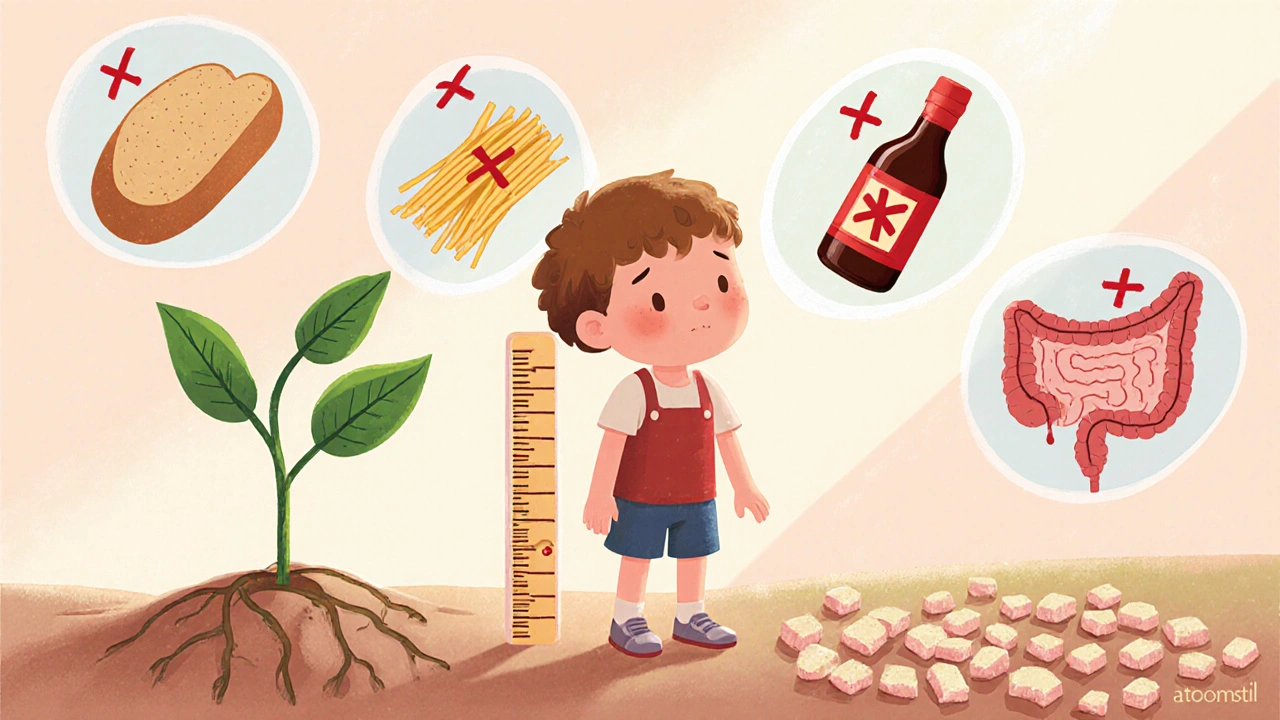
When a child isn’t growing like they should-staying small for their age, losing weight, or seeming tired all the time-it’s easy to blame picky eating or slow metabolism. But for 1 in 133 kids in the U.S., the real cause might be something deeper: celiac disease. This isn’t just a food sensitivity. It’s an autoimmune condition where the body attacks its own intestines every time gluten is eaten. And for children, the biggest red flag isn’t stomach pain-it’s stunted growth.
Why Growth Slows Down in Celiac Disease
The small intestine is lined with tiny finger-like projections called villi. These are the body’s main tools for absorbing nutrients from food. In celiac disease, gluten triggers an immune response that flattens these villi. Think of it like a sponge that’s been crushed flat-it can’t soak up water anymore. In active celiac disease, up to 90% of the surface area for nutrient absorption is lost. That’s why kids with undiagnosed celiac often look undernourished. Iron, calcium, vitamin D, zinc, and B vitamins don’t get absorbed properly. Iron deficiency leads to fatigue and pale skin. Vitamin D deficiency weakens bones. Without enough protein and calories, height and weight stall. Studies show three common growth patterns:- Pattern A: Kids under age 3 who are diagnosed early bounce back quickly. Most catch up in height within a year of starting a gluten-free diet.
- Pattern B: Older kids, often diagnosed after age 6, grow slower than peers but keep growing longer. Their bones mature late, so they have more time to reach normal height.
- Pattern C: These children grow at a normal speed, but their bone age is delayed by 1.5 to 2.5 years. That delay gives them extra time to grow, and many end up at their expected adult height.
A 2018 study of 24 children with delayed diagnosis found their average height score improved from -1.77 to -0.95 after three years on a gluten-free diet. Weight usually improves within six months. Height? That takes about two years.
How Doctors Test for Celiac Disease in Kids
Testing has gotten smarter. In the past, every child suspected of having celiac got an endoscopy and biopsy. Now, many don’t need one. The first step is a blood test for tTG-IgA antibodies. This test is 98% accurate at detecting celiac when done right. But doctors also check total IgA levels-about 2-3% of kids with celiac are IgA deficient, which can give false negatives. If tTG-IgA is more than 10 times the upper limit of normal, and the child has symptoms like poor growth or diarrhea, and they carry the HLA-DQ2 or DQ8 genes (which 95% of celiac patients do), then diagnosis can be made without a biopsy. That’s thanks to updated guidelines from ESPGHAN in 2020. For kids with borderline results, an endoscopy is still needed. During the procedure, doctors look for signs like scalloped folds or mosaic patterns in the intestine. Biopsies show Marsh 3 lesions-severe villous atrophy-in 95% of newly diagnosed children. Bone age X-rays are also helpful. If a child’s bones are behind their chronological age, it’s a good sign they’ll catch up once gluten is removed. One study found 95% of kids with delayed bone age reached their target height after diet changes, compared to only 65% of those with normal bone age.What a Gluten-Free Diet Really Means
Going gluten-free sounds simple: no bread, pasta, or cereal. But gluten hides everywhere. Soy sauce, malt flavoring, processed meats, even some medications and vitamins can contain it. The international standard allows up to 20 parts per million (ppm) of gluten in foods labeled “gluten-free”-but even that tiny amount can trigger damage in sensitive kids. Cross-contamination is the biggest problem. A toaster used for regular bread, a shared cutting board, or even flour dust in the air can cause reactions. One study found 40-50% of households with a child with celiac still have gluten exposure happening daily. Gluten-free products cost 156% to 242% more than regular ones. That’s a heavy burden for families. And grocery stores? Only 15-20% of items are naturally gluten-free. Parents spend hours reading labels and calling manufacturers.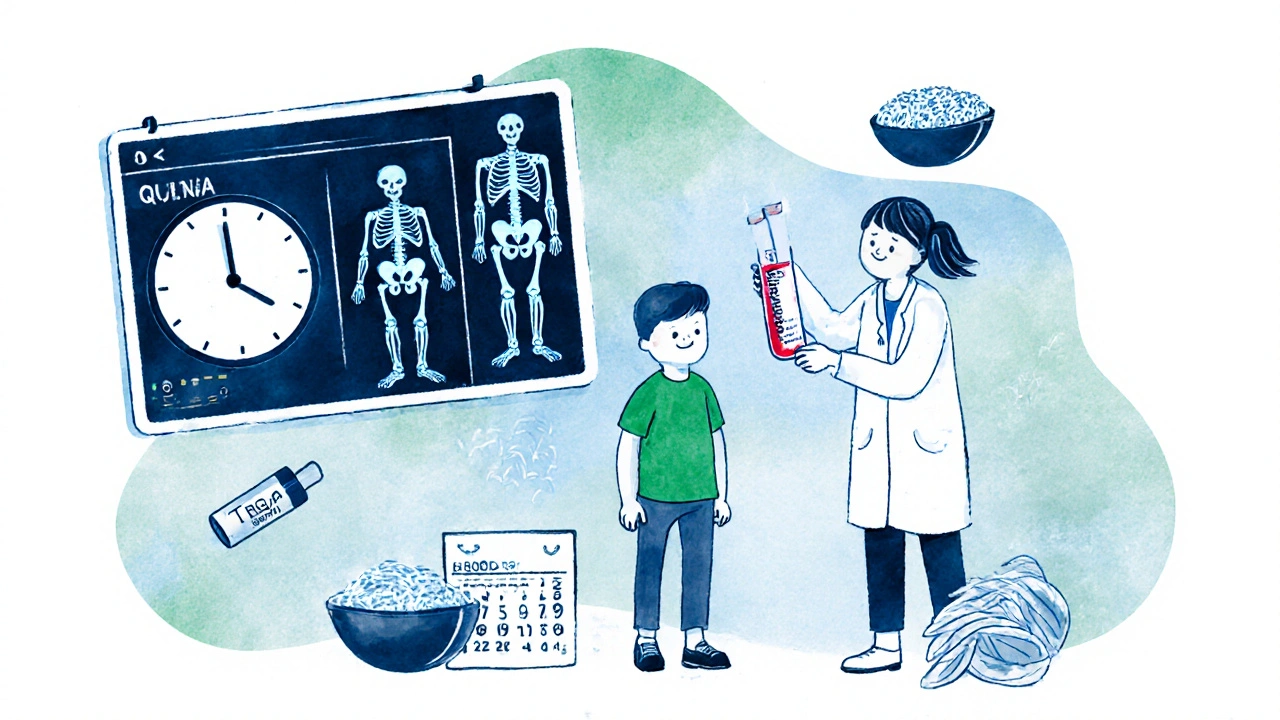
Tracking Progress: Growth as a Measure of Success
The best way to know if the diet is working? Watch the child grow. In the first six months:- Infants gain 15-30 grams per day-fast for their size.
- Older kids grow 2-4 cm per year faster than before.
Regular blood tests for tTG-IgA show if gluten is still getting in. Normal levels within 6-12 months mean good adherence. But 20-30% of kids still test positive even when parents think they’re doing everything right. That’s often due to hidden gluten or accidental exposure.
Nutrient levels matter too. At diagnosis, 30-50% of children have low iron, and 40-60% are vitamin D deficient. These need correction with supplements. Folate and B12 levels are checked quarterly.Why Adherence Fails-Especially in Teens
Younger kids usually follow the diet because parents control what’s served. But teens? That’s where things get hard. A 2023 study from Cincinnati Children’s Hospital found adolescents have 25-35% lower adherence than younger children. Why? Peer pressure. Fear of being different. Wanting to eat like friends at school or parties. One 14-year-old shared on a patient forum: “I skipped my gluten-free lunch once and got sick for two days. I didn’t want to be the kid who couldn’t eat pizza.” Schools are a major risk. A 2022 survey found 58% of kids with celiac had gluten exposure at school-lunches prepared on shared surfaces, classroom treats, or untrained staff. That’s why a 504 plan is critical. It’s a legal document that ensures schools provide safe meals, clean prep areas, and staff training. Families who use these plans report fewer accidents and less stress.
What Works: Support, Education, and Realistic Expectations
Parents need more than a list of forbidden foods. They need hands-on training. The Children’s Hospital of Philadelphia recommends 3-5 sessions with a registered dietitian who specializes in celiac disease. It takes most families 4-6 months to learn how to spot hidden gluten. Community support makes a difference. Families connected to local celiac groups have 25-30% better adherence. They swap recipes, share safe brands, and vent about the stress. Real success stories exist. One mother reported her 7-year-old gained 2.3 kg in three months and grew 4 cm in the first year. Another child’s height score jumped from -2.1 to -0.3 in 18 months. But not every child catches up fully. About 5-10% show little growth improvement despite perfect diet adherence. In those cases, doctors check for other issues-growth hormone deficiency, thyroid problems, or other gut disorders.The Long-Term Picture
The good news? With early diagnosis and strict diet, kids with celiac can live full, healthy lives. A 2023 meta-analysis in Gut journal showed:- 98% of children diagnosed before age 5 reached their target adult height.
- 85% of those diagnosed after age 10 still reached normal height.
- Life expectancy is normal with good adherence.
But the risk of complications rises with poor diet control. Swedish data shows non-adherence increases lymphoma risk by 2-3 times. That’s why lifelong vigilance isn’t optional-it’s essential.
There’s no cure yet. Clinical trials for drugs like larazotide acetate show promise in reducing symptoms from accidental exposure, but they’re not replacements for the diet. Immunotherapy trials have failed so far. For now, the only treatment is gluten-free-and it works.
What Parents Should Do Next
If your child is short for their age, tired, or has unexplained digestive issues:- Ask your pediatrician for a tTG-IgA blood test and total IgA test.
- Don’t start a gluten-free diet before testing-it can hide the diagnosis.
- If positive, see a pediatric gastroenterologist and a dietitian who knows celiac.
- Get a 504 plan for school.
- Test for iron, vitamin D, and B12 deficiencies-and treat them.
- Join a local celiac support group.
Early action means the difference between a child who grows normally and one who spends years playing catch-up. This isn’t a phase. It’s a medical condition. And with the right steps, your child can thrive.
Comments (13)
David Rooksby
November 15, 2025 AT 10:45Okay so let me get this straight-you’re telling me that gluten, the same stuff in bread and pasta that’s been eaten for thousands of years, suddenly became a silent killer because of some immune glitch? And we’re just now figuring this out because Big Pharma didn’t make enough money off it until now? I’ve seen this pattern before-every time a corporation finds a way to sell you a $20 gluten-free muffin, they invent a new disease to justify it. The real problem? We’ve been fed lies about food for decades. Gluten isn’t the villain-industrial agriculture is. And don’t even get me started on how they label things ‘gluten-free’ but still sneak in 20ppm like it’s a joke. That’s not safety-that’s corporate negligence wrapped in a rainbow sticker.
Diane Tomaszewski
November 16, 2025 AT 19:40I’ve seen this with my niece. She was tiny for her age, always tired, and the doctors kept saying she was just a slow grower. We didn’t test for celiac until she was 8. After going gluten-free, she shot up like a weed. No magic pills. Just food. It’s wild how something so simple can change everything.
Melanie Taylor
November 18, 2025 AT 04:04OMG YES!!! I’m a mom of a 6yo with celiac and this hit SO hard 😭 The grocery shopping alone is a full-time job. I read every label like it’s a secret code. And the cross-contamination?! I once cried because my kid licked a spoon that touched regular toast. 🥲 But we’re doing better now-found a local gluten-free bakery that’s a lifesaver 🥖❤️
Daniel Stewart
November 20, 2025 AT 01:22There’s a metaphysical layer here that no one dares to speak of. The body doesn’t ‘attack’ itself-it’s responding to a deeper dissonance. Gluten, as a symbol of modernity’s false promises, is the trigger. The villi don’t just flatten-they *rebel*. We’ve severed our connection to ancestral grains, to real bread, to slow food. This isn’t just an autoimmune disorder-it’s a spiritual wound dressed in medical jargon. The gluten-free diet is a bandage on a soul that’s been colonized by processed culture.
Teresa Smith
November 21, 2025 AT 06:18Parents, please take this seriously. Growth delay isn’t ‘just how they are.’ It’s a red flag. If your child isn’t gaining weight or height appropriately, push for the tTG-IgA test-even if they don’t have stomach issues. Early diagnosis changes everything. And yes, it’s inconvenient. Yes, it’s expensive. But your child’s future is worth the effort. Don’t wait for them to ‘grow out of it.’ They won’t.
ZAK SCHADER
November 22, 2025 AT 05:07Why are we letting the government dictate what we eat? Gluten-free stuff costs 2x and it’s all imported from China anyway. We used to be a country that ate real food. Now we’re a nation of label-readers with anxiety disorders. If your kid’s small, give him a steak and a nap. Problem solved. Stop over-medicalizing childhood.
Deepak Mishra
November 22, 2025 AT 16:37Broooooo I feel this so hard 😭 My cousin’s kid got diagnosed at 5 and now they’re like ‘gluten-free zone’ at home 😅 But the school? Total chaos! One time the teacher gave him a cookie from the class party and he was in bed for 3 days 😫 I’m so tired of being the ‘weird mom’ but I’ll do it again tomorrow 🤞 #CeliacWarrior
Oyejobi Olufemi
November 23, 2025 AT 23:48Let’s be real-this whole celiac narrative is a Western obsession. In Nigeria, kids eat maize, cassava, millet-all naturally gluten-free-and they grow tall and strong. Why are we pathologizing normal human variation? The real issue? Overdiagnosis fueled by wellness culture and profit-driven marketing. Gluten isn’t evil-it’s the new boogeyman for people who have too much time and money to worry about food.
Danish dan iwan Adventure
November 25, 2025 AT 02:04Marsh 3 lesions. tTG-IgA >10x ULN. HLA-DQ2/DQ8 positivity. Diagnostic criteria are well-established. Non-adherence = increased lymphoma risk. End of discussion. No philosophy. No anecdotes. Just data.
Rachel Wusowicz
November 25, 2025 AT 12:32Have you ever wondered… what if gluten isn’t the problem… but the *labeling* is? What if the real autoimmune trigger is the fear? The anxiety? The constant surveillance? The 20ppm rule? The 156% price hike? The social isolation? The 504 plans? The panic in the school cafeteria? What if the body isn’t attacking gluten… it’s attacking the entire system that made this a crisis? I’ve seen kids with celiac who are perfectly healthy on a gluten-free diet… and then they get sick again… and it’s not the food. It’s the stress. The fear. The trauma of being ‘different.’ The disease isn’t in the wheat. It’s in the way we treat people who have it.
Dan Angles
November 26, 2025 AT 05:12As a pediatric gastroenterologist with over 20 years of clinical experience, I can confirm that the diagnostic criteria outlined in the 2020 ESPGHAN guidelines are evidence-based and widely adopted in academic centers. The reduction in unnecessary endoscopies has improved patient outcomes while reducing healthcare costs. However, adherence remains the greatest clinical challenge, particularly in adolescents. We recommend multidisciplinary care: dietitian, psychologist, and school liaison. Early intervention correlates strongly with catch-up growth and long-term quality of life. The data is unequivocal.
Jamie Watts
November 26, 2025 AT 10:36My son was diagnosed at 4. We went gluten-free. He grew 5 inches in 18 months. We thought we were done. Then he started getting stomach cramps again. Turns out-his peanut butter had malt flavoring. We didn’t even know malt was gluten. I spent 3 hours on the phone with the manufacturer. They said ‘it’s naturally occurring.’ I said ‘then why does your label say gluten-free?’ They apologized. We switched brands. But here’s the thing: no one told us this would be this hard. No one warned us about the hidden stuff. The real enemy isn’t wheat. It’s ignorance.
Ankit Right-hand for this but 2 qty HK 21
November 28, 2025 AT 02:40Look, I’m from India. We’ve been eating wheat for centuries. Our kids are tall. Our farmers aren’t dying from gluten. This whole thing is a scam cooked up by Western elites to sell overpriced rice cakes. If your kid’s small, maybe he’s just malnourished from eating too much of your expensive gluten-free crap instead of real food. Stop blaming gluten. Start blaming your wallet.