
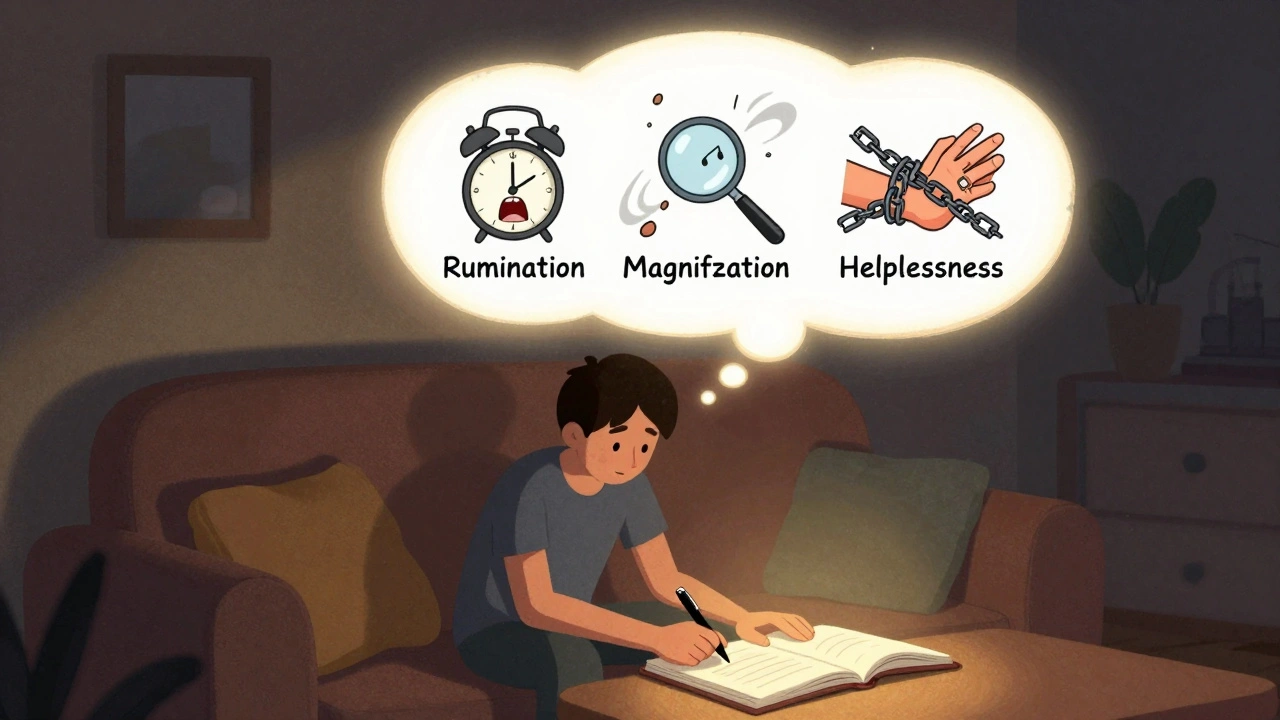
When your pain feels like it’s taking over your mind - when every twinge makes you think, “This is going to get worse,” or “I can’t handle this anymore,” you’re not just feeling physical discomfort. You’re caught in a cycle called pain catastrophizing. It’s not weakness. It’s not exaggeration. It’s your brain getting stuck in a loop of fear, helplessness, and overthinking about pain - and it’s making your pain worse.
Research shows pain catastrophizing is one of the strongest predictors of how badly chronic pain will affect your life. People who catastrophize report higher pain intensity, more disability, longer recovery times, and even greater risk of depression. But here’s the good news: this cycle can be broken. Cognitive Behavioral Therapy (CBT) isn’t just a buzzword - it’s a proven, science-backed way to untangle the mental grip pain has on your life.
What Exactly Is Pain Catastrophizing?
Pain catastrophizing isn’t just being negative. It’s a specific pattern of thinking that kicks in when you’re in pain - or even when you expect pain. Think of it like a mental alarm system that’s turned up too high. Three things happen:
- Rumination: You can’t stop thinking about the pain. It replays in your head like a broken record: “Why won’t this go away? What if it never gets better?”
- Magnification: You blow the threat out of proportion. A small ache becomes “This could mean I’m having a heart attack,” or “If I walk too far, I’ll end up in a wheelchair.”
- Helplessness: You feel powerless. “There’s nothing I can do. I’m at the mercy of this pain.”
This isn’t just “thinking badly.” Brain scans show that when you catastrophize, areas linked to emotion and pain processing light up more intensely. Your mind isn’t just reacting to the pain - it’s amplifying it. Studies from the University of Washington and Duke University confirm this: the more you catastrophize, the more your brain registers pain - even when the physical cause hasn’t changed.
How CBT Breaks the Cycle
CBT doesn’t tell you to “think positive.” It doesn’t deny your pain. Instead, it teaches you to notice how your thoughts, feelings, and body respond to pain - and then gently shift that response.
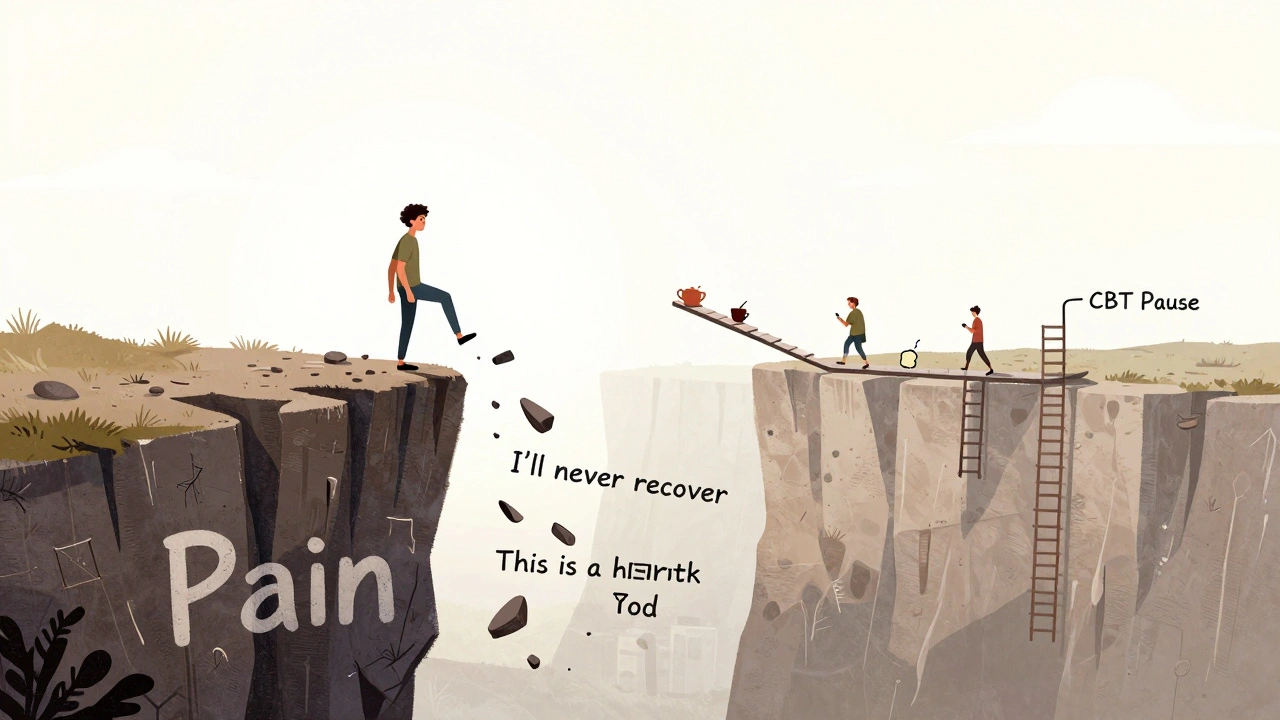
Think of it like learning to hit pause on a runaway train. You don’t stop the train (the pain). You learn to step off before it carries you into panic, avoidance, and exhaustion.
Here’s how it works in practice:
- Identify the thought: You feel a sharp pain in your back while reaching for a pot. Instantly, you think: “This is it. My spine is giving out. I’ll never be able to cook again.”
- Separate fact from fear: You ask yourself: “Is this thought based on evidence? Or is it my fear talking?” You realize: you’ve had this pain before. You’ve recovered. You’re not paralyzed. You just feel scared.
- Replace the script: You reframe it: “This is uncomfortable, but it’s temporary. I’ve handled this before. I’ll take it slow.”
- Act anyway: You keep cooking - maybe with a stool, maybe with less movement. You prove to yourself that the thought didn’t come true.
This isn’t magic. It’s training. And like any skill, it takes practice.
Three CBT Tools That Actually Work
Not all CBT is the same. For pain catastrophizing, these three tools have the strongest evidence:
1. Self-Monitoring: Track Your Thoughts Like a Scientist
Start a simple pain journal. Every time pain flares, write down:
- What happened right before the pain spiked?
- What was the first thought that popped into your head?
- How did you feel emotionally? (Anxious? Hopeless? Angry?)
- What did you do? (Did you rest? Avoid? Cry? Call someone?)
- What was the outcome?
After a week, you’ll start seeing patterns. Maybe every time you think, “I’m going to ruin my weekend,” you cancel plans - and then feel even more isolated and down. That’s the link. That’s your target.
2. Cognitive Restructuring: Challenge the Worst-Case Script
When a catastrophic thought hits - “This pain means I’m getting worse,” or “No one understands how bad this is” - don’t fight it. Question it.
Ask:
- What’s the evidence this thought is true?
- What’s the evidence it’s not true?
- What’s a more balanced way to think about this?
- What would I say to a friend who had this thought?
For example:
Original thought: “I’ll never be able to walk without pain again.”
Reframed thought: “I’ve had bad days before. Some days are worse than others. Right now, it’s tough - but I’ve adapted before, and I can find ways again.”
This doesn’t mean pretending everything’s fine. It means stopping the spiral before it drags you under.
3. Behavioral Activation: Do Something - Even When It Hurts
When you catastrophize, you avoid. Avoiding feels safe - but it makes pain stronger over time. CBT pushes you to do small, meaningful things anyway.
Start tiny:
- Walk to the end of the driveway.
- Make one cup of tea.
- Text a friend.
Then notice: Did the pain get worse? Or did I feel a little more in control? Each small action rewires your brain. You’re not just moving your body - you’re proving to yourself that you’re not helpless.
Who Benefits Most From CBT for Pain Catastrophizing?
CBT works best for people who:
- Have chronic pain that’s lasted more than 3 months
- Feel stuck in fear or helplessness around pain
- Are willing to practice skills daily, even on hard days
- Have some mental energy to focus on thoughts - even if it’s just 10 minutes a day
It’s less effective if:
- You’re in severe depression or active psychosis - those need separate treatment first
- You expect instant results - CBT takes weeks, not days
- You’re not ready to challenge your thoughts - that’s okay. You can come back to it later.
Studies show people who stick with CBT for 8-12 weeks see a 30-50% drop in catastrophizing scores. One 45-year-old woman with fibromyalgia went from a PCS score of 42 (severe catastrophizing) to 18 - and returned to part-time work. That’s not a miracle. That’s CBT.
What If I’m Too Tired to Do CBT?
This is the real barrier. When pain is at an 8/10, your brain is flooded with stress hormones. You don’t have the energy to think clearly. That’s normal.
Here’s what to do:
- Use micro-practices: Instead of journaling, just say one sentence out loud: “This is pain. It’s not a warning. I’m safe.”
- Use reminders: Set a phone alert: “Pause. Breathe. What’s the thought?”
- Use apps: Tools like Curable or PainScale offer 5-minute guided CBT exercises designed for high-pain days.
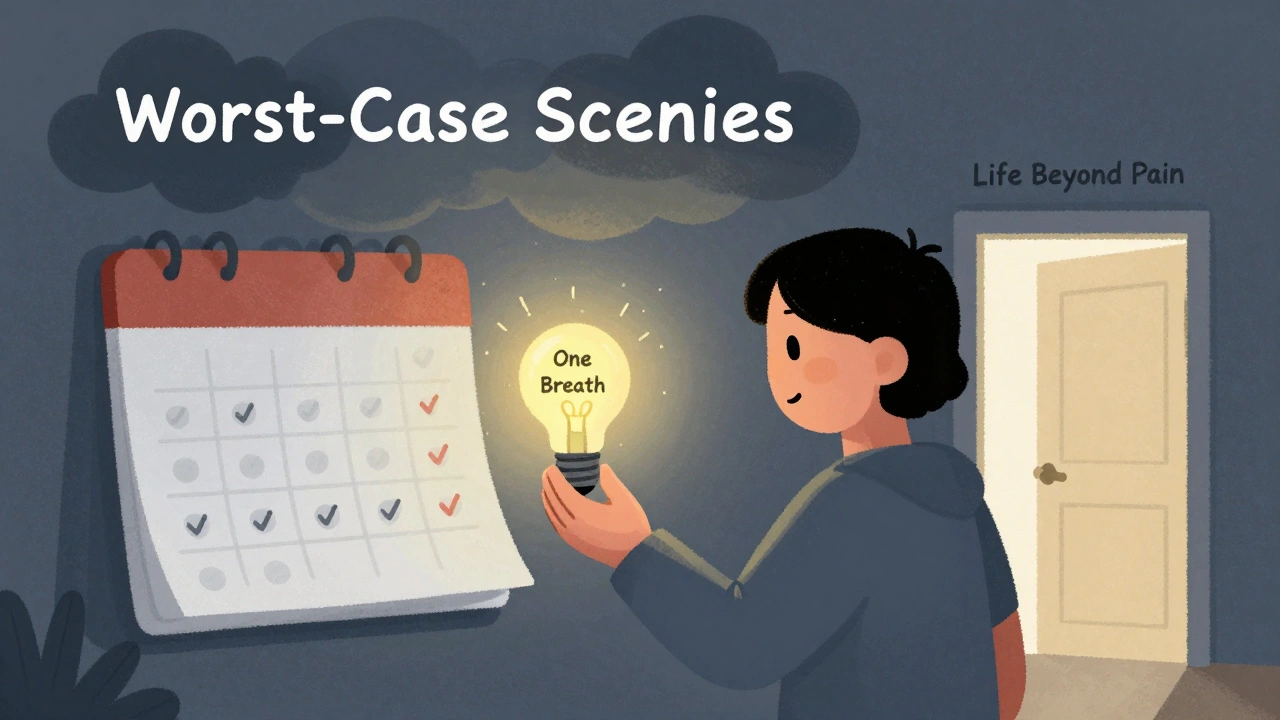
- Let go of perfection: One deep breath counts. One thought challenged counts.
You don’t need to do it perfectly. You just need to do it consistently.
Where to Start
CBT isn’t just for therapists’ offices anymore. Here’s how to access it:
- Ask your GP or pain clinic: “Do you offer CBT for pain catastrophizing?” Most UK NHS pain programs now include it.
- Check your local hospital’s pain management department - many run 8-week CBT groups.
- Use digital tools: Apps like Curable, PainScale, and My Pain Coach offer CBT-based programs backed by research.
- Look for self-help books: “The Pain Management Workbook” by Dr. Alan Gordon or “Living Well with Chronic Pain” by Dr. Beth Darnall.
And if you’re in the UK: the NHS offers free CBT through the IAPT (Improving Access to Psychological Therapies) program. You don’t need a referral from your GP - you can self-refer online.
Why This Matters Now
By 2025, 75% of pain clinics in the UK and US will screen for pain catastrophizing. Why? Because ignoring it wastes time, money, and lives. Painkillers don’t fix the fear. Surgery doesn’t fix the helplessness. But CBT does.
It’s not about eliminating pain. It’s about reclaiming your life from the fear of pain. You can still feel pain - and still live fully. CBT gives you the tools to do that.
Start small. Be patient. Your brain can learn new ways to respond. And that’s the real breakthrough.
Is pain catastrophizing the same as being anxious about pain?
It’s related, but not the same. Anxiety is a general feeling of worry. Pain catastrophizing is a specific pattern of thinking focused on pain: ruminating, magnifying, and feeling helpless. You can be anxious without catastrophizing, and you can catastrophize without generalized anxiety. CBT targets the thought patterns, not just the emotion.
Can CBT make my pain worse at first?
Sometimes. When you start noticing your thoughts, you might feel more aware of how much you’re suffering - which can feel overwhelming. This is normal. It’s not that CBT is making pain worse - it’s just bringing what was hidden into the light. With time and practice, this awareness becomes a tool, not a burden.
How long does it take to see results from CBT for pain catastrophizing?
Most people start noticing changes in 3-4 weeks - like catching a catastrophic thought before it spirals. Meaningful reduction in distress usually happens between 8-12 weeks. The key is consistency, not intensity. Even 5 minutes a day adds up.
Do I need a therapist to do CBT for pain catastrophizing?
Not necessarily. Many people successfully use guided apps, books, or online programs. But if you’re struggling with depression, trauma, or severe pain, working with a trained therapist increases your chances of success. The NHS offers free CBT through IAPT - you can self-refer.
What if CBT doesn’t work for me?
CBT works for most people, but not all. If you’ve tried it for 12 weeks and seen no change, consider other options like Acceptance and Commitment Therapy (ACT) or mindfulness-based stress reduction. Or, check if an underlying mood disorder like depression needs treatment first. It’s not failure - it’s finding the right fit.
Is pain catastrophizing just in my head?
No. It’s real - but it’s not “just” anything. Pain catastrophizing is a measurable psychological process that physically changes how your brain processes pain signals. Brain imaging shows increased activity in pain-processing areas when you catastrophize. It’s a real interaction between mind and body - not imagination.
Comments (10)
Lara Tobin
December 12, 2025 AT 23:29This hit me right in the chest. I’ve been stuck in that rumination loop for years-every twinge feels like the end of the world. I started journaling last month like the post said, and honestly? It’s not magic, but it’s the first time I’ve felt like I’m not powerless. Still hard some days, but I’m learning to pause before I spiral. <3
Alvin Montanez
December 12, 2025 AT 23:30Look, I appreciate the intent, but this is just another example of how modern medicine has abandoned real solutions in favor of feel-good psychological band-aids. Pain is pain. You don’t need to ‘reframe’ your thoughts-you need an MRI, a specialist, maybe surgery. CBT won’t fix a herniated disc. People are suffering, and we’re giving them worksheets instead of answers. This isn’t empowerment-it’s dismissal disguised as science. I’ve seen too many patients get told ‘it’s all in your head’ and then left to drown. Don’t confuse mental resilience with medical neglect.
And don’t get me started on apps. If your spine is failing, downloading Curable isn’t going to save you. Real medicine isn’t a subscription service.
Hamza Laassili
December 14, 2025 AT 14:08tbh i was skeptical but i tried the micro practice thing-just saying ‘this is pain. it’s not a warning. i’m safe.’ out loud when my back flares… and wow. it actually works? like, not magic, but it’s like hitting a reset button on my panic. i did it 3x yesterday and didn’t cancel my walk. i’m not cured, but i’m not crying in the shower anymore. thanks for this. <3
Scott Butler
December 16, 2025 AT 12:11Of course the left-wing pain industry wants you to believe your pain is ‘just in your head.’ That’s the whole agenda-get people off opioids, get them dependent on therapists, and make them feel guilty for wanting real relief. You don’t need to ‘restructure thoughts’-you need a doctor who’ll listen and treat the cause. This CBT nonsense is just another way to gaslight chronic pain patients into silence. If your pain is real, stop wasting time with journaling and find a real specialist. The system is rigged, and this article is part of the problem.
Constantine Vigderman
December 18, 2025 AT 02:11YESSSS!! This is the stuff they DON’T tell you in the ER!! I’ve been doing the behavioral activation thing-started with just walking to the mailbox. Then I made tea. Then I texted my sister. And guess what? I didn’t die. My pain didn’t explode. I felt… in control. For the first time in years. I’m not ‘fixing’ my pain-I’m reclaiming my life from the fear of it. You guys are not alone. Keep going. One tiny step at a time. You got this!! 💪❤️
Cole Newman
December 19, 2025 AT 23:33Okay but have you tried grounding techniques? Like, 5-4-3-2-1? I do that right before I go to sleep when the pain hits-name 5 things you see, 4 you can touch, etc. It doesn’t fix the pain but it stops the panic train. Also, I use the Curable app on my phone-it’s free and has these 3-minute voice guides. And don’t even get me started on how much better I feel since I stopped Googling my symptoms at 2am. That’s the real enemy. You’re welcome.
Casey Mellish
December 20, 2025 AT 12:55As someone who’s lived with chronic back pain for 11 years across three continents, I can confirm this works-not because it’s trendy, but because it’s neuroscience. The brain rewires with repetition. I started with one sentence a day. Now I catch myself before I spiral. It’s not about denying pain-it’s about refusing to let it dictate your identity. I returned to hiking last year. Not because I was pain-free, but because I finally stopped believing pain = brokenness. Keep going. You’re not alone.
Donna Hammond
December 22, 2025 AT 04:01Alvin, I hear your frustration. You’re right-CBT isn’t a substitute for medical care. But it’s not meant to be. It’s a companion. I work with chronic pain patients every day. The ones who get surgery and still feel hopeless? They’re the ones who never touched CBT. The ones who heal fastest? They’ve got the meds, the PT, AND the tools to manage their thoughts. It’s not either/or-it’s both. And for people who’ve been gaslit by doctors for years? Learning to trust their own experience again? That’s healing too.
Also-Hamza, thank you for saying that. The 5-4-3-2-1 technique is gold. I teach it to every new patient. It’s simple, fast, and works even when you’re exhausted. Don’t underestimate small things. They add up.
Richard Ayres
December 23, 2025 AT 00:16Thank you for writing this with such clarity and compassion. Too often, chronic pain is treated as a failure of willpower or a psychological flaw. This post correctly frames catastrophizing as a neurological pattern-not a character defect. The distinction between anxiety and catastrophizing is critical, and the emphasis on micro-practices is brilliant. For those who feel too tired to journal, saying one sentence aloud is a profound act of resistance against despair. I’ve recommended this to every patient I’ve worked with. It’s not a cure, but it’s a lifeline.
Sheldon Bird
December 24, 2025 AT 16:44Just wanted to say-I’ve been using the ‘what would I say to a friend?’ trick since last week. Yesterday, I had a flare-up and thought, ‘I’m never going to be able to play with my kid again.’ Then I paused and asked: ‘Would I tell my best friend that? No. I’d say, ‘You’ve held her before, you’ll hold her again. This is hard, but it’s not forever.’ So I said it to myself. And I picked her up. And we read a book. And I didn’t cry. I just… breathed. Thank you for this. It’s not perfect. But it’s helping.