
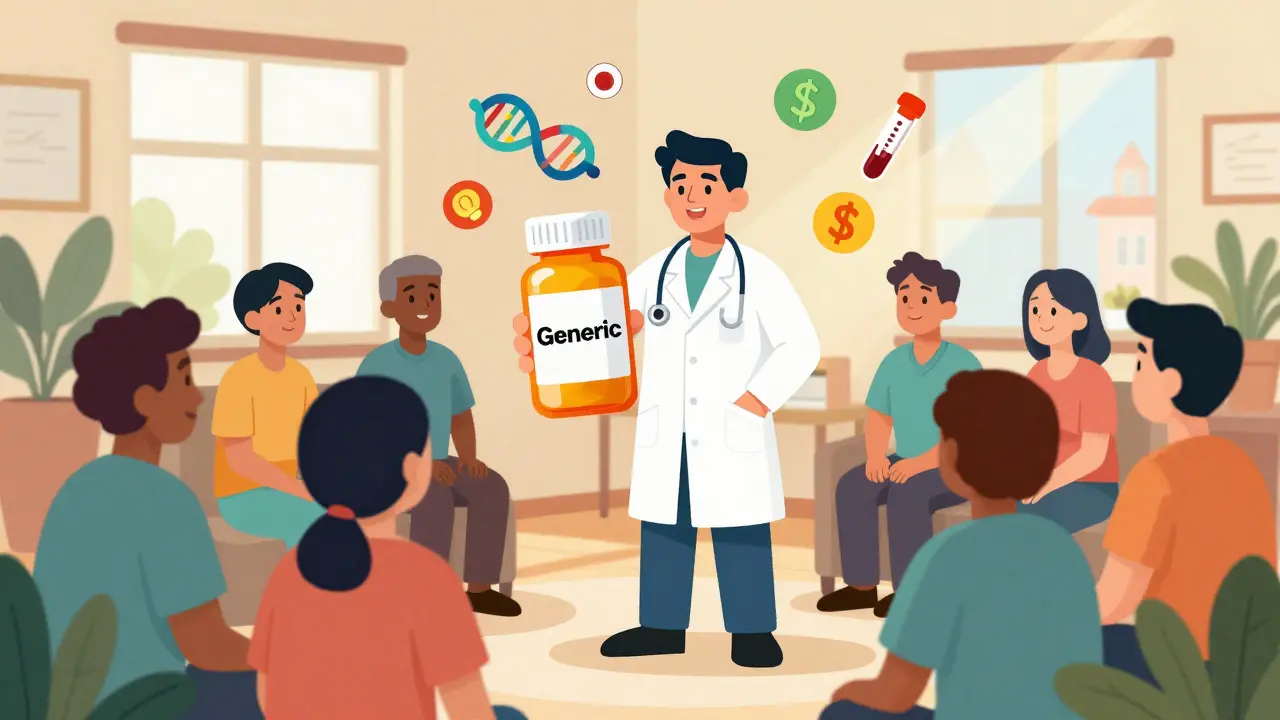
More than 9 in 10 prescriptions filled in the U.S. are for generic drugs. Yet, nearly half of all Americans still think these medications are weaker, less safe, or not as effective as brand-name pills. This gap in understanding isn’t just a myth-it’s costing people their health and their wallets. Community health presentations are stepping in to fix it, using real tools, real data, and real conversations to turn confusion into confidence.
Why Generic Drugs Are Just as Strong
Generic drugs aren’t copies. They’re exact matches. The FDA requires them to have the same active ingredient, strength, dosage form, and route of administration as the brand-name version. That means if you take a generic version of metformin for diabetes, you’re getting the same chemical compound that works the same way in your body. The difference? Price. Generics cost 80-85% less on average. In 2022, that saved the U.S. healthcare system $377 billion.The science behind this isn’t new. Since the 1980s, the FDA has required every generic drug to prove bioequivalence. That means in clinical tests, the generic must deliver between 80% and 125% of the active ingredient compared to the brand-name drug. This isn’t a guess-it’s measured through blood tests tracking concentration over time (called Cmax and AUC). If it doesn’t hit that range, it doesn’t get approved.
Pharmacists know this. A 2021 survey found 97% of pharmacists trust generics as much as brand-name drugs. But patients? Many still hesitate. Why? Because they’ve been told otherwise-by ads, by word of mouth, or even by doctors who didn’t explain the difference.
The Real Reason People Don’t Take Generics
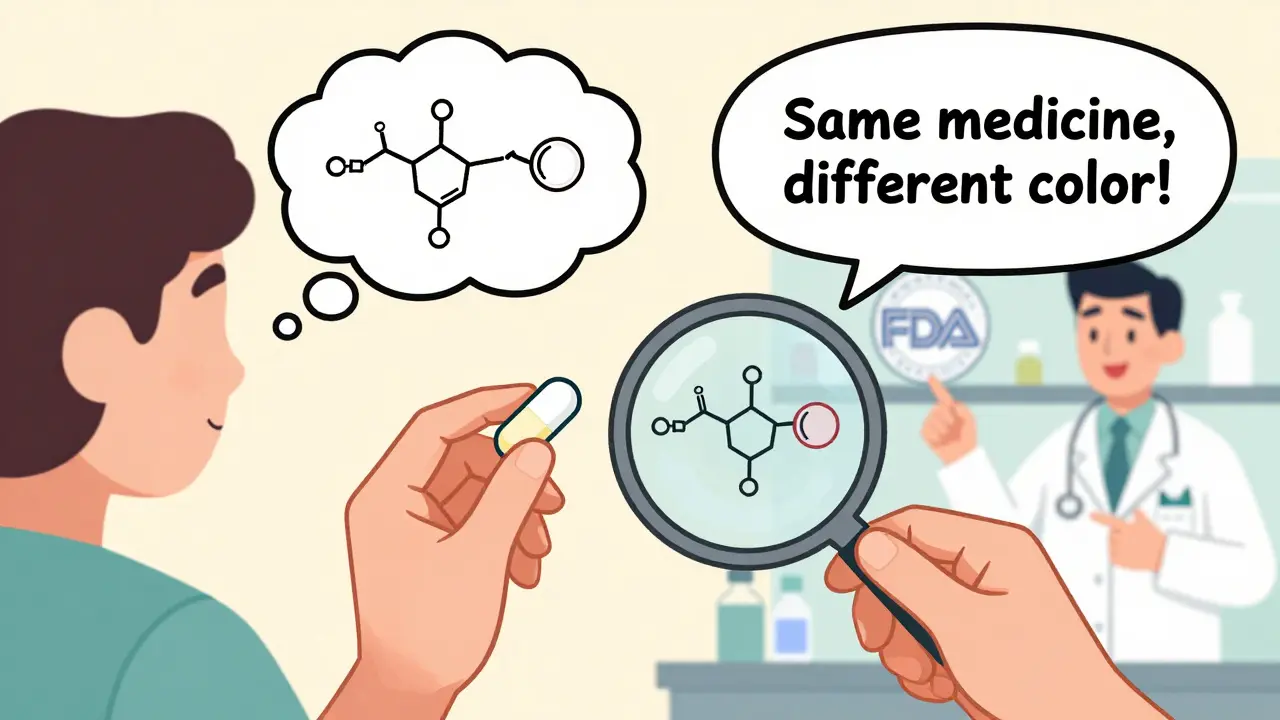
It’s not about safety. It’s about appearance.A University of Michigan survey of 1,247 patients found that 23% questioned whether a generic was working because it looked different-different color, different shape, different markings on the pill. That’s not a medical issue. It’s a psychological one. When your pill changes, your brain says, “Something’s wrong.” This is called the nocebo effect. A 2021 study in Annals of Internal Medicine showed that when patients were told they were switching to a generic, they reported side effects 18.7% more often-even when the pill was identical to what they’d taken before.
And it’s not just patients. Prescribers matter too. A 2022 JAMA Internal Medicine study showed that when doctors explicitly said, “This generic is just as good,” patient acceptance jumped from 52% to 89%. That’s the power of a simple, clear sentence.
What Works in Community Health Presentations
The FDA’s Generic Drugs Stakeholder Toolkit gives community health workers a roadmap. It includes videos, fact sheets, and most importantly-14 proven communication strategies. One of the most effective? The “Teach-Back” method.Instead of saying, “Generics are the same,” you ask: “Can you tell me in your own words why this generic is safe to take?” If the patient says, “Because it has the same medicine inside,” you know they got it. If they say, “I think it’s cheaper so it might not work,” you know you need to go back.
Tools like this aren’t theoretical. At the Community Health Center of Burlington, staff started using the toolkit in 2021. Within six months, patient acceptance of generics rose by 37%. That’s not luck. That’s good teaching.
Where Generics Still Face Resistance
Not all drug classes are treated the same. For blood pressure meds, heart drugs, or antibiotics, generic use is over 95%. But for mental health medications-like antidepressants or seizure drugs-acceptance drops. Only 68% of prescriptions for central nervous system drugs are filled with generics, according to IQVIA data from 2023.Why? Some patients and providers worry about small differences in how the drug is absorbed. A 2023 study in Epilepsy & Behavior found a slightly higher seizure recurrence rate when patients switched from brand to generic antiepileptics. But the American Academy of Neurology says this is rare-and likely due to individual sensitivity, not a flaw in generics. The study’s authors themselves noted that out of millions of switches, only a tiny fraction showed issues.
That’s why experts like the American Medical Association and the Academy of Managed Care Pharmacy stress: generics are safe for nearly everyone. The exceptions are few, and they’re not reasons to avoid generics-they’re reasons to personalize care.
How Much Money Are You Losing by Avoiding Generics?
Let’s say you take a brand-name statin for cholesterol. It costs $200 a month. The generic? $15. That’s $2,220 saved every year. Multiply that by millions of people-and you see why the U.S. spends $377 billion less on drugs because of generics.But the savings aren’t just for insurance companies. For low-income patients, switching to generics improves medication adherence by 22%, according to a 2021 study in Health Affairs. That means fewer hospital visits, fewer complications, and better long-term outcomes. When people can afford their meds, they take them. When they take them, they stay healthy.
What’s Changing in 2025 and Beyond
The tide is turning. Starting January 1, 2025, Medicare Part D plans will be required to give all beneficiaries standardized educational materials about generics. That’s not optional-it’s law. And the FDA’s new “Generics 101” video series, aimed at seniors, has already boosted knowledge retention by 31% in people over 65.Also, 287 brand-name drugs will lose patent protection between 2023 and 2028. That means more generics will hit the market. More choices. More savings. But also more confusion if people aren’t prepared.
Community health centers are already adapting. Starting in January 2024, the National Association of Community Health Centers requires all patient counseling sessions to include a clear explanation of generic drugs. No more assuming people know. No more leaving it to chance.
What You Can Do Right Now
If you’re taking a brand-name drug and paying more than $50 a month, ask your pharmacist: “Is there a generic?” If your doctor says no, ask why. If they say, “It’s not the same,” ask for proof. The FDA’s website has a searchable database of approved generics-no login needed.If you’re a community health worker, use the FDA’s toolkit. Don’t just hand out a flyer. Talk. Listen. Use Teach-Back. Show a picture of the pill. Ask, “What do you think this is?” Then explain: “This one has the same medicine. Just a different color.”
Generics aren’t second-best. They’re the standard. And when people understand that, they take better care of themselves-and save money while doing it.
Are generic drugs really as effective as brand-name drugs?
Yes. The FDA requires generic drugs to have the exact same active ingredient, strength, dosage form, and route of administration as the brand-name version. They must also pass strict bioequivalence tests, proving they deliver the same amount of medicine into your bloodstream at the same rate. Over 40 years of data and millions of prescriptions confirm they work just as well.
Why do generic pills look different from brand-name ones?
By law, generic manufacturers can’t copy the exact appearance of brand-name pills to avoid trademark infringement. That’s why color, shape, or markings may differ. But the medicine inside is identical. If you’re confused by the change, ask your pharmacist to confirm the active ingredient matches what you were taking before.
Can switching to a generic cause side effects?
The medicine itself doesn’t cause new side effects. But some people report them because they believe generics are inferior-a psychological effect called the nocebo effect. Studies show patients report more side effects when they know they’re taking a generic, even when the pill is identical. If you feel worse after switching, talk to your provider before stopping.
Are there any drugs where generics don’t work as well?
For nearly all drugs, generics work just as well. But in rare cases-like some antiepileptic drugs-a small number of patients may respond differently after a switch. This isn’t because generics are inferior, but because these drugs have a narrow therapeutic window. If you’re on one of these, your doctor may recommend staying on the brand if it’s working well. But for 99% of patients, generics are safe and effective.
Why do some doctors refuse to prescribe generics?
Most doctors support generics. But some may have outdated beliefs, or they’re used to prescribing a specific brand. Others may be influenced by pharmaceutical marketing. If your doctor won’t prescribe a generic, ask why. Request data. Check the FDA’s website. In many cases, it’s just habit-not science.
How can I find out if a generic is available for my drug?
Go to the FDA’s website and search the “Drugs@FDA” database. Type in your brand-name drug, and you’ll see if a generic is approved. Your pharmacist can also check this for you. If a generic exists, it’s legally available and just as safe.
Do generics cost less because they’re lower quality?
No. Generics cost less because their manufacturers don’t have to repeat expensive clinical trials. The original brand paid to prove the drug works. Generic makers only prove theirs matches it. The FDA inspects all manufacturing sites-brand and generic-using the same strict standards. Many generics are made in the same factories as brand-name drugs.
Is it true that generics are made in countries with lower safety standards?
Some generic drugs are manufactured overseas, but the FDA inspects all facilities-whether in the U.S., India, China, or elsewhere-using the same rules. The FDA has inspection teams in over 100 countries. If a facility fails inspection, the FDA blocks its products. There’s no special rule for generics. Safety is the same.
Can I ask my pharmacy to switch me to a generic without my doctor’s approval?
In most cases, yes. Pharmacists can substitute a generic unless your doctor writes “dispense as written” or “no substitution” on the prescription. Even then, you can ask your doctor to reconsider. Many don’t realize generics are just as effective. A quick conversation can save you hundreds a year.
What should I do if I’m worried about my generic medication?
Don’t stop taking it. Call your pharmacist and ask: “Is this the same medicine as before?” They can confirm the active ingredient matches. If you still feel unsure, schedule a quick visit with your doctor. Bring your pill bottle. Ask for evidence. Most concerns are based on appearance or myths-not science.
Comments (12)
Colin Pierce
January 27, 2026 AT 00:02I used to be skeptical too-until my dad switched from brand-name Lipitor to the generic and saved $1,800 a year. He didn’t feel any different. No side effects, no weird crashes. Just cheaper pills that did the exact same job. The FDA doesn’t mess around with these approvals. If it’s on the market, it’s legit.
Also, my pharmacist showed me the bioequivalence charts once. It’s not even close to a gamble. It’s science with receipts.
Mark Alan
January 27, 2026 AT 09:57GENERIC DRUGS ARE A SCAM 🤡🇺🇸
They’re made in China by guys who don’t even wash their hands before packaging! I’d rather pay $200 a month and die happy than take some sketchy blue pill that looks like it came out of a vending machine in Mumbai. 💸💀 #BuyAmerican #BrandNameOrBust
Ambrose Curtis
January 29, 2026 AT 09:15lol mark alan you’re literally the reason this myth still exists. yeah, some generics are made overseas-but so are your iPhone, your bike tires, and half your damn clothes. The FDA inspects those factories harder than your mom checks your text history.
And if you think the brand-name version is ‘cleaner’ or ‘purer,’ you’re missing the point. The active ingredient is identical. The fillers? Totally irrelevant unless you’re allergic to dye #5 or whatever. Most people don’t even notice the color change.
Also, 97% of pharmacists use generics themselves. Think about that. If they’re too scared to take them, why are they handing them out like candy?
Stop letting Big Pharma scare you into paying extra. Your bank account will thank you. Your body won’t even notice the difference.
Phil Davis
January 30, 2026 AT 10:58Interesting how we treat generics like they’re the underdog. But they’re not. They’re the baseline. The original drug was the experiment. The generic is the standard. We just forgot that.
It’s like saying a Honda Civic is ‘lesser’ than a BMW because it doesn’t have leather seats. The engine? Same. The fuel efficiency? Better. The price? Affordable. You’re not upgrading. You’re overpaying for branding.
Also, I’m pretty sure the FDA doesn’t have a ‘brand-name only’ department. Just… food for thought.
Anna Lou Chen
January 31, 2026 AT 11:05Deconstructing the pharmacological hegemony: the generic drug paradigm is a neoliberal epistemological trap disguised as cost-efficiency. The very notion of ‘bioequivalence’ is a Foucauldian construct-constructed by institutional power to normalize the commodification of bodily integrity.
When you reduce a pharmaceutical to its molecular structure, you erase the phenomenological experience of healing. The pill’s color, its weight, its texture-they’re not inert. They’re semiotic anchors in the patient’s somatic narrative.
And let’s not forget: the placebo effect isn’t placebo. It’s *presence*. The brand-name pill carries the mythos of innovation. The generic? A ghost. A spectral substitute in the cathedral of biomedicine.
So yes, it’s ‘the same.’ But is it *enough*?
Bryan Fracchia
February 1, 2026 AT 02:50Man, I love how this post doesn’t just throw facts at you-it shows you how to talk about it. That Teach-Back thing? That’s gold.
I work in a clinic and we started using it last year. One lady kept saying, ‘I just don’t trust these blue ones.’ So we pulled out her old bottle and the new one side by side. ‘See this? This word here-metformin? Same word. Same thing.’ She cried. Not because she was sad-because she finally felt heard.
It’s not about science alone. It’s about dignity. People aren’t dumb. They’re scared. And sometimes, all they need is someone to say, ‘I get it. Let’s figure this out together.’
Timothy Davis
February 2, 2026 AT 04:16Okay, but let’s be real-99% of people don’t even know what ‘bioequivalence’ means. And the FDA’s ‘same’ standard is 80-125%? That’s a 45% window. That’s not ‘exact.’ That’s ‘close enough for government work.’
And don’t get me started on the fact that generics aren’t required to undergo full clinical trials. The original drug had 10,000 patients over 10 years. The generic? One bioequivalence study with 24 people.
Yeah, it’s ‘legal.’ But legal doesn’t mean safe. It just means the paperwork’s signed.
And don’t quote me the $377 billion savings-that’s just corporate profit shifting. The real cost is in the long-term complications from inconsistent absorption. You think you’re saving money? You’re just gambling with your kidneys.
fiona vaz
February 3, 2026 AT 23:45My mom switched to generic levothyroxine and her TSH went haywire. She had to go back to the brand. Not because she ‘felt’ different-because the lab results showed it. That’s not nocebo. That’s real.
So yes, generics work for most people. But for some? The difference matters. And that’s okay. It doesn’t make you weak to need the brand. It just means your body is picky.
Don’t shame people who need the original. Just don’t assume everyone can switch.
Sue Latham
February 5, 2026 AT 07:47Oh honey. You really think the FDA is some saintly guardian of public health? Sweetie. They’re underfunded. They get 10 minutes to inspect a factory in India that makes 2 million pills a day. You really think they catch everything?
And don’t even get me started on the fact that the same company that makes the brand-name drug also makes the generic. Same factory. Same workers. Same pill. Just… cheaper packaging.
So yeah. It’s ‘the same.’ But it’s not ‘the same’ if you’re the one who got the batch with the slightly off fillers.
And if you’re saving $2,000 a year… good for you. But don’t act like everyone else is a fool for paying more. Some of us have bodies that don’t play nice with generics.
John Rose
February 6, 2026 AT 21:37One of the most compelling parts of this is how the nocebo effect mirrors the placebo effect in reverse. We’ve spent decades conditioning people to associate price with quality. So when a pill changes color and drops in price, the brain interprets it as ‘lower quality’-even when the chemistry is identical.
It’s a perfect example of how cognitive bias overrides empirical evidence. We’re not rational actors. We’re pattern-seeking storytellers.
That’s why education matters more than regulation. You can’t legislate perception. But you can reframe it.
Brittany Fiddes
February 8, 2026 AT 09:21Let’s be honest: the whole generic drug movement is just Big Pharma’s way of squeezing more profit out of the system while pretending to care about the poor.
They made billions off the brand, then sat back and waited for the patent to expire. Then they turned around and sold the generic version themselves-for 80% less, but still with 90% profit margins.
And now they’re patting themselves on the back for ‘saving’ the system? Please. This isn’t altruism. It’s capitalism with a smiley face.
Also, the fact that we need a ‘toolkit’ to explain that two pills are the same? That’s the real tragedy.
Mel MJPS
February 9, 2026 AT 14:32My aunt took a generic blood pressure med and started feeling dizzy. She thought it was the pills. Turned out, she’d just started a new yoga routine. But she blamed the generic. So she stopped taking it. Ended up in the ER.
People don’t know what’s real and what’s imagined anymore. That’s not the drug’s fault. That’s the system’s failure.
Just… talk to people. Like, actually talk. Not just hand them a flyer and walk away.