
Medication Strategy Evaluator: FDC vs. Individual Therapy
How it works: Select the priority that best describes your current medical situation to see which approach is generally more appropriate.
Simplicity & Consistency
"I struggle to remember multiple pills and want to reduce my daily pill burden."
Precision & Control
"My dosages need frequent adjustment, or I have a history of specific drug allergies."
Recommendation Analysis
Key Trade-off:
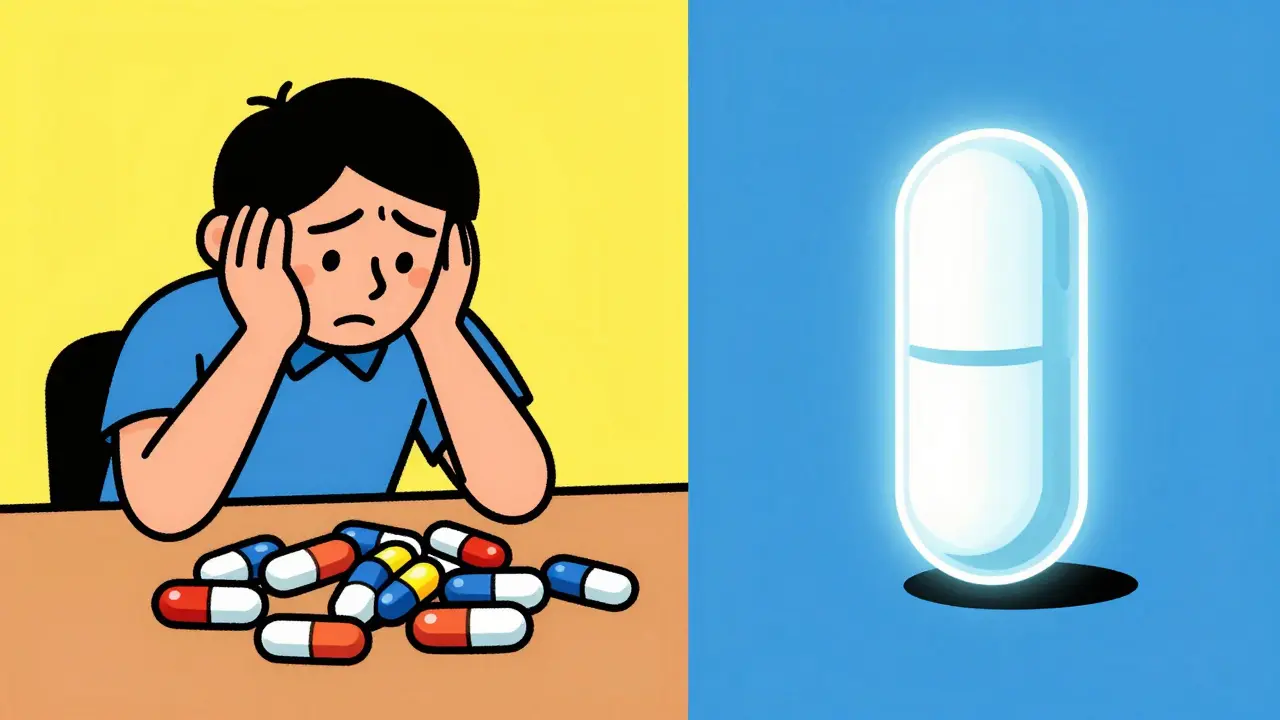
Imagine taking ten different pills every morning just to keep your blood pressure and cholesterol in check. For many people, this "pill burden" isn't just annoying-it's a barrier to getting healthy. This is where fixed-dose combinations is a pharmaceutical approach where two or more active ingredients are combined into a single tablet or capsule. Commonly known as FDCs, these drugs aim to simplify treatment and boost consistency. But is swapping five pills for one always a win? While the convenience is obvious, mixing powerful chemicals in one dose introduces a specific set of risks that can complicate a patient's recovery.
The Logic Behind Mixing Medications
Why not just take separate pills? The primary driver is patient compliance. When a treatment plan is simple, people actually follow it. Research has shown that FDCs significantly improve the quality of life by reducing the mental and physical load of managing multiple prescriptions. But it's not just about convenience; some combinations are strategically designed to be more effective than the sum of their parts.
In the world of oncology, for instance, combination therapies are the gold standard. By attacking a tumor through multiple biological pathways at once, these drugs make it much harder for cancer cells to develop resistance. Similarly, in treating cardiovascular disease, targeting several pathways simultaneously often leads to better heart health outcomes than using a single agent. The World Health Organization (WHO) recognizes this value, including numerous rational FDCs in its List of Essential Medicines, such as those used to treat tuberculosis and Parkinson's disease.
What Makes a Combination "Rational"?
Not every mix of drugs is a good idea. Pharmacologists distinguish between "rational" and "irrational" combinations. A rational FDC is one where the ingredients are chosen based on scientific evidence to improve efficacy or safety. To be considered rational, a combination generally needs to meet three strict criteria:
- Different Mechanisms: The drugs should attack the problem from different angles (e.g., one lowers heart rate while another relaxes blood vessels).
- Compatible Pharmacokinetics: Both ingredients must be absorbed, distributed, and excreted by the body at similar rates so that one doesn't interfere with the other's timing.
- No Supra-Additive Toxicity: The combination shouldn't create a "toxicity spike" where the side effects are worse than if the drugs were taken separately.
Take the example of Levodopa + Carbidopa. Used for Parkinson's, this is a classic rational combination. Carbidopa prevents Levodopa from breaking down too early in the bloodstream, ensuring more of the active medicine actually reaches the brain. Without this pairing, the treatment would be far less effective and cause more nausea.
| Feature | Fixed-Dose Combination (FDC) | Individual Therapy |
|---|---|---|
| Pill Burden | Low (one pill, multiple effects) | High (multiple pills) |
| Dosing Flexibility | Rigid (fixed ratios) | High (customizable doses) |
| Patient Adherence | Generally higher | Higher risk of missed doses |
| Side Effect Management | Harder to isolate the cause | Easier to identify specific triggers |
| Prescription Changes | Must replace entire pill | Can change one drug only |
The Hidden Risks of the "All-in-One" Pill
Convenience comes with a price: a loss of control. One of the biggest headaches for doctors is the inability to customize dosages. If a patient needs a high dose of Ingredient A but only a tiny bit of Ingredient B, a fixed-ratio pill won't work. The clinician is forced to either over-dose the patient on one ingredient or under-dose them on another just to make the pill fit.
Then there is the issue of adverse reactions. When a patient experiences a side effect on a single-drug regimen, it's easy to identify the culprit. With an FDC, pinpointing which ingredient is causing the rash or dizziness becomes a guessing game. In worst-case scenarios, if a patient develops a severe allergy to just one component of the pill, they have to stop the entire therapy immediately, even if the other ingredients were working perfectly.
We also see a rise in "irrational" FDCs, particularly in emerging markets. In India, for example, the CDSCO (Central Drugs Standard Control Organisation) has had to ban several combinations that lacked clinical justification. Some of these unregulated mixes can actually be dangerous, contributing to the global crisis of antimicrobial resistance by using antibiotics in combinations that don't actually treat the infection effectively but do encourage bacteria to evolve.
FDCs vs. Compounded Medications
It's easy to confuse combination drugs with compounded medications, but they are worlds apart in terms of regulation. An FDC is a standardized product that has gone through a rigorous FDA approval process. The FDA evaluates the combination as a unique entity, ensuring that the two drugs don't react poorly together in the bottle or in the body.
Compounded medications, on the other hand, are custom-mixed by a pharmacist for one specific person. You might see this for a patient who can't swallow pills and needs a liquid version of three different meds, or for someone with a rare allergy to a specific filler dye. While compounding offers ultimate personalization, it lacks the same level of oversight; the FDA does not verify the safety or quality of compounded drugs before they reach the patient.
Looking Ahead: AI and the Future of Combinations
The future of these drugs is moving away from "guess-and-check" and toward data-driven design. Companies are now using AI to predict how different molecules will interact, allowing them to find rational combinations for rare diseases that were previously untreatable. By simulating millions of interactions, researchers can identify the exact ratio of ingredients that maximizes potency while minimizing toxicity.
As we move toward 2026 and beyond, expect to see a tighter regulatory grip on irrational combinations. The goal is a healthcare system where the "pill burden" is low, but the safety standards remain high. Whether you are treating hypertension or a complex infection, the balance between convenience and risk remains a conversation you should have with your provider.
What is the main advantage of a combination drug?
The biggest benefit is the reduction of pill burden. By combining multiple active ingredients into one dose, patients are much more likely to stick to their medication schedule, which leads to better long-term health outcomes, especially for chronic conditions like hypertension or HIV.
Why are some combination drugs considered "irrational"?
A combination is irrational when it lacks scientific evidence to prove that the ingredients work better together than separately. Some irrational FDCs are created for marketing purposes or convenience without considering whether the drugs have compatible absorption rates or if they increase the risk of toxicity.
Can I switch from separate pills to a combination pill?
Often, yes, but only if your specific dose matches the fixed ratio of the combination pill. If you require a customized dose of one ingredient, your doctor will likely keep you on separate medications to maintain precise control.
What happens if I have an allergic reaction to one part of a combination drug?
Because the ingredients are physically combined, you cannot simply "remove" the offending part. You would typically have to stop taking the combination drug entirely and switch back to individual medications so your doctor can isolate the trigger and provide an alternative.
How are combination drugs different from compounded drugs?
Combination drugs (FDCs) are mass-produced, standardized, and FDA-approved. Compounded drugs are custom-made by a pharmacist for an individual patient to meet specific needs, such as removing an allergen or changing the form of the medicine (e.g., from a pill to a cream).
Comments (13)
Anastasios Kyriacou
April 21, 2026 AT 19:10honestly just a bunch of common sense stuff.. most ppl already know pills are annoying lol
Caroline Duvoe
April 22, 2026 AT 21:15totally just a marketing ploy to charge more for one pill 🙄 basically the same as taking them apart
Amy Fredericks
April 23, 2026 AT 03:18It is so wonderful to see the focus on patient quality of life! Making treatment simpler can really give someone their dignity back, and I love how the post explains the science behind it. Let's keep pushing for more accessible healthcare options for everyone.
Mayur Pankhi Saikia
April 23, 2026 AT 13:16The sheer audacity of suggesting AI will solve pharmaceutical failures!!! One must wonder if the author even understands the basic biochemical instability of these compounds... absolutely laughable,,, truly.
Mike Arrant
April 25, 2026 AT 03:26You people are just too scared to admit that the medical industry is laziness-driven. I've seen guys take five pills and do just fine, but now we're told a single pill is
Saptatshi Biswas
April 25, 2026 AT 13:26The mention of the CDSCO in India is the only part of this text with any actual substance. It is an absolute disgrace that foreign companies try to push irrational combinations onto our citizens just to inflate their profit margins! This is not just a medical issue; it is an affront to our national health sovereignty and a blatant disregard for the lives of Indian people!
Dave Edwards
April 27, 2026 AT 12:28Oh please, calling it 'convenience' is such a joke. It's actually a dangerous slope toward total dependency on corporate 'all-in-one' solutions that strip away any individual control over our own bodies. Absolute madness! :-)
Sarah Watters
April 29, 2026 AT 09:02Funny how they mention FDA approval like that actually means something. We all know the regulatory bodies are just puppets for Big Pharma. They probably put things in those combination pills that they can't even tell us about. Just a way to keep us sedated and compliant while they test their 'rational' theories on us like lab rats.
Mel Glick
April 30, 2026 AT 07:43I totally agree that compliance is the biggest hurdle in medicine! If you can't take the meds, the best formula in the world is useless. We need to bridge that gap between clinical efficacy and real-world human behavior now!
Sue Stoller
April 30, 2026 AT 15:05This is such a helpful breakdown! 🌟 I think it's so important for us to empower ourselves with this knowledge so we can have better chats with our doctors. Keep spreading the positivity and the facts! ✨💖
Nicole Antunes
May 1, 2026 AT 20:30It is quite heartening to see a balanced perspective on this topic. Many patients feel overwhelmed by their regimens, and providing a clear distinction between FDCs and compounded meds is very useful. (^_^)
vimal purwal
May 3, 2026 AT 10:06I would like to add that from a clinical perspective, the synergy mentioned in oncology is paramount, and while the risks of fixed ratios are real, the overarching benefit of preventing treatment failure due to non-adherence often outweighs the lack of dose titration in a majority of stable patients who have already been titrated on individual components prior to switching. I strongly believe that a collaborative effort between the physician and the pharmacist can mitigate these risks effectively through rigorous monitoring of the patient's response to the combination therapy over time.
RAJESH MARAVI
May 4, 2026 AT 15:32lol vimal is just typing a textbook here. imagine thinkng 'synergy' saves u when the drug is just an irrationl mess made in a cheap lab. totaly fake news about the AI stuff too lmao