
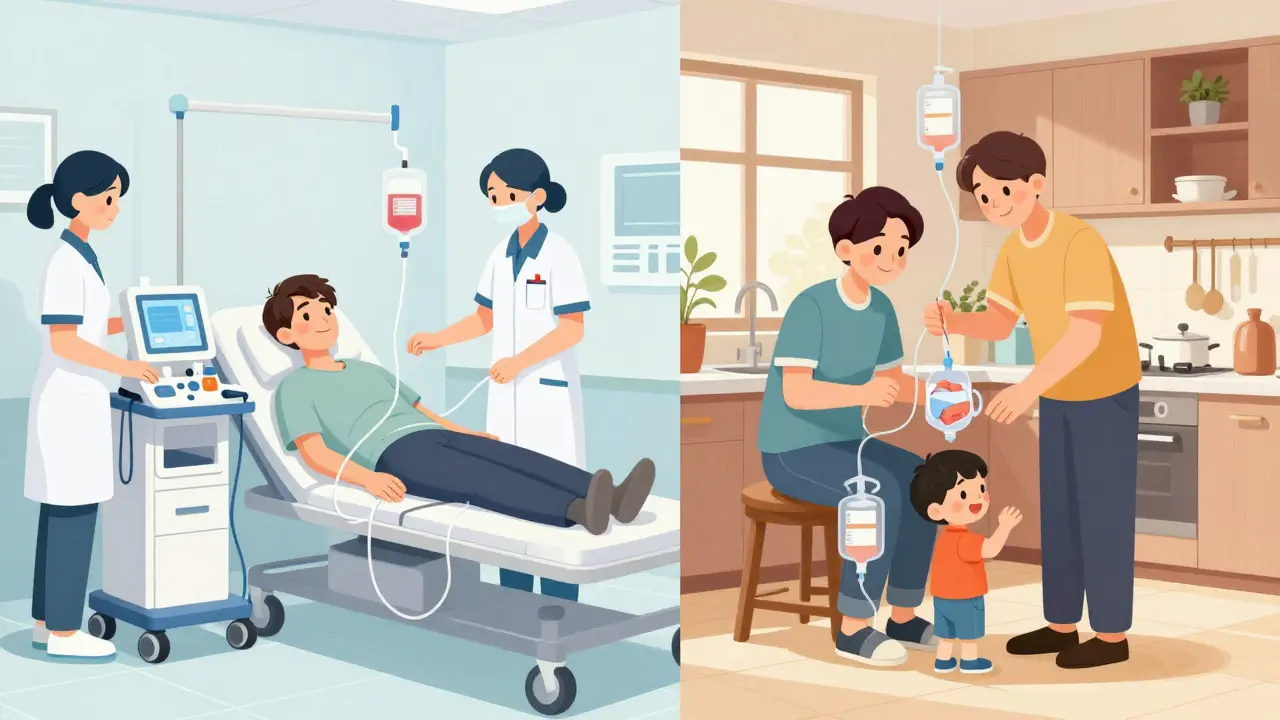
When your kidneys fail, life doesn’t stop-but how you manage it does. Two main treatments keep people alive when their kidneys can’t filter waste anymore: hemodialysis and peritoneal dialysis. Both do the same job-cleaning your blood-but they do it in completely different ways. One happens in a clinic, three times a week, with machines and needles. The other happens at home, every day, using your own abdominal lining as a filter. Choosing between them isn’t just about medical facts; it’s about your lifestyle, your body, and what you can realistically manage day after day.
How Hemodialysis Works
How Peritoneal Dialysis Works
Clearance and Efficiency: Speed vs. Continuity
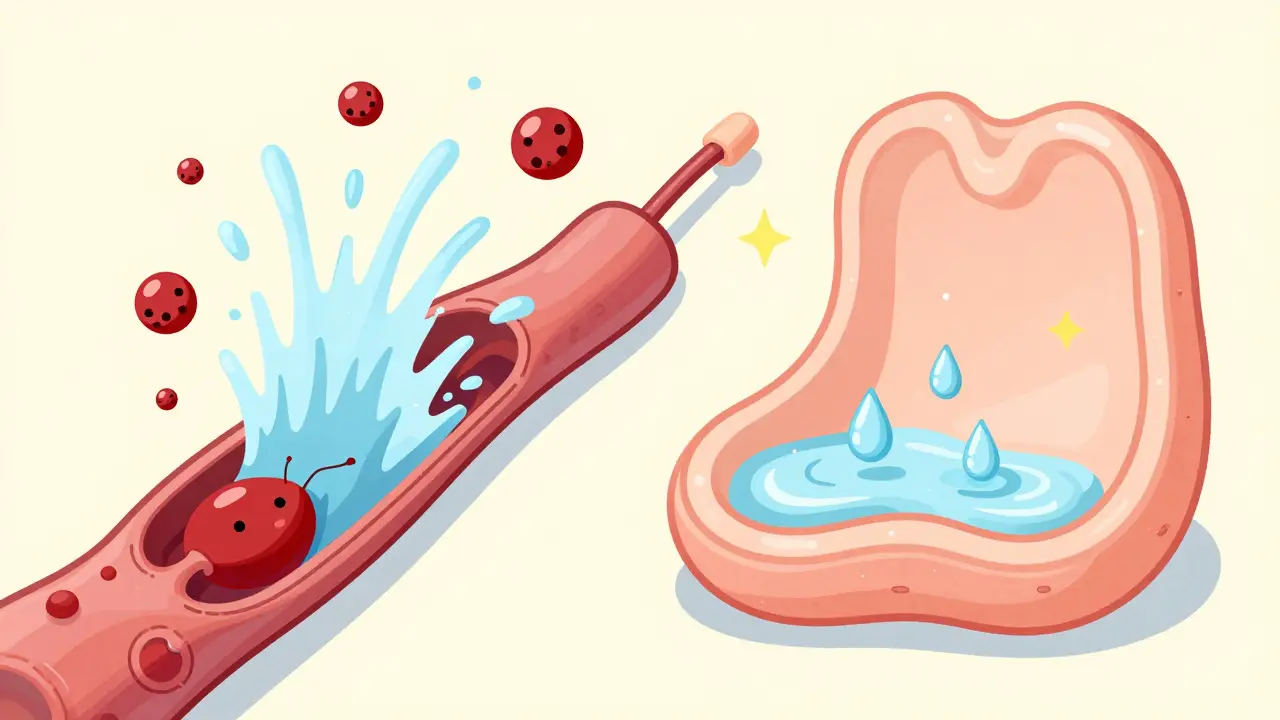
One of the biggest differences between hemodialysis and peritoneal dialysis comes down to how fast and how often waste is removed. Hemodialysis is like a powerful pressure wash-it clears toxins quickly in a short burst. Each session removes urea, creatinine, and extra fluid at high rates, with a Kt/V (a measure of dialysis adequacy) of 1.2 to 1.4 per session. That sounds impressive, but it’s only three times a week. Between sessions, toxins and fluid build up again. That’s why many people feel tired, bloated, or crampy after long gaps between treatments.
Peritoneal dialysis works differently. It doesn’t rush. Instead, it runs slowly, 24 hours a day. Whether you’re doing manual exchanges (CAPD) or nighttime cycles (APD), the dialysis fluid stays in your belly for 4 to 6 hours at a time, gently pulling out waste. Over a full week, the total clearance (weekly Kt/V) ends up being similar-1.7 to 2.1-but it’s spread out. That means less dramatic swings in your blood pressure, fewer cramps, and more stable potassium levels. A 2023 study from the National Center for Biotechnology Information found PD patients had significantly better blood pressure control and less strain on their hearts compared to those on hemodialysis.
Which One Is Safer? Complications Compared
No dialysis is risk-free, but the kinds of risks differ. Hemodialysis patients face problems tied to their blood access. About 70% of people get an arteriovenous (AV) fistula-a connection between an artery and vein in the arm. It takes 6 to 8 weeks to mature before use, but once ready, it’s the most reliable and lowest-infection option. Still, fistulas can clot, narrow, or get infected. Others use a graft or a central catheter. Catheters, especially, carry a high risk of bloodstream infections, which can land you in the hospital.
Peritoneal dialysis avoids blood access entirely-but introduces a different threat: peritonitis. That’s an infection of the abdominal lining, caused by bacteria entering through the catheter during exchanges. The rate is about 0.3 to 0.7 episodes per patient per year. It’s not common, but when it happens, it’s serious. Patients must follow strict sterile technique every single time they connect or disconnect the tubing. One slip-up can mean antibiotics, hospitalization, or even switching to hemodialysis.
A 2023 study comparing 74 HD patients to 77 PD patients found PD had a significantly lower total rate of complications. PD users also had better control of parathyroid hormone levels, which helps protect bones and prevent calcification in blood vessels. Hemodialysis, on the other hand, can cause sudden drops in blood pressure during treatment, leading to nausea, dizziness, or even heart stress-especially in older adults or those with heart disease.
Living With Dialysis: Flexibility, Independence, and Daily Life
Think about your life outside the clinic. Hemodialysis means sticking to a rigid schedule: three visits a week, each lasting 3 to 5 hours. That’s 15+ hours a week away from work, family, or hobbies. Many patients report feeling wiped out for hours after treatment. One Reddit thread with over 140 comments found 97% of HD users complained about the inflexible schedule, and 83% said they felt exhausted afterward.
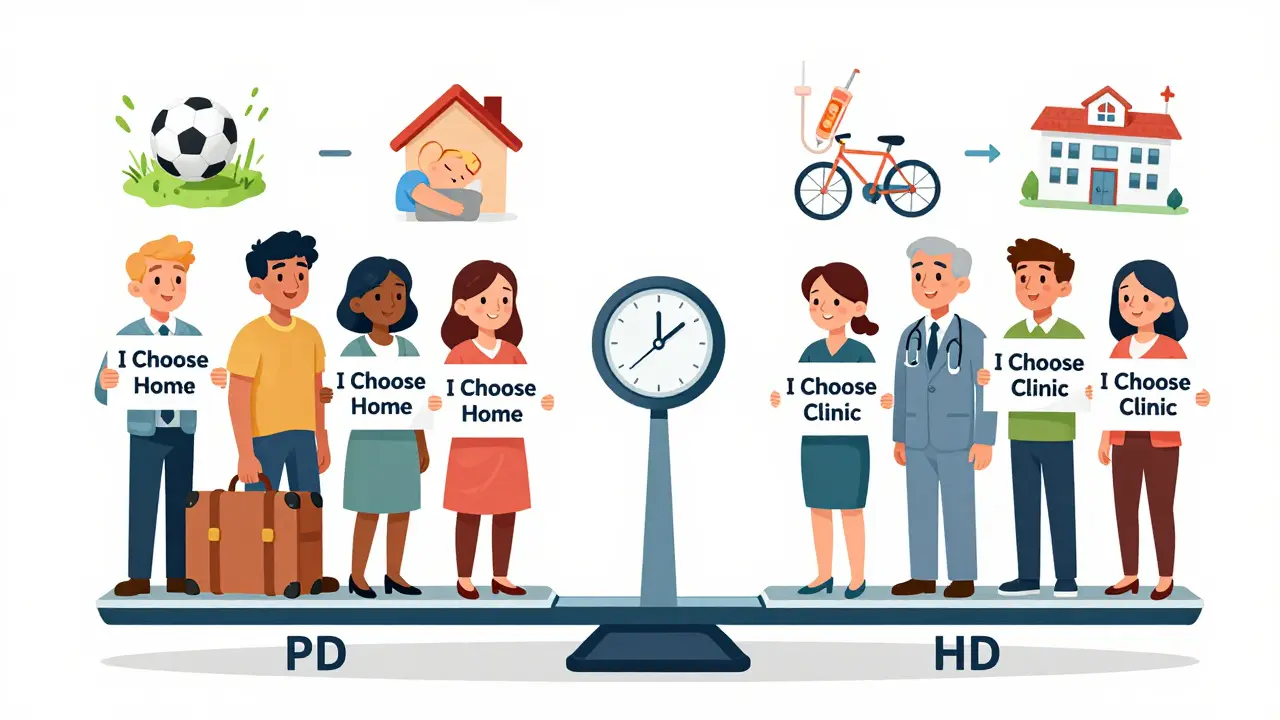
Peritoneal dialysis gives you back control. You can do exchanges during the day while you work, cook, or watch TV. Or you can use a machine at night while you sleep. No need to travel to a clinic. You can travel more easily, too-dialysate bags are lightweight and can be packed in a cooler. A 2022 National Kidney Foundation survey showed 68% of PD users felt more satisfied with their treatment flexibility than only 32% of HD users.
But here’s the catch: PD requires you to be your own nurse. You need to learn sterile technique, track your fluid balance, manage your diet, and handle the catheter every day. If you have arthritis, tremors, or poor eyesight, the manual exchanges can be impossible. Around 41% of PD users report dexterity issues as a major challenge, compared to just 9% of HD users. You also need storage space for dialysate bags-about 20-30 bags per week-and a clean, dry area to do exchanges.
Who Is a Better Candidate for Each?
There’s no one-size-fits-all answer. But certain factors make one option more suitable than the other.
Peritoneal dialysis is often better for:
- People who want to avoid frequent clinic visits
- Those with stable blood pressure and no severe heart failure
- Patients with good manual dexterity and cognitive ability
- People who live far from a dialysis center
- Those who prefer to manage their own care at home
Hemodialysis is often better for:
- Patients with advanced kidney failure and severe fluid overload
- People with abdominal scarring, hernias, or recent abdominal surgery
- Those with poor manual dexterity or vision problems
- Patients with morbid obesity (BMI over 35)
- Individuals who don’t want the responsibility of daily self-care
Age alone isn’t a deciding factor. Many older adults do well on PD if they have support. But if someone has dementia, severe heart disease, or can’t follow complex instructions, in-center hemodialysis may be the safer choice.
Cost, Access, and Global Trends
Cost isn’t just about what you pay-it’s about what the system spends. Peritoneal dialysis is cheaper per patient per year in most countries. A 2023 study in the Journal of Peritoneal Therapy and Clinical Practice found PD offers better value for money, with fewer hospitalizations and lower equipment costs. Yet in the U.S., only about 12% of dialysis patients use PD. Why? Because the system is built around clinics. Most nephrologists are trained in hemodialysis. Insurance reimbursement structures favor facility-based care. Only 34% of U.S. nephrology fellows get proper PD training, according to the American Society of Nephrology.
That’s changing. In Hong Kong, 77% of patients use PD. In the U.K., it’s 22%. In Mexico, nearly half. The U.S. is catching up slowly. The Centers for Medicare & Medicaid Services now pushes for 80% of new dialysis patients to get education on home dialysis or transplant by 2025. And the number of people choosing home dialysis (including both PD and home HD) has grown 2.5% annually since 2018.
Technology is helping too. New dialysate solutions like icodextrin allow longer dwells without damaging the peritoneal membrane. Glucose-sparing regimens reduce the risk of weight gain and diabetes worsening. These advances make PD more sustainable long-term.
What Do Patients Really Say?
Real people live with these choices every day. On Reddit’s r/kidneydisease, PD users talked about the constant presence of the catheter-78% said they felt it was a burden. But they also loved not having to go to a clinic. HD users hated the schedule, the fatigue, and the needle sticks-but appreciated not having to manage their own treatments.
One PD patient wrote: “I do my exchanges while I watch my grandkids play. I don’t miss a soccer game because I’m on a machine.” Another HD patient said: “I’m 78. I can’t remember how to connect the lines every day. I’m grateful someone else does it for me.”
There’s no perfect choice. But there is a right one-for you.
What Happens If You Choose Wrong?
Choosing a dialysis type isn’t a life sentence. Many people switch. Maybe you start with PD because you want independence, but then get frequent peritonitis. You can switch to HD. Or maybe you start with in-center HD and realize you hate the schedule-then transition to home dialysis.
The key is to start with education. Talk to your nephrologist about your daily life, your physical abilities, your support system, and your goals. Ask to meet someone on each therapy. Watch videos. Visit a home dialysis center. Don’t let tradition or convenience decide for you.
Both therapies save lives. But only one will let you live the way you want to.
Can you switch from hemodialysis to peritoneal dialysis?
Yes, many people switch between dialysis types based on their health, lifestyle, or complications. If you’re on hemodialysis and want more flexibility, you can be evaluated for peritoneal dialysis. A surgeon will place a Tenckhoff catheter, and you’ll need training-usually 10 to 14 days. The reverse is also possible: if you develop repeated peritonitis or can’t manage the daily exchanges, switching to hemodialysis is common and safe.
Which dialysis is better for older adults?
There’s no single answer. Older adults can do well on either therapy. Peritoneal dialysis avoids frequent clinic trips and hemodynamic stress, which helps those with heart issues. But if someone has dementia, arthritis, or poor vision, managing daily exchanges becomes unsafe. In those cases, in-center hemodialysis-with staff handling the process-is often the better option. Age alone doesn’t determine suitability; physical ability and support matter more.
Does peritoneal dialysis damage the kidneys faster?
No. In fact, studies show PD helps preserve any remaining kidney function longer than hemodialysis. The gentle, continuous nature of PD puts less stress on the kidneys’ remaining filters. Hemodialysis’s rapid fluid shifts can reduce blood flow to the kidneys, potentially accelerating loss of residual function. Preserving even a little kidney function improves survival, reduces fluid overload, and lowers medication needs.
Is peritoneal dialysis really less expensive?
Yes, over time, peritoneal dialysis typically costs less than in-center hemodialysis. It avoids facility fees, transportation costs, and many hospitalizations related to vascular access problems. A 2023 study found PD offers better value for money due to lower complication rates and fewer emergency visits. While the dialysate solutions and catheter supplies add up, overall system costs are lower, especially when you factor in reduced staffing needs and hospital stays.
Can you travel with peritoneal dialysis?
Yes, and many patients do. Dialysate bags are lightweight and can be shipped ahead or bought at pharmacies in most countries. You’ll need a clean, quiet space to do exchanges, but no machine is needed for CAPD. For APD users, portable cyclers are available. Traveling with PD requires planning-pack extra supplies, know where to get dialysate locally, and carry medical documentation. Most airlines allow dialysis supplies as medical equipment without extra fees.
How long does it take to start each type of dialysis?
For hemodialysis, if you need a fistula, you’ll wait 6 to 8 weeks for it to mature before starting. A catheter can be placed quickly, but it’s a temporary solution. For peritoneal dialysis, the catheter is placed surgically, and you’ll wait 10 to 14 days for healing before starting exchanges. Both require training-usually 1 to 2 weeks-before you’re ready to go home. Planning ahead is key; starting dialysis should never be an emergency decision.
Deciding between hemodialysis and peritoneal dialysis isn’t about which is “better.” It’s about which fits your life. One isn’t superior across the board-each has strengths, risks, and trade-offs. The goal isn’t just to survive. It’s to live well. Talk to your care team. Ask questions. Meet others on each therapy. Your kidneys may have failed-but your life doesn’t have to stop.
Comments (15)
John Wippler
January 26, 2026 AT 18:27It’s not about which one kills you slower-it’s about which one lets you still feel like you’re alive. I’ve seen people on HD cry because they missed their kid’s recital. I’ve seen people on PD cry because they forgot to wash their hands before a swap and spent a week in the hospital. Neither is easy. But the one that lets you keep your damn dignity? That’s the one worth fighting for.
Mohammed Rizvi
January 27, 2026 AT 21:24HD is the corporate version of dialysis. PD is the DIY version. One comes with a waiting room full of people who all look like they’ve seen the end of the world. The other comes with a catheter you forget about until you have to change it while your dog barks and your cat knocks over the dialysate bag. Neither is glamorous. But one lets you wear pajamas to work.
Shawn Raja
January 28, 2026 AT 03:07They say PD is cheaper. They say it’s more flexible. But nobody talks about the emotional tax of being your own nurse. You don’t just manage fluid balance-you manage guilt. Guilt when you skip a swap. Guilt when you’re too tired to clean the line. Guilt when you realize your body is now a factory and you’re the only technician. HD? At least you get to be a patient for a few hours. PD? You’re the whole damn hospital.
And yet-I’d still pick it. Because I’d rather die on my own terms than die in a chair while some nurse watches the clock.
Napoleon Huere
January 29, 2026 AT 07:18There’s a quiet dignity in being able to do your own dialysis. It’s not about being brave. It’s about refusing to let a machine define your life. I know people who’ve switched from HD to PD and say they felt like they got their life back-not their health, but their life. The catheter? Yeah, it’s a weird thing to carry around. But it’s not a leash. It’s a key.
Aishah Bango
January 31, 2026 AT 03:55People act like PD is some kind of heroic choice, but let’s be real-most of us choose it because we’re scared of the clinic. We don’t want to be seen. We don’t want to be the sick person in the waiting room. We don’t want to be reminded every single week that we’re broken. So we hide at home with our bags and our sterile technique and pretend we’re normal. It’s not empowerment. It’s survival with a smile.
Simran Kaur
February 2, 2026 AT 02:16I watched my aunt do PD for three years. She’d do her exchanges while cooking dinner, humming old Bollywood songs. She never complained. But one day, she whispered to me, ‘It’s not the bags that tire me. It’s the silence.’ No one else in the house knew what she was doing. No one asked. She became invisible. I wish someone had asked her how she was really doing-not just if the bags were working.
Jessica Knuteson
February 3, 2026 AT 22:33PD isn’t cheaper. It’s just shifted the cost from the system to the patient. You pay with sleep. You pay with anxiety. You pay with the mental load of being your own nurse. And if you mess up? You get billed for the hospital stay. The system wins either way. The patient just gets quieter.
rasna saha
February 4, 2026 AT 16:20I’ve been on PD for 5 years. I do my exchanges while my grandkids nap. I’ve traveled to three countries with my dialysate in a cooler. I’ve missed zero family dinners. I’ve had one bout of peritonitis-thank God it was caught early. It’s not perfect. But it’s mine. And I’d do it again.
Skye Kooyman
February 5, 2026 AT 03:12Why does everyone act like PD is this radical act of independence? It’s just another form of medical choreography. You’re not free-you’re just doing the dance in your living room instead of the clinic. The machines don’t care where you are. They just want you to follow the rules.
James Nicoll
February 6, 2026 AT 11:40HD is the American way. Fast. Loud. Paid for by insurance. PD is the immigrant way. Quiet. Do-it-yourself. Pay for your own supplies. No wonder the system doesn’t push it. It doesn’t fit the profit model. They want you in the chair. Not in your kitchen.
Uche Okoro
February 7, 2026 AT 01:19Statistically, PD demonstrates superior cost-effectiveness metrics in longitudinal cohort analyses, particularly in low-resource settings where infrastructure for vascular access management is suboptimal. However, the biological burden of peritoneal membrane fibrosis and ultrafiltration failure remains a critical long-term limitation requiring pharmacoeconomic modeling to fully contextualize.
Ashley Porter
February 7, 2026 AT 04:28PD has a 0.5-0.7 episodes/year peritonitis rate. HD has 0.8-1.2 catheter-related bacteremia rates. Both are high. But PD’s complications are preventable. HD’s are systemic. The real difference? PD lets you live. HD lets you survive. One is a lifestyle. The other is a sentence.
Peter Sharplin
February 8, 2026 AT 09:47I’ve been a dialysis nurse for 18 years. I’ve seen people switch from HD to PD and come back to life. I’ve seen people switch from PD to HD and finally sleep at night. There’s no right answer. Only the right fit. If you’re choosing based on what’s easier for your doctor, you’re already losing. Ask yourself: What do you want your life to look like in six months? Not what’s easier today.
Faisal Mohamed
February 10, 2026 AT 07:47PD = 🤖🏠
HD = 🏥⏰
Both = 💔
But one lets you hug your dog after dinner. Choose wisely. 🤝
Josh josh
February 11, 2026 AT 21:14they say pd is better but what if you cant even tie your shoes anymore? i got arthritis and my hands shake. i tried to do a swap and spilled fluid all over my couch. now i just go to the clinic. at least someone else does the dirty work. no shame in that.