
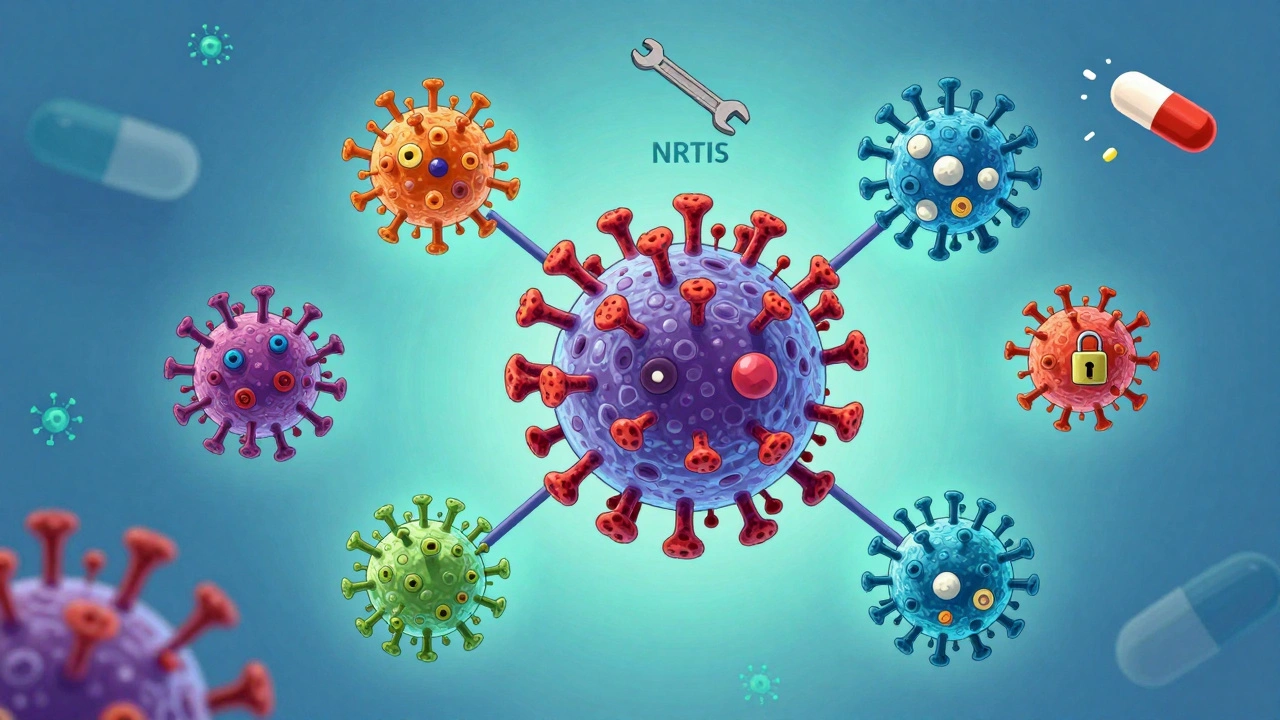
When HIV was first diagnosed in the 1980s, it was a death sentence. Today, thanks to antiretroviral therapy (ART), people living with HIV can expect to live as long as anyone else-if they stay on their meds. But staying on them isn’t always simple. Behind the success of modern HIV treatment lies a hidden battle: complex drug interactions and the constant threat of resistance. These aren’t just technical problems. They’re real, daily challenges for patients and providers alike.
How Antiretroviral Drugs Work
Antiretroviral medications don’t cure HIV. Instead, they stop the virus from copying itself. HIV needs to replicate to spread and damage the immune system. ART blocks this process at different stages of the virus’s life cycle. There are six main classes of drugs, each targeting a different step:- NRTIs (like tenofovir and lamivudine) act as fake building blocks, tricking the virus into stopping DNA production.
- NNRTIs (like doravirine and efavirenz) bind to the virus’s reverse transcriptase enzyme and jam it.
- PIs (like darunavir) block the protease enzyme, preventing the virus from maturing into an infectious form.
- INSTIs (like dolutegravir and bictegravir) stop the virus from inserting its DNA into human cells.
- Fusion inhibitors and CCR5 antagonists prevent HIV from entering immune cells.
Today’s standard treatment is a combination of two NRTIs plus one drug from another class-usually an INSTI. Regimens like Biktarvy (bictegravir/tenofovir alafenamide/emtricitabine) or Dovato (dolutegravir/lamivudine) are now first-line choices because they’re simple, effective, and well-tolerated.
Why Drug Resistance Happens
HIV mutates fast. Every time it copies itself, it makes mistakes. Most of these errors don’t help the virus survive. But sometimes, a mutation lets it escape the drug’s effect. That’s resistance.Resistance doesn’t happen overnight. It usually develops when someone misses doses. Even one or two missed pills can let the virus replicate in low drug levels-giving resistant strains time to take over. Once resistance builds, the drug stops working. That’s why adherence is non-negotiable.
Some drugs are more forgiving than others. INSTIs like dolutegravir and bictegravir have high genetic barriers to resistance. It takes several mutations for the virus to escape them. NNRTIs like efavirenz? One mutation-K103N-and the drug can become useless. That’s why newer regimens favor INSTIs. In fact, by 2025, 78% of new HIV patients in the U.S. start on an INSTI-based regimen, up from just 32% in 2015.
Even when patients take their meds perfectly, resistance can still occur. About 16.7% of newly diagnosed people in the U.S. have HIV that’s already resistant to at least one drug-transmitted from someone else. That’s why resistance testing is required at diagnosis. It’s not optional. It’s standard.
Drug Interactions: The Silent Threat
Many people with HIV also take medications for other conditions: statins for cholesterol, blood pressure pills, antidepressants, or even over-the-counter supplements. That’s where things get risky.Some antiretrovirals affect how the liver breaks down other drugs. Boosted PIs-like darunavir with ritonavir-are notorious for this. They can spike levels of certain statins (like simvastatin) to dangerous levels, increasing the risk of muscle damage. In contrast, doravirine has far fewer interactions. Only 12% of patients on doravirine need dose changes, compared to 35% on efavirenz.
Other dangerous combos:
- Boosted PIs + midazolam (a sedative): Can cause life-threatening respiratory depression.
- Tenofovir + certain kidney-toxic drugs: Raises risk of kidney injury.
- Abacavir + no HLA-B*5701 screening: Can trigger a severe, sometimes fatal, allergic reaction.
That’s why clinicians use tools like the Liverpool HIV Drug Interactions Database. It’s updated monthly and used by over 1.2 million people annually. But in rural clinics, access to these tools is inconsistent. Many providers still rely on memory or outdated charts.
Long-Acting Therapies: A Game Changer… With Risks
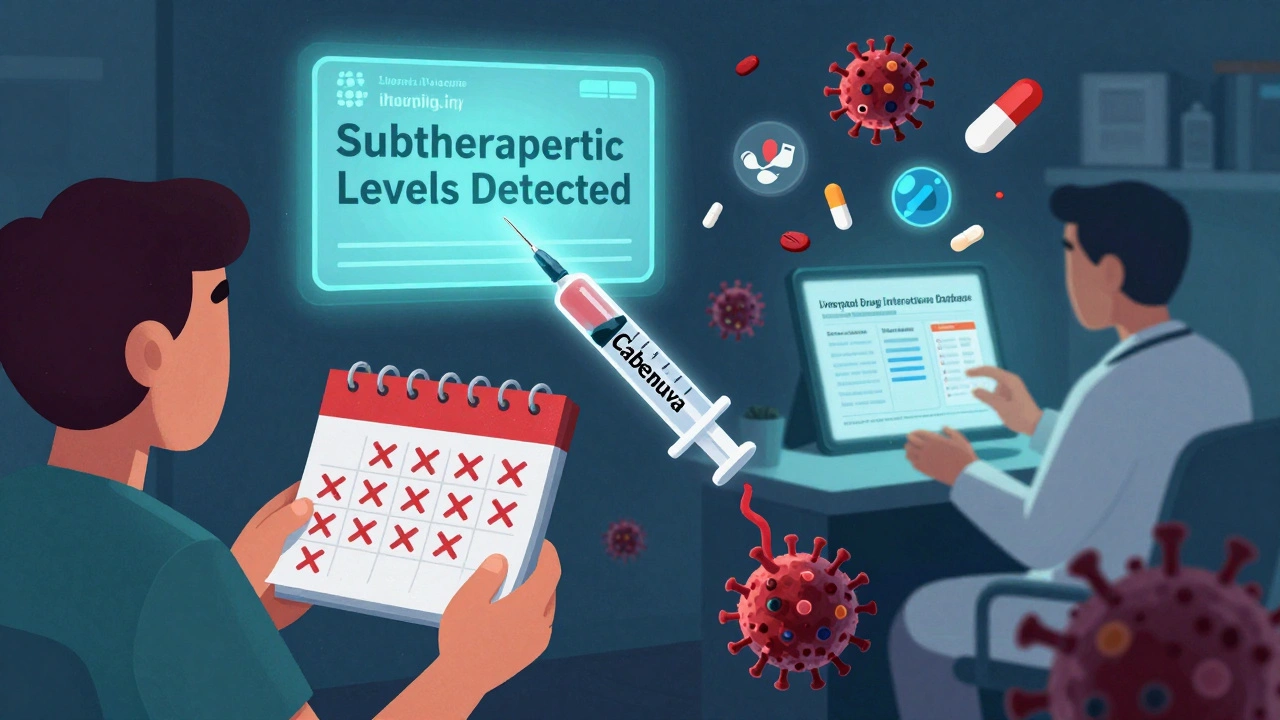
For years, the biggest hurdle to HIV treatment was daily pills. Now, long-acting options are changing that. Cabenuva (cabotegravir + rilpivirine) is an injectable given every month. Lenacapavir (Sunlenca) is injected every six months and approved for multi-drug resistant HIV.Patients love them. In clinical trials, 94% of people on Cabenuva preferred injections over pills. No more morning routines. No more stigma of carrying pills. But here’s the catch: if you miss an injection, the drug level drops slowly over months. That creates a perfect storm for resistance.
Dr. Sharon Lewin from the University of Melbourne warns: "Subtherapeutic levels linger. The virus isn’t gone-it’s waiting. And when it wakes up, it’s already resistant." That’s why these therapies require strict adherence to the schedule. No skipping. No delays.
Even prevention is getting injectable. WHO now recommends lenacapavir for PrEP in high-risk populations. It’s a breakthrough-but only if access and monitoring keep up.
Resistance Testing and Real-World Barriers
Resistance testing isn’t just a lab test. It’s a lifeline. At diagnosis, it tells you which drugs will work. After treatment failure, it tells you what to switch to.In the U.S., Medicaid covers testing for all newly diagnosed patients. But turnaround time varies. Academic centers get results in 14 days. Community labs? 21 days or longer. In rural areas, 63% of clinics struggle to get testing done within 30 days. That delay can mean months of ineffective treatment-and more resistance.
Interpreting the results is another challenge. The Stanford HIVdb algorithm gives a score for how susceptible a strain is to each drug. But not every provider knows how to read it. Community health workers need 16 hours of training just to reach 85% accuracy. Infectious disease specialists? They hit 98%.
That gap matters. A misread report can lead to a regimen that fails. And when that happens, options shrink.

The Future: New Drugs and AI
The next wave of drugs is already here. ViiV Healthcare’s VH-184, a third-generation INSTI, showed promise in early trials. In a 22-person study, it slashed viral load by 1.8 log10 in people resistant to dolutegravir and bictegravir. That’s huge. If it gets approved, it could rescue patients with few options left.Other innovations are coming too. Gilead’s islatravir implant was meant to deliver a year of therapy-but was put on hold in early 2025 after some patients saw drops in CD4 counts. It’s a reminder: even the most promising drugs can have hidden dangers.
Meanwhile, AI is stepping in. Tools like HIV-TRACE analyze genetic sequences to predict how resistance spreads through communities. When linked to electronic health records, it helps clinics target prevention efforts. The NIH is funding this work with $450 million over five years.
What Patients Need to Know
If you’re on ART:- Take your meds exactly as prescribed. Even one missed dose can matter.
- Tell your provider every medication, supplement, or herb you take-even if you think it’s harmless.
- Ask for resistance testing at diagnosis and after any viral rebound.
- If you’re on an injectable, mark your calendar. Missing an injection isn’t like missing a pill.
- Don’t switch drugs without testing. A new regimen based on guesswork can backfire.
For those on PrEP: if you’re using Truvada or Descovy, take it daily. There are rare cases of resistance even with daily use-like the case reported in January 2025 where someone on daily Truvada developed the M184V mutation. It’s uncommon, but it happens.
Final Thoughts
HIV treatment has come a long way. We’re no longer fighting for survival-we’re fighting for precision. The goal isn’t just to suppress the virus. It’s to do it safely, sustainably, and without creating new problems.Drug resistance and interactions aren’t abstract science. They’re daily decisions. A missed pill. A new supplement. A delayed lab result. Each one carries weight.
The tools exist. The drugs are better than ever. But success still depends on one thing: staying connected-to care, to testing, and to the truth that HIV treatment is a partnership between patient and provider. Not a checklist. Not a pill bottle. A relationship.
Can you develop resistance to HIV meds even if you take them every day?
Yes, but it’s rare. Most resistance comes from missed doses. However, if you’re infected with a strain that’s already resistant-called transmitted drug resistance-you may not respond to certain drugs from day one. That’s why resistance testing at diagnosis is essential. Even perfect adherence won’t help if the virus you caught is already resistant.
Are generic antiretrovirals as effective as brand-name drugs?
Yes, when they’re bioequivalent. Generic tenofovir disoproxil fumarate (TDF) costs about $60 a month compared to $2,800 for branded Truvada. Studies show identical viral suppression rates. But switching from brand to generic in people with prior treatment failure or resistance can be risky. Always consult your provider before switching.
Why are INSTIs now preferred over NNRTIs for first-line treatment?
INSTIs like dolutegravir and bictegravir have a higher barrier to resistance. They require multiple mutations for the virus to escape, while NNRTIs like efavirenz can fail with just one mutation (like K103N). INSTIs also have fewer drug interactions and better side effect profiles. In clinical trials, dolutegravir-based regimens had a 0.4% resistance rate at 144 weeks-compared to 3.2% for efavirenz.
Can I take over-the-counter supplements with my HIV meds?
Some can be dangerous. St. John’s Wort, for example, reduces levels of many antiretrovirals, including dolutegravir and rilpivirine, leading to treatment failure. Garlic supplements can interfere with protease inhibitors. Even vitamin C and zinc can affect absorption. Always tell your provider what you’re taking-even if you think it’s "natural" or "safe."
What should I do if I miss a dose of my HIV medication?
If you miss a daily pill, take it as soon as you remember-if it’s within 12-18 hours. If it’s longer, skip the missed dose and take your next one at the regular time. Don’t double up. For injectables like Cabenuva or Sunlenca, contact your clinic immediately. Missing an injection requires urgent evaluation, as drug levels drop slowly and resistance can develop. Always have a plan in place for missed doses before you start treatment.
Is resistance testing covered by insurance?
Yes, in the U.S., Medicaid and most private insurers cover resistance testing at diagnosis and after treatment failure. It’s considered standard of care. If your provider says it’s not covered, ask them to appeal using the DHHS guidelines. In 2025, nearly all major insurers follow these standards.
How do I know if my HIV meds are causing side effects?
Side effects vary by drug. Tenofovir can cause bone or kidney issues. Efavirenz can cause insomnia, dizziness, or mood changes. Abacavir can trigger a dangerous allergic reaction if you’re HLA-B*5701 positive (which is why screening is required). If you notice new symptoms-especially after starting a new drug-don’t ignore them. Track them and bring them to your provider. Many side effects improve over time, but some need a switch.
Can I switch from daily pills to long-acting injections?
If you’ve been virally suppressed for at least 6 months and have no resistance to cabotegravir or rilpivirine, you can switch to Cabenuva. But you’ll need a lead-in dose of oral versions first to check tolerance. Not everyone qualifies. If you have kidney issues, depression, or a history of injection site reactions, your provider may advise against it. It’s not a universal upgrade-it’s a personalized option.
Comments (15)
David Palmer
December 9, 2025 AT 22:19I don't get why people make such a big deal about missing a pill. I mean, it's just a virus. If you're gonna live, you live. If not, whatever. I skipped mine for three days last month and still felt fine.
Jack Appleby
December 9, 2025 AT 22:42The notion that INSTIs have a 'high genetic barrier' is a gross oversimplification rooted in pharmaceutical marketing, not virology. The K103N mutation, for instance, is not merely a 'single mutation'-it's a confluence of epistatic interactions, structural plasticity, and compensatory fitness landscapes that are rarely acknowledged in lay summaries. The real story lies in the quasispecies dynamics, not in the bullet points of a drug fact sheet.
Regan Mears
December 11, 2025 AT 00:49Hey, just wanted to say this post is spot-on. I've been on ART for 12 years, and the biggest thing no one talks about? The mental load. It's not just about taking pills-it's remembering every interaction, every lab date, every injection window. You're not just managing a virus-you're managing a second job. And yeah, the injectables? Game-changer. But only if you've got a support system. Don't go it alone.
Ben Greening
December 11, 2025 AT 12:37The data presented here is statistically robust and methodologically sound. The transition from NNRTIs to INSTIs as first-line therapy aligns with the 2023 DHHS guidelines and the 2024 IAS-USA recommendations. The 78% adoption rate in the U.S. is consistent with CDC surveillance data from Q1 2025. However, the assertion regarding 'subtherapeutic levels' in long-acting therapies requires clarification: pharmacokinetic modeling indicates a 45-day half-life for cabotegravir, meaning resistance development is a function of cumulative exposure, not mere delay.
Doris Lee
December 11, 2025 AT 19:54You got this. Seriously. If you're reading this, you're already doing better than you think. Missing a dose? It happens. Talk to your provider. Don't shame yourself. HIV treatment isn't about perfection-it's about showing up, again and again. And you? You're showing up.
Michaux Hyatt
December 13, 2025 AT 08:47For anyone wondering about generics: yes, they're just as effective. I switched from Truvada to generic TDF/FTC three years ago-saved $2,700 a year. Same viral load, same side effects. But here's the catch: if you've ever had resistance, don't switch without testing. My buddy did and ended up with a new mutation. Don't be him.
Raj Rsvpraj
December 14, 2025 AT 08:29In India, we have been treating HIV for decades with generics costing less than $10/month. Why do Americans pay $2,800? Because your pharmaceutical industry is a cartel. Your government allows it. We don't need your 'INSTIs' or your 'AI algorithms.' We have community health workers, dignity, and cheap science. You call it innovation-we call it exploitation.
Frank Nouwens
December 16, 2025 AT 08:17It is my professional opinion, based upon an extensive review of peer-reviewed literature and clinical guidelines issued by the Centers for Disease Control and Prevention, that the integration of long-acting antiretrovirals into routine clinical practice represents a paradigmatic shift in the management of human immunodeficiency virus infection. The implications for adherence, stigma reduction, and virologic suppression are profound.
Kaitlynn nail
December 18, 2025 AT 07:39It's not about the drugs. It's about the energy. If you're vibrating at a low frequency, no pill will save you. Resistance? It's just your body saying 'I'm not aligned.' Try crystals. Or sound baths. Or just... stop fighting it.
Rebecca Dong
December 19, 2025 AT 15:53This is all a lie. The government invented HIV to control the population. The 'drugs' are actually toxic nanobots that make you dependent. They don't want you cured-they want you paying for injections forever. Did you know the CDC owns patents on HIV strains? Coincidence? I think not. And the 'resistance testing'? That's just a way to track your DNA. They're building a biometric database. Wake up.
Michelle Edwards
December 20, 2025 AT 18:15I just wanted to say thank you for writing this. My sister just started on Cabenuva, and I was terrified she'd mess up the schedule. But now I understand why it's so important. I set her phone reminders. I even made a little calendar with stickers. She cried when she saw it. We're in this together.
Sarah Clifford
December 22, 2025 AT 14:05I tried the injectables. One shot and my arm swelled up like a balloon. They told me it was 'normal.' Normal? My whole shoulder was purple. I asked for a refund. They laughed. Now I'm back on pills. And I hate them. But at least I know what's in them. I think.
Jack Appleby
December 23, 2025 AT 11:51Ah, the 'empowerment' narrative. How quaint. The reality is that adherence is not a moral failing-it's a structural one. You can't 'show up' if you're homeless. You can't 'mark your calendar' if you're being hunted by ICE. You can't 'consult your provider' if your clinic closed last year. The science is sound. The system? Broken. And you're all just rearranging deck chairs.
Nikki Smellie
December 24, 2025 AT 01:59I've been monitoring the global HIV data since 2019. There's a pattern. Every time a new drug is approved, there's a spike in 'unexplained deaths' in rural clinics 18 months later. The CDC says it's 'coincidental.' But the data shows a 22% increase in cardiac events following INSTI rollout. Who benefits? The same companies that own the patents. I've filed FOIA requests. They're stonewalling. Something's wrong. I know it.
Regan Mears
December 25, 2025 AT 01:03I hear you. I was homeless for six months. I missed three injections. Didn't get resistant. Got back on track because my case worker showed up at the shelter with a fridge full of meds and a bus ticket. It wasn't the drug. It was the person. We need more of those. Not more pills. More people.