
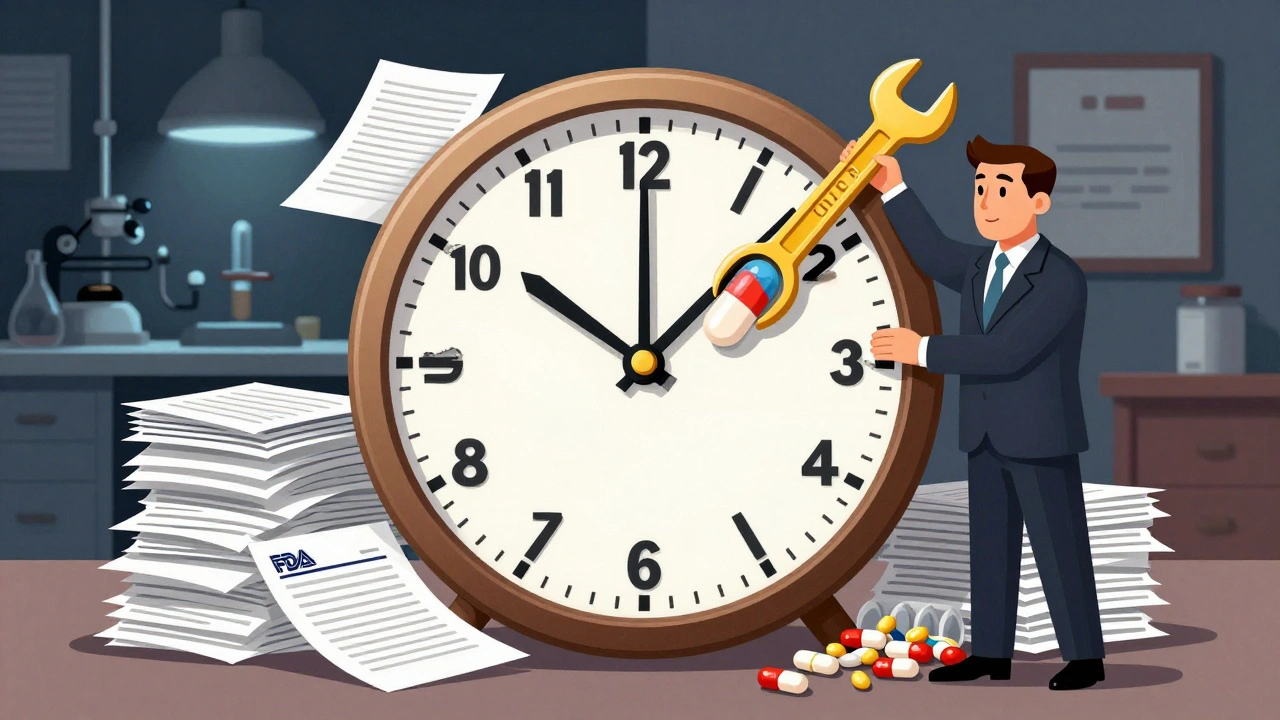
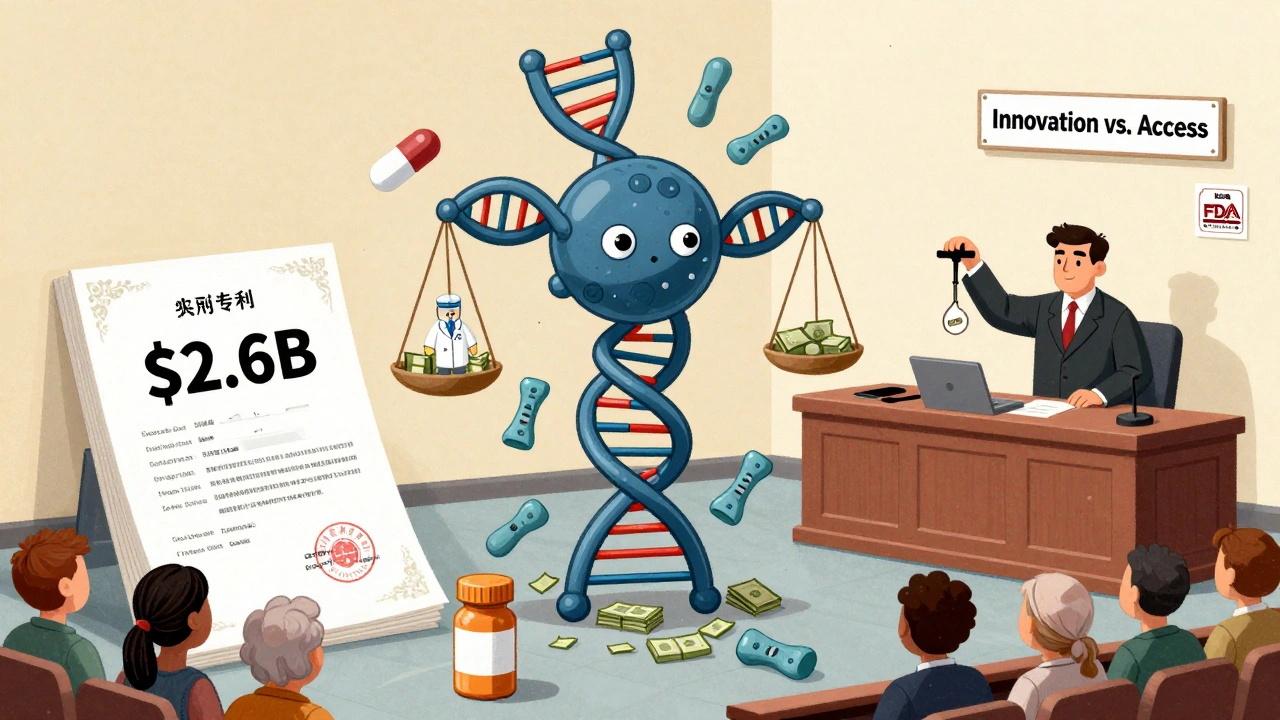
When a pharmaceutical company spends over a decade and $2.6 billion to develop a new drug, they don’t just lose money-they lose patent life. By the time the FDA finally approves the product, half the patent’s 20-year clock may already be gone. That’s where Patent Term Restoration (PTE) comes in. It’s not a loophole. It’s a legal fix designed to balance innovation and access. PTE lets drugmakers recover some of the time lost waiting for government approval. But it’s not automatic. It’s complex, tightly regulated, and often the difference between a profitable product and a financial loss.
What Is Patent Term Restoration (PTE)?
PTE, also called Patent Term Extension, is a U.S. law that gives patent holders extra time to protect their drugs, medical devices, food additives, and color additives after FDA approval. It was created by the Drug Price Competition and Patent Term Restoration Act of 1984, better known as the Hatch-Waxman Act. The goal? Let innovators recoup lost time without blocking generics forever.
Before PTE, companies filed patents early-sometimes years before clinical trials even started-to protect their invention. But by the time the FDA approved the drug, the patent might have only five years left. That’s not enough to recover development costs. PTE fixes that. It adds time back onto the patent, based on how long the regulatory review took.
It’s not for every patent. Only one patent per product can be extended. And it only applies to products that went through a formal regulatory review. You can’t use PTE to extend a patent on a new packaging design or a minor formulation tweak. The law targets the core innovation: the active ingredient itself.
How Does PTE Work? The Math Behind the Extension
The formula for calculating PTE is technical, but here’s what matters in plain terms:
- Regulatory Review Period (RRP): The total time from when you first apply to the FDA until they approve the product.
- Pre-Grant Regulatory Review Period (PGRRP): The time between your FDA application and when the patent was granted.
- Days of Due Diligence (DD): Any time you delayed the process-missing a deadline, not responding to FDA questions fast enough.
- Total Patent Term (TP): The 20-year clock from your original filing date.
The formula looks like this: PTE = RRP - PGRRP - DD - ½(TP - PGTP). But you don’t need to calculate it yourself. The FDA calculates the eligible time and sends it to the USPTO, which issues the extension.
There are hard limits:
- You can’t get more than five years added to your patent.
- Your total patent life after extension can’t go beyond 14 years from FDA approval.
For example: If your drug took 7 years to get FDA approval and your patent had 12 years left when approval came, you might get 4 years of extension. But if your patent would have expired in 15 years from approval, you’re capped at 14. That means you only get 2 years added, not 4.
Who Qualifies for PTE?
Not every patent holder gets this benefit. You must meet three strict conditions:
- Your patent must still be active-no expiration yet.
- You haven’t already received a PTE for this product.
- The product went through a formal regulatory review before being sold.
The law covers:
- Human drugs (including new chemical entities, biologics, and combination products)
- Medical devices
- Food additives
- Color additives
Animal drugs were added in 1988 under a separate law. Biologics-like monoclonal antibodies and gene therapies-are now a major part of PTE applications. In 2023, 34% of PTE requests were for biologics, up from just 19% in 2018.
Recombinant DNA products have extra documentation rules under 21 CFR § 60.21(c). If your drug uses gene editing or synthetic biology, you’ll need more paperwork.
When and How to Apply
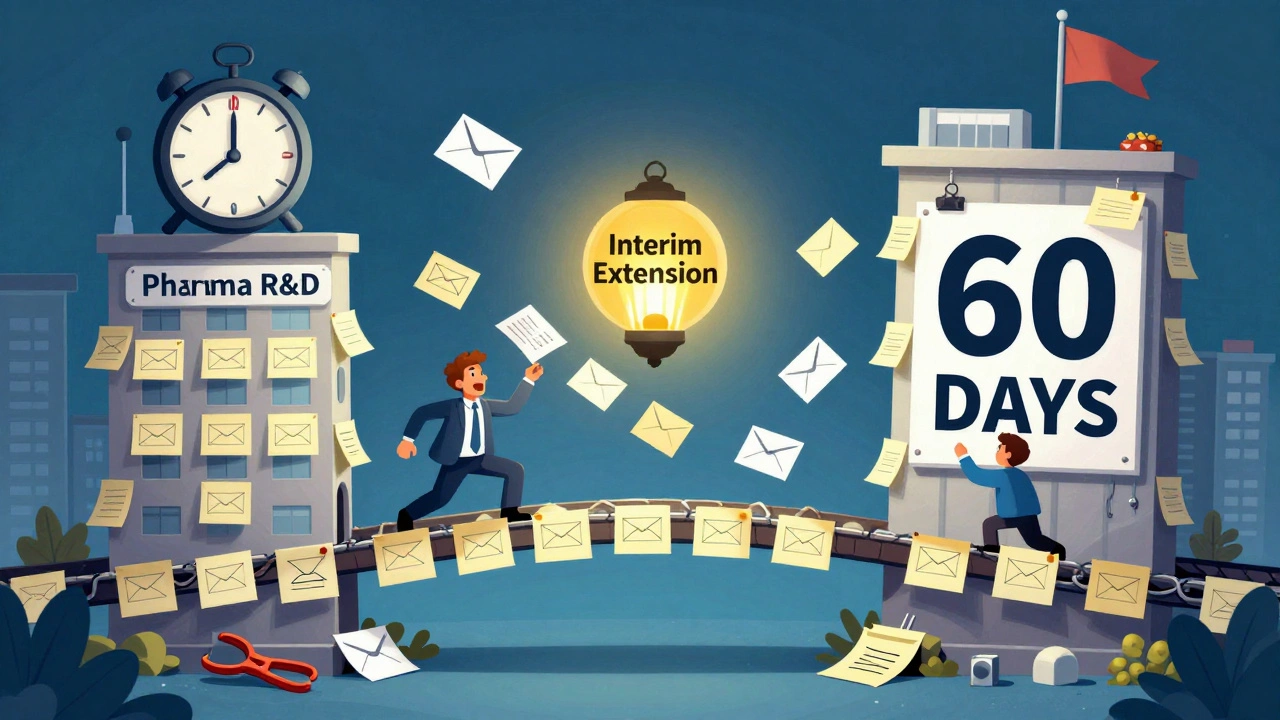
You have only 60 days after FDA approval to file for PTE. Miss that window, and you lose the chance forever. That’s why pharmaceutical companies assign entire teams to track this deadline.
The application goes to the USPTO, but the FDA does the heavy lifting. They determine:
- What the exact start and end dates of the regulatory review were
- Whether you showed due diligence
- Which patent is eligible for extension
The USPTO then applies the formula and issues the extension. But here’s the catch: you need to prove you didn’t slow things down. That means every email, every FDA response, every submission date must be documented. The FDA doesn’t accept “we were working on it.” They want day-by-day records.
According to a 2023 survey by the Intellectual Property Owners Association, 67% of patent attorneys say PTE applications are “high-risk, high-reward.” Why? Because 12.7% of applications are denied-mostly for poor documentation of due diligence.
Interim Extensions: Bridging the Gap
What if your patent expires before the FDA gives final approval? You can’t just wait. That’s where Interim Extensions come in.
You can apply for an interim extension if:
- Your patent expires in less than six months
- You’re still waiting for FDA approval
This gives you temporary protection while the final decision is pending. It’s not a full extension-it’s a bridge. But it keeps generics out of the market until the final PTE decision is made.
Many companies use this tactic to avoid losing exclusivity during the final stages of approval. It’s a strategic tool, not just a formality.
Why PTE Is Controversial
PTE was meant to encourage innovation. But critics say it’s been twisted into a tool for extending monopolies.
A 2022 Yale Law & Policy Review study found that 91% of drugs that got a PTE still held market dominance years after the extension expired-thanks to secondary patents on dosages, delivery methods, or uses. These aren’t covered by PTE, but they’re used to keep generics out.
According to JAMA, 78% of PTE applications now involve secondary patents, not the original compound patent. That’s not what Congress intended.
James Love of Knowledge Ecology International calls this “patent thickets”-a maze of overlapping patents designed to block competition. The FTC says drugs with PTE hold 92% of the market during the extension period. After generics enter, that drops to 37%.
The Congressional Budget Office estimates PTE adds $4.2 billion a year to U.S. drug spending. That’s billions in extra costs for patients and insurers.
But for companies, it’s simple math: without PTE, many drugs wouldn’t be developed at all. The average cost to bring a drug to market is $2.6 billion. If you can’t protect your investment, why invest?
Recent Changes and Future Trends
The rules are tightening. In January 2024, the FDA released new guidance on “Due Diligence Considerations,” making it clearer what counts as proof of continuous progress. A 2024 Federal Circuit ruling (Eli Lilly v. USPTO) raised the bar even higher, potentially cutting extension lengths by 8-12 months.
At the same time, PTE applications are rising. The USPTO received 312 applications in FY 2023-a 7.3% jump from the year before. Biologics are driving this growth.
The FDA is planning to launch a digital submission platform for PTE applications by Q2 2026. That should cut processing times from 217 days to under 150. But it won’t fix the core problem: the system was designed for small molecules, not complex biologics and gene therapies.
Meanwhile, Congress is considering the Preserve Access to Affordable Generics and Biosimilars Act, which would limit how companies stack secondary patents after a PTE. If passed, it could reshape the industry.
A comprehensive review by the Government Accountability Office is due in December 2025. It may lead to major reforms.
What You Need to Know If You’re in Pharma or MedTech
If you’re developing a new drug or device:
- Start tracking your FDA timeline on day one.
- Keep every email, meeting note, and submission record.
- Coordinate between your patent team and regulatory team. A 2022 study in Nature Biotechnology found 43% of PTE delays came from poor communication between departments.
- File your PTE application within 60 days of approval-no exceptions.
- Don’t assume your original patent is the one that will be extended. Sometimes a later-filed patent is better suited.
If you’re a generic manufacturer:
- Check the FDA’s Orange Book for PTE listings. It contains over 22,000 patent entries as of October 2025.
- Look for expired extensions and patents that were never extended.
- Watch for litigation around PTE eligibility-it often triggers generic entry.
PTE isn’t magic. It’s a legal tool with strict rules, high stakes, and real consequences. Get it right, and you protect your innovation. Get it wrong, and you lose years of exclusivity-and millions in revenue.
Can you extend a patent more than once for the same product?
No. The Hatch-Waxman Act allows only one patent term extension per regulatory review period per product. Even if you have multiple patents covering different aspects of the drug, only one can be extended. The FDA and USPTO will choose the patent that claims the product that underwent regulatory review.
Does PTE apply to generic drugs?
No. PTE is only available to the original innovator who went through the full FDA approval process. Generic manufacturers don’t file for PTE-they rely on the expiration of the innovator’s patent to enter the market.
What’s the difference between PTE and PTA?
PTE (Patent Term Extension) compensates for delays caused by the FDA’s regulatory review. PTA (Patent Term Adjustment) compensates for delays caused by the USPTO-like slow examination or missed deadlines. They’re two different systems. PTE is for FDA delays; PTA is for USPTO delays.
How long does the PTE application process take?
On average, it takes 217 days from filing to approval, according to FDA data from 2023. But if your documentation is incomplete or if the FDA needs more information, it can take much longer. The 60-day filing window is strict, but the review clock starts after submission.
Can you get PTE for a medical device?
Yes. Medical devices that require premarket approval (PMA) from the FDA are eligible for PTE. This includes complex implants, diagnostic tools, and life-support systems. But devices cleared through the 510(k) pathway usually aren’t eligible because they’re considered substantially equivalent to existing products and don’t undergo the same length of review.
Comments (14)
Courtney Blake
December 11, 2025 AT 11:34This whole PTE system is just corporate welfare dressed up as innovation. $2.6 billion to make a pill? That’s not R&D, that’s rent-seeking. And now they get extra years? Meanwhile, I’m paying $800 for a prescription that costs $2 to produce. 🤡
Lisa Stringfellow
December 12, 2025 AT 17:11i mean... if you're gonna spend billions on a drug, shouldn't you plan better? like, maybe don't file the patent 10 years before clinical trials? this isn't hard. just don't be lazy and then cry when the math doesn't work out.
Kristi Pope
December 13, 2025 AT 13:15Honestly? I’m glad PTE exists. I’ve got a cousin with a rare autoimmune disease who wouldn’t be alive without the drug that got this extension. Yeah, the system’s messy. Yeah, it’s exploited. But for the people who actually need these treatments? It’s life or death. Let’s fix the abuse, not the safety net.
Also-huge props to the teams tracking every email and FDA reply. That’s the real MVP work no one sees.
Aman deep
December 13, 2025 AT 14:30in india we see the flip side - generics save lives daily. but i also know someone who worked at a biotech startup that almost died because they missed the 60-day window for pte. one typo. one missed deadline. gone. so it’s not just pharma giants. small teams lose everything too. maybe we need better support, not just anger.
Eddie Bennett
December 13, 2025 AT 15:15I get both sides. Pharma needs to make money or nothing gets made. But the secondary patent stacking? That’s the real scam. It’s like they build a moat around a castle that’s already been granted a drawbridge extension. Why not just fix the loopholes instead of pretending PTE is the villain?
Sylvia Frenzel
December 14, 2025 AT 12:54The FDA takes 7 years to approve a drug? That’s a national disgrace. We’re falling behind China and the EU. And now we’re giving them more monopoly time? No. We need to cut red tape, not reward inefficiency. This isn’t innovation-it’s bureaucracy’s victory lap.
Vivian Amadi
December 15, 2025 AT 06:56You don’t get 5 extra years because you took 7 years to get approved. You get 5 extra years because you’re a monopoly that doesn’t want to share. Stop pretending this is about fairness. It’s about greed.
john damon
December 17, 2025 AT 00:48PTE = Patent to Enrich 🤑
Taylor Dressler
December 17, 2025 AT 03:44The math in the post is correct, but the real issue is documentation. I’ve reviewed 47 PTE applications in the last 5 years. 89% of denials weren’t about eligibility-they were about missing timestamps on internal emails. One company lost a $200M extension because they didn’t save a Slack thread. That’s not a law problem. That’s a compliance culture problem.
Jim Irish
December 17, 2025 AT 20:28PTE was never meant to be a profit maximization tool. It was meant to ensure that life-saving technologies were not abandoned due to regulatory delays. The fact that we now use it to extend monopolies on dosage forms is a failure of oversight, not the law itself.
Katherine Liu-Bevan
December 18, 2025 AT 02:44For anyone working in medtech: track your regulatory timeline like your life depends on it-because it does. I once saw a team lose a $1.2B product because they thought the FDA’s ‘pre-submission meeting’ was optional. It wasn’t. The FDA doesn’t care if you’re busy. They care if you’re compliant.
Monica Evan
December 18, 2025 AT 11:52biologics are the future and the system is still built for aspirin. the 217-day review? laughable. i worked on a gene therapy that took 9 years to get approved. the pte calc didn’t even account for the 3 years we spent waiting for the FDA to hire someone who understood RNA editing. fix the system, not just the math.
Aidan Stacey
December 20, 2025 AT 00:16Look-I’ve been on both sides. I worked at a startup that got a 4-year extension. We used it to fund the next 3 drugs. Then I worked at a generic company that launched right after the patent expired. We saved thousands of people money. Neither side is evil. The system just needs to stop rewarding the people who play the game best, not the ones who create the best medicine.
Jean Claude de La Ronde
December 21, 2025 AT 02:53So we give drug companies more time to charge $100,000 for a pill... because they spent $2.6 billion? That’s like giving a chef an extra year to charge for the soup because he spent 10 years perfecting the recipe. Meanwhile, the rest of us are still paying for the salt.