
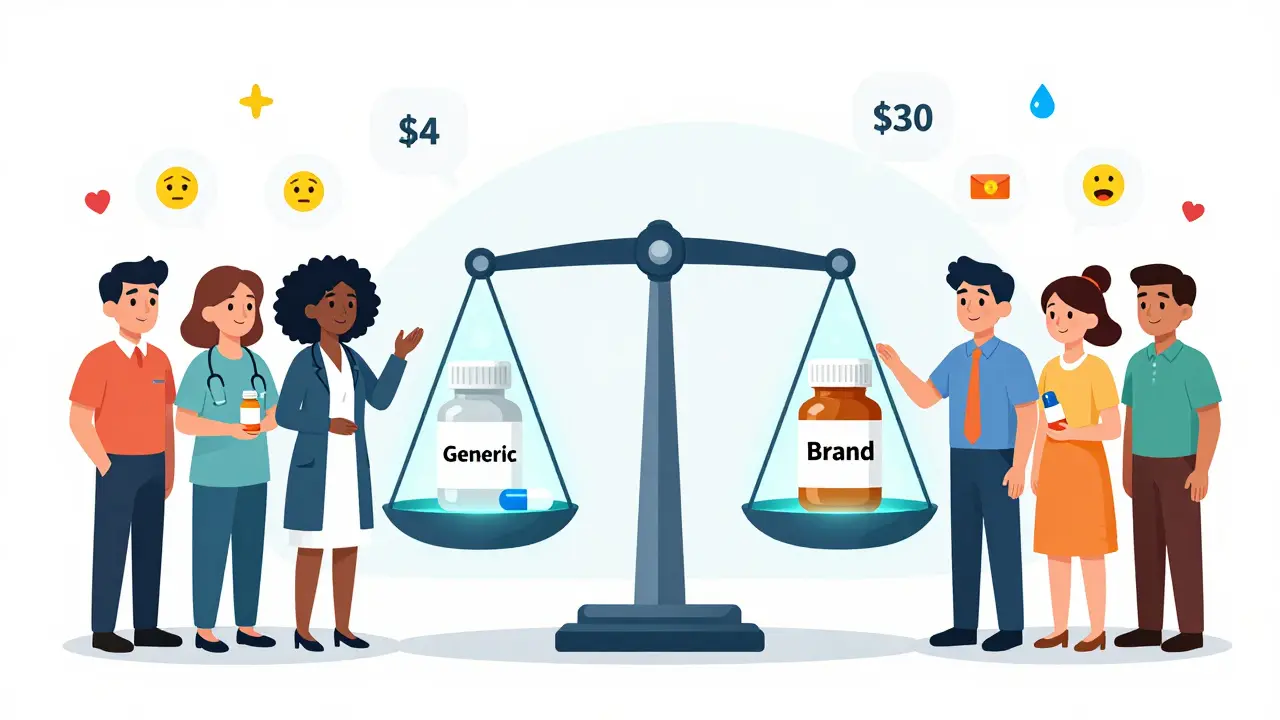
When you pick up a prescription for a generic drug, you’re getting the same active ingredient as the brand-name version-same chemistry, same FDA approval, same clinical results. But if you’ve read online reviews from other patients who say the generic ‘didn’t work’ or ‘made me feel weird,’ you might hesitate. You’re not alone. Even though generics make up 90% of all prescriptions filled in the U.S., nearly one in three patients still believe they’re less effective than brand-name drugs. And it’s not because of science. It’s because of stories.
Why Patients Doubt Generics-Even When Science Says Otherwise
The FDA requires generic drugs to prove they’re bioequivalent to the brand-name version. That means they must deliver the same amount of active ingredient into the bloodstream within a very tight range: 80% to 125% of the original drug’s performance. For most medications, that’s more than enough to work just as well. But patients don’t see the lab reports. They see Reddit threads, Facebook groups, and pharmacy waiting room chats. A 2020 PLOS ONE study found that 33% of patients were unhappy with how little their doctors explained about generic switches. Another 32% distrusted generics simply because they cost less. That’s not logic-it’s psychology. The mind links price to quality. If a pill costs $4 instead of $30, the brain assumes something’s missing. Even if the pill is chemically identical. And then there’s the nocebo effect. It’s the opposite of placebo. Instead of feeling better because you believe a treatment works, you feel worse because you believe it won’t. In one study, patients given identical tramadol (the same exact pill) were told one batch was brand-name and another was generic. Those who thought they were taking the generic reported 18% more pain, took more extra pills, and quit their treatment 23% sooner. The drug didn’t change. Their belief did.What Patients Are Saying Online-And Why It Matters
On platforms like PatientsLikeMe and Reddit, thousands of people share their experiences with generic medications. A 2024 analysis of over 6,000 posts found that nearly half (47%) mentioned ‘different side effects’ after switching. Another third said the generic ‘just didn’t work’ like the brand did. One Reddit user, u/ChronicPainWarrior, wrote in March 2023: ‘My doctor switched me to generic Lyrica and within two weeks my nerve pain returned-I’m convinced the generics aren’t made to the same standards.’ That story sounds real. It feels real. And it’s shared widely. But here’s what’s missing from that post: the possibility that their pain returned because of stress, sleep changes, or even the natural progression of their condition-not because the generic was inferior. Without context, these stories become evidence in the court of public opinion. On the flip side, there are thousands of positive reviews too. u/BudgetSavvyPatient wrote in September 2022: ‘After 3 years on generic sertraline, I’ve saved $2,180 with zero difference in effectiveness.’ But those posts don’t spread as fast. Negative experiences have more emotional weight. They stick. And they shape what new patients expect.Doctors and Pharmacists Are the Key-But They’re Not Always Talking
The biggest predictor of whether a patient accepts a generic? Whether their doctor or pharmacist recommends it. A 2024 study showed that 70% of patients trusted generics when their provider endorsed them. Only 30% did when they weren’t told anything. But here’s the problem: most doctors have under two minutes to discuss medication during a visit. Pharmacists, who are trained to explain generics, often don’t get the chance either. A 2023 AMA survey found that primary care visits average just 1.7 minutes for medication questions. That’s not enough time to explain bioequivalence, inactive ingredients, or the FDA’s approval process. So patients are left to Google it. And Google doesn’t always give them the truth-it gives them the loudest story.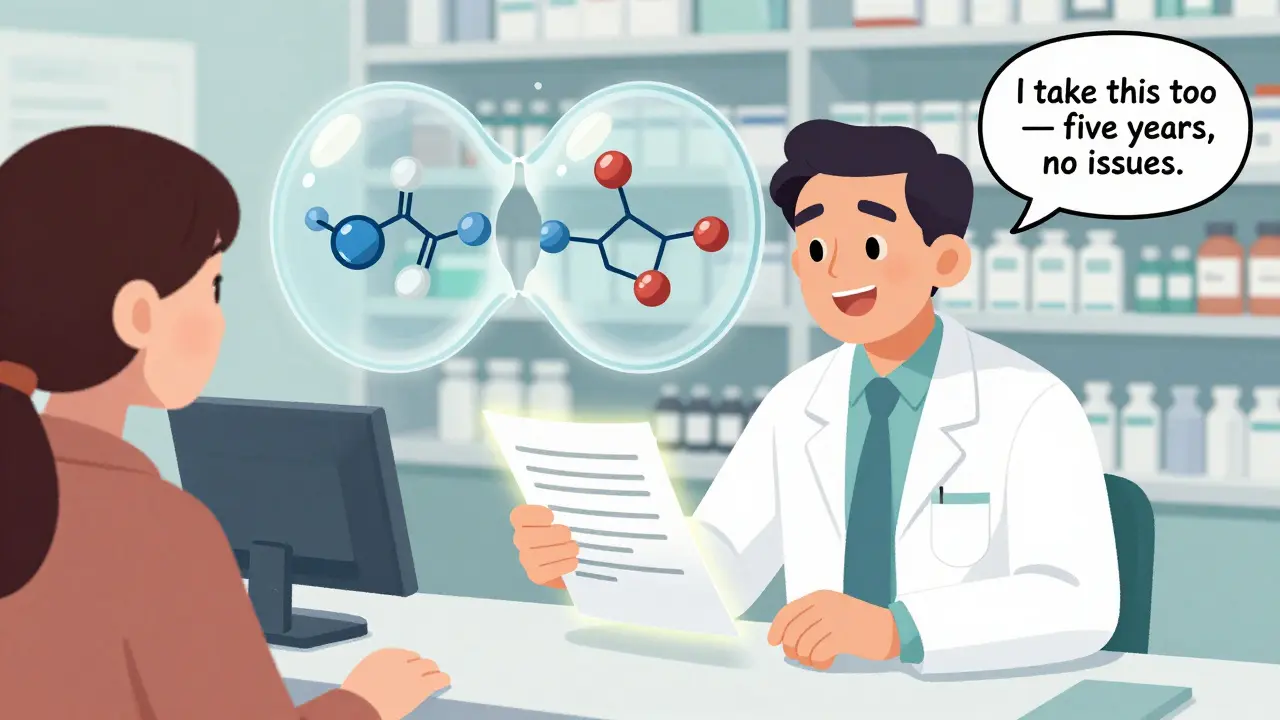
What Works: Real Solutions That Are Changing Minds
Some health systems are fixing this-not with ads, but with conversations. Kaiser Permanente started handing out simple one-page ‘Generic Medication Facts’ sheets at the pharmacy counter. The sheet explained: same active ingredient, same FDA standards, same results. Within six months, patient questions about generics dropped by over half. Adherence went up 19%. In a 15-pharmacy trial, pharmacists were trained to spend just 90 seconds saying: ‘This generic is approved by the FDA to work exactly like your brand. The only difference is the price. You’ll get the same benefit.’ That simple script increased patient acceptance by 39%. Even better? When pharmacists shared their own experience. ‘I take a generic blood pressure pill myself,’ one pharmacist told a skeptical patient. ‘I’ve been on it for five years. No issues.’ That personal touch made all the difference.Why Some Patients Really Do React Differently
It’s not all in their heads. For drugs with a narrow therapeutic index-like warfarin, levothyroxine, or certain seizure meds-even tiny differences in how the body absorbs the drug can matter. The FDA requires tighter testing for these, but not all patients know that. Dr. Randall Stafford from Stanford says: ‘For some people, switching from brand to generic can cause a real shift. That doesn’t mean the generic is bad. It means their body is sensitive. We need to listen, not dismiss.’ That’s why blanket statements like ‘all generics are the same’ backfire. Patients who’ve had a bad experience don’t want to hear that. They want to know: ‘Is this safe for me?’ The answer? Sometimes, yes. Sometimes, no. But the only way to know is to talk about it.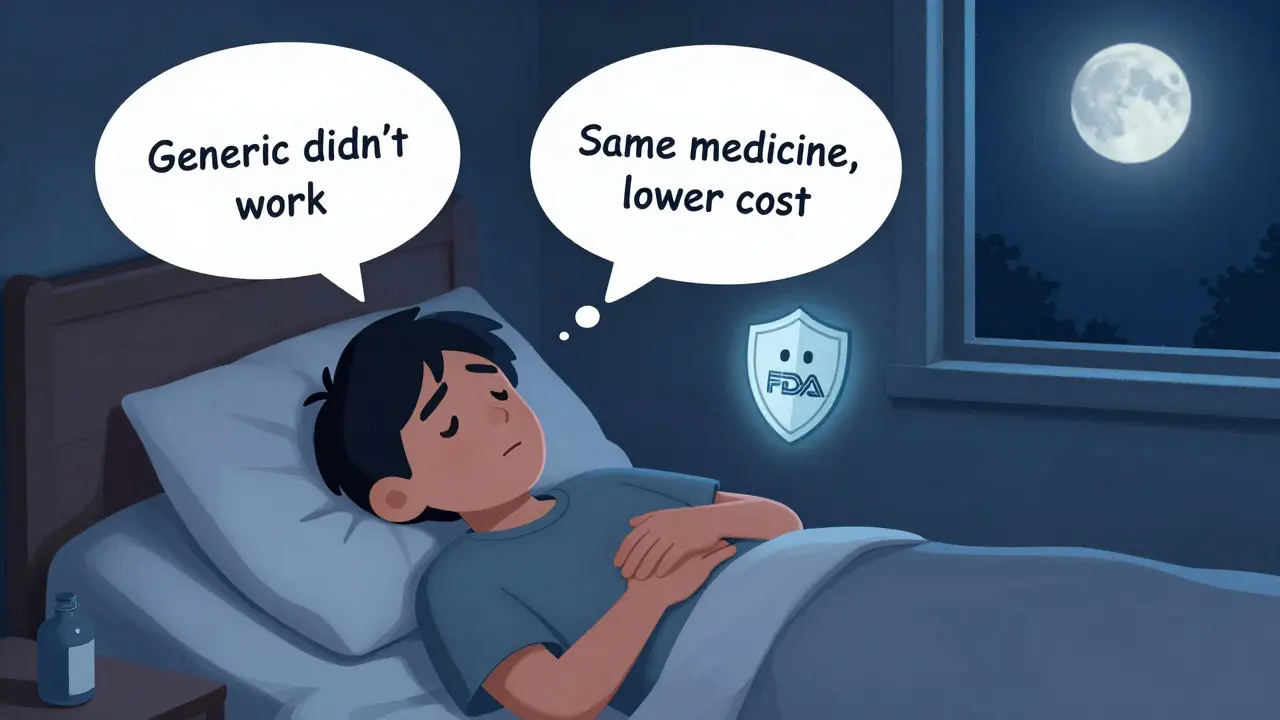
The Real Cost of Misunderstanding Generics
This isn’t just about trust. It’s about money and health. When patients refuse generics, they pay more. The U.S. healthcare system loses an estimated $14.3 billion a year because people stick with brand-name drugs they don’t need. That’s billions in unnecessary spending. And it’s not just cost-it’s adherence. People who think generics don’t work are more likely to skip doses, stop early, or switch back to the expensive brand-and then quit again when they can’t afford it. The FDA’s 2023 ‘Generics: Same Medicine, Lower Cost’ campaign started pushing simple messages on TV and social media. After six months, consumer confidence rose 22%. Not a huge jump. But it’s progress. Meanwhile, authorized generics-brand-name drugs sold under a generic label-are growing fast. In Q4 2023, their prescriptions jumped 38% year-over-year. Why? Because they’re made by the same company, in the same factory. Patients who distrust generics but still need to save money are choosing these as a bridge.What You Can Do-Whether You’re a Patient or a Provider
If you’re a patient:- Ask your pharmacist: ‘Is this generic the same as the brand?’ Don’t be shy. They’re trained to answer.
- Look for the FDA’s list of approved generics. It’s online and free.
- Don’t assume lower price = lower quality. Ask: ‘What’s different about this pill?’ Often, the answer is: nothing.
- Don’t just say ‘I’m switching you to a generic.’ Explain why. Use simple words: ‘This has the same medicine. The only difference is the cost.’
- Share your own experience. ‘I take a generic for my cholesterol.’ That builds trust faster than any pamphlet.
- For sensitive drugs like thyroid or seizure meds, ask: ‘Have you had any issues switching before?’
The Future Isn’t About More Ads-It’s About Honest Conversations
Online reviews aren’t going away. People will keep sharing their stories. But we don’t have to let misinformation win. The best way to fight false beliefs isn’t with data dumps or FDA brochures. It’s with real talk. Between patients and providers. Between pharmacists and the people they serve. Generics aren’t magic. They’re medicine. And they work-just like the brand, for most people, at a fraction of the cost. But until we start listening to patient concerns instead of dismissing them, the gap between science and perception will keep growing.It’s not about convincing people generics are perfect. It’s about helping them understand: they’re not broken. And they’re not a compromise. They’re a choice.
Comments (15)
Raushan Richardson
December 27, 2025 AT 00:17Just had my pharmacist explain this to me yesterday. She said generics are like buying the same brand of cereal in a plain box instead of the colorful one. Same ingredients, same taste, cheaper price. I used to freak out about switching until she told me she takes a generic blood pressure med herself. Now I don’t even think about it.
It’s wild how much our brains trick us. I once swore a generic ibuprofen didn’t work-turned out I’d accidentally switched to a different store brand that had less active ingredient. My fault, not the generic’s.
Robyn Hays
December 28, 2025 AT 23:42Y’all are missing the real villain here: the pharmaceutical marketing machine. Brand-name drugs spend billions on ads telling you ‘this is the one’ while generics are stuck with beige packaging and a pharmacist who says ‘it’s the same’ in a bored tone.
Imagine if Coca-Cola suddenly sold a $0.50 version called ‘Cola Generic’ and told you it had the same syrup. You’d still buy the red can. It’s not about science-it’s about branding. And we’ve been trained to equate color with quality.
Also, the nocebo effect? Real. My cousin stopped her antidepressant because the generic made her ‘feel numb.’ Turned out she was just stressed from a new job. The pill didn’t change. Her anxiety did.
Anna Weitz
December 29, 2025 AT 07:09People think science is a magic wand that erases psychology. It doesn’t. You can show someone a 47-page FDA bioequivalence report and they’ll still say ‘it didn’t work for me’ because their brain won’t let them trust something that costs less than their morning coffee.
And don’t get me started on Reddit threads where one guy says ‘generic Lexapro made me cry for three weeks’ and suddenly it’s a viral trend. Where are the 10,000 people who took it and felt fine? Invisible. The internet rewards drama, not data.
Babe Addict
December 30, 2025 AT 19:03Let’s be real-most people don’t even know what bioequivalence means. The FDA’s 80-125% range? That’s a 45% window. That’s not precision. That’s a wild guess with a lab coat.
And don’t tell me ‘it’s the same’-if it were, why do brand-name companies make authorized generics? Because they know their customers are gullible. They’re monetizing the fear.
Also, ‘inactive ingredients’? Those aren’t inert. Fillers, dyes, binders-they can affect absorption. Especially in people with sensitivities. You’re not listening to patients. You’re just quoting FDA guidelines like a textbook.
Liz MENDOZA
December 31, 2025 AT 03:27I used to be the person who refused generics. Then my mom got kidney failure and needed a $400/month med. We switched to generic. Same pill. Same results. Saved $360/month.
She cried when she saw the receipt. Not because it didn’t work-because she felt guilty for ‘cheating’ the system. That’s the real tragedy. We’ve made people feel like they’re doing something wrong by choosing affordable care.
Let’s stop shaming and start listening. And maybe, just maybe, hand out those one-pagers at every pharmacy counter.
John Barron
January 2, 2026 AT 00:55As a pharmacologist with 22 years in clinical trials, let me dismantle this myth once and for all. The FDA’s bioequivalence standard is not a loophole-it’s a rigorously validated benchmark derived from over 3,000 peer-reviewed studies. The 80-125% AUC and Cmax range is statistically robust, with a 90% confidence interval ensuring therapeutic equivalence.
Furthermore, the so-called ‘inactive ingredients’ are subject to strict compendial standards under USP <51> and <61>. Any variation in absorption is typically attributable to gastrointestinal motility, not formulation differences.
Patients who report ‘different effects’ are often conflating placebo/nocebo dynamics with pharmacokinetic variance. The data is unequivocal. The perception is not.
That said, I agree with Dr. Stafford: for narrow-therapeutic-index drugs, individualized monitoring is prudent. But blanket dismissal of generics? That’s pseudoscience dressed in patient advocacy.
Gerald Tardif
January 3, 2026 AT 11:11My dad’s on warfarin. Switched to generic. His INR spiked. We panicked. Turned out his new generic used a different filler-changed how fast it dissolved. His doctor switched him back to brand. Not because generics are bad. Because his body is finicky.
That’s the nuance no one talks about. Some people are like fine-tuned instruments. A tiny shift in how the pill hits their gut? It matters.
So don’t say ‘all generics are the same.’ Say ‘most are, but if you feel off, tell your doctor. We’ll figure it out.’ That’s the conversation we need.
Liz Tanner
January 3, 2026 AT 14:07I work in a rural clinic. Half our patients are on Medicare. They’re not choosing generics because they’re smart-they’re choosing them because they can’t afford anything else.
And you know what? Most of them don’t care about bioequivalence. They care about whether they can still get to work. Whether their pain is manageable. Whether they can feed their kids.
So stop talking about FDA reports. Start talking about dignity. A pill that costs $3 instead of $30 isn’t a compromise. It’s a lifeline. And if it keeps someone alive? That’s the only metric that matters.
Nicola George
January 3, 2026 AT 22:26Oh here we go again. The ‘it’s all in your head’ crowd showing up with their lab coats and PowerPoint slides.
Let me guess-you’ve never had a generic make you feel like your brain was dipped in wet cement? Didn’t think so.
My sister took a generic for anxiety. Ended up in the ER. Not because she was weak. Because the pill was different. And now she’s terrified of every generic she sees.
Science doesn’t erase lived experience. And if you think it does, you’ve never had to choose between rent and your meds.
Alex Lopez
January 5, 2026 AT 05:40Oh wow. A whole article about how people are dumb for trusting their own bodies over a 20-year-old FDA regulation.
Meanwhile, the same people who say ‘generics are identical’ are also the ones who pay $12 for a bottle of ‘natural’ magnesium that’s just as inactive as the $2 generic.
Y’all are the reason we can’t have nice things. 🙄
Satyakki Bhattacharjee
January 6, 2026 AT 00:51In India, generics are the only option. We don’t have luxury of brand-name drugs. But we have doctors who care. We have pharmacists who explain. We have patients who trust because they’ve seen the results.
Here in America, you have money and you still don’t trust. That’s not science. That’s arrogance.
Stop pretending your pain is special. Millions survive on generics. You can too.
Monika Naumann
January 7, 2026 AT 15:05It is a disgrace that the United States allows its citizens to be misled by profit-driven pharmaceutical corporations. In my homeland, generic medications are distributed with full transparency, and the government ensures that every batch is tested. Here, you are told to ‘trust the system’ while corporations pocket billions.
This is not healthcare. This is capitalism with a stethoscope.
Kishor Raibole
January 8, 2026 AT 13:00It is a well-documented fact that the human psyche is susceptible to cognitive dissonance, particularly when confronted with economic incentives that contradict perceived value. The phenomenon described herein-whereby patients attribute therapeutic failure to pharmaceutical formulation rather than psychosocial variables-is not unique to the United States, but is emblematic of a broader cultural pathology wherein commodification supersedes empirical reasoning.
The FDA’s bioequivalence parameters, while statistically sound, are insufficient to account for inter-individual pharmacogenomic variance. Therefore, to dismiss patient-reported outcomes as mere nocebo effect is not only scientifically negligent, but ethically indefensible.
One must ask: Who benefits from the perpetuation of this narrative? The answer is not complex.
Elizabeth Ganak
January 9, 2026 AT 02:56my aunt switched to generic thyroid med and felt fine. then she switched back to brand because her friend said it was better. then she switched again because the brand was too expensive. she’s been on a rollercoaster for 3 years.
just ask your doc. no need to overthink it.
James Bowers
January 10, 2026 AT 22:03Anyone who believes generics are ‘just as good’ hasn’t done the math. The FDA’s 80-125% window means a generic could deliver 25% less drug than the brand. For a patient on a high-dose anticoagulant, that’s not a margin-that’s a death sentence waiting to happen.
And yet, you people still tell them to ‘trust the system.’
That’s not confidence. That’s negligence dressed as science.