
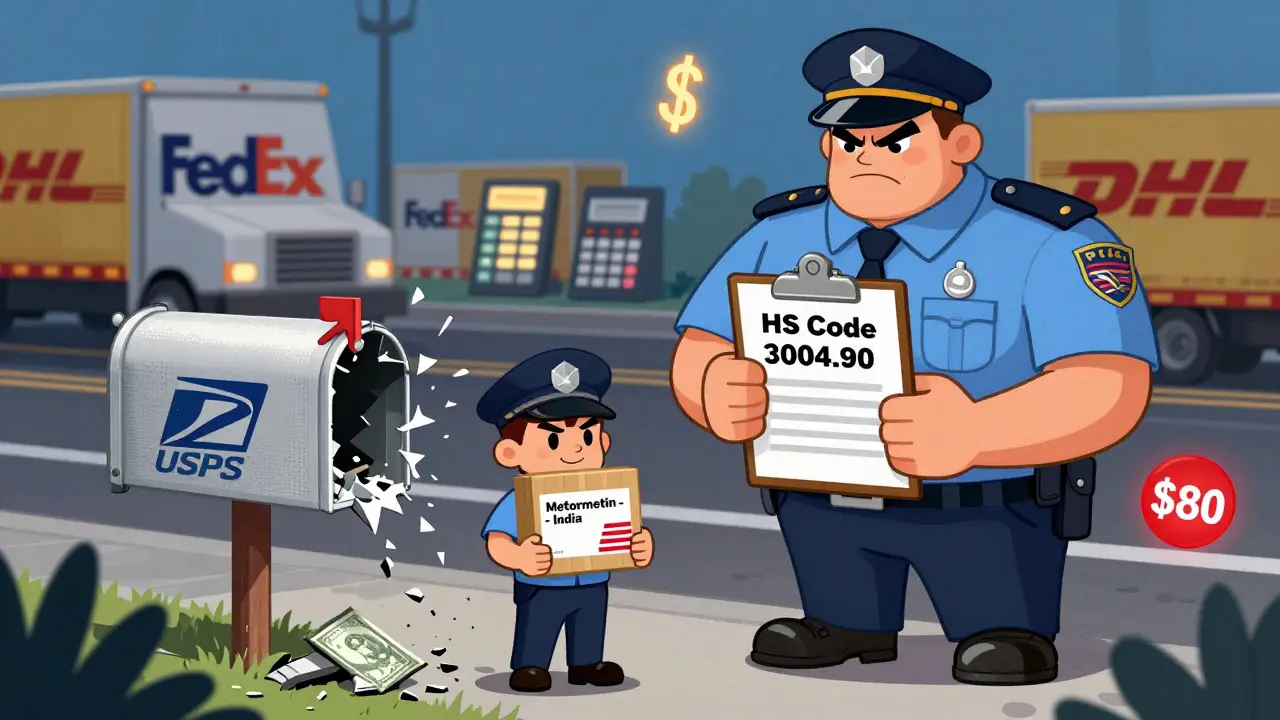
Buying medication from overseas used to be simple. For years, Americans could order pills, creams, or supplements from Canada, India, or Europe for a fraction of U.S. prices-often under $50-and pay nothing extra at the border. The $800 de minimis rule meant packages under that value slipped through customs duty-free. That changed on August 29, 2025. Now, if you’re ordering medication internationally, you’re facing a completely new system. And if you don’t understand it, your package could be seized, you could owe hundreds in unexpected fees, or worse-you could break the law.
What Changed in August 2025
The big shift? The U.S. ended the $800 duty-free threshold for all international mail. Before, you could order $700 worth of insulin from Germany and pay nothing extra. Now, even a $25 bottle of blood pressure pills gets taxed. Only two types of shipments still avoid duties: private gifts under $100 (no commercial labels allowed) and certain medical devices approved by the FDA. This isn’t just about money. It’s about control. The government now requires every commercial shipment-yes, even your personal medication order-to be tracked, classified, and taxed. The U.S. Postal Service now demands a six-digit Harmonized System (HS) code for every item. For medication, that code is usually under Chapter 30 (Pharmaceuticals). If you get it wrong, customs might apply a 300% higher duty rate. One person on Reddit ordered $48 of metformin from India and got hit with an $80 duty under the new flat-rate system. The medication cost less than the tax.Two Ways Customs Collects Duties (Until February 2026)
Right now, you’re stuck in a transition period that ends February 28, 2026. During this time, carriers can choose one of two methods to collect duties:- Method 1 (Ad Valorem): They calculate duty as a percentage of the item’s declared value. For most medications, this is around 2-5%. So a $60 bottle of lisinopril might cost $1.20-$3 in duty.
- Method 2 (Flat Rate): A fixed fee based on the country of origin. If the country has a tariff rate under 16%, you pay $80. Between 16-25%, it’s $160. Over 25%, it’s $200. This is where things get dangerous. Many countries selling low-cost meds (like India, Turkey, or Mexico) fall into the lower tariff brackets-but $80 on a $30 pill is a total loss.
What You Need to Send or Receive Medication Legally
If you still want to order medication from abroad, here’s what you must do:- Know the HS code. For prescription drugs, it’s usually 3004.90 (other medicaments). For supplements, it’s 2106.90. Use the USITC Tariff Database to look up your exact product. Don’t guess. A wrong code = big fines.
- Get a commercial invoice. This isn’t a receipt. It must list: exact drug name, strength, quantity, manufacturer, country of origin, and value in U.S. dollars. No vague terms like "health supplement" or "gift." Customs will reject it.
- Use a bonded carrier. USPS and most foreign postal services no longer handle commercial shipments. Your only options are DHL Express, FedEx, or UPS. These carriers have customs brokers built in. But they charge more-often $25-$40 just for handling.
- Don’t lie about the value. Declaring $10 for a $150 prescription is fraud. CBP uses AI to flag patterns. If you’re caught, your package is seized, you could be fined up to $100,000, and future shipments get flagged permanently.
- Check FDA rules. The FDA allows personal importation of non-FDA-approved drugs only under strict conditions: it’s for a serious condition, no U.S. equivalent exists, and you’re bringing in no more than a 3-month supply. If you’re ordering Viagra or insulin from India, you’re probably fine. If you’re ordering unapproved weight-loss pills, you’re risking seizure.
Who Pays the Duty? (And Why It Matters)
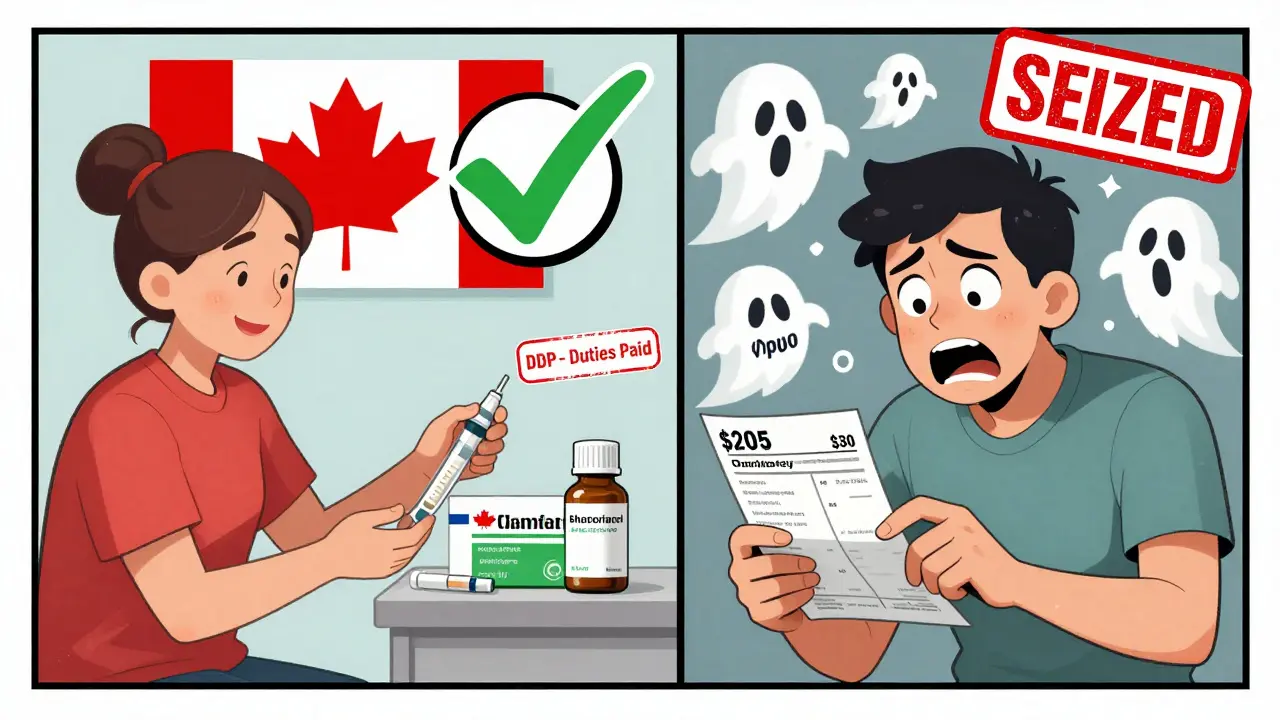
This is the biggest point of confusion. Who pays? The sender? The receiver? The carrier? The answer: It depends on the Incoterm (shipping term) used. Most international pharmacies use DDP (Delivered Duty Paid), meaning they pay the duty upfront and include it in your price. But many don’t. If they use DAP (Delivered at Place), you pay at the border. If you’re the buyer and you don’t know who’s paying, you could get a surprise bill from Customs months later. Or worse-you get a notice that your package was destroyed because duties weren’t paid. Always ask the seller: "Do you pay U.S. customs duties under DDP?" If they say "no," find another source.Why Most Small Orders Won’t Work Anymore
Let’s say you buy a $40 bottle of metformin from a pharmacy in India. Under the old system, you paid $40 and got it in 10 days. Now:- You need to use FedEx or DHL Express: $55 shipping fee
- Duty under Method 2: $80
- Carrier handling fee: $30
- Total cost: $205
Legal Alternatives to International Mail-Order
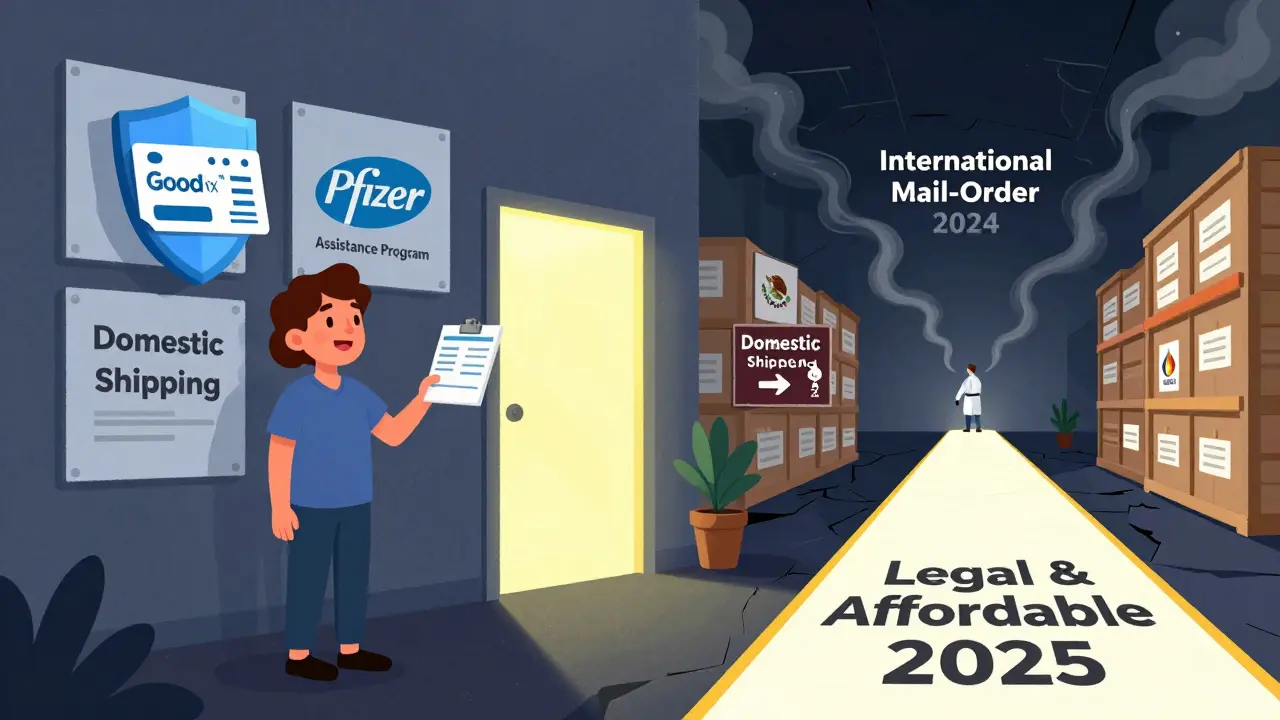
If the cost and risk are too high, here are safer, legal options:- Canadian pharmacies with U.S. shipping: Many licensed Canadian pharmacies (like Canada Drugs Direct) already handle U.S. customs and FDA rules. They use DDP and offer prices 40-60% lower than U.S. pharmacies.
- U.S. pharmacy discount programs: GoodRx, SingleCare, and Blink Health let you compare prices at local pharmacies. Some insulin prices are now under $25 with coupons.
- Medication assistance programs: Many drugmakers (Pfizer, Novo Nordisk, Eli Lilly) offer free or low-cost programs for low-income patients. You don’t need insurance.
- Regional fulfillment hubs: Some companies now warehouse meds in Mexico or Canada and ship them domestically to U.S. customers. This avoids international customs entirely.
What Happens If You Get Caught
The consequences aren’t theoretical. CBP seized over 12,000 international medication packages in the first 90 days after the new rules took effect. Most were from online pharmacies selling unapproved drugs. If your package is caught:- It’s destroyed or returned
- You get a notice of violation
- You may be fined up to $100,000 for false declaration
- Your name is added to a CBP watchlist-future shipments get extra screening
Final Advice: Is It Worth It?
If you’re ordering a $150 insulin pen from Germany, maybe. The savings could justify the $100 in fees. But if you’re buying $25 pills for anxiety or cholesterol? Probably not. The system is now designed to stop small, unregulated drug shipments. It’s not about safety-it’s about control. The government wants you to buy through U.S. pharmacies, even if they’re expensive. Your best move? Talk to your doctor. Ask about patient assistance programs. Use discount cards. Consider switching to a generic brand. And if you still want to order overseas, do it with your eyes wide open: know the HS code, use a bonded carrier, confirm DDP, and never lie about the value. This isn’t the end of international medication access. But it’s the end of the easy way.Can I still order prescription medication from Canada or India?
Yes, but only if you follow the new rules. You must use a bonded carrier like FedEx or DHL Express, provide a correct six-digit HS code (usually 3004.90), and declare the true value. The seller must pay duties upfront (DDP) or you’ll owe them at delivery. Packages sent via regular mail (USPS, Canada Post) are no longer accepted for commercial goods.
What happens if I don’t pay the customs duty?
Your package will be held, then seized or returned. You’ll receive a notice from U.S. Customs and Border Protection. If you ignore it, you could be fined up to $100,000 for false declaration or failure to pay. Your name may be flagged for future shipments, making all international mail harder to receive.
Is it legal to import medication for personal use?
It’s allowed under FDA policy if it’s for a serious condition, no U.S.-approved equivalent exists, and you’re importing no more than a 3-month supply. You must not sell it. But even legal imports must now clear customs under the new duty rules. Just because it’s allowed doesn’t mean it’s easy or cheap.
Why did the $800 rule disappear?
Executive Order 14324, signed in July 2025, eliminated the $800 duty-free threshold to level the playing field for U.S. manufacturers and increase tax revenue. The government estimated $2.8 billion in lost revenue annually from low-value international shipments. The change targets e-commerce, not personal gifts.
Can I use a forwarding service to avoid customs fees?
No. Forwarding services that repackage international shipments as personal mail are now flagged by CBP’s AI systems. If they detect commercial goods being shipped through personal mail channels, both the sender and the forwarding company can be fined. The rules apply regardless of how many times a package changes hands.
Comments (13)
Aliyu Sani
December 23, 2025 AT 04:39so like... we're basically criminalizing poverty now? if you can't afford $500 for insulin in the us but can get it for $40 overseas, and now you gotta pay $80 in duty + $55 shipping + $30 handling... that's not regulation, that's a tax on survival. the system doesn't care if you're diabetic, it just wants its cut. sad.
we used to call this capitalism. now it's just state-sanctioned extortion.
Gabriella da Silva Mendes
December 23, 2025 AT 18:22OMG I CAN’T BELIEVE THIS IS HAPPENING 😭😭😭
Like, I get it, the government wants $$$ but why punish people who are just trying to NOT go bankrupt? My aunt’s insulin costs $1,200 here. She’s 72. She’s not gonna start a GoFundMe for $200 in ‘duty fees.’ This is cruel. 💔🇺🇸
Sai Keerthan Reddy Proddatoori
December 25, 2025 AT 15:35usa always steal our cheap meds. now they say 'no more free stuff' like they never stole our labor, our tech, our patents for decades. we made these pills for them. now they charge $80 tax just to say 'thank you'?
india made insulin cheaper than water. usa made it expensive as gold. now they blame us for being smart? hypocrites.
Johnnie R. Bailey
December 26, 2025 AT 07:25Let me break this down like you’re 12: the $800 rule was a loophole that let Amazon, Alibaba, and shady pharmacies flood the U.S. with unregulated junk. The new system isn’t about punishing patients-it’s about stopping fake weight-loss pills, counterfeit Adderall, and unsterile insulin from killing people.
Yes, it’s messy. Yes, it’s expensive. But if you’re ordering from a legit pharmacy that uses DDP and the right HS code (3004.90), you’re fine. The real villains are the $5 ‘miracle cures’ from shady websites. Don’t punish the system for the scammers.
Also-GoodRx exists. Use it. It’s free. It’s legal. It works.
Tony Du bled
December 27, 2025 AT 21:17so basically the government just made it cheaper to buy from CVS than from India. genius.
also why are we still using hs codes in 2025? this feels like filling out a tax form in 1998.
Kathryn Weymouth
December 29, 2025 AT 05:46Clarifying a critical point: the FDA’s personal importation policy (allowing non-FDA-approved drugs for serious conditions) has not changed. What changed is the customs duty structure. Many people conflate legality with affordability. You can legally import insulin from India under FDA guidelines-but now, you may be financially ruined doing so. The two are distinct, and both require attention.
Herman Rousseau
December 30, 2025 AT 14:51Hey, I get it-this sucks. But here’s the real win: if you’re paying $125 for a $40 pill now, you’re already seeing the market respond. Companies like GoodRx and patient assistance programs are stepping up because they see the pain. This isn’t the end-it’s the catalyst. Use this moment to push your doctor for alternatives. Talk to your pharmacy. Join a patient advocacy group. Change doesn’t come from smuggling-it comes from organizing.
And yes, I’ve ordered meds from Canada for years. I switched to GoodRx last year. Saved $300/month. You can too. 💪
Vikrant Sura
December 31, 2025 AT 15:43the whole thing is a scam. why do you think they changed it? because big pharma paid them. now you pay $200 for insulin. they made it. they own it. they profit. you die. simple.
Jeremy Hendriks
January 1, 2026 AT 08:28isn't it ironic that the same people screaming about 'freedom' and 'personal choice' now want to criminalize your right to buy medicine cheaper than your neighbor? this isn't about revenue-it's about control. they don't want you to have power over your own body. they want you dependent. on them. on their overpriced pills. on their broken system.
the $800 rule wasn't a loophole-it was a lifeline. and now it's gone. because freedom is expensive.
Sam Black
January 2, 2026 AT 23:00Man, I used to send my dad’s blood pressure meds from Thailand via regular mail. $30 for a 3-month supply. Now? FedEx, $55. Duty? $80. Handling? $30. Total: $165. I’m not paying that. So I’m switching to a U.S. generic. It’s $80. Still a ripoff. But at least I’m not risking a federal fine.
What’s wild is that the FDA lets you import it-but the postal system won’t deliver it. So we’re stuck in bureaucratic purgatory. No one wins. Except the lawyers.
Jamison Kissh
January 3, 2026 AT 08:13What’s the deeper question here? Why does the U.S. let drug prices spiral out of control in the first place? If insulin cost $30 here, no one would bother with India. The real problem isn’t the customs rule-it’s that we let corporations set prices like they’re auctioning water in a desert. The duty change is just the symptom. The disease is corporate capture of healthcare.
Art Van Gelder
January 5, 2026 AT 04:37Imagine being a diabetic in rural Alabama. Your nearest pharmacy is 60 miles away. Your insurance doesn’t cover insulin. You’ve been ordering from India for $40. Now? You’re out of options. No one’s coming to save you. The government doesn’t care. The corporations don’t care. You’re just a number in a spreadsheet.
This isn’t policy. It’s abandonment.
And if you think ‘just use GoodRx’ solves this-you’ve never had to choose between food and your meds.
Nader Bsyouni
January 6, 2026 AT 21:06you people are so naive. they changed the rule to make you buy from big pharma. period. no one gives a shit about safety. they just want you to pay more. the hs code? a distraction. the duty? a tax on desperation. the real crime is that you still think this system is fair. wake up. you're being played