
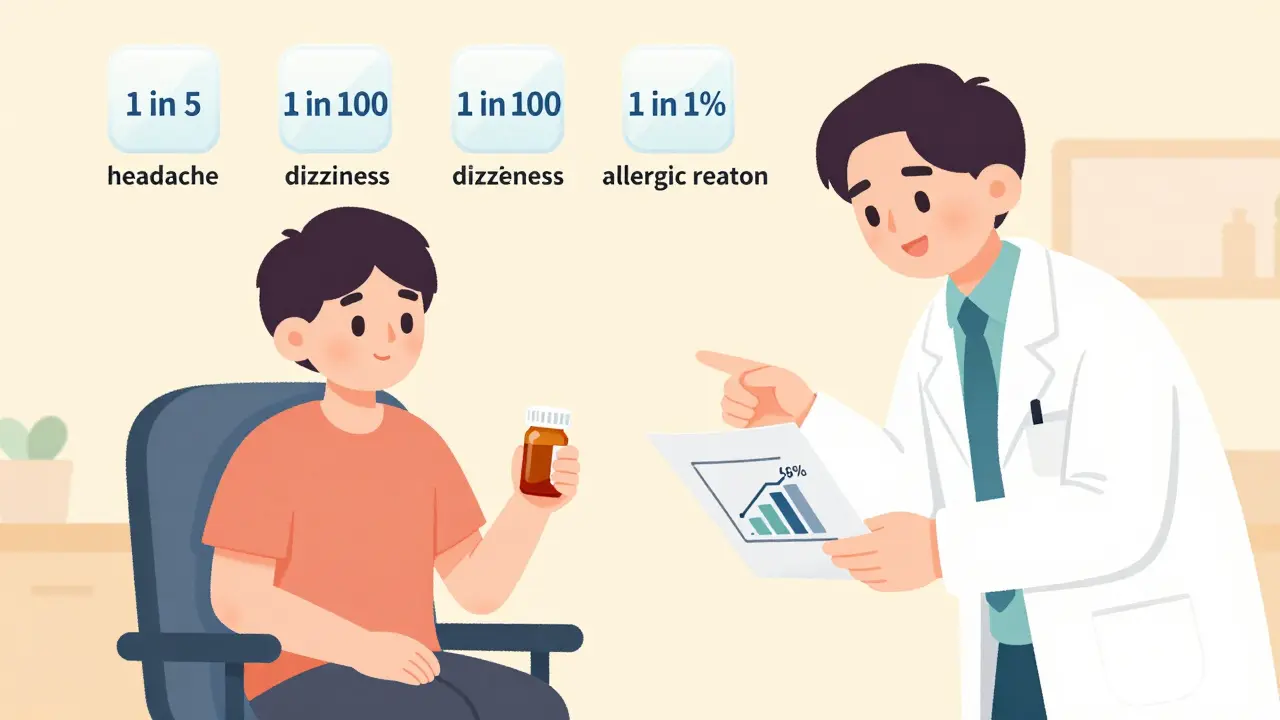
Side Effect Frequency Converter
Why This Matters
83% of patients want specific numbers instead of vague terms like "common" or "rare." Understanding the actual frequency helps you decide if side effects are worth the benefits.
Tip from the article: Ask your doctor: "Out of 10 people, how many usually get this?" to get concrete numbers.
Convert Side Effect Terms
Result
Term
Percentage Range
FDA Definition
Based on FDA standards: Very common (>10%), Common (1-10%), Uncommon (0.1-1%), Rare (0.01-0.1%), Very rare (<0.01%)
Did you know? Patients who get specific side effect information are 22% more likely to stick with their medication.
When you start a new medication, your doctor might say, "Common side effects include headache or dizziness." But what does "common" really mean? One in ten? One in a hundred? If you don’t know, you might stop taking your medicine - and that’s exactly what 68% of patients do when side effects surprise them.
Why Side Effect Communication Matters More Than You Think
Side effects aren’t just annoying - they’re a major reason people stop taking life-saving medications. In the U.S., half of all patients with chronic conditions like high blood pressure, diabetes, or depression don’t take their pills as prescribed. And a big chunk of that? Unexplained side effects. The truth is, doctors aren’t hiding information on purpose. Most want to help. But in a 15-minute visit, with a stack of charts and a ticking clock, talking about every possible side effect isn’t realistic. The problem? Patients expect to hear about risks - 90% say they want to know. But only 75% actually get details about serious side effects, and just 66% hear about the common ones. That gap isn’t just a communication issue - it’s a safety issue. Poor side effect discussions contribute to 18% of malpractice claims tied to prescriptions. And it’s not just legal risk. When patients don’t understand what to expect, they panic. They quit. Their condition worsens. And the cost? Up to $289 billion a year in avoidable hospital visits and emergency care.What Patients Actually Want to Know
Not everyone wants the same level of detail. Some people want every possible side effect listed. Others just want to know what could land them in the hospital. Research shows three clear preferences:- 49% want details on both common and serious side effects
- 26% only want to hear about serious ones
- 17% only care about common ones
The Three-Step Method to Talk About Side Effects
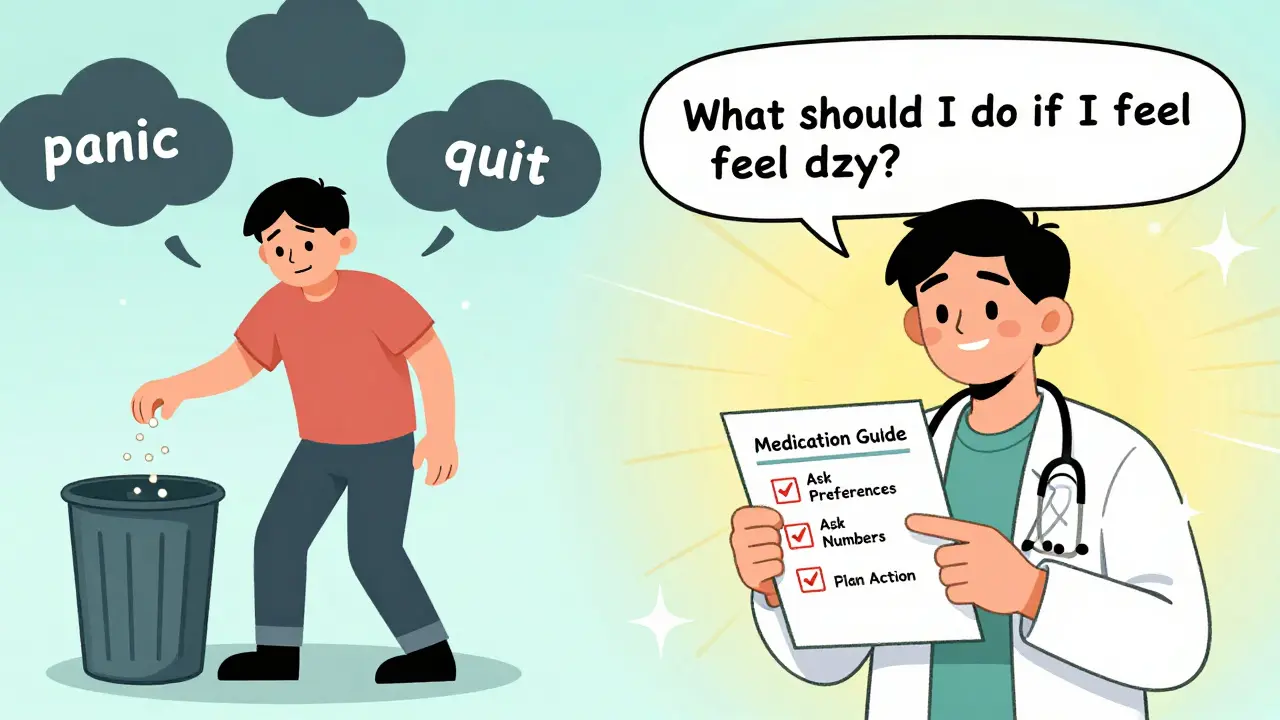
You don’t need to be a medical expert to have a productive conversation. Here’s how to make it work:- Ask about your preferences - Before the doctor starts listing side effects, say: "How much detail would you like me to know about possible side effects?" This gives them permission to tailor the talk to you.
- Ask for numbers - Don’t settle for "common" or "rare." Ask: "Out of 10 people, how many usually get this?" Or: "Is this something that happens in 1 out of 5, or 1 out of 100?" The FDA now recommends using clear categories: very common (>10%), common (1-10%), uncommon (0.1-1%), rare (0.01-0.1%), and very rare (<0.01%).
- Plan what to do if it happens - Ask: "If I get this side effect, what should I do?" Should you call the office? Take an extra pill? Wait it out? For nausea, maybe take the medicine with food. For dizziness, maybe avoid driving for the first week. Get a clear action plan.
What Doctors Should Tell You (But Often Don’t)
Most medications list 15-25 possible side effects. But doctors usually mention only 3.2. That’s not because they’re lazy - it’s because they’re trying to avoid scaring you. But here’s what you need to know:- Common side effects - Headache, nausea, dizziness, fatigue. These happen in 10-30% of people. They’re usually mild and fade after a few days or weeks.
- Serious side effects - Liver damage, severe allergic reactions, heart rhythm changes. These happen in less than 1% of people - sometimes as rare as 1 in 1,000. But if they happen, they need immediate attention.
- Side effect vs. allergic reaction - A side effect is something your body does as a reaction to the drug. An allergic reaction is your immune system overreacting. Allergies cause rashes, swelling, trouble breathing - and require stopping the drug immediately. Side effects don’t always mean you’re allergic.
What to Do Before Your Appointment
You don’t have to wing it. Prep ahead:- Write down all your meds - including over-the-counter pills, vitamins, and supplements. Many side effects come from interactions.
- Think about past experiences: "Have I ever had a bad reaction to a similar drug?" Tell your doctor.
- Ask if you can get a Medication Guide. For high-risk drugs (like blood thinners or certain antidepressants), the FDA requires these printed handouts. They’re detailed, clear, and free.
- If you’re seeing a new doctor, ask if they use electronic tools that show side effect info during visits. About 89% of U.S. hospitals have these systems - but only 37% of doctors use them regularly. If yours doesn’t, ask if they can print you a summary.
What to Do If You’re Already Stopping Your Meds
If you’ve stopped a medication because of side effects - stop blaming yourself. You’re not alone. But don’t just quit without talking to your doctor. Say this: "I stopped taking this because I felt [symptom]. I didn’t know it was a side effect, and I didn’t know what to do. Can we talk about whether this is normal, or if there’s another option?" Doctors respond better when you’re honest - not guilty. A 2023 AMA guideline says: "Thank you for letting us know you’re not taking your meds as prescribed. Can we talk through this together?" That’s the tone you want to encourage. Sometimes, switching to a different drug, lowering the dose, or changing the time of day you take it can make all the difference. But you’ll never know unless you speak up.Why This Is Getting Even More Important
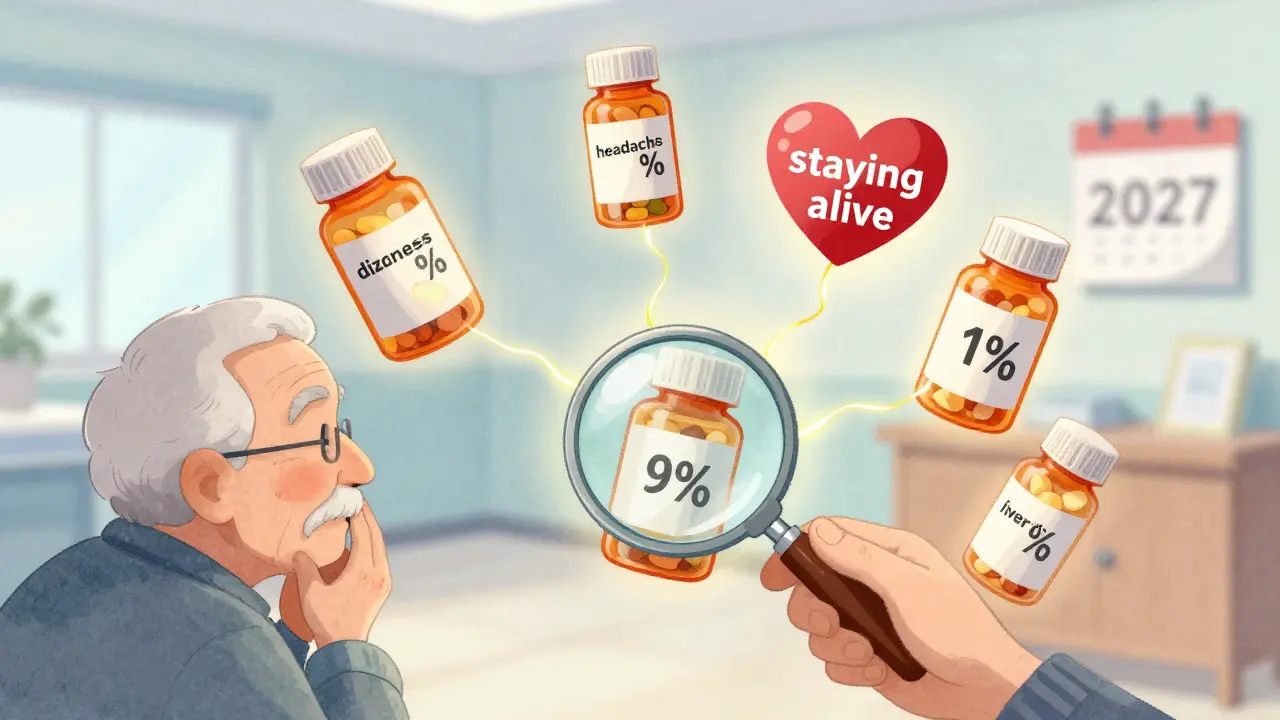
As we age, we take more meds. The average American over 65 is on 4.8 prescription drugs. That means 4.8 different sets of side effects - and possible interactions. A headache from one pill might get worse because of another. A dizziness from one might make you fall. By 2027, experts predict personalized side effect communication could cut adverse drug events by 32%. That’s 15.7 million people who won’t have to quit life-saving treatments because they didn’t understand what was happening to their body. Technology is helping too. Apps like Medisafe use data from over a million users to predict your personal risk for side effects - with 76% accuracy. And the FDA is pushing for standardized language: no more vague terms. Just clear numbers.You’re Not Being Difficult - You’re Being Smart
Asking for specifics isn’t being demanding. It’s being informed. It’s your right to know what your body might go through. And it’s your doctor’s job to help you understand it - not just list it. The next time you get a new prescription, don’t just nod and say "Okay." Ask for numbers. Ask for a plan. Ask what to do if it happens. You’re not just managing side effects - you’re taking control of your health.Remember: the goal isn’t to avoid all side effects. It’s to manage them so you can stay on the treatment that keeps you alive and well.
Comments (9)
Cassandra Collins
December 15, 2025 AT 20:58i swear drs are paid by big pharma to say "it's common" and then you end up in the er with a headache that feels like your skull's cracking open. they don't even tell you what "common" means. is it 1 in 10 or 1 in 1000? who knows. probably a secret code. i stopped my blood pressure med after i got dizzy and my dog started acting weird too. coincidence? i think not.
Elizabeth Bauman
December 16, 2025 AT 22:02This is exactly why we need transparency in healthcare. The FDA has clear categories-very common, common, uncommon-and doctors are skipping them. It’s not laziness; it’s systemic neglect. I’ve seen patients die because they thought dizziness was "just stress." Numbers matter. If your doctor won’t give you percentages, get a new one. This isn’t just medical advice-it’s a civil right.
Mike Smith
December 17, 2025 AT 05:39I appreciate the structure of this article. The three-step method is practical, evidence-based, and respectful of both patient autonomy and clinical constraints. Many patients feel intimidated, but framing the conversation as a collaborative inquiry-rather than a demand-empowers both parties. I encourage clinicians to adopt this language in training programs. It reduces anxiety, improves adherence, and mitigates liability. Small changes, significant impact.
Ron Williams
December 17, 2025 AT 10:07I’ve been on a few meds over the years, and honestly, the ones who told me straight up-like, 'about 3 out of 10 people get a bit of nausea, but it fades in a week'-were the ones I trusted the most. It’s not about scaring people. It’s about giving them a map. If you don’t know what to expect, every little twinge feels like the end of the world. Just say the numbers. It helps.
anthony epps
December 17, 2025 AT 16:54so like... if i get a headache after taking the pill, is that normal? or should i call someone?
Andrew Sychev
December 18, 2025 AT 05:53They don't tell you the real side effects because they're hiding the truth. The headaches? The dizziness? The brain fog? That's not the medication-that's the chemicals they're putting in there to make you dependent. You think it's coincidence that every time you start a new pill, you suddenly need more? Wake up. The system wants you addicted, not healed. They don't want you to know what "common" really means. They want you to stay quiet.
Dan Padgett
December 18, 2025 AT 07:32You know, in my village back home, we don’t have pills for everything. We have elders who listen. They say, "Your body is speaking. What is it trying to tell you?" Maybe the side effect isn’t the pill-it’s the silence between you and your doctor. When we stop talking, the medicine stops working. Not because of chemistry. Because of trust.
Hadi Santoso
December 18, 2025 AT 07:59i just asked my dr "how many peeps get this?" and she looked at me like i asked her to solve a math problem. then she said "some" again. i was like... ok cool. so like... 1? 10? 100? she just smiled and handed me a pamphlet. the pamphlet had a picture of a smiling person holding a pill. no numbers. no info. just vibes.
Arun ana
December 18, 2025 AT 12:26I’ve been taking my meds for 3 years now, and I still ask the same question every refill: "What’s the number?" My doctor now laughs and says, "You’re the one who made me start giving percentages." 🙌 I didn’t want to be that patient. But I didn’t want to be that patient who quit because I didn’t know what was normal. So yeah, ask. And if they don’t answer? Bring a friend. Or a calculator.