
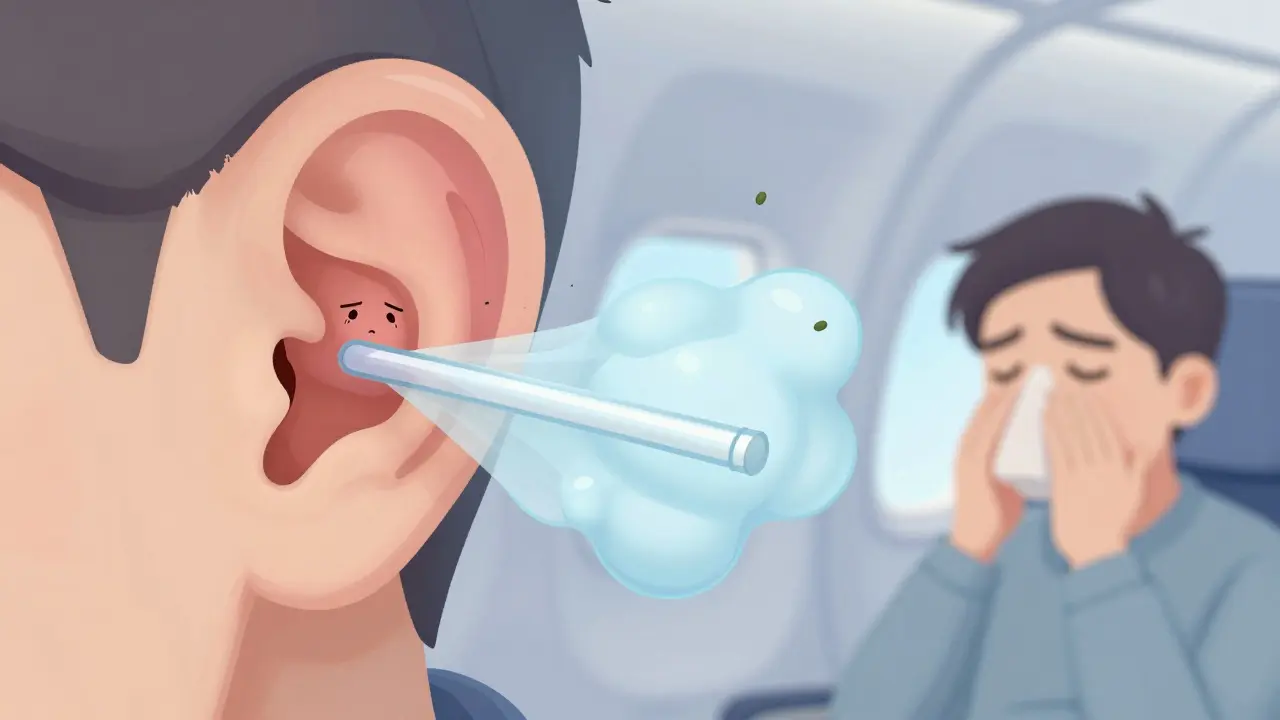
Ever feel like your ears are stuffed with cotton, especially after a cold or during a flight? That heavy, muffled sensation isn’t just annoying-it’s your Eustachian tube struggling to do its job. This tiny canal, about the size of a straw, connects your middle ear to the back of your nose. Its job? Keep pressure balanced on both sides of your eardrum. When it gets blocked, things go sideways fast.
What Exactly Is Eustachian Tube Dysfunction?
Eustachian Tube Dysfunction (ETD) happens when the tube doesn’t open properly when you swallow, yawn, or chew. That stops air from flowing in and out of the middle ear. Without that airflow, the air inside gets absorbed by the lining of the ear, creating negative pressure. The eardrum gets sucked inward. That’s what causes that full, plugged-up feeling.
It’s not rare. About 87% of people with ETD report constant ear pressure. Nearly 92% say their hearing sounds muffled-like they’re underwater. You might also hear popping, clicking, or even ringing (tinnitus). Some feel dizzy or have mild ear pain. If it lasts longer than two weeks, fluid can build up behind the eardrum, making hearing worse by 20-50 decibels. That’s like turning down the volume on your TV by half.
ETD isn’t an infection. It’s a pressure problem. That’s why it’s different from a middle ear infection (otitis media), which usually hurts constantly and often comes with fever. It’s also not swimmer’s ear-that’s an outer ear infection with pain when you tug on your earlobe.
Why Does It Happen?
Most of the time, ETD follows a cold, flu, or sinus infection. About 68% of cases are linked to upper respiratory bugs. Allergies come in second, triggering swelling in the nasal passages (22% of cases). Sinus infections account for 10%. When your nose is stuffed, the opening of the Eustachian tube gets pinched shut.
Children are more prone to it because their tubes are shorter, narrower, and more horizontal-like a flat pipe instead of a slanted one. But adults get it too, especially those in their 30s and 40s with chronic allergies or sinus issues.
And yes, flying, driving up mountains, or even using an elevator can make it worse. That’s because pressure changes outside your ear happen fast, but your tube can’t adjust. If you’ve ever felt your ears pop during takeoff and then just… didn’t, you’ve experienced ETD.
How Do You Know It’s Not Something Serious?
Most cases are harmless and clear up on their own. But if you have constant, sharp pain, sudden hearing loss, dizziness, or discharge from the ear, see a doctor. Those aren’t typical ETD signs. Rarely, a growth in the back of the nose (nasopharynx) or behind the eardrum can mimic ETD. That’s less than 0.5% of cases, but it’s worth ruling out if symptoms don’t follow the usual pattern.
Also, if you’ve tried everything for more than four weeks and it’s still there, don’t just wait. That’s when it becomes chronic-and that’s when treatment needs to step up.

Home Remedies That Actually Work
Before you reach for meds, try these simple moves. They’re free, safe, and backed by real patient reports.
- Swallowing-Do it every 15-20 minutes. It’s not magic, but it keeps the tube moving.
- Chewing gum-Especially during flights or altitude changes. The jaw motion helps open the tube.
- Yawning-Widen your mouth as far as you can. Hold it for a second. Repeat 5-10 times. About 78% of people find this helps.
- The Valsalva maneuver-Take a deep breath, pinch your nose shut, close your mouth, and gently blow. Don’t force it. You should feel a pop. If you don’t, stop. Overdoing it can hurt your eardrum.
- Eating and drinking-Swallowing liquids or food gives your tube a natural workout. Warm broth or tea can also soothe swollen tissues.
One Reddit user, u/FrequentFlyerMD, says: “The Valsalva works like magic for me during flights.” But here’s the catch-45% of people do it wrong. You’re not trying to blow air out your nose. You’re trying to push air into your ears. Too hard, and you risk damage. Too soft, and nothing happens.
Medical Treatments: What Doctors Actually Recommend
If home fixes don’t help after 7-14 days, it’s time to talk to a doctor. Here’s what’s used today.
Nasal Sprays
Decongestant sprays like oxymetazoline (Afrin) can shrink swollen tissue fast. But they’re only for 3 days max. Use them longer, and you get rebound congestion-your nose gets worse than before.
Steroid sprays like fluticasone (Flonase) are better for long-term use. They reduce inflammation without the rebound effect. Use them daily for 2-4 weeks. They’re not instant, but they work over time. Studies show they help 60-70% of allergy-related ETD cases.
Antibiotics? Not Usually
The American Academy of Otolaryngology updated its guidelines in 2022: Don’t use antibiotics for ETD unless there’s a confirmed infection. Most cases aren’t bacterial. Antibiotics won’t fix a blocked tube. They just add side effects and contribute to resistance.
Surgery? Yes, But Only When Needed
If everything else fails and ETD lasts more than 3 months, it’s time to consider procedures.
Balloon Dilation (BDET)
This is the newest option. A tiny balloon is inserted through the nose into the Eustachian tube. It’s inflated for 2 minutes, then deflated and removed. The procedure takes about 20 minutes, is done in-office under local numbing, and you’re back to work the same day.
Success rates? About 67% at 12 months. Some patients get relief for years. One Reddit user, u/ETDWarrior, said: “Balloon dilation gave me 6 months of relief before symptoms returned.” Not perfect, but better than living with pressure for years.
Myringotomy
This is the older option: a tiny cut in the eardrum to drain fluid. A small tube is placed to keep air flowing. It’s effective, but the tube usually falls out in 6-12 months. It’s often used for kids with recurring fluid buildup.
Both procedures are far less invasive than old-school surgeries from 20 years ago. That’s why adoption has jumped 220% since 2018.

What Doesn’t Work (And Why)
Some things you hear about? They’re myths.
- Ear candles-Nope. They don’t remove wax or equalize pressure. They’re dangerous and ineffective.
- Over-the-counter ear drops-Unless you have an outer ear infection, they won’t help. ETD is about pressure, not wax.
- Blowing your nose too hard-This can push mucus into the middle ear and make things worse.
And don’t ignore the seasonal pattern. ETD spikes from October to March, when colds and allergies are high. If you’re prone to it, start using steroid nasal sprays early in the season. Prevention beats treatment.
When to See a Doctor
You don’t need to rush in for every pop. But if you have:
- Pressure or muffled hearing lasting more than 2 weeks
- Symptoms that worsen with altitude changes
- One-sided symptoms (only one ear affected)
- Fluid drainage, sudden hearing loss, or dizziness
…then it’s time for an ENT checkup. They’ll use a tool called a tympanometer to measure pressure in your ear. It’s quick, painless, and tells them if your tube is stuck.
What’s Next? The Future of ETD Treatment
Researchers are testing bioabsorbable stents-tiny devices that prop the tube open temporarily and dissolve on their own. Early trials show 85% symptom improvement at 3 months. If this works, it could replace balloon dilation for many patients.
Doctors also expect a 15% annual increase in minimally invasive procedures through 2026. Why? Because patients want quick, low-risk fixes. No hospital stays. No long recovery. Just relief.
For now, the best advice is simple: Don’t ignore persistent ear pressure. Don’t overuse decongestants. Don’t wait too long. And if you fly often, chew gum before takeoff and landing. It’s that easy.
Can Eustachian tube dysfunction cause permanent hearing loss?
Permanent hearing loss from ETD is rare. Most hearing changes are temporary and reverse once pressure normalizes. But if fluid builds up for months without treatment, it can lead to scarring of the eardrum or damage to the tiny bones in the middle ear. That’s why persistent symptoms-especially beyond 3 months-need medical attention.
Why does ETD get worse when I have allergies?
Allergies cause swelling and mucus production in the nasal passages. Since the Eustachian tube opens into the back of the nose, that swelling physically blocks the tube. Even if your nose feels stuffy, the blockage inside the tube is what traps pressure in your ear. That’s why steroid nasal sprays help-they reduce that swelling at the source.
Is it normal for only one ear to be affected?
Yes. ETD often affects one ear more than the other, especially if one side has more inflammation, mucus, or anatomical differences. It’s not unusual. But if one ear suddenly becomes much worse than the other-especially with pain or hearing loss-it’s worth checking to rule out other issues like an infection or growth.
Can stress or anxiety make ETD worse?
Stress doesn’t cause ETD, but it can make you more aware of it. When you’re anxious, you focus more on bodily sensations-like ear pressure. You might also clench your jaw or swallow more frequently, which can irritate the tube. Managing stress through breathing exercises or relaxation techniques can help reduce the perception of symptoms.
How long should I try home remedies before seeing a doctor?
Try for 7-14 days. Most cases resolve on their own within that time. If you’re not improving-or if symptoms are getting worse-see a doctor. Waiting longer than 4 weeks increases the risk of fluid buildup and complications. Don’t wait for it to “go away on its own” if it’s affecting your sleep, hearing, or daily life.
Comments (13)
Andrew Muchmore
March 18, 2026 AT 15:38Chewing gum on flights is the only thing that saved me during 12 straight hours of flying last month. No meds, no sprays, just constant jaw movement. Works every time.
Paul Ratliff
March 19, 2026 AT 04:32yall overthink this so much. just swallow. its not rocket science. i had this for weeks after a cold and it cleared in 3 days by just drinking water every 20 mins. no bs.
Jeremy Van Veelen
March 20, 2026 AT 07:57Ah yes, the ancient art of 'balloon dilation'-a procedure so cutting-edge it makes me weep with joy. We've moved from medieval ear-popping rituals to 21st-century pneumatic intervention. Truly, humanity has ascended. 🎩✨
Laura Gabel
March 21, 2026 AT 02:45Why do we even have doctors for this? My grandma used to slap the side of your head and say 'blow it out'. Worked better than all these sprays. Modern medicine is a scam.
Andrew Mamone
March 22, 2026 AT 14:30I’ve tried everything. Valsalva? Too risky. Steroid spray? Took 3 weeks. Gum? Helped but didn’t fix it. Then I started drinking warm salt water gargles before bed. Not scientifically proven, but my ears finally stopped feeling like they’re in a vacuum. 🤞
Prathamesh Ghodke
March 23, 2026 AT 21:34I used to suffer this every monsoon season in Mumbai. The humidity + allergies = ear prison. What helped? Steam inhalation with eucalyptus oil. Simple. Cheap. Effective. And yes, chewing gum works too. Just don’t overdo it - your jaw will thank you.
Stephen Habegger
March 25, 2026 AT 01:02This is such a common issue and nobody talks about it enough. Seriously, if you fly or have allergies, this is your life. I’m so glad someone laid it out clearly. Thank you for the clarity. 🙌
Linda Olsson
March 26, 2026 AT 01:42I bet this whole thing is funded by Big Pharma. Why would they release a 2022 guideline that says DON’T use antibiotics? That cuts profits. And balloon dilation? Sounds like a scam. They’re just replacing tubes with more expensive tubes.
Ayan Khan
March 26, 2026 AT 12:25The ear is not just a hearing organ. It is a pressure-sensitive sentinel of our inner equilibrium. When we ignore its signals, we ignore the quiet wisdom of the body. Perhaps the solution is not in balloons or sprays, but in stillness - in learning to breathe through the silence of blocked tubes.
cara s
March 27, 2026 AT 19:35It is of paramount importance to underscore that the physiological mechanisms governing Eustachian tube function are, in fact, exquisitely nuanced and subject to a multitude of biomechanical, neurovascular, and immunological variables. One must not reduce this complex, multi-systemic phenomenon to the mere act of chewing gum or performing a Valsalva maneuver, as such oversimplifications are not only epistemologically unsound but potentially hazardous to long-term otological health.
Amadi Kenneth
March 28, 2026 AT 01:02Wait - so you’re telling me the government doesn’t WANT us to know that ETD is caused by 5G radiation? They’re covering it up! I’ve been using copper earplugs and a Faraday hat. It’s working. The FDA won’t admit it, but the data is out there. Google ‘Eustachian tube 5G’ and you’ll see. They deleted the studies.
Shameer Ahammad
March 28, 2026 AT 12:17I find it utterly reprehensible that so many individuals are being misled into believing that chewing gum constitutes a legitimate therapeutic intervention. The Eustachian tube requires precise, medically validated pressure modulation - not juvenile mastication. Furthermore, the recommendation to use steroid sprays without a prior endoscopic evaluation is irresponsible. This post is dangerously negligent.
Alexander Pitt
March 28, 2026 AT 14:47Balloon dilation isn’t perfect, but it’s the best option for chronic ETD that’s lasted over a year. I had it done last year. First week was weird - weird pressure, weird taste, weird quietness. But by week 3, my ears felt normal for the first time in 5 years. No more muffled music. No more flight dread. Worth every penny.