
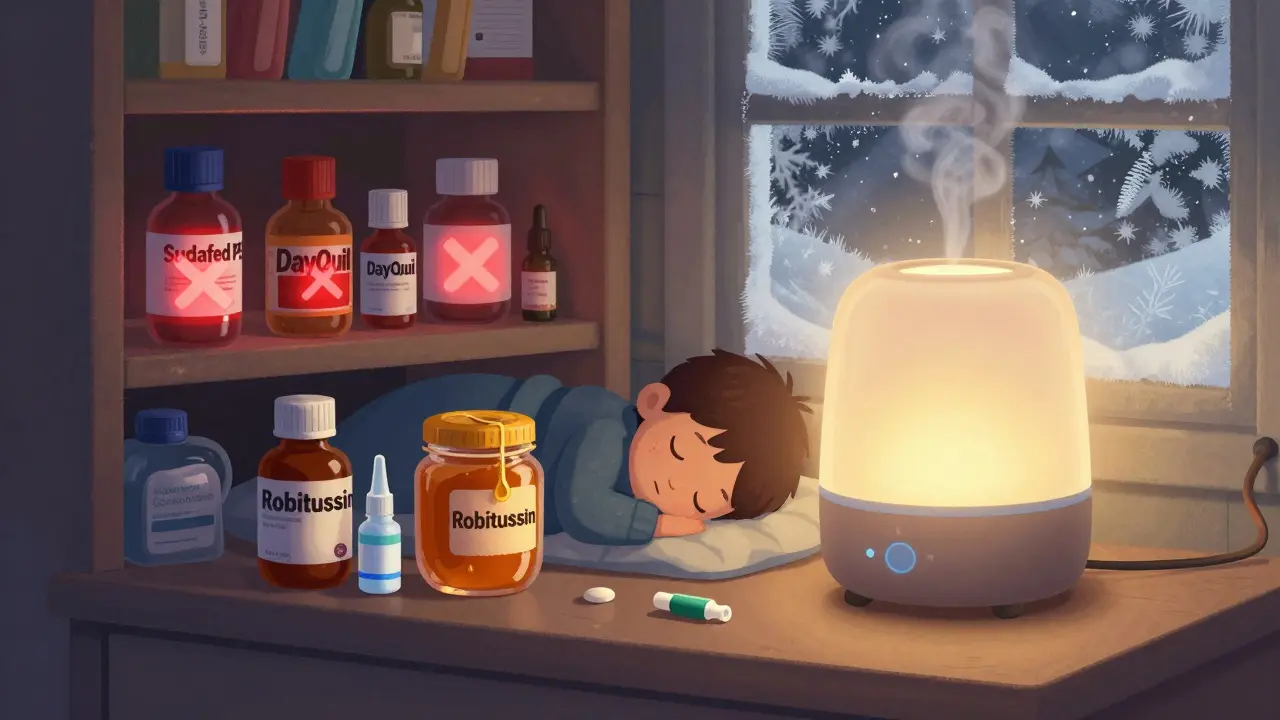
Every winter, millions of people reach for OTC cough and cold medicines thinking they’ll feel better faster. But what if most of those pills and syrups don’t actually work-and could even be risky? The truth is, the products sitting on pharmacy shelves today are built on old assumptions, not modern science. And for kids, the risks are real. If you’ve ever given your child a cough syrup only to watch them still cough all night, or bought a bottle of DayQuil and felt no relief, you’re not alone. The FDA just confirmed what many pharmacists and pediatricians have been saying for years: oral phenylephrine, the decongestant in nearly every cold medicine on the shelf, doesn’t work at the doses you’re taking.
Why Your Cold Medicine Might Be Wasting Your Money
Oral phenylephrine is in products like Sudafed PE, DayQuil, and Robitussin Cold. It’s been on the market for decades. But in September 2023, the FDA’s expert panel reviewed over 100 studies and concluded that 10mg of oral phenylephrine-what’s in every tablet or caplet-has no meaningful effect on nasal congestion. Not even close. A 2007 study found that this dose did nothing compared to a sugar pill. Even a 25mg dose (which isn’t sold to consumers) only helped a little, and patients didn’t even feel better.So why is it still everywhere? Because it’s cheap to make, and regulators didn’t require proof of effectiveness until recently. Now, the FDA is moving to remove it from the list of approved OTC ingredients. If finalized, manufacturers will have to reformulate by late 2025. That means your current bottle of cold medicine might be the last one that contains it.
And phenylephrine isn’t the only problem. Dextromethorphan, the cough suppressant in Robitussin and Mucinex DM, has mixed evidence. Some studies show slight benefit in adults; others show no difference from placebo. Guaifenesin, the expectorant meant to thin mucus, has almost no solid data backing its use in acute coughs. A 2014 review of 29 clinical trials found no clear benefit for most OTC cough medicines in adults or children.
Children and OTC Cold Medicine: A Dangerous Mix
This is where things get serious. The American Academy of Pediatrics has warned since 2007 that OTC cough and cold medicines should not be given to children under 6. In 2008, the FDA expanded that warning to children under 2. Why? Because these products have no proven benefit-and they’ve caused real harm.Between 2000 and 2007, 20 children in the U.S. died after accidentally swallowing these medicines. Thirteen of those children were under two years old. Many of the deaths were linked to overdoses from multiple products containing the same ingredients. A parent gives a cough syrup, then a fever reducer that also contains dextromethorphan, then a nighttime cold tablet with antihistamines. The result? Too much of everything. Sedation, rapid heartbeat, seizures-even death.
Parents are catching on. A survey by What to Expect found that 73% of parents have stopped giving OTC cold medicines to kids under 6 since the warnings came out. That’s a good sign. But many still give them to older kids, thinking it’s safer. It’s not. A 2023 study from UCSF found no evidence that these medicines help children recover faster. They just mask symptoms-sometimes dangerously.
What Actually Works? Evidence-Based Alternatives
If the pills don’t work, what does? The answer is simple: the same things your grandma used.Honey is the most proven alternative for coughs in children over 12 months. A 2023 review by the American Medical Association found that a half-teaspoon (2.5mL) of honey before bedtime reduced nighttime coughing as well as, or better than, dextromethorphan. And it’s safe, natural, and in most kitchens. No prescriptions. No side effects. Just a spoonful.
Saline nose drops and suction are the gold standard for babies and toddlers. A few drops of saltwater in each nostril, then a bulb syringe to gently clear mucus, works better than any nasal spray or oral decongestant. It’s safe, immediate, and doesn’t interfere with sleep.
Humidified air helps loosen congestion. A cool-mist humidifier in the bedroom, especially during dry winter nights, can make breathing easier. Don’t use steam vaporizers-they’re a burn risk.
Fluids matter more than you think. Keeping hydrated helps thin mucus naturally. Water, broth, or even popsicles for kids keep things moving. Dehydration makes coughs worse.
For adults, nasal decongestant sprays like oxymetazoline (Afrin) still work-but only for three days max. Overuse causes rebound congestion, making things worse. But unlike oral phenylephrine, nasal sprays act locally. They don’t flood your bloodstream with chemicals that can raise blood pressure or cause jitteriness.
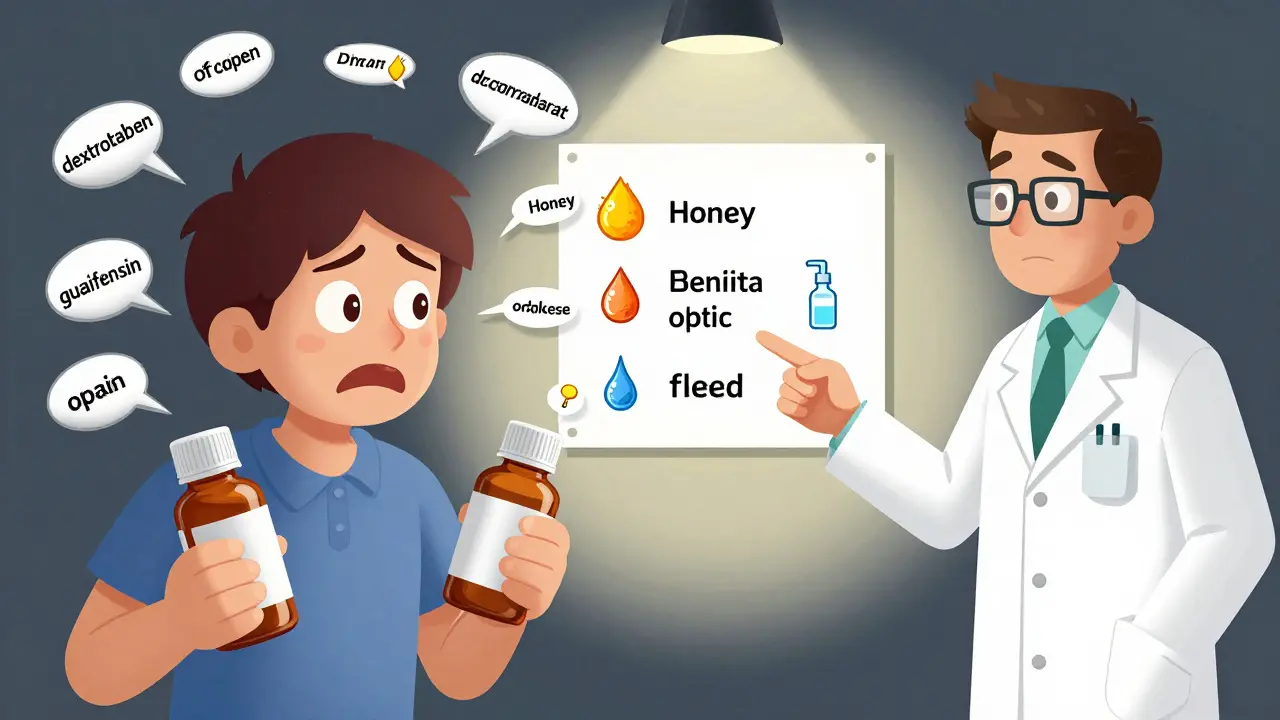
Reading the Drug Facts Label: Your Lifesaver
The biggest danger isn’t the medicine itself-it’s taking too many. Many OTC cold products contain the same active ingredients. You might think you’re treating cough, congestion, and fever separately, but you’re actually doubling up on dextromethorphan, guaifenesin, or acetaminophen.Here’s how to avoid accidental overdose:
- Look for the Active Ingredients section on the Drug Facts label.
- Never take two products with the same ingredient (e.g., dextromethorphan in both cough syrup and nighttime cold tablet).
- Check for acetaminophen (Tylenol) in cold medicines. Taking extra Tylenol on top can cause liver failure.
- Don’t use cold medicines to make kids sleepy. Antihistamines like diphenhydramine can cause agitation, hallucinations, or seizures in children.
Pharmacists say the most common mistake? Giving a child a cough syrup and then a fever reducer that also has cough medicine in it. Always check the label. If you’re unsure, ask your pharmacist. They’re trained to catch these overlaps.
What’s Coming Next? The Future of Cold Care
The market is shifting. With phenylephrine likely gone by 2025, companies are scrambling. Some are reformulating with pseudoephedrine (the real decongestant), but that’s kept behind the counter because it’s used to make methamphetamine. Others are turning to honey-based syrups, saline sprays, and herbal blends.IBISWorld predicts sales of non-pharmaceutical cold remedies-like honey, saline, and humidifiers-will grow 12.7% annually through 2026. Meanwhile, traditional OTC cold medicine sales could drop 15-20% as consumers realize they’ve been paying for placebo.
The FDA’s move signals a bigger change: we’re finally holding OTC drugs to the same standard as prescription ones. If a product claims to treat a symptom, it must prove it works. That’s a win for public health.
For now, the best advice is simple: skip the pills unless you’re an adult with no other options. For kids, stick with honey, saline, and fluids. For adults, try nasal sprays for congestion and honey for cough. Your body knows how to fight a cold. You don’t need a chemical crutch.
Frequently Asked Questions
Is it safe to give my child OTC cough medicine?
No, it’s not recommended for children under 6. The FDA and American Academy of Pediatrics warn that these medicines don’t work in kids and can cause serious side effects like rapid heart rate, seizures, and even death. For children over 12 months, honey is a safer, proven alternative for cough relief.
Does phenylephrine really not work?
Yes. Multiple studies, including one reviewed by the FDA in 2023, show that 10mg of oral phenylephrine-what’s in every tablet-has no effect on nasal congestion. Even higher doses (25mg) only reduce congestion by about 27%, and patients don’t feel better. It’s not dangerous-it just doesn’t work.
What’s the difference between phenylephrine and pseudoephedrine?
Pseudoephedrine is the real decongestant. It works well for nasal congestion but is kept behind the pharmacy counter because it’s used to make methamphetamine. You need to show ID and sign a logbook to buy it. Phenylephrine, on the other hand, is sold openly but doesn’t work at the doses available to consumers.
Can I take OTC cold medicine if I’m on blood pressure medication?
Be very careful. Decongestants like phenylephrine and pseudoephedrine can raise blood pressure and interfere with heart medications. Antihistamines and dextromethorphan can also interact dangerously with antidepressants, especially MAOIs. Always check with your doctor or pharmacist before taking any OTC cold medicine if you have high blood pressure, heart disease, or take prescription meds.
What should I do if I accidentally gave my child too much cough medicine?
Call Poison Control immediately at 1-800-222-1222. Do not wait for symptoms to appear. Overdoses can be silent at first but lead to seizures, coma, or heart problems. Keep the medicine bottle handy when you call so you can tell them the exact ingredients and amounts taken.
Comments (11)
chandra tan
January 10, 2026 AT 12:38Man, I just checked my cabinet and wow - three bottles with phenylephrine. Guess I’ve been throwing money away since 2020. My kid coughs like a chainsaw at night and I’ve been giving him that pink syrup like it’s holy water. Time to switch to honey. Also, why is everything in the US labeled like a legal contract? I need a translator just to buy cold medicine.
Dwayne Dickson
January 10, 2026 AT 18:04It is an egregious oversight of regulatory oversight that phenylephrine, a compound demonstrably inert at therapeutic dosages, has remained on the market for over a decade without rigorous pharmacodynamic validation. The FDA’s delayed intervention represents a systemic failure of the OTC drug approval paradigm, wherein cost-efficiency and commercial inertia supersede evidence-based medicine. One must question the integrity of the entire pharmacovigilance framework when placebo-level efficacy is tolerated as a standard of care.
Ted Conerly
January 12, 2026 AT 11:38Hey everyone - I’m a pharmacist and I see this every day. You’re not crazy for thinking these meds don’t work. They really don’t. The honey trick? Works. Saline for babies? Works. Reading the label? Lifesaving. I had a mom come in last week who gave her 3-year-old DayQuil AND Tylenol Cold - same dose of acetaminophen twice. She didn’t know. We saved her kid. Don’t guess. Check the label. Ask. You’ve got this.
Faith Edwards
January 14, 2026 AT 07:51It’s almost poetic, isn’t it? We’ve elevated the art of self-deception to pharmaceutical science. We’ve turned our medicine cabinets into altars to the god of placebo, bowing before bottles of chemically inert sugar water while our children cough themselves hoarse. And yet, we still pay $12 for a bottle of ‘relief’ that does nothing - because convenience is the new virtue, and ignorance, the new fashion. How tragically, beautifully American.
Jay Amparo
January 15, 2026 AT 07:23I grew up in India where moms just used turmeric milk and steam from a kettle. We didn’t have all this fancy stuff, but we didn’t need it. My cousin’s baby had a cough for a week - no medicine, just honey on a spoon and a humidifier made from a bowl of hot water. She slept through the night. Funny how the simplest things work best. We’ve overcomplicated healing. Maybe we need to go back to basics.
Lisa Cozad
January 16, 2026 AT 07:25My 4-year-old got a cold last month and I gave him honey before bed. He actually slept. Like, actually slept. I cried. Not because he was better - because I finally didn’t feel like a bad mom for not giving him the pink bottle. Also, I threw out every cold medicine in the house. No more pretending.
Saumya Roy Chaudhuri
January 18, 2026 AT 07:21Of course phenylephrine doesn’t work - it’s been proven since the 80s. The FDA only acted because social media got loud. Meanwhile, people still buy it like it’s magic. And don’t even get me started on guaifenesin - it’s just water with a fancy name. If you think expectorants thin mucus, you’ve been lied to by pharmaceutical marketing since you were a child. Wake up.
Ian Cheung
January 18, 2026 AT 19:17My grandma used to rub Vicks on my chest and say ‘breathe deep’ - and somehow it worked better than any syrup I’ve bought since. Honey for cough? Yeah. Saline drops? Yep. Humidifier? Always. I don’t need a 12-page label to tell me what works. My body knows. And so does yours. Stop overthinking it. Just breathe. And maybe stop buying stuff that’s just sugar with a logo.
anthony martinez
January 19, 2026 AT 04:53So let me get this straight - we spent 20 years paying for fake medicine because regulators were asleep at the wheel, and now we’re supposed to be impressed that they’re finally catching up? Congrats, FDA. You’re 15 years late. Meanwhile, my kid’s still coughing. And I’m still out $80 on bottles that do nothing. Thanks for the update, I guess.
Mario Bros
January 19, 2026 AT 12:12Just tried the honey trick last night - my 5-year-old actually slept 7 hours. No coughing. No nightmares. Just honey. I’m never going back. Also, I bought a humidifier and saline drops. My kid’s basically a little science experiment now - but a happy one. 🙌
Jake Nunez
January 19, 2026 AT 21:48My dad used to say ‘if it doesn’t have a label in your language, don’t take it.’ He was right. I’m from the Philippines but live in the US - I used to buy cold meds because I didn’t understand the labels. Now I just use salt water and steam. Simple. Safe. Works. Why do we make things so complicated?