
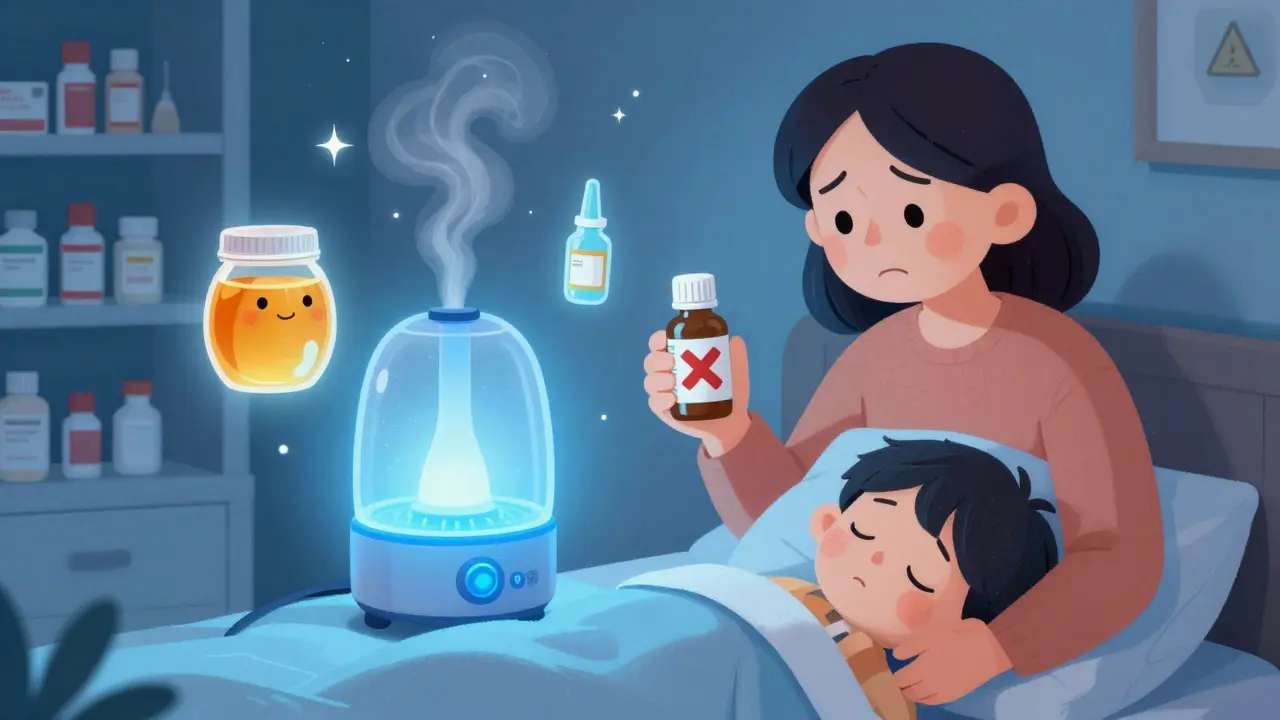
Every winter, parents face the same struggle: their child is coughing, congested, and can’t sleep. It’s heartbreaking. And in the rush to help, many reach for the nearest bottle of children’s cough and cold medicine. But here’s the hard truth: over-the-counter cough and cold products are not safe for kids under 6. Not because they’re weak - because they’re dangerous.
Why These Medicines Are Risky for Young Kids
OTC cough and cold medicines for kids usually contain a mix of ingredients: antihistamines to dry up runny noses, decongestants to clear sinuses, cough suppressants like dextromethorphan, and expectorants like guaifenesin. Sounds helpful, right? Not for little bodies.
Children under 6 have immature liver enzymes. Their bodies can’t process these chemicals the way adults do. For example, kids under two have only about 23% of the adult enzyme activity needed to break down dextromethorphan. That means even a small dose can build up in their system, leading to serious side effects - like fast heart rate, trouble breathing, seizures, or even death.
The U.S. Food and Drug Administration (FDA) looked at data from 1969 to 2006 and found 123 deaths linked to these products in young children. Thousands more ended up in emergency rooms. In 2007, the FDA officially warned against using these medicines in kids under 2. Later, they extended the warning to under 6. Why? Because there’s no proof they work - and plenty of proof they hurt.
What the Experts Say
It’s not just the FDA. Every major medical group agrees:
- The American Academy of Pediatrics (AAP) says cough and cold medicines aren’t recommended for children under 4, and should be avoided under 6.
- The American Academy of Family Physicians (AAFP) states clearly: don’t use OTC cough and cold meds in kids under 6.
- The Mayo Clinic and Cincinnati Children’s Hospital warn that these products can cause high blood pressure, hallucinations, erratic behavior, and constipation.
- The CDC found that between 2004 and 2005, over 7,000 kids under 11 were treated in ERs each year for bad reactions to these medicines - mostly toddlers aged 2 to 3.
Even the manufacturers agree. Since 2008, most brands have added "Do not use in children under 4" to their labels. But here’s the problem: many parents still ignore it.
The Real Danger: Accidental Overdose
One of the biggest risks isn’t giving too much of one medicine - it’s giving too many.
Most cough and cold products contain acetaminophen (for fever and pain) or ibuprofen. If a parent gives their child a cold medicine and a separate fever reducer - both containing the same active ingredient - they can accidentally overdose. That’s how liver damage happens. In fact, the FDA says acetaminophen overdose is the leading cause of acute liver failure in children.
And it’s not just mixing products. A 2015 study found that 67% of dosing errors in kids under 6 came from using kitchen spoons instead of the measuring cup that came with the medicine. A teaspoon isn’t the same as a medicine cup. A tablespoon can be three times too much. One parent on Reddit shared: "I gave my 3-year-old Children’s Dimetapp as directed - but he was hyper, couldn’t sleep for 12 hours. We rushed to the ER."
What Parents Are Still Doing (And Why)
Despite all the warnings, a 2022 survey by the University of Michigan found that 42% of parents with kids under 6 still gave them OTC cold medicine. Why? Because they believe it helps their child feel better faster.
That belief is understandable. When your child is struggling to breathe or can’t sleep, you want to fix it. But the science doesn’t lie: these medicines don’t shorten illness. They don’t make coughs go away. They just add risk.
And some parents go even further. Walgreens reviews from 2023 show that 38% of parents admitted to using adult cold medicine when they couldn’t find the children’s version. That’s terrifying. Adult doses can be lethal for a 2-year-old.
What Actually Works - Safe Alternatives
Good news: you don’t need medicine to help your child feel better. Here’s what works, backed by doctors:
- For babies under 6 months: Use saline nasal drops and a bulb syringe to clear their nose. A cool-mist humidifier in the room helps too. Never use nasal sprays like oxymetazoline - they’re not safe for infants.
- For babies 6 months to 2 years: If they have a fever or pain, you can use acetaminophen (Tylenol) at 10-15 mg per kg of body weight, every 4-6 hours. Never give more than 5 doses in 24 hours.
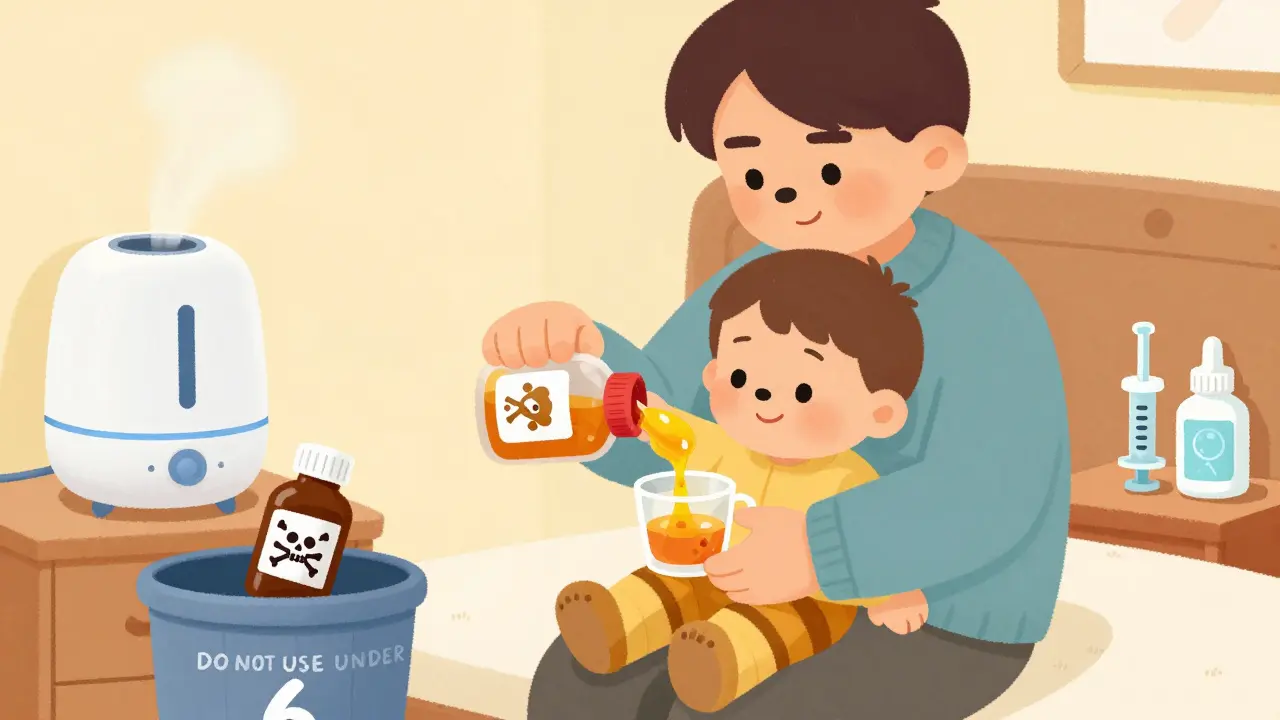
- For kids 1 year and older: Honey is the gold standard for cough. Give ½ to 1 teaspoon before bed. Studies show it works better than dextromethorphan. It thins mucus and soothes the throat. But never give honey to babies under 1 - it can cause infant botulism.
- For all ages: Keep them hydrated. Offer water, breast milk, or formula often. Warm fluids like broth help loosen mucus. Elevate their head slightly when sleeping - even a rolled towel under the mattress helps.
- Humidifiers: Use only cool-mist. Warm-mist humidifiers can cause burns or worsen nasal swelling.
One parent on a parenting forum wrote: "My 20-month-old had a cough for three nights. I tried honey and saline drops. By morning, the cough was gone. No medicine needed."
When to Call the Doctor
Most colds are harmless and clear up in 7-10 days. But watch for these red flags:
- Fever over 102°F (39°C) that doesn’t go down with acetaminophen
- Difficulty breathing, fast breathing, or wheezing
- Cough lasting more than 10 days
- Lethargy, refusal to drink, or fewer wet diapers
- Blue lips or face
If you see any of these, call your pediatrician. Don’t wait. Don’t guess. Don’t reach for the medicine cabinet.
What’s Changing Now?
There’s good progress. After the 2007 FDA advisory, ER visits for OTC medicine reactions in kids under 2 dropped by 45% by 2011. A 2023 study in JAMA Pediatrics showed that giving parents a simple educational handout reduced unsafe use by 58%.
But the work isn’t done. A 2021 FDA inspection found that 22% of children’s cold products still didn’t have the proper "do not use under 4" warning. And sales of these products still hit $1.27 billion in the U.S. in 2022.
The message is clear: children’s cough and cold medicines are not a solution - they’re a risk. The real solution is patience, hydration, and simple, safe care.
Can I give my 3-year-old children’s cough medicine if I use half the dose?
No. Even half the dose can be dangerous. Children’s medicines are formulated for specific weight ranges, not scaled-down adult doses. The active ingredients can still build up in a young child’s system and cause serious side effects like rapid heartbeat, seizures, or breathing problems. There’s no safe "half dose" for under-6 kids.
Is honey really safe for a 2-year-old with a cough?
Yes. Honey is recommended as a first-line treatment for cough in children over 1 year old. Studies show it’s as effective as dextromethorphan and safer. Give ½ to 1 teaspoon before bed. It coats the throat and reduces nighttime coughing. Never give honey to babies under 1 year - it can cause infant botulism, a rare but serious illness.
Why can’t I use adult cough medicine if I give less?
Adult medicines are not designed for children. Their concentration of active ingredients is much higher, and even small amounts can be toxic. A teaspoon of adult cold medicine can contain enough dextromethorphan or pseudoephedrine to cause a life-threatening reaction in a toddler. Always use products labeled for children - and even then, avoid them under age 6.
What about natural remedies like vapor rub or essential oils?
Vapor rubs (like Vicks) are not recommended for children under 2. For older kids, they may provide a mild soothing effect, but they don’t treat the cold. Essential oils are not safe for young children - they can be absorbed through the skin or inhaled, leading to seizures or breathing issues. Stick to proven methods: saline, honey, humidifiers, and hydration.
My child’s doctor gave me a prescription for a cough medicine. Is that different?
Yes. Prescription cough medicines are different from OTC ones. They’re often single-ingredient and dosed precisely for your child’s weight. If your doctor prescribed something, follow their instructions exactly. But if it’s an OTC product you bought yourself - especially one labeled for "children" - it’s still not safe under age 6. Always double-check with your pediatrician before giving any medicine.
What to Do Next
Clear out your medicine cabinet. Remove any cough and cold products meant for kids under 6. Don’t keep them "just in case." They’re not a safety net - they’re a hazard.
Instead, keep these on hand:
- Saline nasal drops
- A bulb syringe
- A cool-mist humidifier
- Honey (for kids over 1)
- Acetaminophen (for fever or pain, if needed)
When your child gets sick, focus on comfort, not cure. They’ll recover faster without medicine - and you’ll sleep better knowing you didn’t risk their health.
Comments (10)
Jonah Mann
February 7, 2026 AT 21:13So many parents don’t realize how dangerous these meds are… I gave my kid a little bit of Children’s NyQuil once ‘cause he was coughing so bad. Thought it was fine. Then he got super hyper, couldn’t sleep, heart was racing. We rushed to the ER. Turned out the dose was still too high for his weight. Never again. Always check the label. Always. Even if it says ‘children’s.’
Tricia O'Sullivan
February 9, 2026 AT 19:32Thank you for this meticulously researched and profoundly necessary piece. I am deeply grateful for the clarity and evidence-based approach presented herein. As a healthcare professional in Ireland, I have witnessed firsthand the consequences of well-intentioned but misguided parental interventions. The data is unequivocal: pharmacological intervention in this age group is not merely ineffective-it is hazardous. I shall share this with every parent I counsel.
Tatiana Barbosa
February 11, 2026 AT 08:31YESSSS. I’m so tired of seeing moms panic and reach for the medicine cabinet like it’s a magic wand. Honey works. Saline drops work. Humidifiers work. Your kid isn’t going to die from a cough. They’re going to get better… with time. And love. And hydration. Stop medicating normal childhood illnesses. You’re not helping. You’re risking. And honestly? The fact that we still sell these products like candy is insane. #ParentingWin #NoMoreChemicals
MANI V
February 12, 2026 AT 18:18Of course the FDA says this. They’re just another puppet of Big Pharma. You think they care about kids? They care about lawsuits. They care about liability. The real reason these meds are banned? Because they’re too cheap to patent. The real solution? Homeopathy. Or better yet-chiropractic adjustments. I’ve seen kids cough less after spinal realignment. No drugs. No side effects. Just pure biology. Wake up, sheeple.
Ryan Vargas
February 14, 2026 AT 09:41Let’s not pretend this is merely a medical issue. This is a systemic failure of epistemology. We live in a postmodern epistemic crisis where anecdote supersedes evidence, marketing masquerades as science, and emotional urgency overrides rationality. The OTC cough medicine industry thrives not because of efficacy-but because of a deeply ingrained cultural mythology that equates intervention with care. We have normalized pharmacological overreach as parental virtue. This isn’t about dosing-it’s about the collapse of scientific literacy. And until we address the root epistemic decay, we will continue to poison our children with placebo bottles labeled ‘safety.’
Tasha Lake
February 15, 2026 AT 22:00Wait-so if honey works for cough, why isn’t it FDA-approved as a first-line treatment? I mean, it’s natural, accessible, and has clinical backing. Is it because it’s not patentable? That’s wild. Also, is there a recommended type of honey? Manuka? Local raw? Or does any honey do? Asking for a friend who’s now terrified they used the wrong kind.
Simon Critchley
February 17, 2026 AT 10:36LOL I gave my 4-year-old a teaspoon of adult Mucinex ‘cause I thought it was just ‘more concentrated.’ My kid was bouncing off the walls for 8 hours. We had to call poison control. They laughed. Then they sent an ambulance. Moral of the story? If it doesn’t say ‘for children’ on the bottle… DON’T. EVER. USE. IT. 🤦♂️
John McDonald
February 18, 2026 AT 15:24My sister used to give her 3-year-old cough syrup every night like it was bedtime tea. I begged her to stop. She said, ‘It helps him sleep.’ I said, ‘So does a warm bath and a book.’ She didn’t listen. Then he had a seizure. Not from a virus. From dextromethorphan. She still doesn’t get it. I’m not judging. I’m just saying… please, just read the damn label.
Chelsea Cook
February 19, 2026 AT 05:46Oh sweet mercy. So we’re supposed to just… watch our kids cough themselves to sleep? No wonder we’re all exhausted. But hey, at least we’re doing it ‘safely.’ Meanwhile, I’m over here Googling ‘how to make saline drops at home’ at 2am while my kid sounds like a dying seal. The system is broken. But at least now I know honey > NyQuil. Thanks, I guess.
John Sonnenberg
February 19, 2026 AT 17:00THIS IS A TRAGEDY. A NATIONAL TRAGEDY. I’VE SEEN IT FIRSTHAND. MY SON GOT A FEVER AFTER TAKING A SINGLE DROPS OF CHILDREN’S DIMETAPP. I THOUGHT IT WAS A COINCIDENCE. I WAS WRONG. HE SPENT THREE DAYS IN THE HOSPITAL. THE DOCTORS SAID HE COULD’VE DIED. NOW I’M AFRAID TO EVEN GIVE HIM WATER. WHAT KIND OF WORLD IS THIS?!