
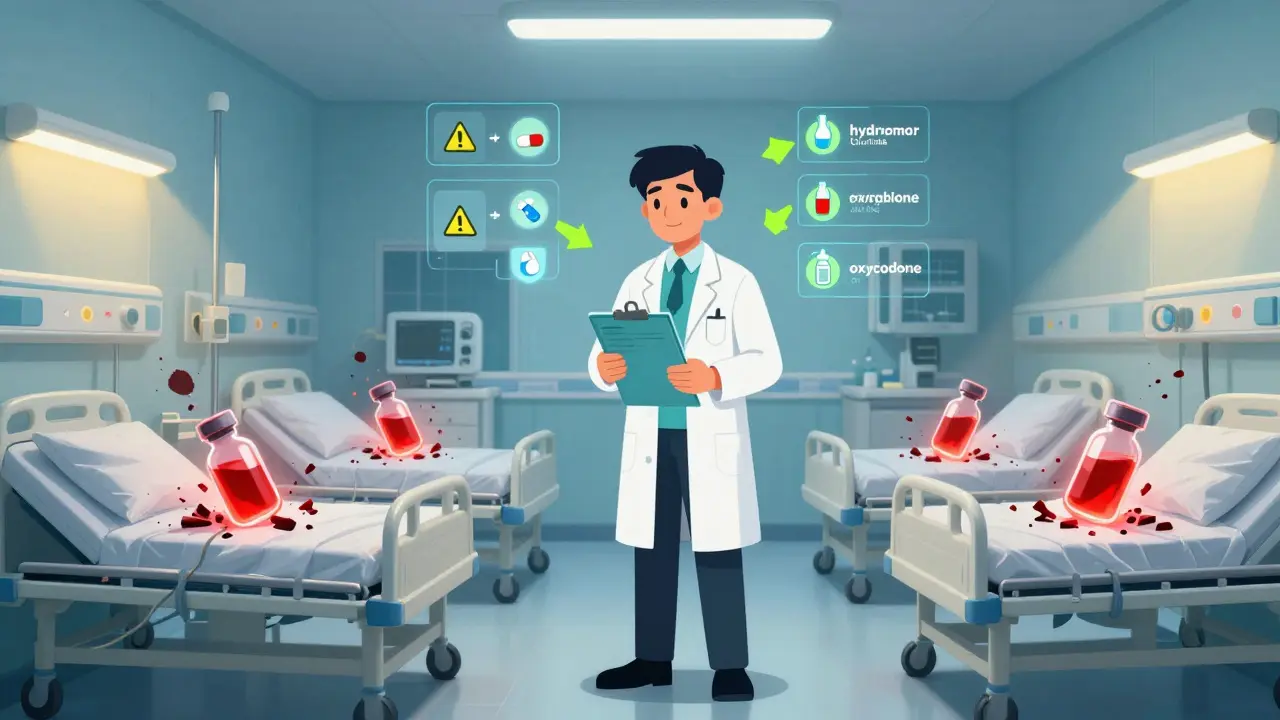
When a critical medication expires in a hospital, it’s not just a paperwork issue-it’s a patient safety emergency. Imagine a ventilated ICU patient on fentanyl, and suddenly, the entire supply has passed its expiration date. You can’t just grab another vial off the shelf. You need to act fast, safely, and with clear direction. But how do you decide what to replace it with? And who makes that call? This isn’t guesswork. It’s a structured, evidence-based process-and every hospital should have one.
Why Expired Medications Are Different from Shortages
Many people confuse expired medications with drug shortages, but they’re not the same. A shortage means the drug isn’t being produced or shipped. An expired medication means the drug was there, but time ran out. Both leave gaps in care, but expiration is often sudden, localized, and preventable. A batch expires because it was stored too long, mislabeled, or not rotated properly. That’s a systems failure, not a supply chain collapse.
The stakes are high. In the ICU, patients are on multiple life-sustaining drugs. One wrong substitution can trigger withdrawal, over-sedation, or even cardiac arrest. A 2023 study tracking 10,000 ICU patients found that when medication transitions weren’t managed properly, 11-12% of patients were readmitted within 30 days. Many of those readmissions were tied to poorly handled medication changes after expiration.
The ASHP Three-Tier Replacement Framework
The American Society of Health-System Pharmacists (ASHP) doesn’t just give advice-they give a clear, tiered system for replacing critical drugs. This isn’t theory. It’s what top hospitals use every day. The system has three levels:
- 1st line: The best, most evidence-backed alternative. Matches the original drug’s action as closely as possible.
- 2nd line: A solid backup. May need dose adjustments or more monitoring.
- 3rd line: Only if the first two aren’t available. Higher risk, more side effects.
Take neuromuscular blockers, for example. If cisatracurium expires, the 1st line replacement is cisatracurium. If that’s gone, rocuronium or vecuronium are 2nd line. Pancuronium? That’s 3rd line-older, less predictable, and harder to reverse.
This system works because it’s based on real clinical data. It doesn’t rely on what’s cheapest or what’s sitting in the pharmacy closet. It’s about what’s safest for the patient right now.
Seven Steps to Replace an Expired Critical Drug
Here’s the exact process used in high-performing hospitals:
- Validate the expiration. Double-check the lot number, expiration date, and how many vials are affected. Don’t assume-verify with inventory logs.
- Check remaining stock. How much of the original drug is left? Is it usable? Sometimes, a few vials are still safe if stored properly.
- Identify affected patients. Who’s on this drug? How many? Are they ventilated? On dialysis? Pregnant? These factors change your options.
- Match to tiered alternatives. Use your hospital’s ASHP-based protocol. Don’t wing it. If you don’t have one, build one now.
- Adjust doses. Alternatives aren’t 1:1. Hydromorphone isn’t fentanyl. You need to convert doses using published guidelines-like the CDC’s opioid conversion calculator.
- Update systems. Change the EHR order set, barcode labels, and IV pump settings. If the system still says “fentanyl,” someone will accidentally give it again.
- Monitor closely. For the first 24-48 hours after the switch, check vital signs, sedation scores (RASS), and withdrawal signs. Document everything.
One ICU pharmacist in Michigan told me: “We lost our fentanyl supply overnight. We had 14 patients. We used the tiered list, converted doses correctly, and didn’t have a single withdrawal episode. We had a plan. They didn’t.”

Who Should Lead This? Pharmacists-Not Nurses or Doctors
Too many hospitals ask nurses or intensivists to pick replacements. That’s a mistake. You need someone who understands pharmacokinetics, drug interactions, and therapeutic equivalence.
Critical care pharmacists are trained to do this. They know that rocuronium lasts longer than vecuronium in renal failure. They know that morphine builds up in elderly patients but hydromorphone doesn’t. They know the exact conversion ratios for opioids, sedatives, and vasopressors.
Studies show that when pharmacists lead these transitions, mortality drops by 18.7% and ICU stays shorten by 2.3 days. That’s not a small win-it’s life-changing. Yet, only 42% of community hospitals have a dedicated critical care pharmacist. The rest are left scrambling.
The Big Gap: Community Hospitals vs. Academic Centers
Here’s the ugly truth: if you work in a big academic hospital, you probably have a protocol, a pharmacist, and automated alerts. If you’re in a rural or community hospital? You’re on your own.
89% of academic centers have formal replacement protocols. Only 42% of community hospitals do. Why? It costs money. It takes time. And many hospitals still see pharmacists as “fillers of prescriptions,” not clinical decision-makers.
But the cost of not having a protocol is higher. One intensivist on Reddit reported three medication errors after an expired drug led to a substitution. Patients stayed 11.2 days longer on average. That’s tens of thousands in extra costs-and worse, preventable harm.
What’s Changing in 2026?
The system is waking up. The FDA is working on new rules to extend expiration dates for stable drugs using better stability testing. If approved, this could cut unnecessary waste by up to 22%.
ASHP is releasing updated guidelines in early 2026-this time, with specific sections just for expired medications. No more guessing.
And AI is stepping in. CU Anschutz is testing a tool that analyzes 147 patient factors-kidney function, weight, age, liver enzymes, current meds-and recommends the best alternative. In early trials, it matched expert pharmacists 94.7% of the time.
But technology won’t fix this alone. You still need trained pharmacists to interpret the results and make judgment calls.
What You Can Do Right Now
If you’re in a hospital without a protocol:
- Start with the ASHP tiered list. Download it. Print it. Post it in the pharmacy and ICU.
- Build a simple checklist for your team. Step-by-step. No jargon.
- Train nurses and doctors on why pharmacists need to be in the room during transitions.
- Set up automated inventory alerts. If a drug expires in 30 days, flag it. Don’t wait until it’s gone.
- Advocate for a critical care pharmacist. Even one full-time role can cut errors by over 30%.
Expired medications aren’t inevitable. They’re a sign that systems are broken. Fix the system, and you don’t just replace a drug-you save lives.
Comments (9)
Tobias Mösl
March 2, 2026 AT 23:29Let me guess - the hospital didn’t even have a pharmacist on call when this happened. Of course they didn’t. That’s why 89% of community hospitals are just one expired fentanyl batch away from a death cluster. This isn’t about protocols. It’s about greed. Hospitals cut pharmacists because they’re ‘expensive’ while paying $200k for a robot that scans IV bags. Meanwhile, patients are getting morphine instead of fentanyl because some nurse Googled ‘opioid conversion’ at 3 AM. We’re not fixing systems. We’re just rearranging deck chairs on the Titanic.
Ethan Zeeb
March 3, 2026 AT 23:42I’ve seen this play out. In my ICU, we lost a batch of midazolam. No protocol. No pharmacist. Just the attending yelling at the pharmacy tech. We ended up using propofol for sedation. One patient coded. Turned out the dose was triple what it should’ve been. The ASHP tiers? They’re not theory - they’re survival. If your hospital doesn’t have them printed on the wall next to the crash cart, you’re already dead.
Siri Elena
March 4, 2026 AT 23:28Oh honey. You mean the same people who think ‘clinical pharmacist’ is a fancy term for ‘pill counter’? Sweetie. The fact that you even need a 7-step checklist for replacing a drug that expires means your hospital’s entire philosophy is ‘hope for the best, pray for the worst.’ I mean, really. Do they also use duct tape to fix ventilators? I’m not even mad. I’m just… disappointed.
Divya Mallick
March 5, 2026 AT 10:28This is why America’s healthcare system is a joke. You have a whole post about replacing expired meds like it’s some revolutionary breakthrough? In India, we don’t wait for expiration dates - we use what works. We don’t have 14-step protocols. We have doctors who know their drugs. We don’t need AI to tell us that hydromorphone isn’t fentanyl. We have experience. You people overthink everything. In India, we save lives. In the US, you write 5000-word essays about it.
Pankaj Gupta
March 5, 2026 AT 12:04While the emotional tone of some responses is understandable, the core argument here is valid and urgently needed. The ASHP framework is not just a suggestion - it’s a standard grounded in pharmacovigilance and clinical trials. The real issue isn’t whether pharmacists should lead - it’s why hospitals continue to deprioritize them despite evidence that their involvement reduces mortality, length of stay, and error rates. Systemic neglect isn’t a policy issue - it’s a moral failure.
Jane Ryan Ryder
March 7, 2026 AT 06:14Pharmacists lead this? Lol. The same ones who took 45 minutes to tell me why I couldn’t get my insulin because the ‘formulary’ said no? Yeah. Let them lead the next time someone dies because they didn’t have the right vial. I’ve seen it. The system doesn’t need more protocols. It needs less bureaucracy.
John Smith
March 7, 2026 AT 07:06Bro. I work in a rural ER. We had a guy on fentanyl. Batch expired. No pharmacist. No clue. We grabbed hydromorphone. Didn’t know the conversion. Guy woke up screaming like he was being stabbed. We had to call a med center 90 miles away just to get someone on the line who knew what to do. This ain’t rocket science. It’s basic. You got a list? Print it. Tape it to the fridge. If your hospital doesn’t have one, you’re playing Russian roulette with a loaded gun and a blindfold.
Sharon Lammas
March 9, 2026 AT 06:37There’s something deeply human here beyond the protocols. It’s not just about drugs - it’s about who we let make decisions for the most vulnerable. When we sideline pharmacists, we’re saying their knowledge doesn’t matter as much as a doctor’s title or a nurse’s hustle. But drugs don’t care about titles. They care about science. And science doesn’t lie. Maybe the real crisis isn’t expiration dates - it’s that we’ve forgotten to listen to the people who actually understand the medicine.
Donna Zurick
March 9, 2026 AT 19:01Just posted the ASHP tier list on our pharmacy bulletin board. Nurses are already asking questions. One said, ‘I didn’t even know we had a tier system.’ We’re starting small. But we’re starting. And yeah - I’m lobbying for a critical care pharmacist. One person. One role. Could change everything.