
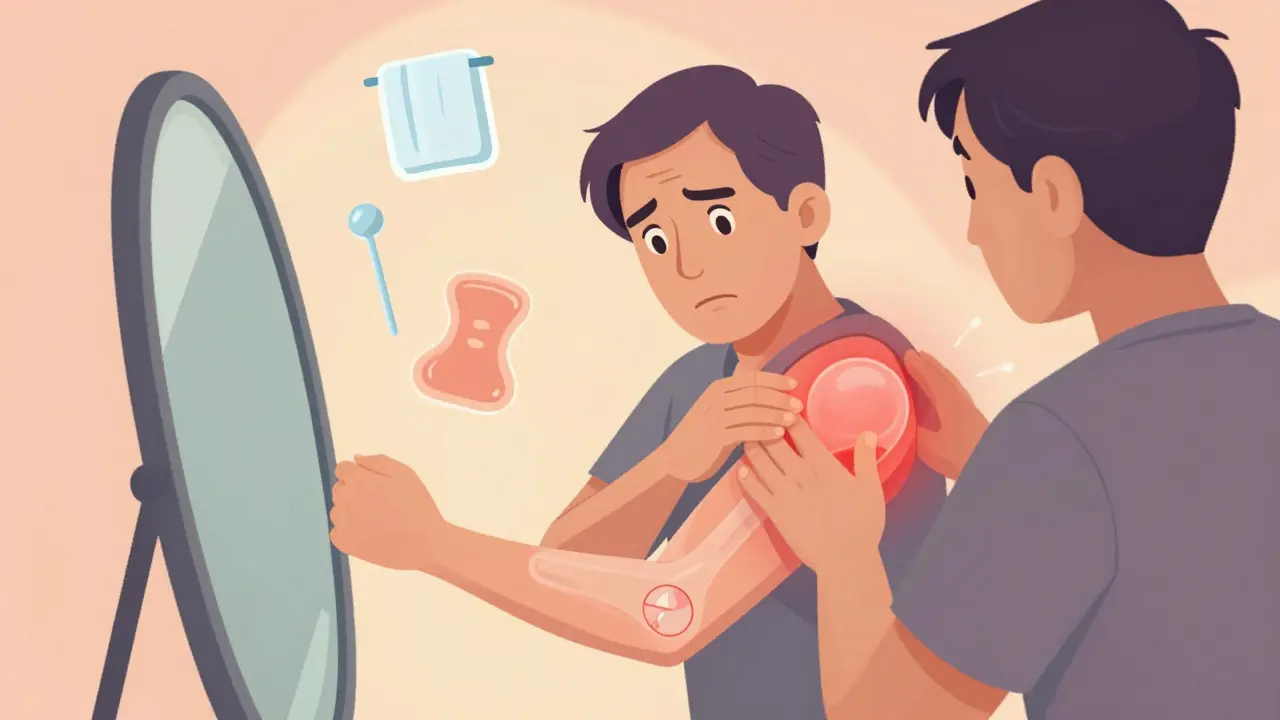
When your shoulder starts hurting for no clear reason - and then won’t move at all - it’s not just a bad muscle strain. It could be frozen shoulder, also known as adhesive capsulitis. You might notice it slowly creeping in: first, a dull ache that gets worse at night, then the frustrating realization that you can’t reach behind your back, lift your arm, or even brush your hair. It doesn’t come from a fall or a sports injury. It just shows up, and it doesn’t go away quickly.
What Exactly Is Frozen Shoulder?
Frozen shoulder isn’t just tight muscles. It’s a condition where the capsule - the tough, flexible tissue that wraps around your shoulder joint - becomes inflamed, thickens, and shrinks. This capsule normally holds the ball of your upper arm bone snugly in the socket, letting you move freely. But when it tightens, your shoulder locks up. The medical name, adhesive capsulitis, sounds scary, but true adhesions (like glue) are rare. It’s more like the capsule has shrunk and stiffened from constant inflammation. This condition affects 2 to 5% of the general population, but if you have diabetes, your risk jumps to 10-20%. It’s more common in people between 40 and 60, and women are more likely to get it than men. The pain and stiffness don’t come on overnight. They follow a clear pattern - three stages that can last anywhere from one to three years if left untreated.The Three Stages of Frozen Shoulder
Stage 1: Freezing - This lasts about 6 weeks to 9 months. Pain is the main problem. It gets worse with movement and often wakes you up at night. You might not notice the stiffness right away, but your shoulder is already changing inside. The joint capsule starts to thicken, and the volume drops from a normal 30-35 mL down to just 10-15 mL. That’s almost half the space. Stage 2: Frozen - After the worst of the pain fades (around 4-6 months in), stiffness takes over. Pain may lessen, but your shoulder feels like it’s locked. You can’t reach overhead, scratch your back, or even put your hand on your opposite shoulder. This stage lasts 4 to 6 months. The big clue? Both your active movement (when you move your arm yourself) and passive movement (when someone else moves it for you) are equally limited. That’s different from a rotator cuff tear, where you can still move your shoulder if someone else helps you. Stage 3: Thawing - This is when things slowly get better. Over 6 months to 2 years, your range of motion returns - if you do nothing. But here’s the key: you don’t have to wait that long.Why Mobilization Works - And When to Start
For years, doctors told people with frozen shoulder to rest and wait it out. That’s outdated. Research now shows that gentle, consistent movement during the freezing phase cuts recovery time in half. A 2019 review in American Family Physician found that people who started physical therapy early recovered in 6-12 months instead of 24-40. The trick? Don’t push through pain. Don’t force it. Don’t try to stretch your arm behind your head on day one. That’s what many people do - and it backfires. One patient on Cleveland Clinic’s portal reported forcing a cross-body stretch during the freezing phase and ended up with pain jumping from 4/10 to 8/10 for three weeks. Instead, focus on gentle movement within your pain tolerance. The goal isn’t to stretch the capsule - it’s to keep it from tightening further. Think of it like preventing ice from freezing solid. Once it’s fully frozen, it’s harder to break apart.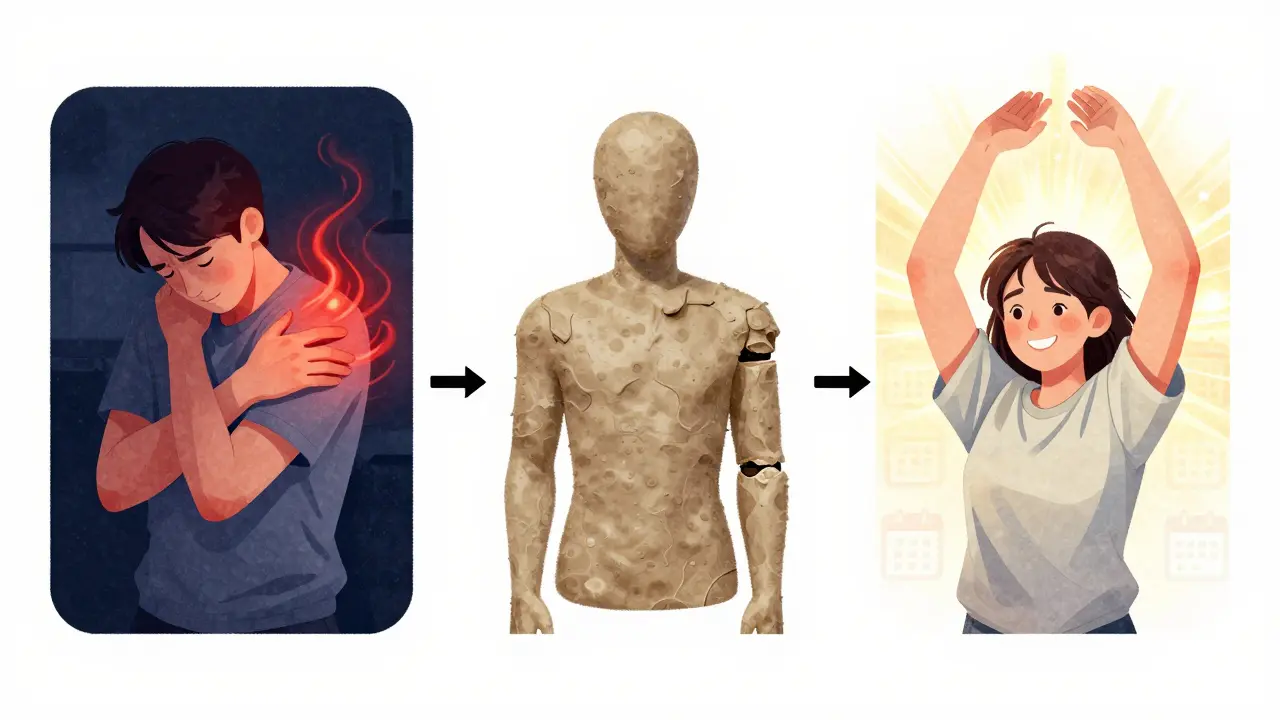
Best Mobilization Strategies
Here are the most effective, evidence-backed techniques - simple, safe, and doable at home.- Pendulum exercises: Lean forward, let your arm hang loose, and gently swing it in small circles - clockwise and counterclockwise. Do this for 5 minutes, twice a day. It’s low-risk, and patients on Reddit reported gaining 20 degrees of external rotation in just four weeks.
- Towel stretch: Hold a towel behind your back with both hands. Use your good arm to gently pull the towel upward, helping the affected arm stretch. This helps with internal rotation, which is often the hardest to regain.
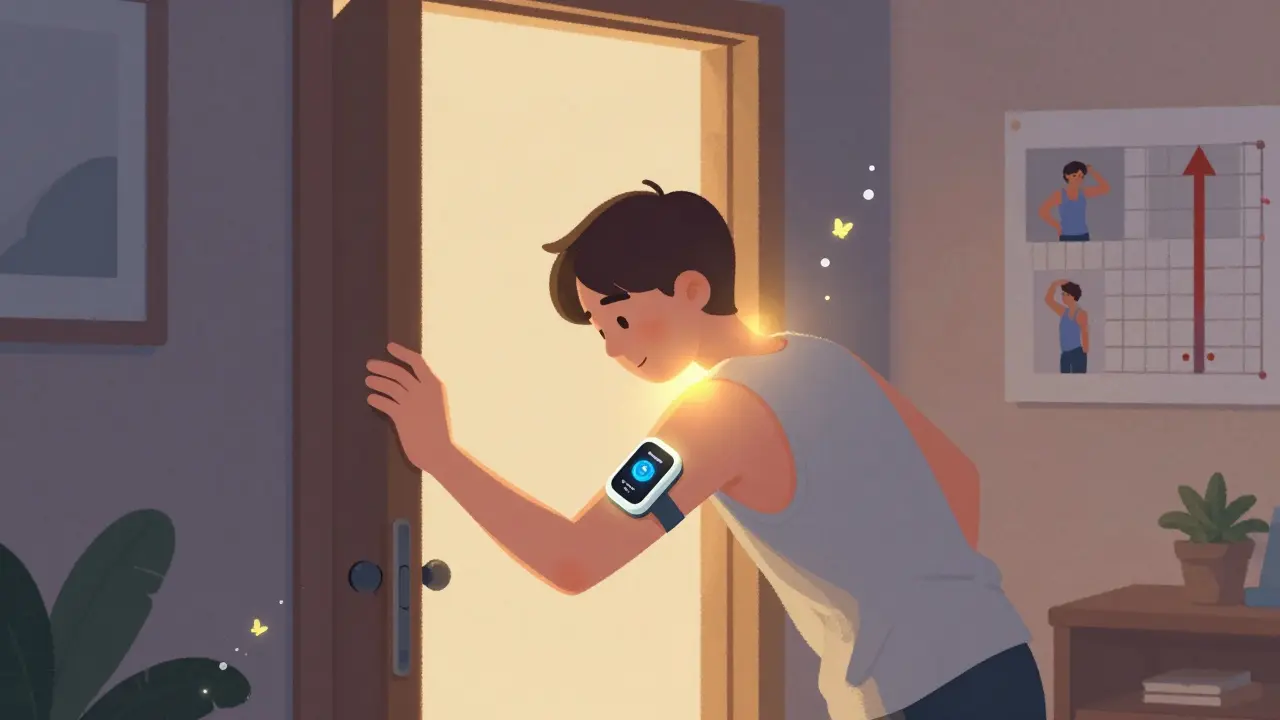
- Doorway stretch: Stand in a doorway, place your hand on the frame at shoulder height, and gently lean forward. Keep your elbow bent at 90 degrees. Hold for 30 seconds. This targets the front of the shoulder capsule.
- Wand exercises: Use a broomstick or a special rehab wand. Lie on your back, hold the wand with both hands, and slowly lift it overhead. Let your good arm guide the stiff one. This helps regain abduction.
What Doesn’t Work - And What to Avoid
Don’t skip the diagnosis. Many people mistake frozen shoulder for a rotator cuff tear, arthritis, or even a pinched nerve. But here’s the giveaway: if both active and passive motion are equally limited, and your pain started slowly without trauma, it’s likely frozen shoulder. Avoid aggressive treatments too early. Manipulation under anesthesia (where a doctor forcefully moves your shoulder while you’re asleep) sounds tempting. But the American Academy of Orthopaedic Surgeons says it should only be considered after six months of failed conservative care. Do it too soon, and you risk tearing muscles, fracturing bones, or making inflammation worse. Corticosteroid injections? They might help short-term pain - for 4 to 8 weeks - but studies show no real improvement in long-term function at 12 weeks. They’re not a magic fix. Physical therapy is.How to Track Progress
You won’t feel better overnight. But you can measure it. Keep a simple log:- How far can you reach overhead? (Use a ruler or tape measure)
- Can you touch your opposite shoulder blade?
- Can you reach behind your back to grab your belt loop?
When to See a Professional
You can start with home exercises. But if you’re not seeing improvement after 4-6 weeks - or if your pain is getting worse - see a physical therapist. Supervised therapy in the freezing phase leads to 28% faster recovery than doing exercises alone, according to level I evidence. Also, if you have red flags - fever, night sweats, unexplained weight loss, or pain that spreads down your arm - get checked for other conditions. Frozen shoulder doesn’t cause those. Something else might.What’s New in 2026
Technology is helping. In 2023, the FDA cleared the ShoulderROM device - a small wearable that tracks your range of motion during home exercises. Clinical trials showed users recovered 32% faster than those using traditional methods. It’s still pricey, but more insurance plans are covering telehealth physical therapy now. About 41% of major U.S. employers include virtual shoulder rehab in their health benefits. The biggest shift in guidelines? The American Academy of Family Physicians updated its 2023 advice: Move early, within pain tolerance. No more waiting for the pain to fade. The inflammation isn’t a reason to rest - it’s a reason to move gently.Final Thoughts
Frozen shoulder is slow. It’s frustrating. But it’s not permanent. Eighty-seven percent of people recover full function within two years - even without treatment. But if you want to get back to lifting groceries, reaching for a top shelf, or sleeping through the night without pain? Start moving now. Not aggressively. Not dramatically. Just consistently. Use the pendulum. Use the towel. Apply heat. Track your progress. And don’t let anyone tell you to just wait it out. You don’t have to suffer for two years. You can take control - one gentle stretch at a time.How long does frozen shoulder last without treatment?
Without treatment, frozen shoulder typically lasts 1 to 3 years, with some cases dragging on for up to 11 years. The pain usually peaks in the first 6-9 months, then stiffness dominates for another 4-6 months, followed by a slow recovery phase that can take 6 months to 2 years. Early mobilization can cut this timeline in half.
Can frozen shoulder come back in the same shoulder?
It’s rare for frozen shoulder to return in the same shoulder once fully recovered. But about 20-30% of people develop it in the opposite shoulder within 5-7 years, especially if they have diabetes or other autoimmune conditions. Once you’ve had it, staying active and doing regular shoulder mobility work helps prevent recurrence.
Is surgery ever needed for frozen shoulder?
Surgery is only considered for the 13% of patients who don’t improve after 6-12 months of consistent physical therapy. The most common procedure is arthroscopic capsular release - a minimally invasive surgery where the tight capsule is carefully cut. It’s effective, but not a first-line option. Most people recover fully without it.
Does diabetes make frozen shoulder worse?
Yes. People with diabetes are 2 to 5 times more likely to develop frozen shoulder, and their symptoms tend to be more severe and last longer. High blood sugar may cause abnormal collagen buildup in the joint capsule, making it stiffer and slower to heal. Tight blood sugar control doesn’t prevent it, but it can improve recovery speed.
Can I still exercise with frozen shoulder?
Yes - but avoid heavy lifting or overhead activities that strain the shoulder. Focus on gentle mobility work like pendulums, towel stretches, and walking. Keep your heart rate up with lower-body exercises like cycling or swimming (using a flutter kick). Movement elsewhere helps circulation and reduces overall inflammation, which can ease shoulder symptoms.
Why does frozen shoulder hurt more at night?
Night pain happens because lying still lets inflammation build up without movement to circulate fluid. Also, without distractions, you notice the pain more. Many physical therapists recommend sleeping on your back with a pillow under the affected arm to keep it slightly elevated and supported. Avoid sleeping on the affected side.
What’s the best way to sleep with frozen shoulder?
Sleep on your back with a pillow under the affected arm to keep it slightly elevated and prevent it from falling behind your body. If you must sleep on your side, use a pillow between your arms to keep the shoulder in a neutral position. Avoid sleeping on the affected shoulder - it increases pressure and pain. Most patients report better sleep after using pillow positioning consistently for a week.
Are there any foods that help with frozen shoulder recovery?
No specific food cures frozen shoulder, but anti-inflammatory diets may help reduce overall joint inflammation. Focus on omega-3s (salmon, flaxseeds), turmeric, berries, leafy greens, and avoid excess sugar and processed foods. For people with diabetes, managing blood sugar is the most important dietary factor - high glucose levels are linked to worse outcomes.
Comments (12)
Lydia H.
January 18, 2026 AT 18:58Been there. Took me 18 months to get back to brushing my hair without wincing. The pendulum exercise saved me-not because it was magic, but because it didn’t make me want to scream. Do it even when you’re tired. Even when it feels pointless. Just move.
And yeah, sleep on your back. I tried side-sleeping for a week. Regretted it for a month.
Josh Kenna
January 18, 2026 AT 22:09Just started the towel stretch yesterday and my shoulder felt like it was gonna snap but i kept going and now i can kinda reach my back?? idk if its real or just wishful thinking but im gonna keep doing it cause i refuse to be the guy who cant reach his own butt
also heat before stretching is a game changer i used a microwavable rice sock and now i feel like a wizard
Christi Steinbeck
January 19, 2026 AT 16:31You’re not alone. I had this for 14 months. Tried the ‘wait it out’ advice. Almost lost my job because I couldn’t lift boxes. Started the wand exercises with a broomstick-barely moved at first. Now I’m back to lifting weights. Not heavy, but enough. Consistency > intensity. Repeat that like a mantra.
Valerie DeLoach
January 21, 2026 AT 07:01As someone who’s taught mobility classes for over a decade, I’ve seen this pattern repeat: people treat frozen shoulder like a temporary injury, not a systemic joint remodeling process. The capsule doesn’t just ‘tighten’-it remodels under chronic low-grade inflammation. Gentle, rhythmic movement doesn’t stretch it-it reprograms the nervous system’s fear response to motion. That’s why forcing it backfires. You’re not fighting tissue; you’re calming a hyperalert nervous system.
And yes-diabetes is a major risk factor. Not because of sugar alone, but because glycation alters collagen structure. That’s why even well-controlled diabetics still get it. The body’s repair mechanisms are just… slower.
Jacob Hill
January 22, 2026 AT 10:09So, I just want to say-don’t underestimate the power of hydration. I know it sounds silly, but my PT told me that the joint capsule is mostly water-based, and when you’re dehydrated, it gets sticky. I started drinking 3L of water a day, plus electrolytes. After two weeks, my morning stiffness dropped by like 40%. Maybe it’s placebo, maybe it’s science-I don’t care. It worked.
Also, I did the doorway stretch with my elbow at 90 degrees, but I kept my shoulder blades retracted. That made all the difference. Just a little tweak.
Erwin Kodiat
January 23, 2026 AT 14:34My dad had this. He ignored it for a year. Then one day he couldn’t reach the top shelf to grab his coffee mug. That was the wake-up call. He started the pendulum thing, and now he’s back to gardening. He’s 72. You’re not too old. You’re not too far gone. Just start small. Today. Not tomorrow.
Jackson Doughart
January 24, 2026 AT 06:35The notion that frozen shoulder is merely a mechanical issue is misleading. It is, in fact, a neuro-immunological phenomenon-chronic low-grade inflammation alters proprioceptive feedback, leading to protective inhibition of movement. The capsule thickens not solely due to fibrosis, but as a consequence of sustained nociceptive signaling.
Therefore, mobilization must be calibrated to modulate central sensitization, not merely increase range of motion. This is why passive stretching alone fails. The brain must be convinced that movement is safe. Hence, the emphasis on pain tolerance-not as a limit, but as a guide.
sujit paul
January 25, 2026 AT 06:41They never tell you the truth. This isn't just a shoulder issue. It's the body's way of saying you're overworked, emotionally suppressed, and spiritually disconnected. I've seen it in my village in Kerala-people who work too hard, don't pray enough, and never sit in silence. The shoulder freezes because the soul is frozen. Do the stretches, yes-but also chant Om Namah Shivaya every morning. And avoid dairy. Dairy is the enemy of the joint.
Also, check your EMF exposure. Phones near your bed? That's the real cause.
Phil Hillson
January 26, 2026 AT 08:15Why is everyone acting like this is some revolutionary discovery? I had this in 2017. Did the same exercises. Same timeline. Same pain. The only difference? I didn’t waste 6 months waiting to see if it’d get better. I went to PT on day 3. People need to stop romanticizing suffering. You don’t need to suffer for two years. You need to stop being lazy and move.
Also, the FDA cleared a device? Bro, it’s a glorified accelerometer. I’ve got a Fitbit that does the same thing. You’re paying $500 for a reminder to stretch.
Aman Kumar
January 26, 2026 AT 10:38Let’s be real-this is a symptom of systemic metabolic dysfunction. The capsule isn’t just stiffening-it’s calcifying. The collagen cross-linking is accelerated by insulin resistance. That’s why diabetics are hit harder. And no, corticosteroids won’t fix it because they don’t address the root: glycation end-products. You need AGE inhibitors. Berberine. Alpha-lipoic acid. N-acetylcysteine. Not some dumb towel stretch.
And if you’re using a heating pad? You’re just masking inflammation. You’re not healing. You’re delaying the inevitable. Fix the blood sugar. Fix the gut. Fix the mitochondria. Then the shoulder will follow. Or it won’t. And that’s okay. Sometimes the body just says no.
Malikah Rajap
January 28, 2026 AT 08:52Oh my gosh, I love this post so much!! I’ve been living this for 11 months and I just wanted to say THANK YOU for saying ‘move gently’-because everyone else was telling me to ‘push through’ and I was terrified I’d ruin my shoulder forever. I started the pendulum thing last week and I cried the first time I could reach my head without pain. I’m not cured, but I’m not broken anymore. You’re not alone. We’re all here. And we’re healing, one tiny circle at a time 💛
Lewis Yeaple
January 30, 2026 AT 01:37While the described mobilization techniques are generally supported by the literature, the assertion that early intervention reduces recovery time by 50% is misleading. The 2019 review cited does not establish causality, only correlation. Moreover, the 32% faster recovery with the ShoulderROM device was observed in a single-center, non-blinded trial with a small sample size (n=47). The American Academy of Family Physicians’ 2023 guideline update is not evidence-based-it is consensus-based. One should exercise caution before accepting these recommendations as definitive. The natural history of adhesive capsulitis remains poorly understood, and the role of patient-reported outcomes is confounded by placebo effects and recall bias.