
Tamoxifen & Antidepressant Interaction Checker
Select your current or proposed antidepressant below to see how it might interact with Tamoxifen. This tool is for educational purposes only and does not replace professional medical advice.
Select a medication above to view details.
You’re taking Tamoxifen to keep your estrogen receptor-positive breast cancer at bay. Then, life throws you a curveball-depression or anxiety hits hard, and your doctor suggests an SSRI. Suddenly, you hear whispers about a dangerous drug interaction. Is your antidepressant secretly sabotaging your cancer treatment? The short answer is: it’s complicated, but likely not as scary as the headlines suggest.
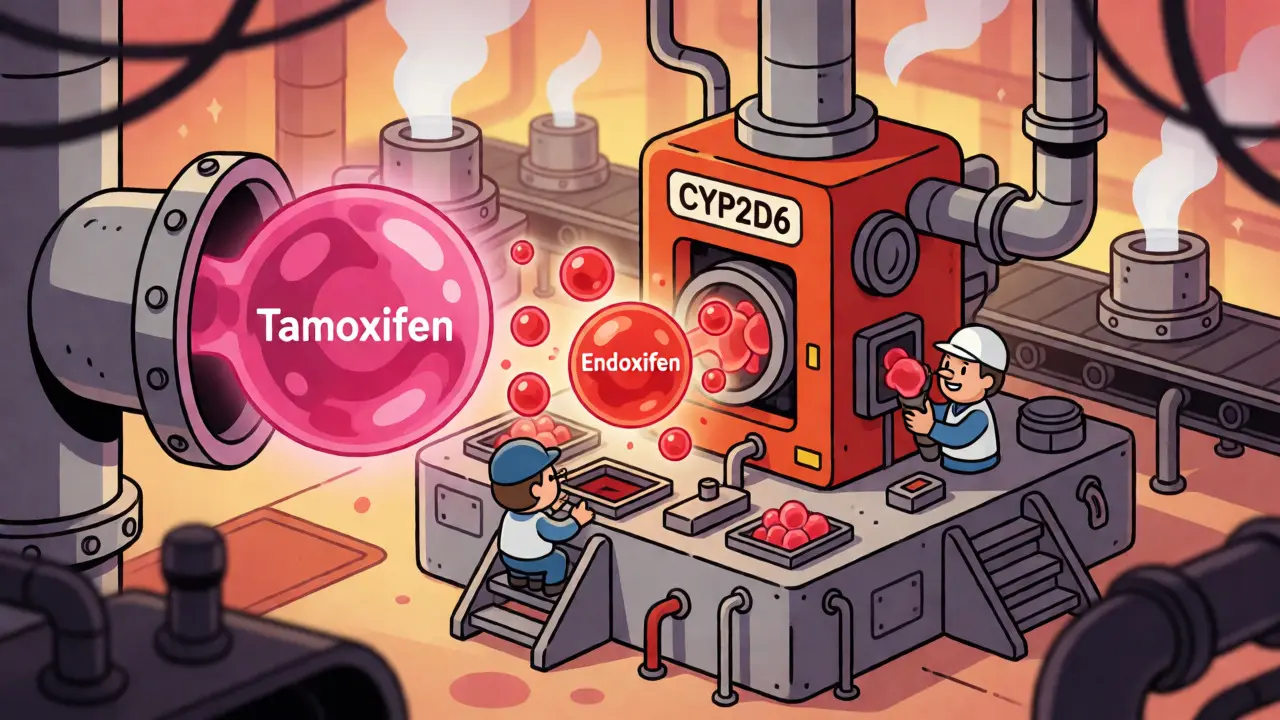
The core of this debate lies in how your body processes drugs. Tamoxifen isn’t active when you swallow it; it’s a prodrug. Your liver needs to convert it into endoxifen, which is up to 100 times more potent against cancer cells than tamoxifen itself. This conversion relies heavily on an enzyme called CYP2D6. Here’s the catch: some Selective Serotonin Reuptake Inhibitors (SSRIs) block CYP2D6. If the enzyme is blocked, less endoxifen is made. Theoretically, this means less protection against recurrence. But does lower endoxifen actually mean worse survival rates? Let’s break down the science, the conflicting studies, and what current guidelines really say.
How Tamoxifen Works and Why CYP2D6 Matters
To understand the risk, you need to know the mechanism. Tamoxifen belongs to a class of drugs called selective estrogen receptor modulators (SERMs). It doesn’t kill cancer cells directly; it blocks estrogen from binding to receptors on those cells, starving them. However, tamoxifen itself has weak anti-estrogenic activity. Its main job is to be a precursor.
Your liver uses cytochrome P450 enzymes to metabolize tamoxifen. While several enzymes are involved, CYP2D6 is the bottleneck for creating endoxifen. Think of CYP2D6 as a key worker in a factory line. If you hire someone who blocks that worker (like certain SSRIs), production slows down. Studies show that women with genetically low CYP2D6 activity (poor metabolizers) have significantly lower endoxifen levels. When you add a strong CYP2D6 inhibitor like paroxetine to the mix, endoxifen plasma concentrations can drop by 56-64%. That sounds alarming. But biology is resilient. Other enzymes, like CYP3A4 and CYP2C9, can pick up some slack, though they aren’t as efficient at making endoxifen specifically.
Not All SSRIs Are Created Equal
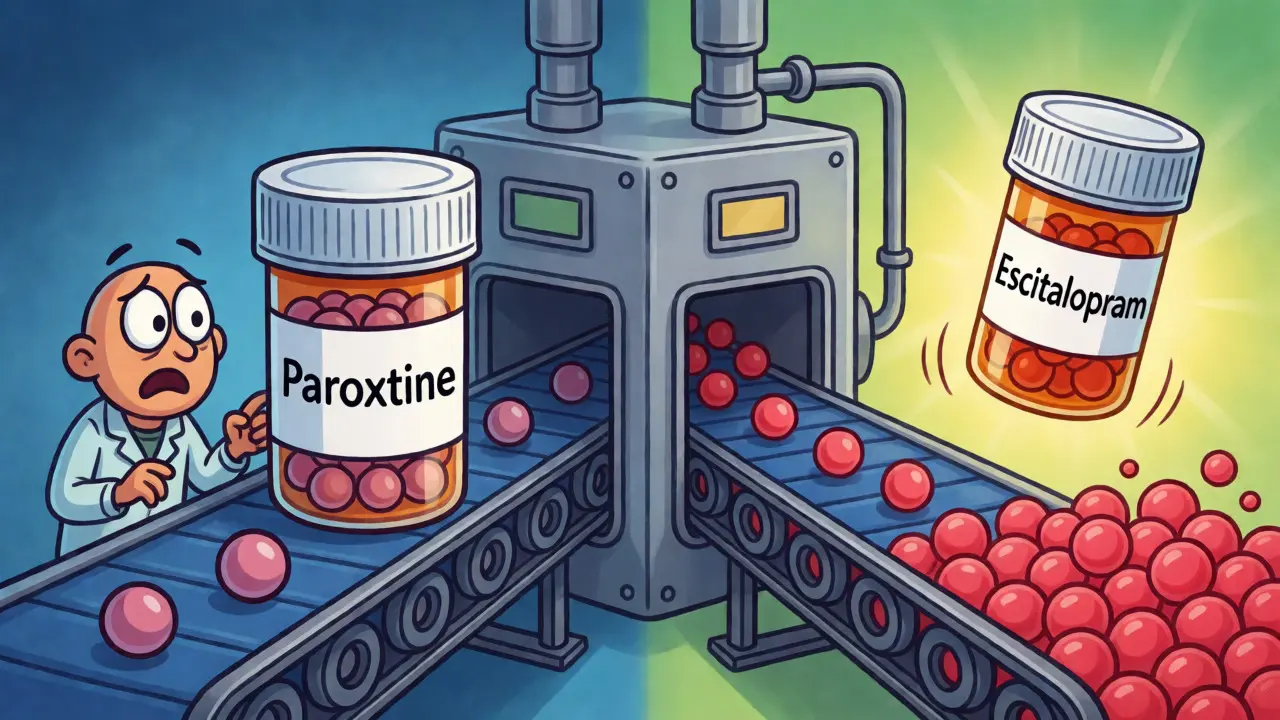
If you’re worried about interactions, stop treating all antidepressants the same. They vary wildly in their ability to inhibit CYP2D6. Pharmacologists use a scale to rate this inhibition potency. Paroxetine is the worst offender here-it’s a strong inhibitor. Fluoxetine is also a moderate-to-strong inhibitor. On the other side of the spectrum, citalopram and escitalopram are weak inhibitors, meaning they barely touch the CYP2D6 pathway. Venlafaxine, technically an SNRI but often grouped with SSRIs in patient conversations, is also a weak inhibitor.
| Medication | Class | CYP2D6 Inhibition Potency | Impact on Endoxifen Levels | Clinical Recommendation |
|---|---|---|---|---|
| Paroxetine | SSRI | Strong | High Reduction (up to 60%) | Avoid if possible |
| Fluoxetine | SSRI | Moderate/Strong | Moderate Reduction | Use with caution |
| Sertraline | SSRI | Moderate | Variable/Low Reduction | Generally acceptable |
| Citalopram | SSRI | Weak | Negligible | Preferred alternative |
| Escitalopram | SSRI | Weak | Negligible | Preferred alternative |
| Venlafaxine | SNRI | Weak | Negligible | Safe option |
This table highlights why blanket statements like "don't take SSRIs" are outdated. Choosing escitalopram over paroxetine might give you the mental health support you need without compromising your cancer therapy’s metabolic activation.
What Do the Big Studies Actually Show?
Here is where things get messy. Early studies raised red flags. A 2009 Canadian study looked at 2,430 women and found that those taking paroxetine alongside tamoxifen had a 24% higher risk of dying from breast cancer compared to those who didn’t. For women who overlapped these drugs for more than six months, the risk jumped to 90%. That data terrified patients and doctors alike.
But then came larger, more robust datasets. A massive 2016 Kaiser Permanente study analyzed nearly 17,000 breast cancer survivors followed for up to 14 years. They found no statistically significant increase in breast cancer mortality among women using any antidepressant, including paroxetine. Another huge Danish cohort study of over 16,000 women echoed this, showing no difference in recurrence rates. More recently, a 2023 Bayesian modeling study of 4,493 premenopausal women suggested a slight increase in recurrence hazard with CYP2D6 inhibitors, but the effect size was small (Hazard Ratio 1.14) and confidence intervals were wide.
Why the discrepancy? Smaller studies often struggle with confounding factors. Depression itself is linked to poorer cancer outcomes due to lifestyle factors, immune suppression, or delayed care. Larger studies try to adjust for this, but it’s never perfect. Also, pharmacokinetic changes (lower blood levels of endoxifen) don’t always translate to clinical failures. The body has backup systems, and the threshold for "dangerously low" endoxifen is still debated.
Current Guidelines: What Should You Do?
So, what do experts recommend today? The American Society of Clinical Oncology (ASCO) updated its guidelines in 2022. They explicitly state that clinicians should not avoid antidepressants solely because of CYP2D6 concerns. Instead, selection should be based on efficacy, side effects, and patient preference. The National Comprehensive Cancer Network (NCCN) agrees, suggesting that while avoiding strong inhibitors like paroxetine and fluoxetine is prudent, it’s not an absolute rule if those drugs work best for the patient’s depression.
In practice, oncologists are shifting away from fear-based prescribing. A 2022 survey showed that 68% of US oncologists no longer automatically avoid all SSRIs. Many now prefer starting with weak inhibitors like escitalopram or venlafaxine. If a patient has been stable on paroxetine for years before starting tamoxifen, switching them abruptly might cause withdrawal symptoms or destabilize their mood, which carries its own risks. It’s a balance between theoretical metabolic interference and real-world quality of life.
Practical Steps for Patients
If you are on tamoxifen and struggling with mood, here is how to navigate this:
- Don’t stop cold turkey: Never discontinue an antidepressant without medical supervision. Withdrawal can be severe.
- Ask about alternatives: If you haven’t started an antidepressant yet, ask your doctor if escitalopram, citalopram, or venlafaxine would be suitable first-line options.
- Review your current meds: If you are already on paroxetine and feeling well, discuss the pros and cons of switching with your oncologist. The evidence for harm is inconsistent, so stability might outweigh theoretical risk.
- Monitor symptoms: Keep track of your mood and any side effects. Good mental health supports better adherence to cancer treatments.
Remember, untreated depression can negatively impact your immune system and your ability to cope with cancer treatment. Ignoring mental health to protect a theoretical drug interaction might do more harm than good.
Does taking paroxetine with tamoxifen definitely increase my cancer recurrence risk?
Not necessarily. While early studies suggested a link, large-scale recent studies involving thousands of women have shown no statistically significant increase in mortality or recurrence. The risk, if present, appears to be small and may not apply to everyone.
Which antidepressants are safest to take with tamoxifen?
Antidepressants with weak CYP2D6 inhibition are generally preferred. These include escitalopram (Lexapro), citalopram (Celexa), and venlafaxine (Effexor). They interfere minimally with the conversion of tamoxifen to its active form, endoxifen.
Should I get genetic testing for CYP2D6?
Current ASCO guidelines do not recommend routine CYP2D6 genetic testing for tamoxifen users. While poor metabolizers have lower endoxifen levels, clinical outcome data remains inconsistent, and testing rarely changes management decisions outside of research settings.
Can I switch from paroxetine to another SSRI while on tamoxifen?
Yes, but it must be done carefully. Switching requires tapering one medication and titrating another to avoid withdrawal symptoms or serotonin syndrome. Always coordinate this process with both your psychiatrist and oncologist.
Does depression itself affect breast cancer outcomes?
There is evidence that chronic stress and depression can influence immune function and inflammation, potentially affecting cancer progression. Treating depression effectively is crucial for overall well-being and may indirectly support better health outcomes, regardless of drug interactions.
Comments (8)
Marc-David Mayer
September 3, 2026 AT 00:04Oh wow, this is such a relief to read! 🥹 I was so terrified when my mom started Tamoxifen and the psych doc suggested Paroxetine. The internet made it sound like she was drinking poison! 😱 But seeing that the big studies don't show a huge mortality risk really helps calm my nerves. It’s all about balance right? We need mental health just as much as we need the cancer meds! 💪❤️ Keep fighting everyone! 🌟
Stuart Lorne
September 4, 2026 AT 10:45youre missing the point entirely its not about fear its about data people ignore the pharmacokinetics because they want to feel better about taking their happy pills but endoxifen levels drop by over 50% with paroxetine that is not negligible if you are poor metabolizer genetically you are basically wasting your tamoxifen dose simple as that stop relying on bad science from large cohorts that cant control for every variable properly
Anderson Miller
September 4, 2026 AT 23:56Sarcastic aside... oh please. Because nothing says "trust the medical establishment" like a blog post citing conflicting studies while telling us to do exactly what our doctors say anyway. 🙄 The real issue isn't the drug interaction; it's that the system forces patients to choose between sanity and survival metrics. If untreated depression kills more people than a slight reduction in endoxifen, then maybe the "risk" is actually the treatment itself? Just saying.
Rose Boerner
September 6, 2026 AT 10:24I find it deeply concerning that we are normalizing potential harm to vulnerable women based on inconsistent data. It is morally imperative that clinicians prioritize safety over convenience. To suggest that patients should simply "monitor symptoms" ignores the psychological burden of living with uncertainty. We must advocate for stricter guidelines, not loose interpretations of hazard ratios!
larry williams
September 7, 2026 AT 15:01I appreciate the nuance here, though I tend to think that the body's resilience is often underestimated in these discussions. While the CYP2D6 pathway is critical, the fact that other enzymes can compensate suggests that the biological system has evolved safeguards against single-point failures. It is crucial to remember that the stress of switching medications or the withdrawal effects from abrupt cessation can have profound impacts on immune function, which might counteract any theoretical benefit of avoiding an SSRI. Therefore, a holistic approach that values mental stability alongside metabolic precision seems the most prudent path forward for most patients.
Akeem Feiton
September 9, 2026 AT 02:47Its always the same story with US healthcare they push the cheapest options first even if they interact badly! Big Pharma loves it cause generic SSRIs are dirt cheap but who cares if your cancer comes back right?? We need to demand better testing not just guess work!! Its a scam!! 🇺🇸💢
Stephen Horn
September 9, 2026 AT 05:51The dismissal of genetic testing is suspicious. Why would ASCO discourage CYP2D6 screening if it truly provided actionable data? One must consider the economic incentives behind maintaining the status quo. Large cohort studies are easily manipulated by confounding variables that favor pharmaceutical profitability. Until individualized pharmacogenomics becomes standard, we are merely guessing at efficacy, and the data suggests a clear disadvantage for those with specific genotypes.
Kristina Rhodes
September 11, 2026 AT 00:46It’s fascinating how we frame this as a binary choice between mind and body. Perhaps the true tragedy is that we’ve separated them so thoroughly in our medical practice. If depression weakens the immune system, then treating it is part of the oncological care, not separate from it. The anxiety caused by fearing the interaction might be more damaging than the interaction itself. We should trust the patient’s lived experience more than the hazard ratio.