

Imagine your immune system, usually the body’s defense force, suddenly turning against its own organs. That is exactly what happens in Hashimoto’s thyroiditis, an autoimmune disorder where the immune system attacks the thyroid gland. First described by Japanese physician Hakaru Hashimoto in 1912, this condition is now the leading cause of hypothyroidism (underactive thyroid) in regions with sufficient iodine intake. If you have been told you have Hashimoto’s, or if you suspect it due to unexplained fatigue and weight gain, understanding how to manage your TSH levels (Thyroid Stimulating Hormone) is critical for regaining control of your health.
This article breaks down the science behind the disease, explains why TSH management is tricky, and offers practical steps to stabilize your symptoms based on current medical guidelines from organizations like the American Thyroid Association (ATA).
Understanding Hashimoto’s Thyroiditis and Its Progression
Hashimoto’s is not a static condition; it evolves through distinct phases. The disease involves the immune system sending white blood cells, specifically CD4+ and CD8+ T cells, to infiltrate the thyroid gland. This causes chronic inflammation and gradual destruction of the thyroid follicular cells that produce hormones.
The progression typically follows four stages:
- Phase 1 (Euthyroid): You have positive antibodies (TPOAb or TgAb) but normal thyroid hormone levels. Many people are diagnosed here before symptoms appear.
- Phase 2 (Subclinical Hypothyroidism): TSH rises slightly (between 4.5 and 10 mIU/L), but free T4 remains normal. Symptoms may be mild or absent.
- Phase 3 (Overt Hypothyroidism): TSH exceeds 10 mIU/L, and free T4 drops. This is when classic symptoms like severe fatigue, cold intolerance, and brain fog become prominent.
- Phase 4 (Atrophy): The thyroid shrinks significantly, and goiter (if present) resolves. Hormone production is severely compromised.
Diagnosis relies heavily on blood tests. In 90-95% of cases, patients show elevated thyroid peroxidase antibodies (TPOAb). Thyroglobulin antibodies (TgAb) are also common, appearing in 60-80% of cases. An ultrasound often reveals a heterogeneous echotexture, indicating tissue damage.
Why TSH Management Is Complex
Managing Hashimoto’s isn’t just about taking a pill; it’s about precision. The goal is to maintain euthyroid status, meaning your thyroid hormone levels are within a normal range. However, several factors make this challenging.
First, there is the phenomenon of "hashitoxicosis." In 15-20% of patients, the initial destruction of thyroid cells releases stored hormones into the bloodstream, causing temporary hyperthyroidism (overactive thyroid). Symptoms include heart palpitations, anxiety, and weight loss. This phase can last 2-8 weeks before transitioning into hypothyroidism. Misdiagnosing this as Graves’ disease can lead to harmful treatments.
Second, TSH levels fluctuate naturally. Research shows that TSH levels are 15-20% higher in winter compared to summer in temperate climates. Additionally, up to 30-40% of patients require dose adjustments within their first year of treatment due to weight changes, aging, or seasonal shifts.
Third, lab interference occurs. In 5-10% of Hashimoto’s cases, autoantibodies interfere with TSH assays, causing falsely elevated readings. This is why doctors often measure Free T4 alongside TSH to get a complete picture.
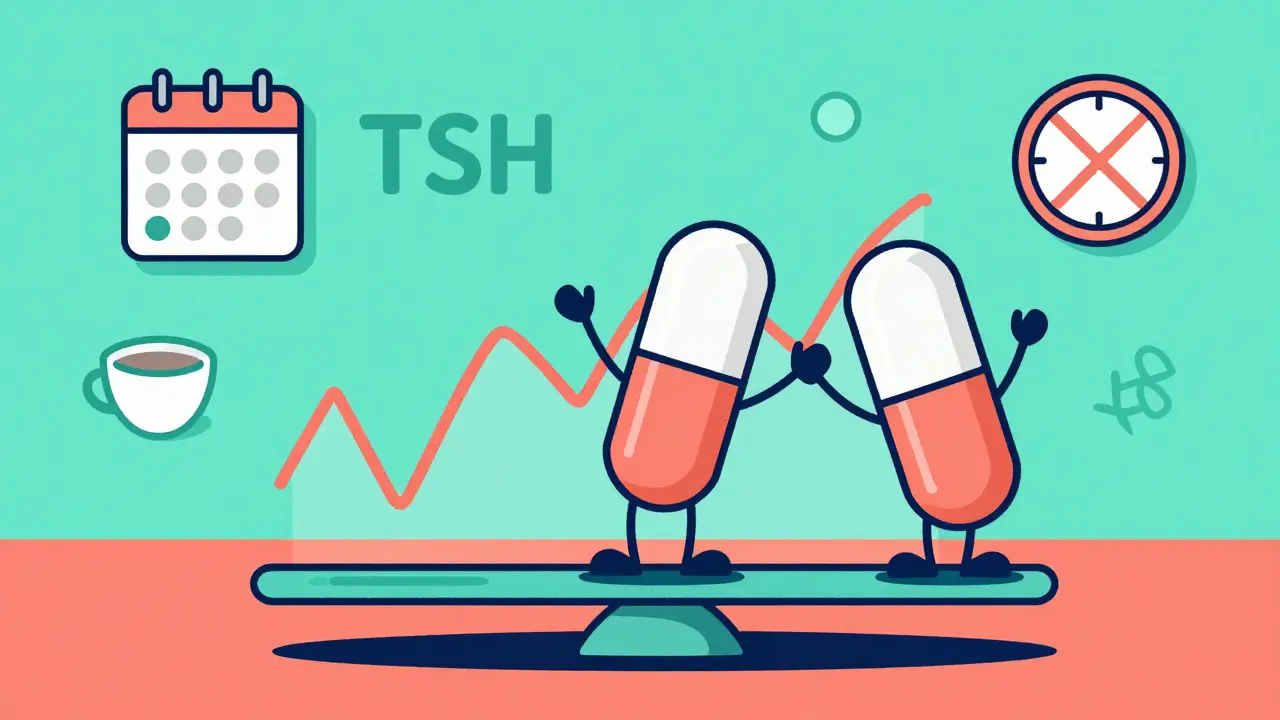
Standard Treatment: Levothyroxine Therapy
The gold standard for treating Hashimoto’s-induced hypothyroidism is levothyroxine, a synthetic form of T4 (thyroxine). It replaces the hormone your thyroid can no longer produce adequately.
Here are the key rules for effective levothyroxine management:
- Dosing Increments: Adjustments are made in small increments, typically 12.5 to 25 mcg. Large jumps can destabilize your system.
- Stabilization Time: After any dose change, wait 6-8 weeks before retesting. It takes this long for TSH levels to fully reflect the new dosage.
- Timing Matters: Take levothyroxine on an empty stomach, ideally 30-60 minutes before breakfast. Avoid calcium supplements, iron, and antacids within 4 hours, as they can reduce absorption by up to 30%.
- Brand Consistency: The FDA classifies levothyroxine as a narrow therapeutic index drug. Bioavailability can vary by 5-10% between brands. Stick to one manufacturer whenever possible.
| Patient Group | Recommended TSH Target (mIU/L) | Rationale |
|---|---|---|
| General Adults | 0.5 - 4.5 | Maintains euthyroid status without overtreatment risks. |
| Younger Patients / High Risk | 1.0 - 2.0 | More stringent targets for better symptom control. |
| Women Trying to Conceive | 0.5 - 2.5 | TSH >2.5 in first trimester increases miscarriage risk by 2.3x. |
| Elderly (>80 years) | 4.0 - 6.0 | Higher targets avoid cardiac strain from overtreatment. |
Optimizing Your Lab Tests for Accuracy
Garbage in, garbage out. If your blood test conditions are wrong, your dosage will be wrong. Follow these protocols to ensure accurate TSH and Free T4 results:
- Morning Testing: Schedule blood draws for early morning. TSH has a diurnal rhythm, peaking at night and dropping during the day.
- Pre-Medication Draw: Get blood drawn before taking your daily levothyroxine. Taking the pill beforehand can suppress TSH temporarily, leading to a false low reading.
- Avoid Biotin: Stop biotin supplements (common in hair/skin/nail vitamins) at least 24-48 hours before testing. Biotin can cause significant errors in immunoassays, skewing TSH results by 20-30%.
- Consistent Labs: Use the same laboratory for all tests. Different labs use different reference ranges and assay methods, making comparisons difficult.

When Standard Treatment Isn't Enough
About 10-15% of patients continue to experience symptoms despite having "normal" TSH levels on levothyroxine monotherapy. This group sometimes explores combination therapy with liothyronine (T3). However, major guidelines from the ATA and Endocrine Society currently recommend against routine T4/T3 combination therapy, as large meta-analyses have shown no significant benefit for most patients.
If you feel unwell despite optimal TSH, discuss checking for other issues such as vitamin D deficiency, iron stores (ferritin), or adrenal function. Sometimes, the symptoms overlap with other conditions, and treating the root cause requires a broader look.
Lifestyle Factors and Trigger Management
While medication manages hormone levels, lifestyle influences immune activity. Patient surveys indicate that stress (cited by 41% of users), gluten exposure (32%), and seasonal changes (27%) are common triggers for symptom flares.
Although a gluten-free diet is not a cure for Hashimoto’s, some patients report reduced inflammation and improved energy levels after eliminating gluten. This may be due to cross-reactivity between gluten proteins and thyroid tissue in genetically susceptible individuals. Always consult a dietitian before making drastic dietary changes to ensure nutritional adequacy.
How often should I check my TSH levels?
After starting treatment or changing your dose, test every 6-8 weeks until stable. Once your TSH is consistently in range, annual testing is generally sufficient for stable patients, though some clinicians prefer semi-annual checks.
Can Hashimoto’s go away on its own?
No, Hashimoto’s is a chronic autoimmune condition. While the rate of thyroid destruction can slow down over time, the underlying immune dysfunction remains. Lifelong monitoring and likely lifelong hormone replacement are necessary.
Is levothyroxine safe for long-term use?
Yes, levothyroxine is bioidentical to the T4 hormone your body produces. When dosed correctly to maintain normal TSH levels, it is safe for decades of use. Risks only arise from overdosing (causing hyperthyroidism) or underdosing (leaving you hypothyroid).
Why do I still feel tired if my TSH is normal?
Normal TSH does not always equate to feeling well. Check your Free T4 and Free T3 levels. Some patients convert T4 to T3 poorly. Additionally, screen for sleep apnea, depression, anemia, or vitamin deficiencies, which commonly coexist with Hashimoto’s.
Does diet affect Hashimoto’s?
Diet does not cure Hashimoto’s, but it can influence inflammation. Some patients benefit from reducing gluten or dairy. Ensuring adequate selenium and zinc intake supports thyroid hormone conversion. Avoid excessive iodine supplementation, as it can worsen autoimmune activity in Hashimoto’s.